TL;DR
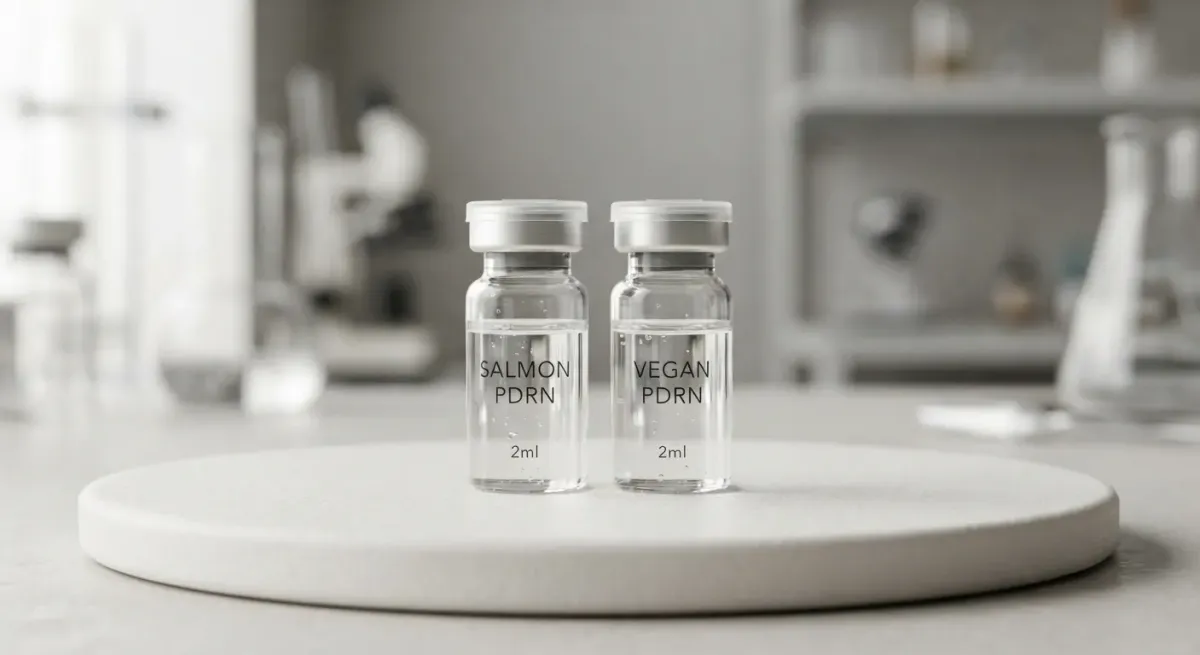
- Salmon PDRN is a fragmented salmon-DNA polymer (typically 50–1,500 kDa) that works mainly through the adenosine A2A receptor plus a nucleotide "salvage pathway"; its very high homology to human DNA is why it is well tolerated.
- Vegan PDRN is not a gimmick. Botanical sources (red algae, ginseng) and microbial fermentation (Lactobacillus) are documented; the clinical evidence base is simply younger than salmon grade.
- If your buyers are fish-allergic, halal, kosher, or vegan-positioned, a non-salmon grade is mandatory — and a shared production line quietly voids that promise.
- Pick the grade by target claim, regional compliance, and your ability to document source traceability. GINKVORA runs two fully isolated supply chains so one never contaminates the other.
Why Vegan PDRN Demand Is Exploding
 Three forces are pushing brands to ask for a plant-based or microbial PDRN grade, and none of them is a fad.
First, the clean-beauty and vegan shopper is now mainstream. The global vegan cosmetics market was valued at roughly $19.5–21.8 billion in 2025 and is forecast to reach $30–34 billion by the early 2030s (CAGR ~7–9%) (The Business Research Company, PMarketResearch). One supplier survey found that over 40% of global cosmetic consumers actively look for vegan options when they buy (Markntel Advisors). That is a large addressable audience a salmon-derived active simply cannot serve — and "vegan-washing" (a marketing line with no supply-chain proof) is exactly the shortcut regulators and reviewers are learning to spot.
Second, fish allergy is small but real, and it is a hard exclusion. Fish allergy affects about 0.2% of the general population worldwide, with markedly higher rates in parts of Asia (e.g., ~2.3% in the Philippines) (PMC6181092). In Europe, self-reported lifetime fish allergy runs around 1.4% (PMID 37405695). For those consumers, a salmon-derived active — even highly purified — is a non-starter, and "contains no salmon" has to be defensible down to the batch record, not just the marketing copy.
Third, religious certification is opening entire regions. The halal cosmetics market was about $53 billion in 2025 and is projected toward $140–165 billion by the mid-2030s at roughly 11–12% CAGR (Fortune Business Insights, Precedence Research). Muslim-majority and increasingly mainstream Western buyers treat halal as a proxy for "no animal-derived impurities, no alcohol, full traceability." A plant or microbial grade removes the ambiguity that any animal-derived input creates, and it overlaps neatly with the vegan and cruelty-free positioning those same buyers already trust.
This is also why the question lands now rather than five years ago. PDRN spent most of its life as an injectable story — Rejuran and similar professional treatments — which trained consumers to recognize it as a "salmon DNA" active. As brands port that credibility into topical serums and clean-label formats, the same shoppers who want the benefit are now asking the source question out loud. For a vegan or halal positioned line, a single salmon-derived ingredient can quietly disqualify the product from the fastest-growing shelves in beauty, which is exactly the gap a plant or microbial grade fills.
Three Plant Routes Compared
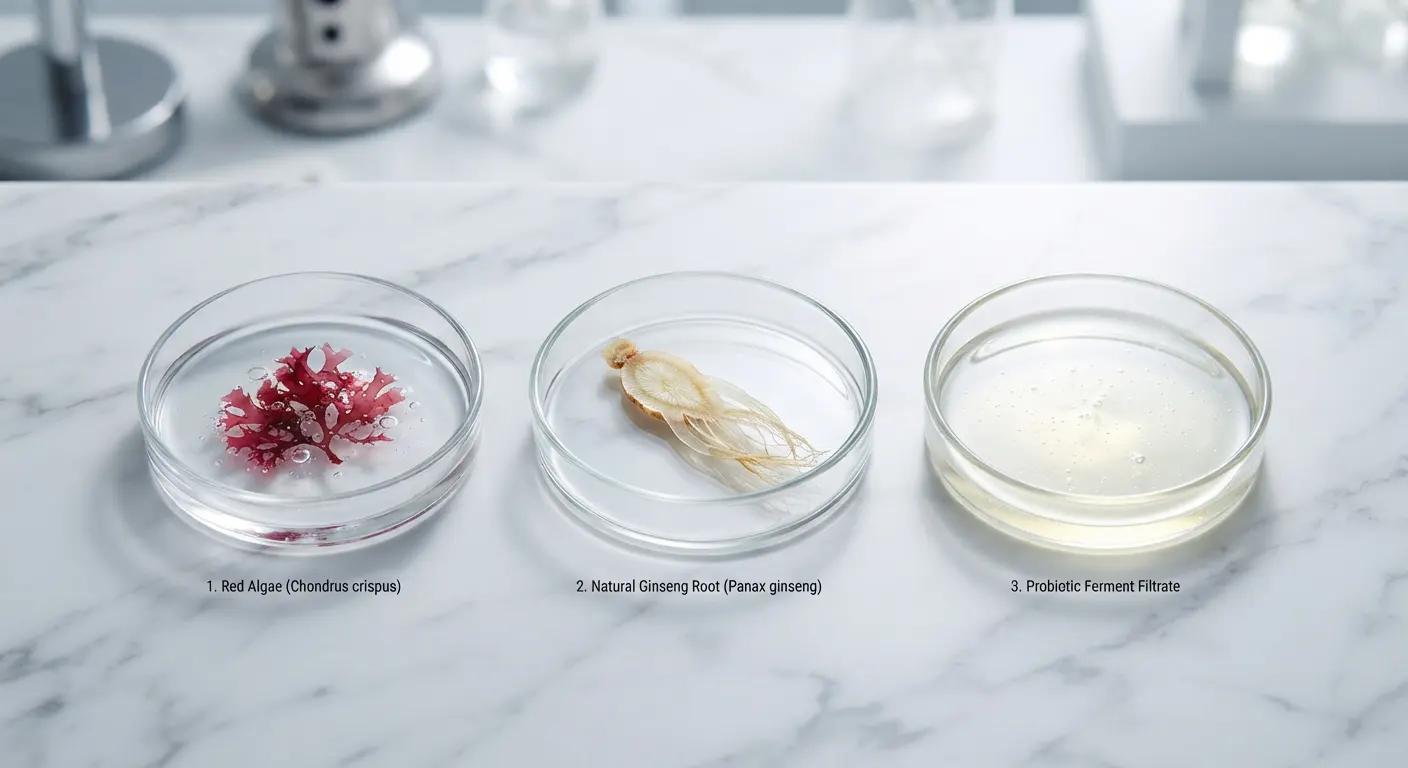 PDRN is just a polymer of deoxyribonucleotides. The source DNA does not have to come from fish. Published reviews list extraction sources that include red algae (seaweed), ginseng, and human placenta alongside salmon and trout sperm (review). In practice, three routes matter for cosmetics buyers today:
- Seaweed / red algae. Algal DNA is the most documented botanical source and sidesteps fish entirely, carrying a "marine botanica" story brands like. Best-fit claim: ocean-derived, vegan, allergen-free. Watch-out: cosmetic-grade supply is still niche and batch consistency tracks the harvest, so lock your spec to a molecular-weight range, not a species name.
- Botanical extracts (e.g., ginseng). Plant-derived nucleotide polymers are real, but the challenge is consistency of molecular-weight distribution and DNA content at cosmetic scale. Best-fit claim: "botanical ferment / plant extract" positioning. Watch-out: less standardized for actives use; demand a per-lot COA before committing volume.
- Microbial fermentation (Lactobacillus and similar). The route closest to scaling like a modern biotech active — controlled fermentation gives a reproducible nucleotide profile and removes agricultural variability. Best-fit claim: "fermented, animal-free," clean-label, halal-friendly. Watch-out: the publicly available clinical dataset is the youngest of the three, so set efficacy expectations against in-vitro and stability data, not injectable claims.
The honest takeaway: salmon remains the most clinically studied grade, red algae and ginseng are real and documented, and microbial fermentation is the one to watch for scalable, fully animal-free supply.
Does Plant-Based Perform the Same?
 Here is where I will not oversell. The mechanism that makes salmon PDRN interesting is well characterized: it acts as an adenosine A2A receptor agonist and also feeds a nucleotide salvage pathway, driving anti-inflammatory, angiogenic, and tissue-repair effects (PMC7585621). Salmon PDRN is supplied as a fragmented DNA polymer (typically 50–1,500 kDa) at >95% DNA purity after purification, with its high homology to human DNA underpinning low immunogenicity (e-kmj 2025).
For plant and microbial grades, the intent is the same — deliver nucleotide polymers that can engage the same repair biology — but the evidence ladder is lower:
- In vitro repair and anti-inflammatory signals are plausible and reported for non-salmon nucleotide sources, but head-to-head comparisons against salmon PDRN at matched molecular weight are limited.
- Human clinical data for salmon PDRN (wound healing, post-procedure repair) is far deeper than for any plant grade today.
For a topical, the honest comparison is not "salmon vs plant" in the abstract — it is "matched molecular weight, matched delivery, matched endpoint." Salmon grade wins today simply because more of that matched evidence exists. As we covered in our topical-PDRN breakdown, delivery, not the ingredient name, decides whether a PDRN formula actually does anything on skin, and that rule applies identically to plant grade.
So the accurate statement for your marketing and R&D teams: vegan PDRN can be a legitimate active, but "performs identically to salmon PDRN" is not yet a claim the published data supports. Position plant grade on its own merits — animal-free, allergen-free, halal/kosher-friendly — not on a parity promise you cannot document yet. And if you are formulating topically, remember that molecular-weight distribution decides whether the active can even reach the dermis; the same rule applies to plant grade as to salmon, so spec the distribution, don't just spec the name.
Why Supply-Chain Segregation Makes or Breaks the Claim
 This is the part brands get wrong and regret. If you sell a "vegan," "halal," or "fish-free" product, the active must never touch a line that also runs salmon PDRN. Cross-contact — even trace — can invalidate a halal certificate, trigger a recall for a fish-allergic customer, and destroy the claim in a way no lab result can undo after the fact.
GINKVORA runs two fully isolated supply chains: a salmon-derived grade and a plant/microbial-fermentation grade, with separate raw-material intake, dedicated production lines, and independent batch records. There is no shared intermediate, no blended buffer tank, no "we cleaned it between runs" gap. A real isolation statement should name the separated lines, confirm no shared equipment or utilities, and be signed by the manufacturer's quality function — that document, not the label claim, is what survives an audit. Consider the failure mode: a halal-certified finished good recalled because a supplier ran salmon PDRN on the same line the week before and a residue test came back positive. The certificate is withdrawn, the batch is destroyed, and the brand's halal positioning — often years in the building — is what actually takes the damage. Segregation is cheaper than that lesson.
Certifications Brand Buyers Should Demand
When you spec a non-salmon PDRN, ask the supplier for the documents, not the adjectives:
- Vegan — third-party certification (e.g., Vegan Society / equivalent), not a self-declaration.
- HALAL — recognized certifying body; confirm the full process, not just the source.
- KOSHER — relevant if you sell into markets that require it.
- ISO 22000 / HACCP — food-safety management of the line.
- GMP — good manufacturing practice for cosmetic-ingredient grade.
- Batch COA — every lot, with DNA content, molecular-weight distribution, endotoxin, heavy metals, and microbial limits (the same rigor you would demand for salmon grade; see our COA guide).
Red flag: any supplier that hands you a certificate but cannot also produce the isolation statement for a vegan/halal grade is mixing claims with convenience. The "vegan" or "halal" label on your finished good is built on sand without both. A quick verification habit: check the issuing body and the scope of the certificate, not just the logo on the PDF — a halal mark from an unrecognized body carries no weight with the buyers who matter.
How to Choose Between Salmon and Vegan Grade
Use this decision frame:
| If your brand… | Choose |
|---|---|
| Wants the deepest clinical story and cost-efficient scale | Salmon grade |
| Targets fish-allergic or "free-from" consumers | Plant / microbial grade |
| Sells into halal or kosher markets and wants zero ambiguity | Plant / microbial grade (with cert + isolation statement) |
| Needs volume with a clean "fermented, animal-free" claim | Microbial fermentation grade |
| Positions on "clinical regenerative actives" with proven data | Salmon grade (pair with plant grade later) |
Most brands do not have to pick one forever. A growing number run both — salmon grade for the clinical hero product, plant grade for the clean-label and religious-certification lines — as long as the two never share a line. If you are piloting, start with one grade matched to your lead claim, validate stability and the COA, then add the second grade on its own isolated line once the first is documented. Most teams find the salmon grade easier to launch first (deepest data, simplest stability story) and introduce the plant grade as a clean-label extension once the isolation paperwork is in hand.
Ready to spec? See the PDRN product page for dual-source grades, isolation statements, and per-batch COAs, and read how to actually read a PDRN Certificate of Analysis before you buy bulk.