TL;DR
- Short term, the data are reassuring. Oral NMN at 250–900 mg/day for up to 12 weeks shows no serious adverse events in RCTs; the usual culprit is mild, transient GI upset [Irie 2020, PMID 32357765; Yoshino 2021, PMID 33888596; Yi 2023, PMID 36482258].
- Long term, the data do not exist. There is essentially no multi-year human safety record. "Well tolerated for a quarter" is not the same claim as "safe for a decade" — and conflating them is the most common error I see on supplement labels.
- Some groups are excluded by evidence gap, not by preference: pregnancy, breastfeeding, under-18, and active malignancy have no human data and should not be assumed safe [EFSA / drug-monograph references].
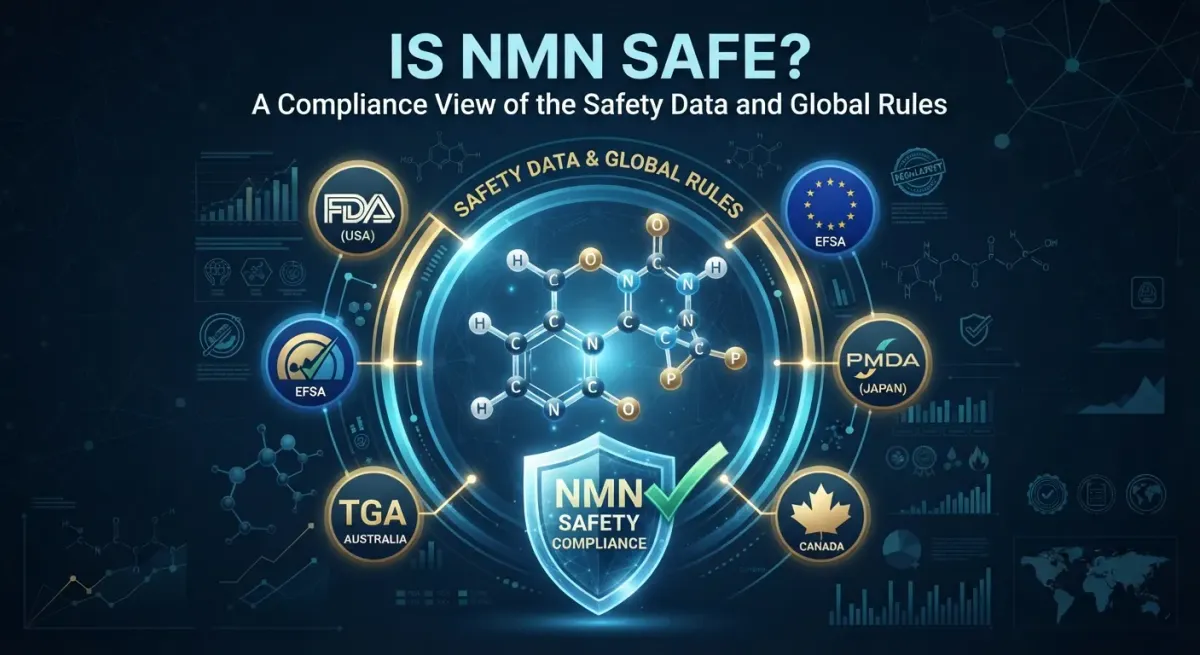
- Regulatory status is a moving map. US reinstated supplement status in 2025; Australia listed it in late 2025; the EU is still in Novel Food review; China allows it only as a cosmetic ingredient and via cross-border e-commerce for food use.
- The claim line is bright: NMN is not a treatment for any disease. You may speak to supporting NAD+ levels — never to reversing, curing, or preventing aging or illness.
Disclaimer: This article is compliance education, not medical advice. It does not diagnose, treat, or recommend any product for a medical condition. Consult a licensed clinician before starting any supplement — especially if you are pregnant, nursing, on medication, or have a health condition.
What the Human Safety Data Actually Show
When a buyer or a brand asks me "is NMN safe," the honest answer is two sentences, not one. The first: the short-term human record is genuinely reassuring. The second: the long-term human record is essentially空白 — and the second sentence is not a footnote to the first.
The short-term evidence is real and consistent. Randomized controlled trials using 250–1250 mg/day for up to 12 weeks reported no serious adverse events; the most frequent observation is mild, self-limiting gastrointestinal discomfort (nausea, bloating, occasional diarrhea) [Irie 2020, PMID 32357765; Fukamizu 2022, Sci Rep, doi 10.1038/s41598-022-18272-y; Yoshino 2021, Science, PMID 33888596]. A 2024 meta-analysis of eight RCTs (n=342, 250–2000 mg/day) confirmed NMN reliably elevates blood NAD+ and is well tolerated, while a 10-trial systematic review of physical-performance outcomes reached the same tolerability conclusion [Song 2024; Nadeeshani 2024].
Now the sentence people skip. The longest human NMN trials run about 12 weeks. We have no established multi-year human safety profile. Animal studies (rats) show high No-Observed-Adverse-Effect-Levels, but extrapolating a rat's year to a human's decade is exactly the leap the evidence does not support. When I say "very low risk, but not zero unknown," that is precise: the observed risk is low, and the unobserved window is simply unstudied.
One more calibration point: NMN does not cause the niacin-style skin flush (it does not directly trigger the GPR109A receptor). Isolated mild flushing in sensitive individuals at high doses is the exception, not the rule. So the side-effect story is mild — but "mild" and "fully characterized for life" are different claims.
Myths vs Facts
This is where compliance and marketing most often collide, so I'll lay it out plainly.
| Myth | Fact |
|---|---|
| "NMN reverses aging." | No human trial has demonstrated reversal of aging or prevention of any disease. It raises NAD+ — a biomarker, not an outcome [Song 2024; Prokopidis 2025, 10 RCTs in adults >60]. |
| "If it's safe for 12 weeks, it's safe for life." | Different question. Long-term (>1 year) human safety data are absent. Short-term tolerance is a green light for the studied window only. |
| "More is always better." | Dose-response plateaus — one dose-ranging trial flattened blood NAD+ and 6-minute-walk gains around 600 mg/day. Higher doses add mild side-effect risk without proven added benefit. |
| "It's natural, so no precautions apply." | The exclusions (pregnancy, breastfeeding, under-18, active cancer) come from an evidence gap, not a philosophy. Nature does not issue a safety certificate. |
| "The FDA approved this supplement." | In the US, an NDIN is a notification, not an approval. As of the latest update, only SyncoZymes' (Shanghai) NMN is on the FDA's NDIN list. Everyone else must file their own. |
Regulatory Status: A Moving Map
NMN's legal identity changes at every border, and it has been one of the most litigated ingredients of the decade. Here is the state of play as of this writing.
United States — reinstated in 2025, but read the fine print
The saga is worth knowing because it shapes every US claim. NMN was first submitted as a New Dietary Ingredient (NDIN) in 2021. In November 2022, FDA issued a letter arguing NMN was excluded from the dietary-supplement definition under the drug-exclusion clause of DSHEA (21 U.S.C. §321(ff)(3)(B)(ii)), because it was under investigation as a new drug. The Natural Products Association (NPA) filed a citizen petition in March 2023. On September 29, 2025, FDA reversed course, concluding NMN was not excluded — citing evidence it had been marketed as a supplement before the drug-investigation authorization. In December 2025, FDA published the reinstatement letter (NDIN 1240 and 1247), withdrawing the 2022 exclusion letter [FDA response to NPA petition; Regulations.gov, NDIN 1240/1247].
The compliance catch: an NDIN is a pre-market notification for FDA to review safety — it is not an FDA approval or endorsement. And as of the latest update, only SyncoZymes' NMN appears on the FDA's official NDIN list. Any other company selling NMN in the US must file its own notification.
China — food banned, cosmetic allowed
In China, NMN has not obtained approval as a food, health food, food additive, or new food ingredient. The National Health Commission denied a food-additive application in May 2023 ("不予行政许可"). The market regulator circulated a 2021 notice against unlawful "anti-aging" NMN food sales. The one open door: NMN was cleared as a cosmetic new ingredient (NMPA备案, 2022), so it is legitimate in topical products. For oral use, Chinese consumers access it almost entirely through cross-border e-commerce import channels — and those channels have faced tightening customs scrutiny since 2024.
European Union — still under Novel Food review
The EU classifies NMN as a Novel Food, authorized only after a safety assessment. Multiple companies have filed (reports cite roughly six applications, with three actively advancing — including chemically synthesized NMN from a Shanghai applicant that reached EFSA risk assessment, and enzymatically produced NMN from SyncoZymes in public consultation). As of this writing, no final EU authorization has been granted. RASFF notifications in past years reflect tight control while applications are pending. Brands should not assume EU food-supplement status.
Australia — listed in 2025, with a twist
Australia's TGA added NMN to the permitted-ingredient list for listed complementary medicines in December 2025, creating a clear compliance pathway. The twist: TGA granted a two-year market-exclusivity window (Dec 10, 2025 – Dec 10, 2027) limited to the applicant (SyncoZymes) and its authorized parties. So NMN is lawful in Australian listed medicines — but only through that authorized supply for now.
Japan and Canada — the quiet yeses
For completeness: Japan listed β-NMN in its non-pharmaceutical catalog in 2020 (usable as a food/functional-food ingredient, no disease claims). Canada added NMN to its Natural Health Product ingredient database in 2021 (requires an NPN license number). Both are workable, bounded frameworks.
The Claim Line: What You May and May Not Say
This is the part I repeat to every brand before they publish a product page. The boundary is not vague.
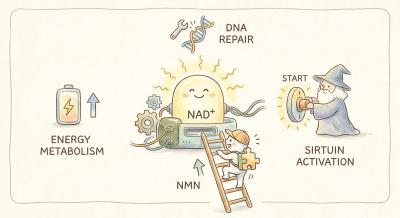
You may say (within local structure/function rules): NMN supports or helps maintain NAD+ levels; contributes to cellular energy metabolism; fits a healthy-aging lifestyle. These are defensible because they track the biomarker evidence (NAD+ rises) without asserting an outcome.
You may not say: NMN treats, cures, or prevents any disease; reverses aging; "anti-aging therapy"; or implies a specific disease outcome (e.g., "for diabetes," "for cognitive decline"). Those are drug claims. The line is bright, and crossing it is the fastest way to a regulator's attention in any of the markets above.
A useful internal test: if the sentence could appear in a drug label, it does not belong on a supplement page. "Supports NAD+" stays. "Restores youthful function" goes.
Who Should Be Cautious
The safety data let most healthy adults proceed at studied doses — but several groups should not, and the reason is an absence of evidence, not a known harm.
- Pregnancy and breastfeeding: no human data → not recommended.
- Under 18: no pediatric data → excluded by default.
- Active or prior malignancy: theoretical concern that raising NAD+ could fuel tumor cell energy metabolism → most clinicians advise avoidance, especially during active treatment [drug-monograph contraindication lists].
- People on medication: NMN's effect on insulin sensitivity could amplify diabetes drugs; warfarin and immunosuppressant interactions are theoretically plausible and unstudied. Show your clinician the exact product and dose.
Source pharmaceutical-grade NMN (beta-Nicotinamide Mononucleotide) with beta-specificity and a per-batch HPLC COA — the documented material that makes a compliant, evidence-based claim possible.
Related Articles
- NMN, NMNH & the NAD+ Market: Global Trends — where the category is headed and what buyers are asking for.
- PQQ & Mitochondrial Health: Market Trend — another mitochondrial-angle active where sourcing and testing decide quality.
- Salmon vs Vegan PDRN — how raw-material selection and supply-chain segregation shape a finished active.
- What Is NMN? A Raw-Material Scientist Breaks Down the Mechanism
- What Does 99.5% NMN Really Mean? A Purity Scientist Reads the COA