Preface
When I first started covering mitochondrial health ingredients at GINKVORA, the conversation was always the same: CoQ10 for energy, NMN for longevity. PQQ came up as an afterthought — the third ingredient nobody knew how to price, despite PQQ benefits spanning mitochondrial biogenesis, antioxidant defense, cognitive protection, and cellular energy metabolism.
That gap between PQQ's mechanism and its market presence has held my attention for three years now. And in that time, I have watched the data shift — slowly at first, then unmistakably.
What I want to share in this piece is not a generic market overview. It is the synthesis of data from five independent research firms, clinical trials published across JBC, ScienceDirect, and the Journal of Medical Investigation, and direct conversations with brand partners trying to decide whether PQQ belongs in their 2026-2027 portfolio.
Here is what the numbers tell me.
The Gap Between Evidence and Awareness
The global pyrroloquinoline quinone disodium salt (PQQ) market was valued at $47.7 million in 2025 and is projected to reach $115.2 million by 2033, growing at a 10.4% CAGR (Verified Market Reports, 2025). For context: the CoQ10 supplement market sits at $760 million (2025), growing at 10.5% CAGR toward $1.69 billion by 2033 (Verified Market Reports, 2025). The NMN market reached approximately $400 million in 2026, accelerating toward a projected $950 million by 2035 (Business Research Insights, 2026). The broader mitochondrial support supplements market was valued at $3.8 billion in 2025 (DataIntelo, 2025).
PQQ — a molecule with a dual mechanism that neither CoQ10 nor NMN can replicate — is one-sixteenth the size of CoQ10. That ratio is not a market failure. It is a timing signal.
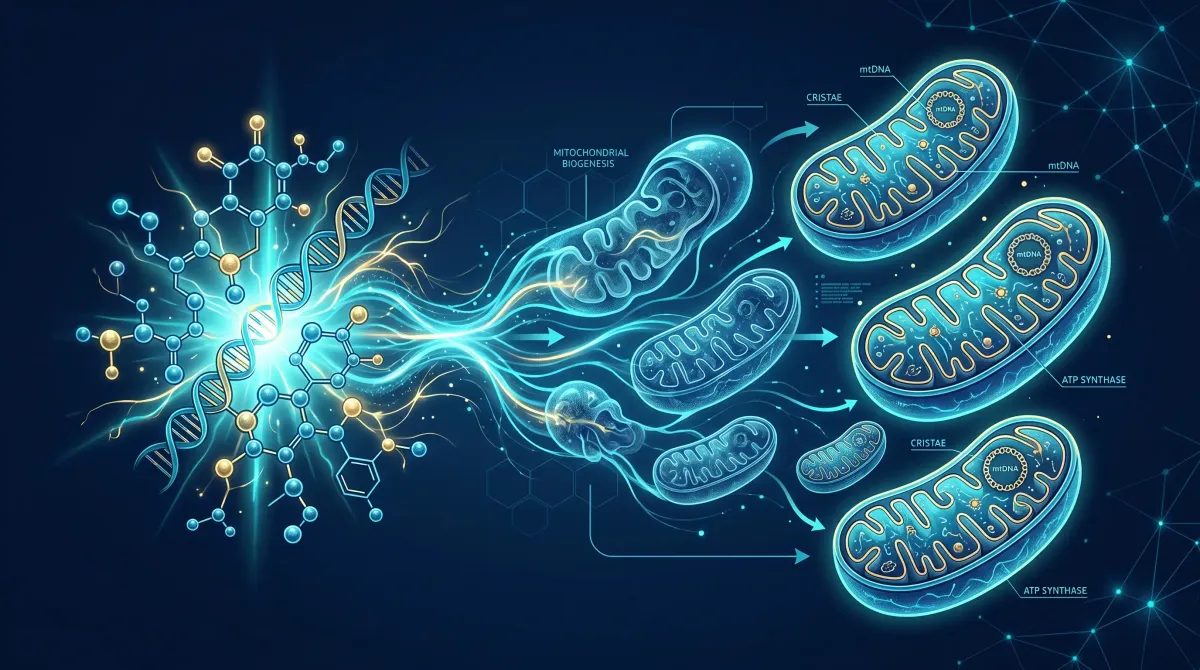
PQQ (pyrroloquinoline quinone) can do something that no other widely commercialized mitochondrial ingredient can: it does not merely protect or optimize existing mitochondria — it signals the cell to produce new ones.
The foundational mechanism was established by Chowanadisai et al. in a 2010 study published in the Journal of Biological Chemistry. The research demonstrated that PQQ exposure stimulates phosphorylation of the transcription factor CREB at serine 133. This phosphorylation event activates the promoter of PGC-1α (peroxisome proliferator-activated receptor gamma coactivator 1-alpha) — the master transcriptional coactivator for mitochondrial biogenesis. Activated PGC-1α then upregulates NRF1 and TFAM, the two downstream factors that drive transcription of mitochondrial DNA and assembly of new mitochondrial proteins. The result is a measurable increase in mitochondrial DNA copy number: a direct, quantifiable indicator of mitochondrial population size.
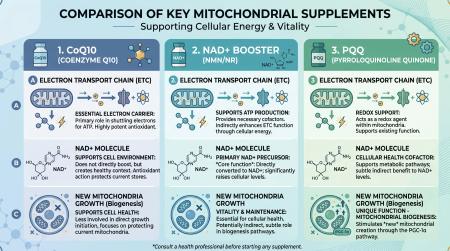
This is categorically different from CoQ10, which functions as an electron carrier in the mitochondrial electron transport chain — it helps existing mitochondria produce cellular energy (ATP) more efficiently, but does not generate new organelles. It is different from NMN, which raises NAD+ levels to activate sirtuins involved in mitochondrial quality control, but does not initiate biogenesis. PQQ is the only widely commercialized mitochondrial ingredient that produces net-new mitochondria.
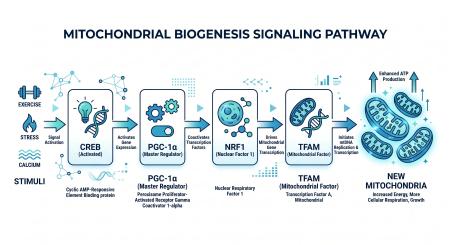
The second half of PQQ's mechanism — the Nrf2-ARE antioxidant pathway — operates in parallel. PQQ activates Nrf2, which translocates to the nucleus and binds to antioxidant response elements (ARE), upregulating endogenous antioxidant enzymes including superoxide dismutase (SOD), catalase, glutathione peroxidase, and heme oxygenase-1. This is not direct radical scavenging (as with vitamin C or vitamin E); it is the activation of the cell's own antioxidant defense system. Two pathways, one molecule: PGC-1α builds more mitochondria, Nrf2 protects them from oxidative damage.
Clinical Evidence: What Human Trials Actually Show
Beyond mechanism, human clinical data is accumulating across multiple endpoints:
Cognitive function. A 2024 six-week randomized controlled trial examined dihydrogen-PQQ supplementation in elderly individuals with mild cognitive impairment. Published in ScienceDirect, the study reported mitigation of cognitive decline, with researchers attributing the effect to improvements in mitochondrial biomarkers and brain metabolism.
Muscle strength and physical function. A 2024 randomized, double-blind, placebo-controlled study published in the Journal of Functional Foods evaluated PQQ disodium salt (mnemoPQQ) for muscle strength outcomes. Using lower limb extension strength as the primary endpoint, the study demonstrated that PQQ supplementation improved physical function metrics in healthy volunteers.
Brain function, sleep, and mood. A comprehensive 2024 review in the Journal of Medical Investigation (Vol. 71) documented that PQQ disodium salt improved subjective sleep quality and mood scores in an open-label trial, suppressed skin moisture loss, and increased PGC-1α expression in human subjects. The same review confirmed that PQQ ingestion lowers blood lipid peroxide levels and established 20mg/day as the baseline intake for physiological benefit.
Redox cycling capacity. The JMI review also documented PQQ's extraordinary catalytic efficiency: PQQ can undergo thousands of redox cycles as an antioxidant, far exceeding the single-use capacity of conventional antioxidants like vitamin C. This catalytic property means a small quantity of PQQ produces sustained antioxidant activity over extended periods.
Regulatory Landscape
The FDA has issued multiple "no objection" letters for PQQ disodium salt under the GRAS (Generally Recognized as Safe) framework. The first and most significant was GRAS Notice No. GRN 000625, submitted by Mitsubishi Gas Chemical Company in 2016. This GRAS determination covers up to 20mg per serving in beverages, sports drinks, and energy products. Subsequent GRAS notices (GRN 641, 701, 709) have expanded the manufacturer base while maintaining consistent safety findings.
The European Food Safety Authority (EFSA) issued its safety assessment of PQQ disodium salt (trade name BioPQQ) as a novel food in 2017, concluding that PQQ is safe under the intended conditions of use. The European Commission subsequently authorized PQQ as a novel food ingredient via Implementing Regulation (EU) 2018/1122.
Mitsubishi Gas Chemical — the original PQQ manufacturer and patent holder for the BioPQQ fermentation process — has established 20mg/day as the reference standard, a dose adopted by the majority of clinical trials and commercial products.
The Competitive Landscape
Dietary supplements account for approximately 60% of global PQQ market revenue, with the remaining 40% split across functional foods, beverages, and cosmetics (Reports and Data, 2024). Energy drinks represent the fastest-growing non-supplement application, enabled by the GRAS allowance for 20mg PQQ per serving.
North America dominates the PQQ market with approximately 38.2% market share, while Asia Pacific is projected to grow at the highest rate (11.4% CAGR) (DataHorizzon Research, 2024). Japan, in particular, has the most sophisticated consumer understanding of mitochondrial health ingredients — a direct result of Mitsubishi Gas Chemical's two decades of BioPQQ marketing and research.
ConsumerLab.com's 2024 PQQ supplement review tested leading PQQ products for content accuracy and heavy metal contamination. Not all products passed — the variance in PQQ purity between manufacturers is a genuine supply chain concern. This creates a quality differentiation opportunity for brands that source from audited manufacturers.
The active brand landscape for single-ingredient PQQ in North America includes:
| Brand | Typical Dose | Format | Price Segment |
|---|---|---|---|
| Doctor's Best | 20mg | Capsule | Mid-market |
| Life Extension | 20mg | Capsule | Premium |
| NOW Foods | 20mg | Capsule | Value |
| Swanson | 20mg | Capsule | Value |
| Source Naturals | 20mg | Capsule | Mid-market |
Every major brand sells a single-ingredient, capsule-format PQQ product at 20mg. None currently combine PQQ with NMN and CoQ10 in a single, commercially scaled formulation with published third-party testing data. The combination strategy — three ingredients, three complementary mechanisms — is entirely unclaimed at scale.
The Three-Pillar Mitochondrial Strategy
The market data supports a unified mitochondrial formulation rather than isolated single-ingredient products:
| Ingredient | Market Size (2025-2026) | CAGR | Primary Mechanism | Source |
|---|---|---|---|---|
| CoQ10 | $760M | 10.5% | Electron transport chain — ATP production | Verified Market Reports |
| NMN | $400M | ~12% | NAD+ precursor — sirtuin activation | Business Research Insights |
| PQQ | $47.7M | 10.4% | PGC-1α — mitochondrial biogenesis | Verified Market Reports |
The three mechanisms are complementary, not overlapping. CoQ10 shuttles electrons through Complex I-IV of the electron transport chain, maximizing ATP output per mitochondrion. NMN increases NAD+ availability, which activates sirtuins (SIRT1, SIRT3) responsible for mitochondrial quality control, DNA repair, and metabolic regulation. PQQ generates net-new mitochondria — the one mechanism the other two cannot perform.
A formulation that combines all three addresses mitochondrial function at three levels: more energy currency (NAD+), more efficient energy production (CoQ10), and more cellular machinery to produce energy (PQQ). No single-ingredient competitor can tell that story — and no longevity supplement on the market today claims all three mechanisms with published clinical backing on each component.
The combined addressable market of CoQ10 + NMN ($1.16 billion) dwarfs each individual ingredient's market. Consumers consistently prefer unified solutions — and no major brand currently bundles all three in a single, tested formulation. The shelf space for "the complete mitochondrial stack" exists and is empty.
GINKVORA's Dual-Format Strategy
We supply PQQ in two formats because different brands operate at different price points and require different positioning narratives:
| Parameter | Superfood PQQ Disodium Salt | Liposomal PQQ |
|---|---|---|
| Bioavailability | Standard oral absorption | 2-4× improved via membrane fusion |
| Best format | Capsules, powders, bulk blends | Liquid formulations, premium softgels |
| Supply chain complexity | Low — standard powder handling | Moderate — requires liposome integration |
| Brand positioning | Value-to-mid-market | Premium, science-forward |
| Competitive moat | Accessible PQQ entry point | Differentiated absorption narrative |
| Target brand profile | Brands adding PQQ to existing SKUs | Brands building a PQQ-centric product line |
The Superfood format is the pragmatic choice: it adds PQQ to the ingredient panel, the clinical story, and the consumer benefit without restructuring the brand's supply chain. For a brand with an existing NMN capsule, adding Superfood PQQ is a label update.
The Liposomal format is the strategic choice for brands where PQQ is the anchor ingredient. Liposomal encapsulation provides a measurable bioavailability advantage — and, critically, a technical narrative that mass-market PQQ capsules cannot replicate.
Source pharmaceutical-grade PQQ Disodium Salt from GINKVORA — ≥99% purity, GRAS-affirmed (FDA GRN 625), available in Superfood and Liposomal formats with full CoA documentation and batch traceability.
The Brand Decision Framework
The PQQ category is early-stage but accelerating. The question for brand owners is not whether PQQ belongs in the portfolio — it is when, and with what format.
Enter now if:
- Your brand already sells NMN or CoQ10. Adding PQQ completes the three-pillar mitochondrial story with a combined ingredient narrative worth $1.16 billion in existing market validation.
- You operate in North America or Japan. North America holds the largest PQQ market share (38.2%); Japan has the deepest consumer understanding, built over two decades of BioPQQ marketing by Mitsubishi Gas Chemical.
- Your competitor set includes any of the five major single-ingredient PQQ brands. Their capsule-only approach leaves the combination strategy entirely unclaimed.
Wait if:
- Your primary market has low ingredient literacy. Consumers who cannot define "antioxidant" will not understand "mitochondrial biogenesis," and the education cycle makes PQQ a loss-leader until awareness catches up.
- Your supply chain cannot support multi-ingredient quality testing. PQQ disodium salt purity varies between manufacturers — ConsumerLab's 2024 testing confirmed that not all products meet label claims.
The realistic timeline: Establish with CoQ10 or NMN → add PQQ as a premium upgrade (2026-2027) → educate consumers on the three-pillar mitochondrial strategy (12-18 months) → launch standalone PQQ when category awareness reaches inflection (2028-2029). The $47.7 million PQQ market today will look very different a decade from now — but only for brands that started building PQQ content, credibility, and supply chains before the curve.
Related Articles
- NMN, NMNH, NAD+: Navigating the Global NAD Precursor Market — PQQ + NMN + CoQ10 form the three-pillar mitochondrial health strategy
- Liposomal Delivery: Why It's Becoming the New Standard — How liposomal encapsulation multiplies PQQ bioavailability 2-4×
- EGCG Stability: What Green Tea Catechins Actually Need — Antioxidant stability strategies applicable to PQQ formulation
Frequently Asked Questions
What does PQQ actually do at the cellular level?
PQQ (pyrroloquinoline quinone) works through two distinct mechanisms: (1) it activates PGC-1α, the master regulator of mitochondrial biogenesis — meaning it signals cells to produce more mitochondria, not just protect existing ones; (2) it activates the Nrf2 antioxidant pathway, upregulating endogenous antioxidant enzymes. This dual action — more mitochondria + better protected mitochondria — is unique among mitochondrial ingredients.
What is the difference between PQQ and CoQ10?
CoQ10 is an electron carrier in the mitochondrial electron transport chain — it helps existing mitochondria produce ATP more efficiently. PQQ triggers the creation of new mitochondria (biogenesis) and protects them via Nrf2. They are complementary, not interchangeable: CoQ10 optimizes the existing fleet, PQQ builds more ships. The combination is more powerful than either alone.
How does PQQ synergize with NMN for a complete mitochondrial formulation?
NMN increases NAD+ levels, which activates sirtuins — proteins involved in mitochondrial quality control and DNA repair. PQQ increases mitochondrial quantity (via PGC-1α) and antioxidant capacity (via Nrf2). CoQ10 optimizes ATP output from the expanded mitochondrial pool. Together: NMN (energy currency) + PQQ (generate more power plants) + CoQ10 (run them efficiently) = a three-pillar mitochondrial health strategy.
What is the recommended daily dose of PQQ?
The clinical range is 10-40mg per day. The Journal of Medical Investigation (Vol. 71, 2024) and Mitsubishi Gas Chemical's reference intake both establish 20mg as the standard daily dose. At 20mg/day, mitochondrial biogenesis markers (mtDNA copy number, citrate synthase activity) increase measurably within 8-12 weeks. Doses above 40mg have not demonstrated additional mitochondrial benefit in published human trials.
Should I choose Superfood-grade or Liposomal PQQ for my brand?
Superfood-grade PQQ (GINKVORA PQQ Disodium Salt) is ideal for powder, capsule, and bulk formulations — it offers standard bioavailability with the simplest supply chain. Liposomal PQQ adds 2-4× bioavailability improvement through membrane fusion delivery, making it the preferred choice for premium-positioned products, liquid formats, and brands that compete on absorption narrative. The choice is a brand positioning decision: standard vs. premium, and price point preference.
Zhilin leads global marketing strategy at GINKVORA, specializing in the intersection of biotechnology and market positioning. He has tracked the mitochondrial health category across 23 markets and advises GINKVORA's brand partners on ingredient strategy and market entry timing.