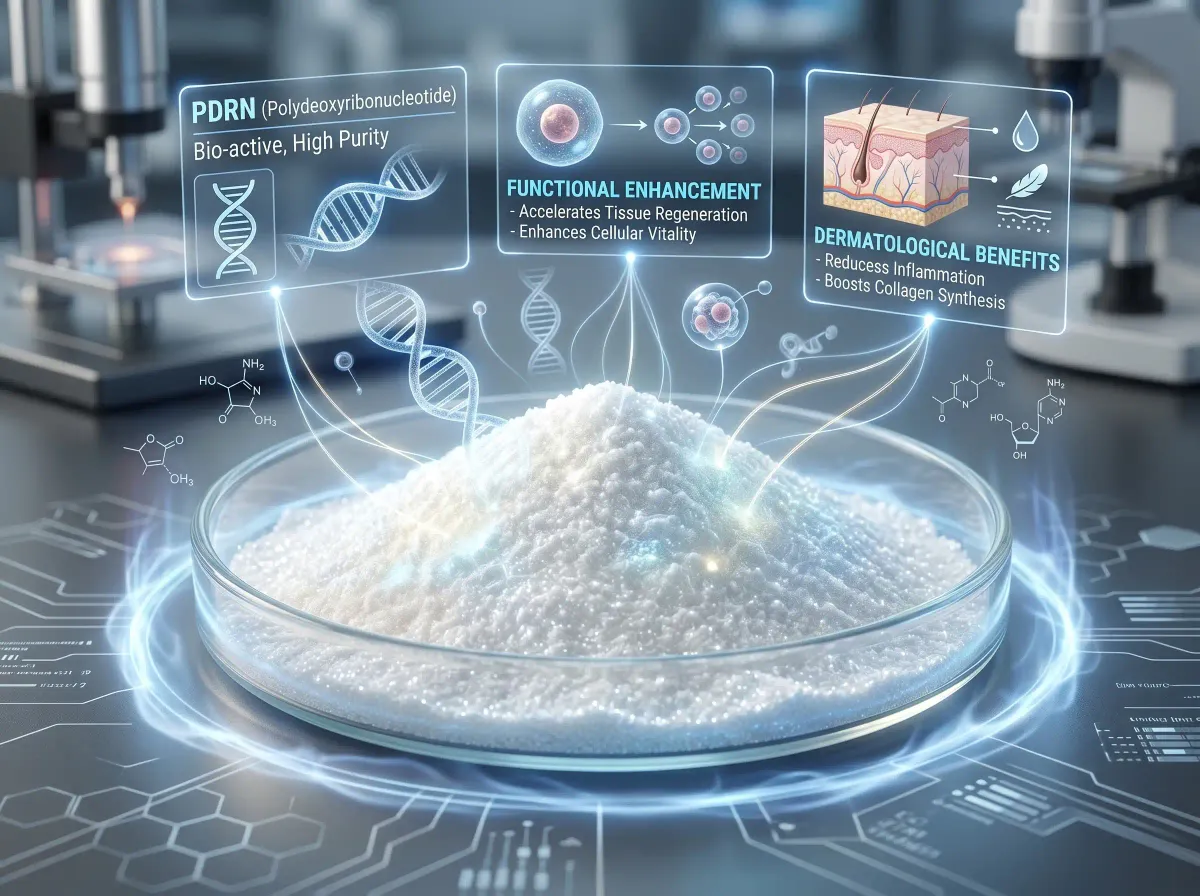
PDRN (Polydeoxyribonucleotide) — Bulk Cosmetic Raw Material
Salmon (Oncorhynchus keta) sperm DNA-derived polydeoxyribonucleotide
Factory-direct PDRN (Polydeoxyribonucleotide) bulk powder — cosmetic-grade salmon DNA extract with 95% structural homology to human DNA. Clinically validated for skin regeneration, anti-aging, and wound healing. ≥90% / ≥98% purity. COA per batch.
PDRN (Polydeoxyribonucleotide) — Cosmetic Raw Material from Salmon DNA
PDRN (Polydeoxyribonucleotide) is a highly purified DNA polymer extracted from salmon (Oncorhynchus keta) sperm through advanced enzymatic hydrolysis. Supplied as a white to off-white bulk powder, PDRN is the gold-standard regenerative active ingredient in premium K-Beauty and medical aesthetic formulations.
With ~95% structural homology to human DNA, PDRN delivers exceptional biocompatibility and triggers the adenosine A2A receptor pathway — the body's natural tissue repair signaling cascade. The result is clinically documented skin regeneration, accelerated wound healing, and measurable anti-aging effects without irritation or cytotoxicity.
Why Cosmetic Formulators Choose PDRN
- Clinically validated skin regeneration — A2A receptor agonism stimulates fibroblast proliferation and endogenous growth factor release (EGF, FGF, VEGF, IGF)
- 95% human DNA homology — Near-identical to human nucleic acids, minimizing immunogenicity while maximizing bioavailability
- Multi-pathway anti-aging — Boosts collagen synthesis, elastin production, and microcirculation simultaneously
- Proven wound healing acceleration — The "salvage pathway" provides purine/pyrimidine building blocks for rapid DNA repair and cellular turnover
- Broad formulation compatibility — Miscible with hyaluronic acid, peptides, ceramides, niacinamide, growth factors, and Centella asiatica extracts
- Standardized production — Produced under ISO22000 / GMP-certified facilities; HPLC-verified purity with COA per batch
Mode of Action
| Pathway | Mechanism | Cosmetic Outcome |
|---|---|---|
| A2A Receptor Agonism | Binds adenosine A2A receptors on dermal fibroblasts | Cell proliferation & tissue regeneration |
| Salvage Pathway Activation | Supplies purine/pyrimidine bases for DNA synthesis | Accelerated cellular turnover & repair |
| Growth Factor Cascade | Upregulates EGF, VEGF, FGF, IGF secretion | Collagen synthesis & angiogenesis |
| Anti-inflammatory Modulation | Downregulates IL-6, TNF-α, COX-2 expression | Redness reduction & sensitive skin soothing |
| Microcirculation Enhancement | VEGF-mediated capillary formation | Improved skin luminosity & nutrient delivery |
Recommended Usage
- Cosmetic formulations: 0.01%–2.0% (w/w), added during the cooling phase below 40°C to preserve bioactivity
- Optimal pH range: 5.0–7.0 in aqueous systems
- Formulation types: Anti-aging serums, regenerative ampoules, post-procedure recovery creams, bio-cellulose masks, barrier-repair balms, microneedling solutions, under-eye treatments, and skin-brightening formulations
Quality & Compliance
- Purity: ≥ 90.0% (standard) / ≥ 98.0% (premium) verified by HPLC
- Sterility: Aseptic processing; endotoxin ≤ 0.5 EU/mg
- Heavy metals: ≤ 10 ppm total (Pb ≤ 2 ppm, As ≤ 1 ppm, Hg ≤ 0.1 ppm, Cd ≤ 1 ppm)
- Certifications: ISO22000, GMP, KOSHER, HALAL, HACCP
- Batch traceability: Every batch ships with a Certificate of Analysis (COA)
Source pharmaceutical-grade PDRN (Polydeoxyribonucleotide) bulk powder from GINKVORA — your trusted partner for premium cosmetic active ingredients with stable supply and batch-level transparency.
Related Articles
- Quercetin Safety & Dosage — Evidence-based dosing guidelines for bioactive ingredients
- Before and After Glabridin — How raw material purity impacts cosmetic efficacy
- Quercetin Supplement Formulation — Practical guide to formulating with high-purity actives
Frequently Asked Questions
What is PDRN and where does it come from?
PDRN (Polydeoxyribonucleotide) is a DNA-derived biopolymer extracted from salmon (Oncorhynchus keta) sperm cells through controlled enzymatic hydrolysis. The resulting low-molecular-weight DNA fragments (50–2,000 kDa) retain the nucleotide sequence scaffold that shares ~95% structural homology with human DNA, making it one of the most biocompatible regenerative cosmetic ingredients available. PDRN is not "salmon sperm" — it is a purified, standardized, sterile-grade nucleic acid preparation suitable for regulated cosmetic manufacturing.
How is PDRN different from polynucleotides (PN)?
PDRN and PN (polynucleotides) are closely related DNA-derived ingredients, but they differ in molecular weight, processing, and intended use. PDRN typically has a lower molecular weight range (50–2,000 kDa) produced via enzymatic hydrolysis, making it ideal for topical cosmetic formulations where trans-epidermal penetration is critical. PN are longer-chain DNA polymers that retain a double-helical structure and are primarily used in injectable medical device applications. For cosmetic formulators, PDRN's smaller fragment size and superior water solubility make it the practical choice for serums, ampoules, creams, and masks.
What is the recommended concentration of PDRN in cosmetic products?
Cosmetic-grade PDRN is typically used at 0.01%–2.0% (w/w) depending on the product type. Serums and ampoules commonly use 0.1%–0.5%, while intensive regenerative treatments (post-procedure creams, microneedling solutions) may use 0.5%–2.0%. PDRN should be added during the cooling phase (below 40°C) to preserve its bioactivity. It is highly stable in aqueous systems at pH 5.0–7.0 and can be combined with hyaluronic acid, peptides, niacinamide, and Centella asiatica for synergistic effects. Always validate compatibility and stability in your specific formulation through accelerated testing.
Is PDRN safe for all skin types and sensitive skin?
Yes. PDRN is exceptionally well-tolerated due to its 95% structural homology with human DNA. It does not trigger immune responses, has no known photo-sensitizing effects, and is consistently rated as non-irritating in human patch tests. The ingredient's anti-inflammatory properties — mediated through downregulation of IL-6, TNF-α, and COX-2 — make it particularly beneficial for sensitive, reactive, and post-procedure skin. Unlike aggressive actives such as retinoids or high-concentration AHAs, PDRN regenerates without causing barrier disruption or inflammation.
How should PDRN bulk powder be stored?
PDRN bulk powder must be stored at 2–8°C in airtight, light-protected containers to maintain molecular integrity and bioactivity. The polymer is hygroscopic — exposure to ambient humidity can cause clumping and degradation. Reseal containers immediately after dispensing, and minimize air exchange during handling. Under proper storage, unopened containers have a shelf life of 24 months from the manufacture date. Opened containers should be consumed within 3 months. Do not freeze-thaw repeatedly; aliquot into single-use portions if frequent access is required.
Frequently Asked Questions
Request a Quote for PDRN (Polydeoxyribonucleotide) — Bulk Cosmetic Raw Material
Complete the form below to receive pricing, specifications, and a free sample. Our sales team will contact you within 12 hours.