TL;DR
- Quercetin formulation starts with a fundamental choice: standard dihydrate (cost-effective, requires absorption enhancer) vs. enhanced-bioavailability forms (phytosome, EMIQ, liposomal — higher cost, higher efficacy)
- Clinical dosing: 500–1,000 mg/day for immune/allergy; 250–500 mg/day for antioxidant maintenance. All doses taken with meals.
- Three validated synergy stacks: (1) + Bromelain for absorption, (2) + Zinc for ionophore-mediated antiviral activity, (3) + Vitamin C for sustained antioxidant recycling
- Delivery form selection depends on quercetin form: capsules for powder, softgels for phytosome, EMIQ for beverages, careful formulation required for tablets and gummies
- Quality specs: ≥95% HPLC, heavy metals compliant, full batch COA, botanical source traceability
- This guide covers every formulation decision a supplement developer faces — from ingredient selection to label claims
The Formulation Decision Tree
Every quercetin supplement starts with a sequence of decisions. The following framework maps every choice a formulator faces:
STEP 1: Choose quercetin form
    ├── Standard dihydrate (≥95%) → cost-effective, needs absorption help
    ├── Phytosome complex → 20× bioavailability, premium positioning
    ├── EMIQ → water-soluble, ideal for beverages/gummies
    └── Liposomal → highest bioavailability, highest cost/complexity

STEP 2: Select target dose
    ├── 250–500 mg/day → antioxidant maintenance
    ├── 500 mg/day → general immune, mild allergy
    └── 1,000 mg/day → clinical immune, moderate-severe allergy

STEP 3: Choose synergy ingredients
    ├── + Bromelain → solves absorption (standard quercetin)
    ├── + Zinc → ionophore antiviral stack
    ├── + Vitamin C → sustained antioxidant activity
    ├── + Vitamin D3 → macrophage modulation
    └── Multi-synergy stack → premium immune formula

STEP 4: Select delivery form
    ├── Capsule → 2-piece HPMC or gelatin, most common
    ├── Tablet → wet granulation required for compressibility
    ├── Softgel → for phytosome (oil-dispersible)
    ├── Powder → single-serving stick packs, drink mixes
    ├── Gummy → EMIQ form, strong flavor masking needed
    └── Functional beverage → EMIQ or microencapsulated

STEP 5: Quality assurance
    ├── Ingredient specs (HPLC assay, heavy metals, micro)
    ├── Finished product testing (potency, dissolution, stability)
    └── Documentation (COA, CoC, stability data)
Step 1: Choosing the Right Quercetin Form
The form of quercetin you select determines your product's efficacy, cost, delivery options, and label claims. This is the single most important formulation decision.
Standard Quercetin Dihydrate
| Attribute | Specification |
|---|---|
| Form | Yellow to light brown fine powder, 80-mesh |
| Assay | ≥95% quercetin by HPLC |
| Bioavailability | 1–5% orally |
| Solubility | Practically insoluble in water (<1 mg/mL); soluble in ethanol and DMSO |
| Cost | Lowest per kg |
| Best for | Capsules with bromelain enhancement; tablet formulations with absorption excipients |
| Not ideal for | Beverages, gummies, or any water-based system without microencapsulation |
Formulator's note: Standard quercetin without an absorption strategy will underperform. The choice is not "should I add bromelain?" but "which absorption strategy will I use?" — bromelain co-administration, phytosome processing, or liposomal/micellar delivery.
Quercetin Phytosome (Phospholipid Complex)
| Attribute | Specification |
|---|---|
| Form | Patent-protected complex: quercetin + phosphatidylcholine (typically from sunflower lecithin) |
| Bioavailability | ~20× higher than standard quercetin (based on pharmacokinetic AUC comparison) |
| Solubility | Lipophilic — dispersible in oils, suitable for softgels |
| Cost | 3–8× standard quercetin |
| Best for | Premium clinical-grade products; softgels; products where "quercetin phytosome" is a consumer-recognized differentiator |
| Not ideal for | Budget formulations; aqueous delivery systems |
Clinical evidence: The 2023 Frontiers in Pharmacology COVID-19 RCT (n=100) used quercetin phytosome at 500 mg TDS/BDS. The 68% viral clearance at week 1 vs. 24% in controls (p=0.0004) was achieved with this form.
EMIQ (Enzymatically Modified Isoquercitrin)
| Attribute | Specification |
|---|---|
| Form | Water-soluble quercetin glycoside: quercetin-3-O-glucoside enzymatically polymerized |
| Bioavailability | High — absorbed intact via SGLT1 glucose transporter in small intestine |
| Solubility | Water-soluble (~100 mg/mL) |
| Cost | Higher than standard, comparable to phytosome |
| Best for | Functional beverages, gummies, effervescent tablets, stick packs |
| Not ideal for | Where cost is the primary constraint |
Formulator's note: EMIQ's water solubility is its defining advantage. If your product concept is a ready-to-drink immune shot or a quercetin gummy, EMIQ is the only form that dissolves without turbidity and does not require microencapsulation. It also avoids the bitterness problem — standard quercetin is intensely bitter, while EMIQ has a milder taste profile.
Liposomal Quercetin
| Attribute | Specification |
|---|---|
| Form | Quercetin encapsulated in phospholipid bilayer vesicles (liposomes), typically 100–400 nm |
| Bioavailability | Highest theoretical — liposomes fuse with cell membranes and deliver cargo directly |
| Solubility | Aqueous suspension (liposomal dispersion) |
| Cost | Highest — requires specialized manufacturing equipment and quality control |
| Best for | Ultra-premium clinical products; medical food positioning |
| Not ideal for | Standard retail supplement price points |
Formulator's note: Liposomal quercetin is a manufacturing-intensive form. In-house production requires high-pressure homogenization or microfluidization equipment, particle size analysis (DLS), and encapsulation efficiency testing. Outsourcing to a liposomal CMO is more common for brands without in-house nano-encapsulation capability.
Form Comparison Summary
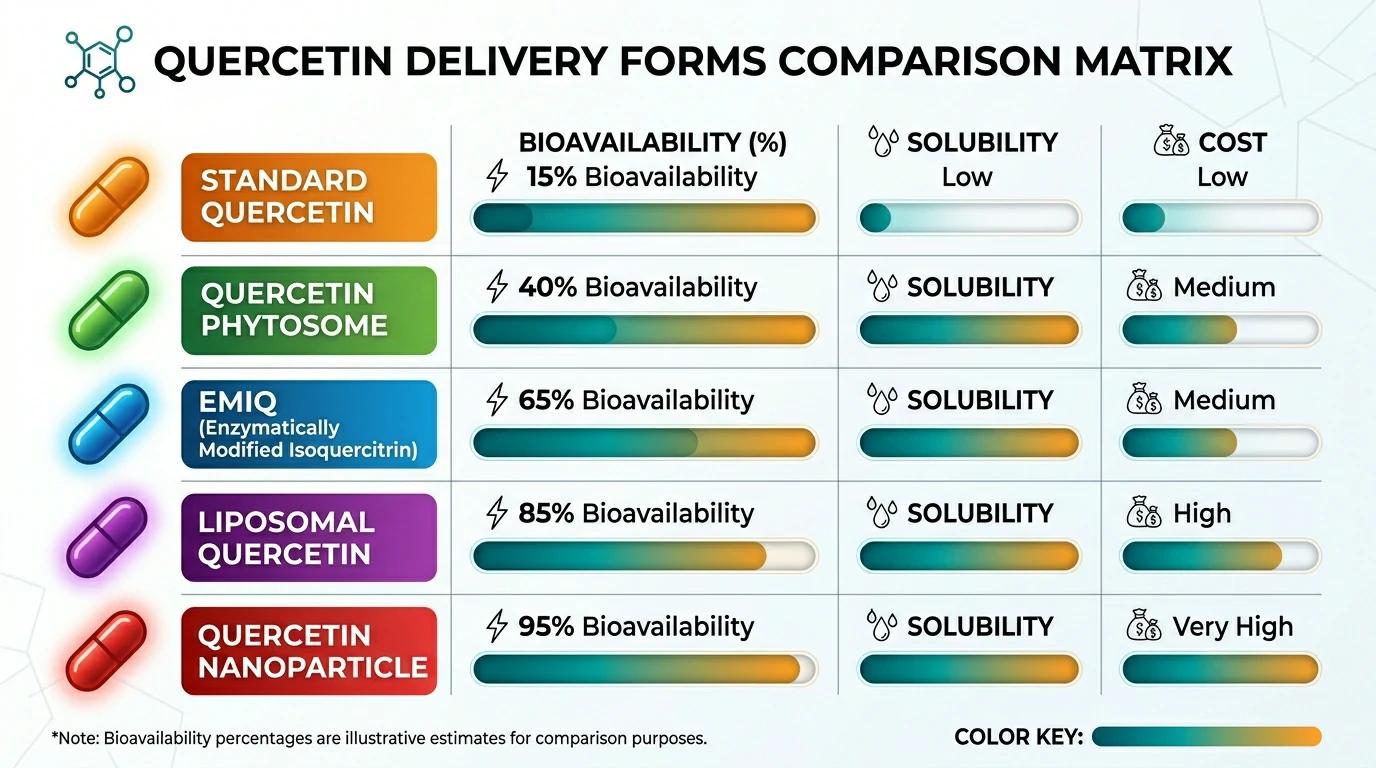
| Form | Relative Bioavailability | Water Soluble | Cost Level | Best Delivery Form |
|---|---|---|---|---|
| Dihydrate | 1× (baseline) | No | $ | Capsule + bromelain |
| + Bromelain | ~20× | No (bromelain water-soluble) | $$ | Capsule (2-piece) |
| Phytosome | ~20× | Oil-dispersible | $$$ | Softgel |
| EMIQ | High (SGLT1 route) | Yes (~100 mg/mL) | $$$ | Beverage, gummy, effervescent |
| Liposomal | Highest | Suspension | $$$$ | Liquid sachet, drinkable ampoule |
Clara's Note — From Our R&D Lab: In our formulation lab, I've worked with all four quercetin forms across dozens of client projects. Here's what the bioavailability numbers don't tell you: standard dihydrate + bromelain often delivers comparable clinical results to phytosome for immune applications — at roughly one-third the ingredient cost. The trade-off isn't just about bioavailability; it's about matching the form to your product's margin structure and consumer price point. For a premium clinical product, phytosome justifies its cost. For a mass-market immune capsule, standard quercetin + bromelain is the pragmatic choice I recommend to most brand founders.
For Formulators: Need side-by-side specs for all four quercetin forms? Whether you're evaluating standard dihydrate for a budget immune capsule or liposomal quercetin for a premium clinical product, we provide comparison documentation across all forms. Request the quercetin formulator comparison kit →
Step 2: Evidence-Based Dosing by Health Target
Quercetin dosing is not one-size-fits-all. The clinical evidence supports different doses for different health targets.
Dose Ranges and Supporting Evidence
| Health Target | Dose (mg/day) | Frequency | Supporting Evidence |
|---|---|---|---|
| Antioxidant maintenance | 250–500 | Once daily | General flavonoid research; no large RCT at this dose |
| General immune support | 500 | Once daily | Extrapolated from 1,000 mg data; standard OTC labeling |
| Enhanced immune / URTI prevention | 1,000 | Once daily or 500 BDS | Nieman RCT, n=1,002 (2010): 36% URTI reduction in ≥40 age group |
| Seasonal allergy | 500–1,000 | Divided BDS with meals | Clinical observations; mast cell stabilization dose response |
| Acute antiviral support | 500 TDS → tapered to BDS | 3× day week 1, 2× day week 2 | COVID-19 RCT, n=100 (2023): 68% clearance at week 1 |
| Athletic recovery | 1,000 | Once daily post-exercise | Nieman pilot, cyclists (2007): 1/20 vs 9/20 URTI |
Dosing Practicalities
- With meals: Quercetin on an empty stomach can cause mild gastric irritation. Bromelain on an empty stomach may cause more significant discomfort. Always instruct "take with food."
- Divided dosing: For 1,000 mg, splitting into 500 mg BDS (twice daily) improves gastric tolerance and maintains more consistent plasma levels.
- Loading phase: Some protocols use a higher loading dose (e.g., 500 mg TDS for 1–2 weeks) tapering to maintenance (500 mg BDS). This is supported by the 2023 COVID-19 RCT design.
Step 3: Validated Synergy Combinations
Quercetin's formulation advantage is its compatibility with synergistic ingredients. The following combinations are not marketing ideas — they are mechanistically validated and, in some cases, clinically tested.
Synergy Stack 1: Quercetin + Bromelain (Absorption) — see also: Why This Trio Is the Ultimate Immune Stack
| Ingredient | Dose per 500 mg Quercetin | Mechanism |
|---|---|---|
| Bromelain (2,400 GDU/g) | 100–200 mg | Proteolytic cleavage of tight-junction glycoproteins → transient paracellular permeability → quercetin absorption increased ~20× |
Product concept: "Quercetin with Bromelain" — immune + absorption. Most common quercetin product on e-commerce platforms. Simple, consumer-recognized, differentiates from basic quercetin.
Synergy Stack 2: Quercetin + Zinc (Ionophore Antiviral)
| Ingredient | Dose per Serving | Mechanism |
|---|---|---|
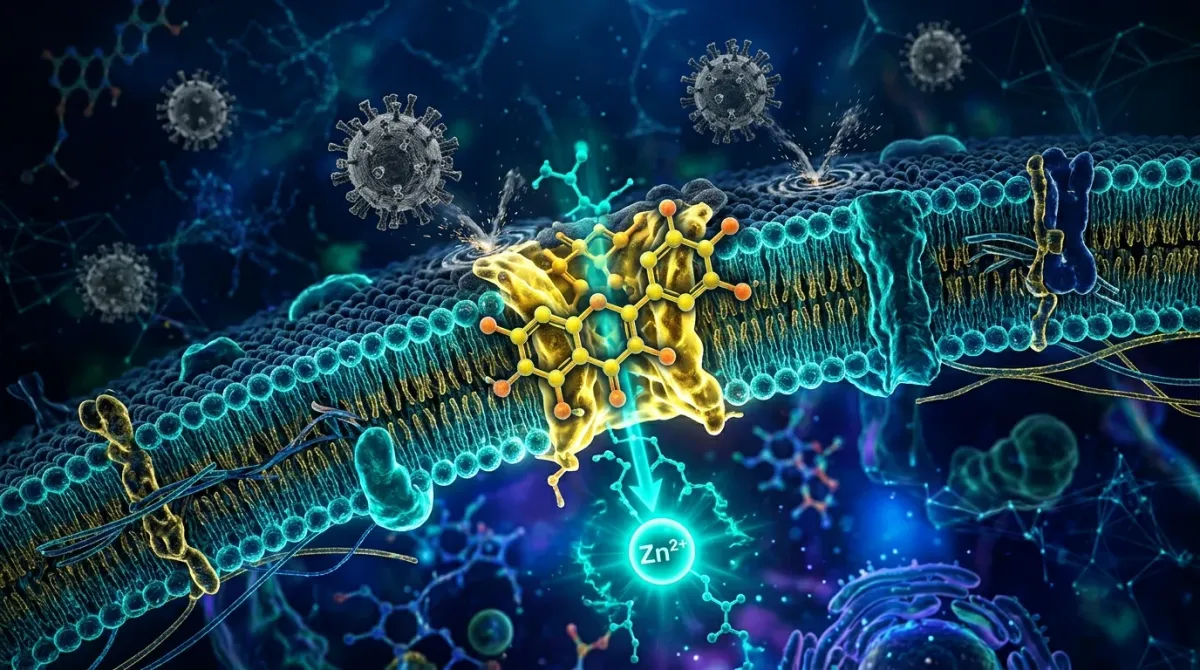
| Zinc (picolinate or citrate) | 15–30 mg | Quercetin transports zinc into cells → intracellular zinc inhibits viral RdRP |
Product concept: "Quercetin + Zinc Immune Defense" — antiviral positioning. Two-component system: quercetin as ionophore shuttle (read our deep-dive: Quercetin and Zinc: The Ionophore Mechanism), zinc as antiviral cargo. Scientifically differentiated.
Synergy Stack 3: Quercetin + Vitamin C (Sustained Antioxidant)
| Ingredient | Dose per Serving | Mechanism |
|---|---|---|
| Vitamin C (ascorbic acid) | 250–500 mg | Ascorbate reduces oxidized quercetin radicals back to active form → extends antioxidant lifespan via redox cycling |
Product concept: "Quercetin + Vitamin C Antioxidant Complex" — sustained antioxidant positioning. One ascorbate molecule recycles multiple quercetin molecules.
Synergy Stack 4: Full Immune Quad
| Ingredient | Dose per Serving | Mechanism |
|---|---|---|
| Quercetin (≥95% or phytosome) | 500 mg | Multi-target immune modulator + zinc ionophore |
| Bromelain | 100 mg | Absorption enhancer + independent anti-inflammatory |
| Vitamin C | 250–500 mg | Quercetin regeneration + neutrophil support |
| Zinc (picolinate) | 15 mg | Antiviral cargo + T cell/NK cell cofactor |
| Vitamin D3 (optional) | 1,000–2,000 IU | Macrophage modulation + cathelicidin induction |
Product concept: "Complete Immune Defense Complex" — premium, multi-mechanism positioning. Clinically rational (each ingredient has independent evidence + synergy data). Margin protection through complexity.
Synergy Stack 5: Longevity / Senolytic
| Ingredient | Dose per Serving | Mechanism |
|---|---|---|
| Quercetin (≥95%) | 500 mg | Senolytic: clears senescent cells |
| Fisetin | 100 mg | Additional senolytic flavonoid |
| Resveratrol | 250 mg | SIRT1 activation + complementary senolytic |
| NAD+ precursor (NMN or NR) | 250–300 mg | Mitochondrial support + quercetin SIRT1 synergy |
Product concept: "Cellular Longevity Formula" — biohacker / longevity niche. Quercetin as a senolytic is a rising low-competition keyword.
Clara's Note — Formulation Trade-Offs: When I formulate multi-ingredient immune stacks for clients, the most common mistake I see is over-stacking. More ingredients → more capsules → lower compliance. My rule of thumb: a quercetin immune product should deliver its core promise in 2 capsules per serving. The Full Immune Quad (Quercetin + Bromelain + Vitamin C + Zinc) fits this constraint at 500 mg quercetin per serving. Adding D3 pushes it to 3 capsules. Every additional ingredient must earn its capsule real estate — if it doesn't have independent clinical evidence at the dose you can fit, leave it out.
For Formulators: Building a quercetin synergy stack? The five validated stacks in this chapter each require specific complementary ingredients — and sourcing them from a single qualified supplier simplifies your supply chain, COA management, and batch consistency. Get bulk pricing on quercetin + stack ingredients →
Step 4: Delivery Form Selection
Capsules (Most Common)
| Parameter | Recommendation |
|---|---|
| Capsule type | HPMC (vegetarian) for market flexibility; gelatin acceptable |
| Capsule size | Size 00 (holds ~600–700 mg powder) or size 0 (~400–500 mg) |
| Servings per day | 2 capsules = 1 serving for 1,000 mg dose (500 mg/capsule) |
| Excipients | Minimal — 1–2% magnesium stearate or silica as flow aid |
| Pros | Fastest to market; no taste issue; simple manufacturing |
| Cons | Larger capsule for multi-ingredient stacks; some consumers avoid capsules |
Note for multi-ingredient stacks: A quercetin (500 mg) + bromelain (100 mg) + vitamin C (250 mg) + zinc (15 mg) stack requires 2–3 capsules per serving. If this exceeds your target capsule count, consider reducing quercetin to 400 mg or using a phytosome form that achieves comparable efficacy at a lower fill weight.
Tablets
| Parameter | Recommendation |
|---|---|
| Granulation | Wet granulation recommended — quercetin has poor flow and compressibility |
| Binder | PVP (polyvinylpyrrolidone) or HPMC at 3–5% |
| Disintegrant | Croscarmellose sodium or sodium starch glycolate at 2–4% |
| Coating | Film coating recommended for taste masking (quercetin is bitter) |
| Pros | Consumer familiarity; smaller per-unit size vs. capsules for same dose |
| Cons | Higher manufacturing complexity; requires experienced tablet formulator |
Softgels (for Phytosome)
| Parameter | Recommendation |
|---|---|
| Fill material | Quercetin phytosome dispersed in MCT oil or sunflower oil |
| Shell | Gelatin (standard) or modified starch (vegetarian) |
| Fill weight | ~800–1,200 mg fill per softgel to deliver 500 mg quercetin equivalent |
| Pros | Premium appearance; good for oil-dispersible forms; oxygen barrier |
| Cons | Higher COG; requires softgel CMO; vegetarian shell adds cost |
Functional Beverages
| Parameter | Recommendation |
|---|---|
| Quercetin form | EMIQ (water-soluble) — standard quercetin will precipitate |
| Dose per serving | 100–250 mg (beverage doses are lower than capsules) |
| pH | 3.0–4.5 (acidic) for EMIQ stability |
| Flavor | Citrus, berry, or ginger mask quercetin bitterness |
| Preservation | Hot-fill or aseptic processing; pasteurization required |
| Pros | Trend-forward format; on-the-go consumption; premium positioning |
| Cons | Lowest dose per serving; shorter shelf life; high formulation complexity |
Gummies
| Parameter | Recommendation |
|---|---|
| Quercetin form | EMIQ (required — standard quercetin insolubility + bitterness) |
| Dose per gummy | 50–100 mg quercetin equivalent |
| Servings | 2–4 gummies per serving to reach meaningful dose |
| Flavor masking | Essential — quercetin bitterness requires sweetener + flavor + acid combination |
| Pros | Highest consumer compliance; family-friendly format |
| Cons | Low dose per gummy limits efficacy positioning; sugar content scrutinized |
Clara's Note — On Gummy Formulation: I'll be direct — quercetin gummies are the most requested format by brand founders, and the most challenging to formulate well. The bitterness problem is real. EMIQ makes it possible, but even EMIQ at 100 mg per gummy needs aggressive flavor masking: a combination of citrus oil, monk fruit extract, and citric acid is the best starting point I've found. If your brand concept requires gummies, start with a 2-gummy, 200 mg EMIQ serving. Don't promise 500 mg in gummy form — you'll compromise taste and stability.
Step 5: Quality Specifications and Supplier Vetting
Minimum Acceptable Specifications
| Test | Method | Acceptance Criteria |
|---|---|---|
| Assay (quercetin) | HPLC | ≥95.0% on dried basis |
| Identification | HPLC retention time match vs. reference standard | Conforms |
| Loss on drying | USP <731> | ≤5.0% |
| Heavy metals — lead | ICP-MS / USP <2232> | ≤1.0 ppm |
| Heavy metals — arsenic | ICP-MS / USP <2232> | ≤1.0 ppm |
| Heavy metals — cadmium | ICP-MS / USP <2232> | ≤0.5 ppm |
| Heavy metals — mercury | ICP-MS / USP <2232> | ≤0.1 ppm |
| Total aerobic microbial count | USP <2021> | ≤1,000 CFU/g |
| Total yeast and mold | USP <2021> | ≤100 CFU/g |
| E. coli | USP <2022> | Absent in 10 g |
| Salmonella | USP <2022> | Absent in 25 g |
| Residual solvents | USP <467> | Class 2/3 within limits |
Beyond Minimum: Supplier Differentiation Factors
| Factor | Why It Matters |
|---|---|
| Botanical source traceability | Supplier should document Sophora japonica origin (region, harvest year, extraction method). Traceability supports your GMP documentation and provides supply chain transparency for audit. |
| Third-party COA per batch | Supplier's in-house COA is not sufficient. Request an independent third-party lab COA — especially for heavy metals and assay — or send retain samples to your own lab. |
| Pesticide residue screen | Sophora japonica is an agricultural crop. A 70+ pesticide panel (USP <561> or EU 396/2005) confirms your ingredient is not contaminated. Many suppliers skip this test. |
| Aflatoxin testing | Botanical powders stored in humid conditions can develop aflatoxin contamination. Total aflatoxins should be ≤4 ppb (EU 1881/2006). |
| Particle size distribution | 80-mesh powder is standard. Non-standard particle sizes affect blend uniformity in multi-ingredient capsule formulations. |
| ISO 9001 / HACCP / GMP certification | Manufacturing facility certifications provide a baseline quality system. ISO 22000 (food safety) is more relevant than ISO 9001 (general quality). |
Stability Considerations
| Factor | Recommendation |
|---|---|
| Light sensitivity | Quercetin is light-sensitive. Store in amber or opaque packaging; avoid clear capsules or bottles. |
| Oxidation | Quercetin oxidizes in the presence of oxygen and moisture. Desiccant + oxygen absorber in packaging recommended. |
| Shelf life | 24 months from date of manufacture under recommended storage (cool, dry, protected from light). Accelerated stability testing (40°C/75% RH) for 6 months should confirm. |
| Incompatibilities | Avoid co-formulation with strong oxidizing agents or alkaline excipients (quercetin is stable in acidic conditions). |
Step 6: Regulatory and Labeling Considerations
Market-Specific Status
| Market | Quercetin Status | Claims Framework |
|---|---|---|
| USA | Dietary ingredient under DSHEA. Pre-DSHEA use not required (NDI notification may apply for new forms). | Structure-function claims with FDA disclaimer. Disease claims prohibited. |
| EU | Food supplement ingredient under Directive 2002/46/EC. Not on approved health claims list (Reg. 1924/2006). | General wellness statements only. "Supports immune system" is borderline. Consult EU regulatory counsel. |
| Canada | Natural Health Product (NHP). Requires product license (NPN) from Health Canada. | Approved claims listed in NNHPD monograph. |
| China | Health food ingredient. Requires "blue hat" (保健食品) registration. | Strict claim limitations. "Enhances immunity" is the most common approved claim. |
| Japan | Food with Function Claims (FFC) or Foods for Specified Health Uses (FOSHU) pathway. | Must submit clinical evidence for specific claims. |
Labeling Best Practices
- Supplement Facts panel: List quercetin as "Quercetin (from Sophora japonica flower bud extract)" — botanical source builds consumer confidence.
- Standardization statement: "Standardized to contain ≥95% quercetin" — communicates quality.
- Allergen statement: Quercetin from Sophora japonica is not a major allergen. Check excipients and co-ingredients.
- Non-GMO / Gluten-free / Vegan: Quercetin is naturally non-GMO, gluten-free, and vegan. These claims cost little to add and expand consumer reach.
The Formulation Workbook: One-Page Reference
Scenario A: Budget Immune Support
| Parameter | Decision |
|---|---|
| Form | Standard quercetin dihydrate ≥95% |
| Dose | 500 mg/serving, 2 capsules = 1 serving |
| Absorption | + Bromelain 100 mg (2,400 GDU/g) |
| Synergy | + Vitamin C 250 mg |
| Delivery | 2-piece HPMC capsule, size 00 |
| Positioning | "Quercetin + Bromelain Immune Support" |
Scenario B: Premium Clinical Immune
| Parameter | Decision |
|---|---|
| Form | Quercetin phytosome |
| Dose | 500 mg/serving (phytosome equivalent), 1–2 servings/day |
| Synergy | + Zinc picolinate 15 mg + Vitamin D3 1,000 IU |
| Delivery | Softgel |
| Positioning | "Clinical-Grade Quercetin Phytosome Immune Defense" |
Scenario C: On-the-Go Immune Shot
| Parameter | Decision |
|---|---|
| Form | EMIQ (water-soluble) |
| Dose | 200 mg/serving in 60 mL liquid |
| Synergy | + Vitamin C 500 mg + Zinc citrate 10 mg |
| Delivery | PET bottle, hot-fill, citrus-berry flavor |
| Positioning | "Daily Immune Defense Shot" |
Why GINKVORA Quercetin for Your Next Supplement Formulation
Every decision in this guide — from quercetin form selection to synergy stacking to quality specifications — depends on one foundational variable: the quality of the ingredient you start with. A brilliantly designed formula cannot compensate for an inconsistently assayed active ingredient.
- ≥95% quercetin by HPLC, batch-to-batch verified
- Sourced from Sophora japonica flower buds with full botanical traceability
- Heavy metals compliant: USP <2232>, EU 1881/2006, and Chinese Pharmacopoeia limits
- Microbiology compliant: USP <2021> / <2022>
- 80-mesh standardized particle size for blend uniformity in capsule and tablet formulations
- Full documentation per shipment: COA, MSDS, Certificate of Origin, and additional testing (pesticides, aflatoxins) available on request
- ISO-compliant manufacturing with HACCP food safety system
Whether you are formulating a standard quercetin + bromelain capsule, a quercetin phytosome softgel, a zinc-ionophore antiviral defense product, or a functional beverage with EMIQ — the ingredient quality is where your formula's clinical promise either materializes or collapses.
Request a quote, specification sheet, or sample for your formulation team →
Related Articles
- How Quercetin Stabilizes Mast Cells to Reduce Seasonal Allergy Reactions — Formulating for allergy relief
- Quercetin and Zinc: The Ionophore Mechanism That Enhances Antiviral Defense — Building a quercetin + zinc antiviral stack
- Quercetin for Immune Defense: The Flavonoid That Activates Your Body's First-Line Protection — Immune mechanism deep-dive
- Quercetin as a Senolytic: How It Clears Zombie Cells to Slow Biological Aging — The longevity/senolytic application
- Quercetin + Bromelain + Vitamin C: Why This Trio Is the Ultimate Immune Stack — A proven 3-ingredient formulation stack
- Liposomal Delivery: Why It's Becoming the New Standard — Liposomal quercetin as a premium delivery form
Sources: Nieman DC et al., Pharmacol Res (2010) — Quercetin URTI RCT n=1,002; Rondanelli M et al., Front. Pharmacol. (2023) — Quercetin COVID-19 RCT n=100; Dabbagh-Bazarbachi H et al., J. Agric. Food Chem. (2014) — Zinc Ionophore Activity; Pavan R et al., Molecules (2021) — Bromelain-Enhanced Flavonoid Bioavailability; Chen L et al., Molecules (2021) — Flavonoid Bioavailability Strategies; USP <2232> — Dietary Supplements Heavy Metals; USP <2021>/<2022> — Microbial Enumeration; USP <467> — Residual Solvents; DSHEA (1994) — Dietary Supplement Health and Education Act; Directive 2002/46/EC — Food Supplements; Regulation 1924/2006 — Nutrition and Health Claims (EU).
Reviewed for scientific accuracy. This content is intended for B2B industry professionals — formulators, R&D teams, and supplement brand developers. It does not constitute regulatory or legal advice. Always consult qualified regulatory counsel for your specific product and target market.