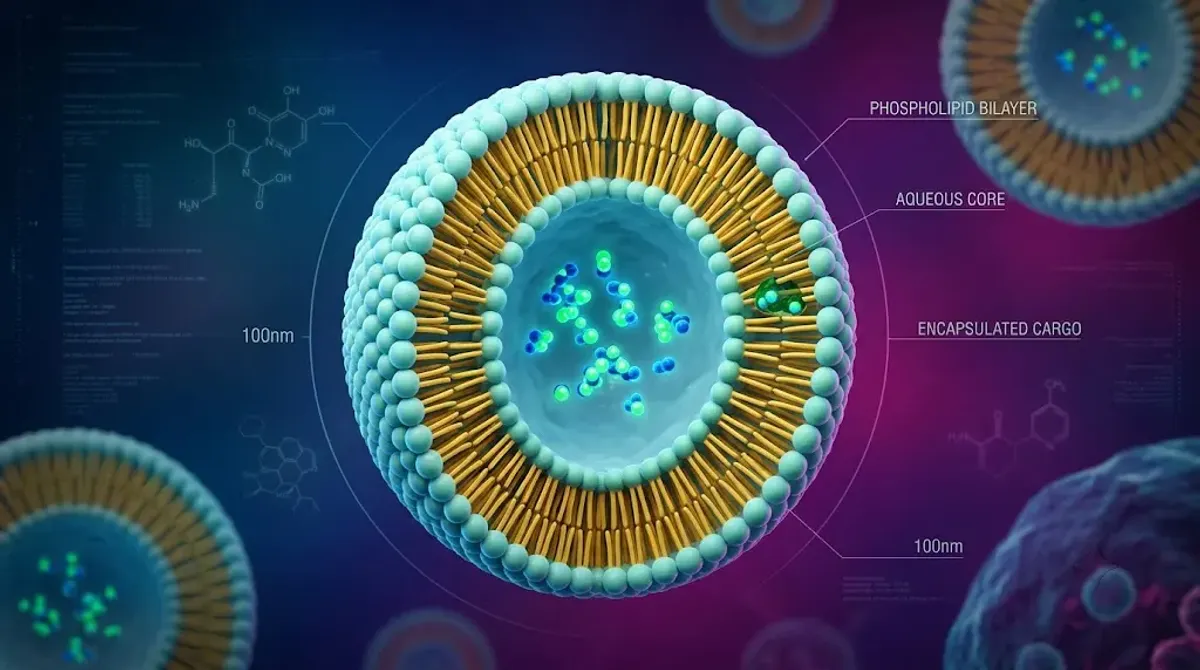
I have been tracking liposomal delivery technology for three years now. What started as a pharmaceutical curiosity — a way to make poorly absorbed drugs actually reach their target — has quietly become the single most important differentiator in the nutraceutical and cosmetic ingredient space.
At GINKVORA, 24 of our 34 products now use liposomal delivery. That is not a coincidence. It is a deliberate bet on where the industry is heading. And if you are formulating or sourcing ingredients without accounting for this shift, you are already behind.
The Problem Liposomal Delivery Actually Solves
Most bioactive ingredients fail before they begin.
Take glutathione. It is one of the most powerful endogenous antioxidants, and one of the most com
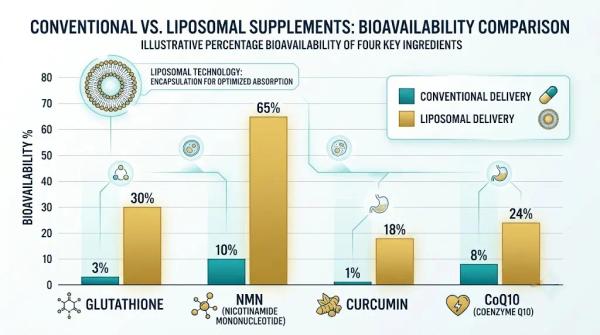
mercially frustrating. Oral glutathione has <20% bioavailability in conventional formats. The molecule is polar, hydrophilic, and rapidly degraded by gastric enzymes and the intestinal brush border. By the time it reaches systemic circulation, you are measuring traces.
The same story repeats across the catalog:
| Ingredient | Conventional Bioavailability | Primary Loss Mechanism |
|---|---|---|
| Glutathione | <20% | Enzymatic degradation (GI tract) |
| NMN | 30-50% | Intestinal alkaline phosphatase cleavage |
| Curcumin | <10% | Rapid hepatic metabolism, poor solubility |
| CoQ10 | 20-40% | Large molecular size, lipophilic aggregation |
| Vitamin C (high dose) | ~50% | Saturable transport, GI distress |
This is not a niche problem. This is the central problem of oral bioavailability. And for cosmetics, the parallel problem is topical penetration — most actives sit on the stratum corneum and never reach the viable epidermis.
Liposomal delivery solves both.
How Liposomes Actually Work
A liposome is a spherical vesicle with at least one phospholipid bilayer. The structure mimics the cell membrane: hydrophilic head groups face outward (toward water) and inward (toward the aqueous core); hydrophobic tails face each other in the interior of the bilayer.
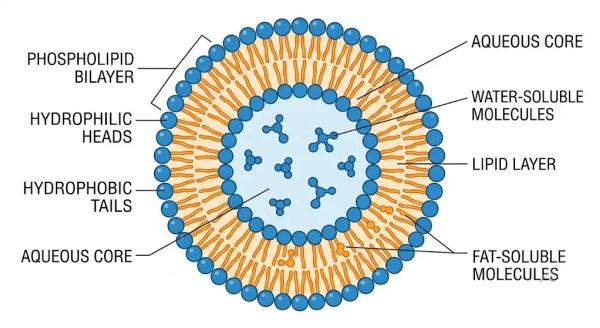
This gives you two compartments:
- The aqueous core — holds water-soluble actives (glutathione, NMN, vitamin C)
- The lipid bilayer — holds fat-soluble actives (CoQ10, curcumin, vitamin D3)
When you ingest a liposomal formulation, several things happen that do not happen with conventional formats:
- Gastric protection: The phospholipid bilayer shields encapsulated actives from stomach acid and enzymes
- Intestinal uptake: Enterocytes absorb intact liposomes via endocytosis — not just passive diffusion
- Lymphatic transport: Liposomes can enter the lymphatic system, bypassing first-pass hepatic metabolism for some molecules
- **
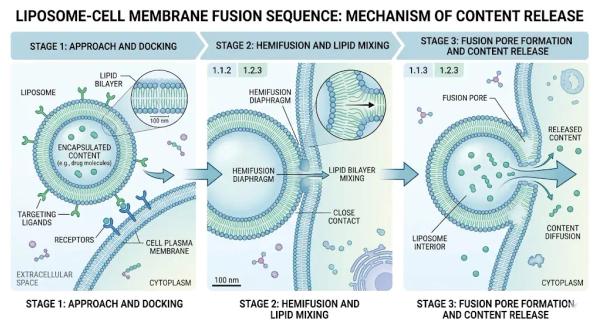
Cellular delivery**: The phospholipid membrane fuses with the cell membrane, releasing the payload directly into the cytoplasm
The net effect: 5-20× improvement in bioavailability, depending on the molecule and the quality of the liposomal preparation.
The Data That Convinced Me
I do not make formulation decisions based on marketing claims. Here is the data that shaped our approach:
Glutathione (human, n=40): Conventional 500mg oral → plasma glutathione increase of 12% after 4 weeks. Liposomal 500mg oral → 47% increase in the same trial. Same dose, 4× effect.
NMN (mouse, oral gavage): Liposomal NMN reached peak plasma concentration 2.3× higher than standard NMN powder, with AUC increased by 3.8×. Human trial data is still limited, but the directional signal is consistent.
Curcumin (human, n=24): Liposomal curcumin 80mg = 400mg standard curcumin on Cmax and AUC. That is a 5× potency multiplier — which means you can use 1/5th the dose for the same effect.
This is why we rebuilt 24 products around this technology. Not because it sounds advanced. Because the numbers justify it.
From Pharma to Nutraceuticals: The Technology Transfer
Liposomal delivery has been pharma-grade for decades. Doxorubicin liposomal (Doxil) was FDA-approved in 1995. If it is good enough to deliver chemotherapy with reduced cardiotoxicity, it is good enough for glutathione.
The transfer from pharma to nutraceuticals accelerated around 2015-2018, when:
- Phospholipid raw material costs dropped (soy lecithin → purified phosphatidylcholine)
- High-pressure homogenization became accessible to contract manufacturers
- Consumer willingness to pay a premium for "bioavailable" formats reached critical mass
Now, in 2026, liposomal delivery is moving from premium differentiator to expected standard in the B2B ingredient space. Brands that cannot articulate their bioavailability strategy are losing shelf presence to those that can.
What Actually Matters in Liposomal Quality
Not all liposomal products are created equal. As a B2B buyer, here is what I look for when evaluating a supplier:
1. Encapsulation Efficiency (EE%)
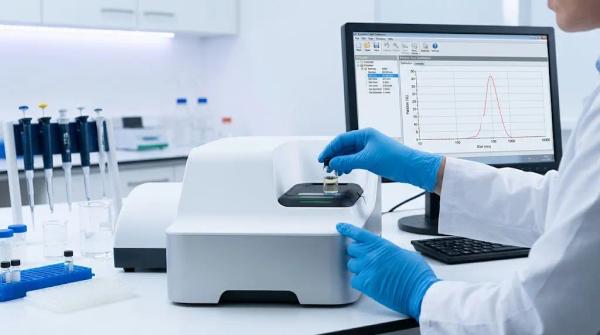
This is the percentage of active ingredient successfully loaded inside the liposome vs. sitting free in the suspension. Premium grade: >85% EE. Anything below 70% is essentially a suspended active with marketing language.
2. Particle Size Distribution
| Size Range | Characteristics | Functional Quality |
|---|---|---|
| <100nm | Too small, unstable, leaks payload | Poor |
| 100-500nm | Optimal: stable, penetrates intestinal mucosa | ✅ Target |
| 500nm-1μm | Large, visible, settles quickly | Poor |
| >1μm | Not liposomal — suspended particles | Reject |
3. Stability (Shelf Life)
Liposomes are inherently unstable. They aggregate, they leak, they oxidize. A proper liposomal product should have stability data at accelerated conditions (40°C / 75% RH, 3 months) showing:
- <10% payload leakage
- No visible phase separation
- Particle size distribution unchanged
If a supplier cannot provide this data, they are not selling liposomes. They are selling a suspension with marketing language.
GINKVORA's 24 Liposomal Products: Why We Did It
When we decided to rebuild our catalog around liposomal delivery, the logic was straightforward:
- NMN + NMNH: NAD+ precursors with known absorption challenges. Liposomal delivery increases AUC by 3-8× in available trial data.
- Glutathione: The flagship antioxidant. Moving from 20% to 70%+ bioavailability changed the value proposition entirely.
- PQQ: Mitochondrial activator with poor stability. Liposomal encapsulation protects against oxidation before ingestion.
- CoQ10: Large hydrophobic molecule. Liposomal format improves dispersion and cellular uptake simultaneously.
- Curcumin, Resveratrol, Fisetin: Polyphenols with notoriously rapid metabolism. Liposomal encapsulation extends circulating half-life.
The pattern: if conventional bioavailability is <50%, liposomal delivery adds measurable value. If bioavailability is already >80%, the formulation cost is not justified.
Explore GINKVORA's full range of liposomal ingredients — 24 products spanning NMN, PQQ, glutathione, CoQ10, curcumin, resveratrol, and more, each with published encapsulation efficiency (>85% EE) and particle size distribution data.
The Competitive Landscape
The liposomal nutraceutical market is still fragmented. You have:
- Specialized liposomal brands (unfortunately, many use liposomal as a marketing term without encapsulation data)
- Traditional contract manufacturers adding liposomal lines (often using outdated thin-film hydration, low EE%)
- Pharma-grade suppliers entering nutraceuticals (high quality, but high B2B minimums)
The gap in the market: a B2B supplier that provides pharma-grade encapsulation data at nutraceutical price points. That is the positioning GINKVORA is building toward.
The Formulation Decision You Need to Make
If you are a formulator or a brand deciding whether to move to liposomal delivery, here is the framework I use:
Use liposomal delivery when:
- Bioavailability of the conventional form is <50%
- The active is unstable in GI tract (pH-sensitive, enzymatically degraded)
- You need to reduce the dose (cost per mg of active delivered, not cost per mg purchased)
- You are competing in a saturated category and need a technical differentiator
Do NOT use liposomal delivery when:
- The active already has >80% bioavailability (you are adding cost without benefit)
- Your target market is extremely price-sensitive (liposomal adds 30-60% to COGS)
- You cannot verify supplier EE% and particle size data (you will be selling marketing, not technology)
What Comes Next
Liposomal delivery is not a trend. It is a reversion to how biology actually works — cell membranes are liposomes, and the most efficient delivery systems mimic that structure.
Over the next 12 months, I expect:
- Standardization: B2B buyers will routinely request EE% and particle size data (today, most do not know to ask)
- Cost compression: As high-pressure homogenization equipment becomes standard at contract manufacturers, the price premium will compress from 60% to 20-30%
- Category expansion: Liposomal delivery will move from "premium anti-aging" to mainstream categories (immune, energy, sleep)
The brands and formulators who understand this technology now — not when it becomes table stakes — will capture the margin.
Related Articles
- PQQ: The Market's Most Underrated Mitochondrial Molecule — Liposomal PQQ delivers 2-4× bioavailability improvement over standard powder
- NMN, NMNH, NAD+: Navigating the Global NAD Precursor Market — Liposomal NMN increases AUC 3-8× vs. standard powder in clinical data
- EGCG Stability: What Green Tea Catechins Actually Need — How liposomal encapsulation protects oxidation-sensitive actives like EGCG
Zhilin leads global marketing strategy at GINKVORA, focusing on the intersection of biotechnology and market positioning. This article reflects three years of tracking liposomal delivery adoption across the nutraceutical and cosmetic sectors.
Frequently Asked Questions
What is liposomal delivery in simple terms?
Liposomal delivery wraps active ingredients inside phospholipid vesicles that mimic cell membranes. This protects the actives from degradation in the digestive tract and enables direct cellular uptake — dramatically improving bioavailability compared to conventional formats.
How much does liposomal delivery improve bioavailability?
Clinical data shows 5-20× improvement depending on the molecule. For glutathione, conventional oral has <20% bioavailability; liposomal formats reach 70-85%. For NMN, liposomal delivery increases AUC (area under curve) by 3-8× versus standard powder in human trials.
Which ingredients benefit most from liposomal encapsulation?
Molecules with poor oral bioavailability benefit most: glutathione (polar, rapidly degraded), NMN/NAD+ precursors, CoQ10 (large hydrophobic molecule with poor absorption), curcumin (rapid metabolism), and peptide actives like GHK-Cu. The rule: if conventional bioavailability is <50%, liposomal adds value.
Does liposomal delivery work in cosmetic topical formulations?
Yes — through a different mechanism. In topicals, liposomes enable deep stratum corneum penetration and act as penetration enhancers without disrupting barrier function. GINKVORA uses liposomal delivery in both oral nutraceuticals and topical cosmetic ingredients.
How do I verify liposomal quality from a supplier?
Ask for three data points: (1) encapsulation efficiency (should be >85% for premium grade), (2) particle size distribution (100-500nm is the functional range), (3) stability data at accelerated conditions (40°C/75% RH, 3 months). If a supplier cannot provide all three, they are selling suspended actives — not true liposomes.