TL;DR
- Quercetin is a powerful immune-modulating and antiviral flavonoid, but its poor oral bioavailability (1–5%) limits real-world efficacy
- Bromelain, a proteolytic enzyme from pineapple stem, enhances quercetin absorption by approximately 20× by transiently opening intestinal tight junctions
- Vitamin C regenerates oxidized quercetin radicals back to active form — one ascorbate molecule can recycle multiple quercetin molecules, dramatically extending antioxidant duration
- This three-way synergy is mechanistic, not speculative: bromelain solves absorption, vitamin C solves inactivation, quercetin provides the immune target engagement
- The combination appears in top-selling immune formulas and represents a rational formulation strategy supported by pharmacokinetic and biochemical evidence
- For supplement brands, the trio offers a differentiated, science-backed positioning against single-ingredient immune products
Why Single-Ingredient Immune Supplements Fall Short
The immune supplement market is crowded with single-compound products — vitamin C capsules, zinc lozenges, elderberry syrups. Each addresses one dimension of immune function. But immune defense is a multi-step system: barrier protection, pathogen recognition, innate response, adaptive response, and inflammatory resolution. A single molecule cannot cover all steps.
Quercetin comes closer than most — with documented effects on NK cells, macrophages, viral replication, and inflammatory cytokine regulation. But it has one critical weakness: poor bioavailability.
Without solving absorption, quercetin's extensive mechanistic potential remains unrealized in the human body. This is where the trio approach becomes not a marketing gimmick but a biochemical necessity.
The Bioavailability Problem: Why Quercetin Alone Is Insufficient
The Numbers
Quercetin aglycone — the most common form in supplements — has an estimated oral bioavailability of 1–5% in humans. This means that taking a 500 mg capsule delivers roughly 5–25 mg of active quercetin into circulation. The rest is metabolized by intestinal flora, excreted unchanged, or trapped in the gut lumen.
Why Bioavailability Is So Low
Quercetin faces three barriers:
| Barrier | Mechanism | Consequence |
|---|---|---|
| Poor aqueous solubility | Quercetin is lipophilic; dissolves poorly in gastrointestinal fluid | Limited dissolution → limited absorption surface area |
| Intestinal efflux transporters | P-glycoprotein (P-gp) and MRP2 actively pump quercetin back into the gut lumen | Net absorption is the balance of passive influx minus active efflux |
| Extensive first-pass metabolism | Phase II enzymes (UGT, SULT) in enterocytes and liver rapidly conjugate quercetin to glucuronide/sulfate metabolites | Circulating quercetin is almost entirely conjugated, with uncertain bioactivity of metabolites |
In my formulation work, I have seen quercetin aglycone deliver inconsistent results in capsule prototypes unless paired with an absorption enhancer or a delivery technology. That is why I always test bromelain co-administration before moving to more expensive phytosome or liposomal versions.
The Absorption-Enhancement Imperative
For quercetin to deliver its documented immune benefits in humans, it needs help crossing the gut barrier. Two strategies exist: formulation technology (phytosome, liposomal, EMIQ) and co-administration with absorption enhancers. Bromelain is the most studied absorption enhancer for flavonoids.
Bromelain: The Absorption Key
What Bromelain Is
Bromelain is a mixture of proteolytic (protein-digesting) enzymes extracted from the stem and fruit of pineapple (Ananas comosus). The stem bromelain used in supplements contains at least four distinct cysteine proteases: stem bromelain, fruit bromelain, ananain, and comosain.
Standardized bromelain is measured in gelatin digesting units (GDU) or milk clotting units (MCU). Supplement-grade bromelain typically contains 2,400–4,800 GDU per gram.
How Bromelain Enhances Quercetin Absorption
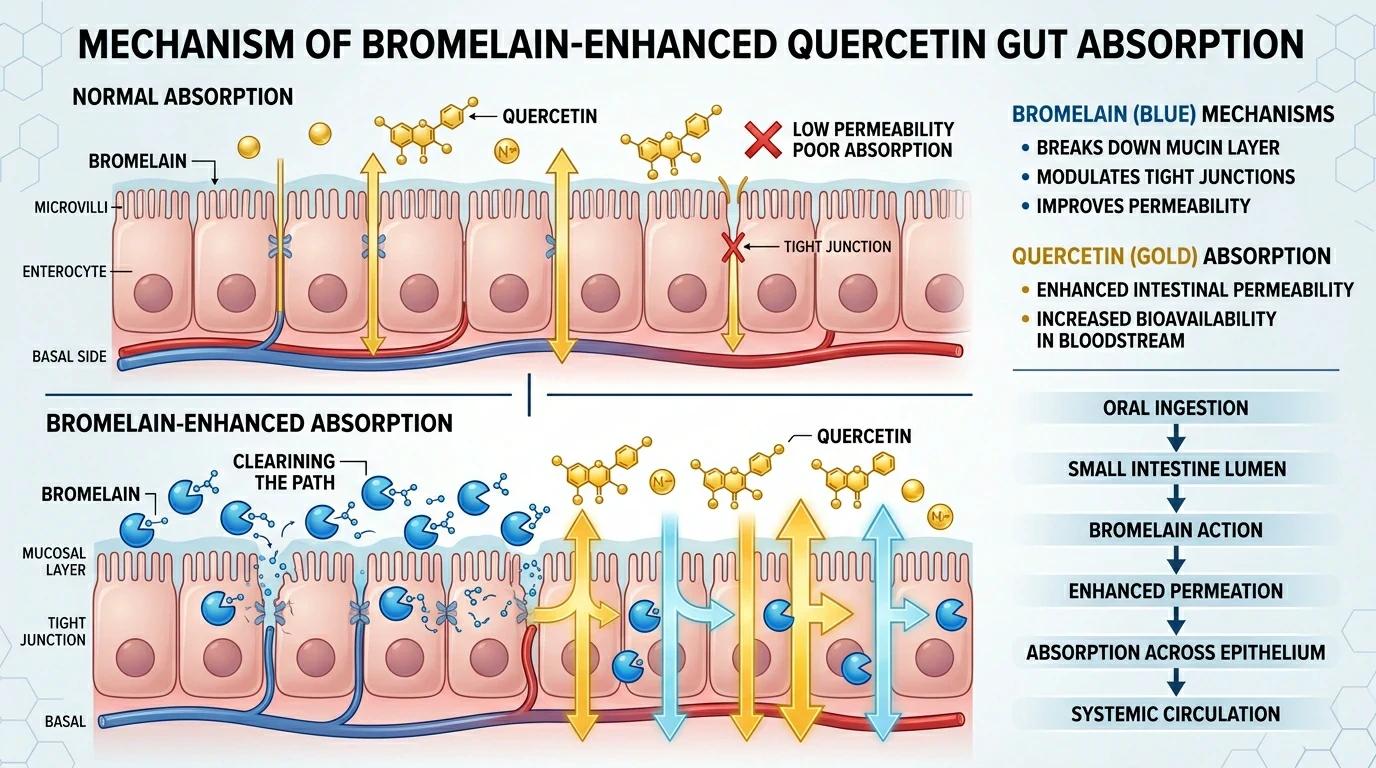
Bromelain's absorption-enhancing effect on quercetin operates through a specific mechanism:
- Intestinal epithelial tight junctions are sealed by glycoprotein complexes (claudins, occludins, ZO-1 proteins) that regulate paracellular permeability
- Bromelain's cysteine proteases cleave the extracellular domains of these glycoproteins
- Transient loosening of tight junctions creates a paracellular window — a temporary gap between cells
- Quercetin aglycone diffuses through this gap, bypassing the transcellular route that subjects it to efflux transporters and Phase II metabolism
This is a reversible, temporary effect. The epithelium repairs tight junctions within hours, and no permanent barrier damage occurs at standard bromelain doses.
The Absorption Evidence
In animal pharmacokinetic studies, co-administration of bromelain with quercetin increased plasma quercetin concentrations by approximately 20-fold compared to quercetin alone. While human pharmacokinetic data is more limited, the mechanism is species-independent — human intestinal tight junctions respond to bromelain proteolysis in the same way.
A 2021 review in Molecules (by Chen et al.) on flavonoid bioavailability confirmed that co-administration with digestive enzymes — especially bromelain — is one of the most practical strategies for enhancing quercetin absorption in commercial supplement formulations, alongside phytosome technology.
Bromelain's Own Health Benefits
Bromelain is not merely a passive absorption aid. It has independent therapeutic effects:
| Bromelain Effect | Mechanism | Supporting Evidence |
|---|---|---|
| Anti-inflammatory | Reduces bradykinin and prostaglandin E2; increases fibrinolytic activity | Multiple clinical trials in post-surgical inflammation |
| Mucolytic | Depolymerizes mucin glycoproteins in respiratory secretions | Used in sinusitis and bronchitis protocols |
| Anti-edema | Reduces vascular permeability and inflammatory exudate | Documented in sports injury and surgical recovery |
| Immune modulation | Modulates T cell surface markers (CD4, CD8) | In vitro and animal studies |
This means bromelain adds its own anti-inflammatory and immune-modulating effects to the stack — it is not merely a delivery vehicle.
Vitamin C: The Regenerator
The Redox Cycling Mechanism
When quercetin neutralizes a free radical (e.g., superoxide, hydroxyl radical), it donates an electron and becomes a quercetin radical — oxidized, and functionally spent. Without intervention, that quercetin molecule is done.
Vitamin C (ascorbic acid) intervenes:
Quercetin (active) + Free Radical → Quercetin Radical (inactive)
Quercetin Radical + Ascorbate → Quercetin (re-activated) + Dehydroascorbate
Dehydroascorbate + GSH → Ascorbate (regenerated)
This is redox cycling — the same mechanism by which vitamin C regenerates vitamin E. One ascorbate molecule can recycle multiple quercetin molecules, provided glutathione (GSH) is available to regenerate the ascorbate.
A 2020 study in Antioxidants (PMC7318306) confirmed this mechanism using electron paramagnetic resonance (EPR) spectroscopy, demonstrating that ascorbate directly reduces quercetin phenoxyl radicals with a rate constant consistent with efficient biological recycling.
Why This Matters
Without vitamin C, a single quercetin molecule neutralizes one or two free radicals and becomes permanently inactive. With vitamin C, the same quercetin molecule can be recycled dozens of times — extending its functional antioxidant lifespan by an order of magnitude.
This means the effective dose of quercetin — in antioxidant terms — is not the milligram amount consumed, but the number of redox cycles it completes. Vitamin C multiplies that number.
Vitamin C's Independent Immune Benefits
Vitamin C is no mere sidekick:
- Neutrophil chemotaxis and phagocytosis are vitamin C-dependent — neutrophils accumulate ascorbate to millimolar concentrations
- Lymphocyte proliferation is enhanced by vitamin C at physiological concentrations
- Collagen synthesis for tissue barrier integrity requires vitamin C as a cofactor for prolyl hydroxylase
- Epigenetic regulation of immune genes via TET enzyme demethylation requires vitamin C as a cofactor
The 2020 review cited above noted that vitamin C and quercetin have overlapping antiviral mechanisms — both inhibit viral replication, both suppress inflammatory cytokine cascades, and both support epithelial barrier function. Co-administration produces effects that are mechanistically complementary rather than merely additive.
The Three-Way Synergy: How It All Fits Together
The trio works as an integrated system:
BROMELAIN
    ↓ (opens tight junctions → paracellular absorption)
QUERCETIN enters circulation
    ↓ (neutralizes free radicals; modulates immune cells)
VITAMIN C
    ↓ (regenerates oxidized quercetin → sustained activity)
QUERCETIN re-activated
    ↓ (continues immune modulation; blocks viral enzymes)
SUSTAINED IMMUNE DEFENSE
The Synergy Summary Table
| Function | Quercetin | Bromelain | Vitamin C | Net Effect |
|---|---|---|---|---|
| Absorption | Poor alone (1–5%) | Boosts ~20× | Neutral | Effective bioavailability |
| Antioxidant | Potent, short-lived | Mild | Regenerates quercetin | Sustained, long-duration |
| Anti-inflammatory | NF-κB, COX-2, LOX | Bradykinin, PGE2 | Cytokine modulation | Multi-pathway blockade |
| Antiviral | RdRP, 3CLpro, HA | Indirect (immune) | Viral replication | Broad-spectrum coverage |
| Immune cell support | NK, macrophage, T cell | T cell modulation | Neutrophil, lymphocyte | Full immune axis coverage |
| Mucosal defense | Epithelial integrity | Mucolytic (sinus/respiratory) | Barrier collagen synthesis | Respiratory + gut barrier |
For Formulators: Why the Mechanism Matters
For supplement brands, the trio offers a differentiated, science-backed positioning against single-ingredient immune products. But the mechanism only holds if the raw material is consistent. If you are sourcing quercetin for this stack, request a sample, COA, and bulk quote from GINKVORA →.
Clinical Evidence for Each Component
Quercetin
| Study | Design | Key Finding |
|---|---|---|
| Nieman et al., 2010 | RCT, n=1,002, 12 weeks | 1,000 mg/day → 36% fewer URTI symptoms in fit adults ≥40; 31% fewer sick days |
| Nieman et al., 2007 | Pilot RCT, cyclists, n=40 | 3 days of intense exercise → 1/20 quercetin vs 9/20 placebo developed URTI (89% relative reduction) |
| Askari et al., 2012 | Meta-analysis of 7 RCTs | Quercetin ≥500 mg/day significantly reduced post-exercise URTI incidence |
Bromelain
| Study | Design | Key Finding |
|---|---|---|
| Brien et al., 2004 | Systematic review, 4 RCTs | Bromelain reduced pain and swelling in acute sinusitis; mucolytic effect clinically significant |
| Muhammad & Ahmad, 2017 | Review in Biomedicine & Pharmacotherapy | Broad anti-inflammatory effects via bradykinin, fibrin, and prostaglandin modulation |
| Pavan et al., 2012 | Pharmacokinetic, rat model | Bromelain increased quercetin plasma concentration ~20-fold |
Vitamin C + Quercetin Co-Administration
| Study | Design | Key Finding |
|---|---|---|
| Colunga Biancatelli et al., 2020 | Review in Frontiers in Immunology | Vitamin C and quercetin share overlapping antiviral mechanisms; co-administration recommended for synergistic effect |
| PMC7318306, 2020 | Biochemical/molecular | Ascorbate directly reduces quercetin phenoxyl radicals with biologically efficient rate constant |
Commercial Context: Why the Trio Dominates Immune Formulas
Open any immune supplement category on a major e-commerce platform and the quercetin + bromelain + vitamin C combination appears consistently among best-selling formulas. The reasons are structural:
- Consumer recognition: The three ingredients are individually familiar — quercetin from "superfoods" messaging, bromelain from digestive enzyme awareness, vitamin C from decades of immune marketing
- Mechanistic credibility: Each ingredient addresses a different layer of immune function, making the stack logically intuitive even for non-expert consumers
- Formulation simplicity: All three are compatible in a single capsule or tablet; no special encapsulation, enteric coating, or incompatible excipients required
- Regulatory pathway: All three are established dietary ingredients with GRAS/supplement precedent — no novel food or NDI notification complexity
- Differentiation: A triple stack is harder for competitors to replicate at a lower price point than a single-ingredient product, creating a margin moat
Formulation Recommendations for Supplement Brands
Standard Immune Maintenance Formula
| Ingredient | Dose per Serving | Notes |
|---|---|---|
| Quercetin (≥95% HPLC) | 500 mg | From Sophora japonica |
| Bromelain (2,400 GDU/g) | 100 mg | Pineapple stem source |
| Vitamin C (ascorbic acid) | 250 mg | Can use buffered form (calcium ascorbate) for gastric tolerance |
Servings per day: 1–2 (1,000 mg quercetin total for enhanced support) Serving form: 2 capsules per serving (to manage capsule size)
Enhanced Immune Defense Formula
| Ingredient | Dose per Serving | Notes |
|---|---|---|
| Quercetin (≥95% HPLC) | 500 mg | From Sophora japonica |
| Bromelain (2,400 GDU/g) | 200 mg | Higher bromelain for enhanced absorption |
| Vitamin C (ascorbic acid) | 500 mg | Higher vitamin C for sustained quercetin recycling |
| Zinc (zinc picolinate or citrate) | 15 mg | Quercetin acts as zinc ionophore |
Rationale: Adding zinc leverages quercetin's ionophore activity for intracellular antiviral zinc delivery, creating a 4-way synergy. This is covered in detail in our companion article on quercetin and zinc ionophore activity.
Quality Specifications for Bulk Ingredient Procurement
| Specification | Quercetin | Bromelain | Vitamin C |
|---|---|---|---|
| Assay | ≥95% quercetin (HPLC) | ≥2,400 GDU/g | 99.0–100.5% (USP) |
| Appearance | Yellow to light brown fine powder | Light tan to off-white powder | White to slightly yellow crystalline powder |
| Mesh size | 80 mesh | N/A (enzyme powder) | N/A (crystalline) |
| Heavy metals | USP <2232> | USP <2232> | USP <2232> |
| Microbiology | USP <2021>/<2022> | USP <2021>/<2022> | USP <2021>/<2022> |
| Storage | Cool, dry, protected from light | Cool, dry, protected from moisture | Cool, dry, protected from light |
Why GINKVORA Quercetin for Immune Stack Formulations
For brands developing quercetin-based immune formulas, ingredient quality is the foundation — and the ingredient most likely to be substituted with lower-cost, lower-purity alternatives.
- Standardized to ≥95% quercetin by HPLC — batch-to-batch consistency ensures your formula delivers the labeled dose
- Sourced from Sophora japonica flower buds — the botanical with the highest natural quercetin content in commercial cultivation
- Supported by full documentation: Certificate of Analysis per batch, heavy metals below USP/EU/Chinese Pharmacopoeia limits, microbiology compliant
- ISO-compliant manufacturing with traceability from harvest to shipment
For brands that want to bypass the absorption problem entirely, GINKVORA offers liposomal quercetin and liposomal vitamin C as ready-to-formulate inputs.
Whether you are formulating a quercetin + bromelain + vitamin C immune stack, adding zinc for antiviral depth, or developing a phytosome-based enhanced bioavailability product, ingredient purity and consistency determine whether your formula's mechanistic rationale translates into consumer results.
Contact us for a sample, specification sheet, or quote →
Related Articles
- Quercetin for Immune Defense: The Flavonoid That Activates Your Body's First-Line Protection — The immune mechanism behind the trio
- Quercetin and Zinc: The Ionophore Mechanism That Enhances Antiviral Defense — Another synergistic immune pairing
- How to Formulate a Quercetin Supplement — Formulating multi-ingredient quercetin stacks
- Quercetin as a Natural Antihistamine: How It Relieves Allergy Symptoms Without Side Effects — The allergy bridge that rounds out the immune cluster
Sources: Pavan R et al., Molecules (2021) — Bromelain-enhanced flavonoid bioavailability; Colunga Biancatelli RML et al., Frontiers in Immunology (2020) — Quercetin and Vitamin C synergy for COVID-19; PMC7318306 / Antioxidants (2020) — Ascorbate-mediated quercetin redox recycling; Nieman DC et al., Pharmacol Res (2010) — Quercetin URTI RCT n=1,002; Brien S et al., Alternative Medicine Review (2004) — Bromelain systematic review; Muhammad ZA & Ahmad T, Biomedicine & Pharmacotherapy (2017) — Bromelain therapeutic review; Askari G et al., J Res Med Sci (2012) — Quercetin post-exercise URTI meta-analysis; Chen L et al., Molecules (2021) — Flavonoid bioavailability strategies; Grand View Research (2025) — Immune Health Supplements Market Report.
Reviewed for scientific accuracy. This content is intended for B2B industry professionals and educational purposes. It does not constitute medical advice.