TL;DR
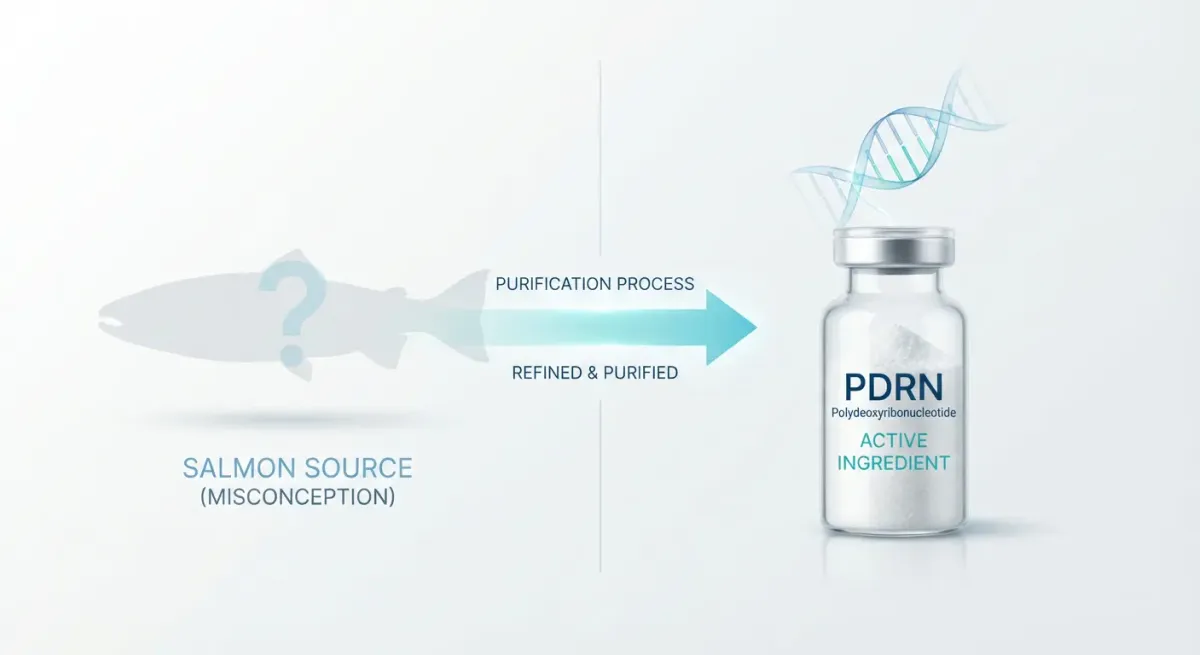
- "Salmon sperm" is a marketing hook, not a material description. The source tissue is salmon milt (chosen for its DNA concentration), but the finished PDRN ingredient is a sterile, cell-free nucleotide polymer — zero reproductive cells, zero proteins, zero biological debris.
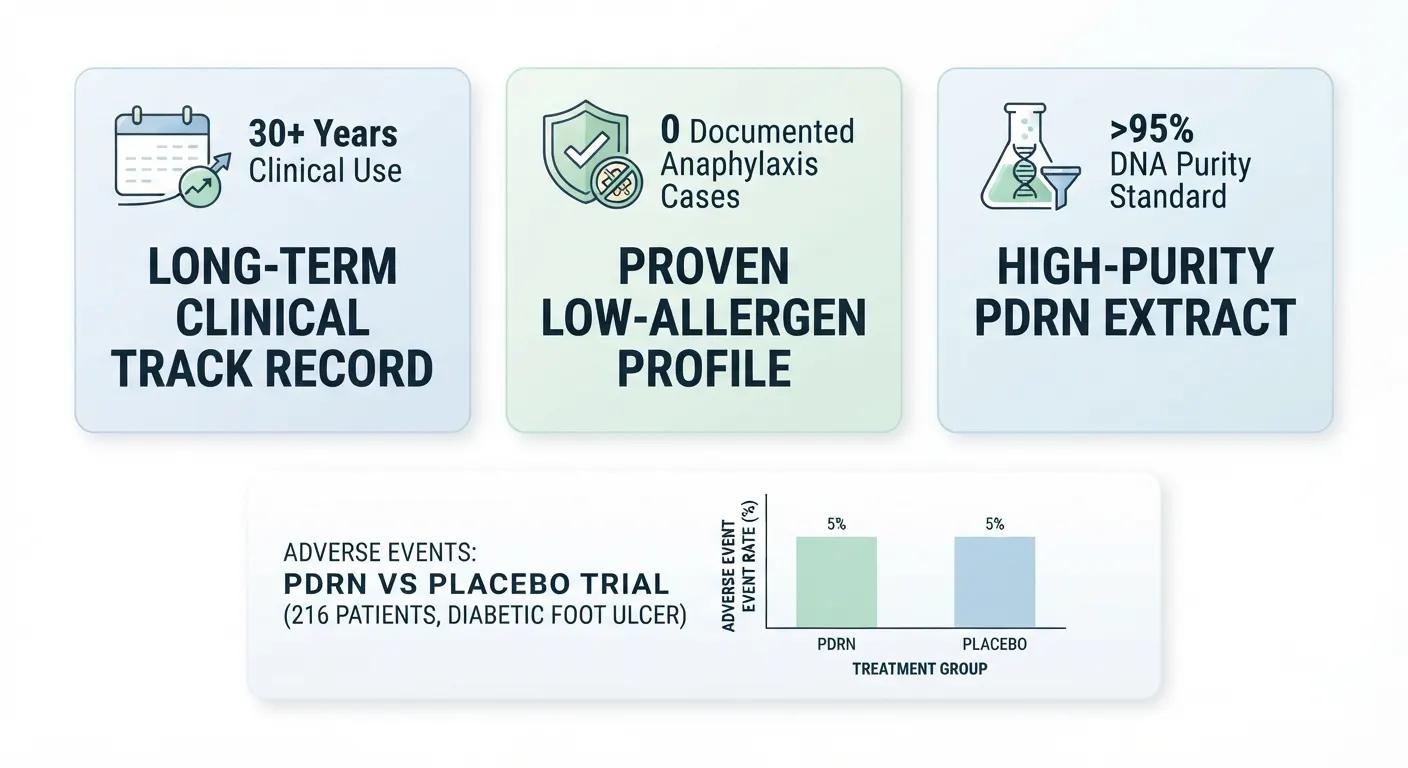
- Fish allergy is the real question, and the answer is reassuring: the major fish allergen (parvalbumin) is a protein, and PDRN purification removes >95% of proteins. No case of PDRN-induced anaphylaxis exists in the literature. But purification quality varies by supplier, so severe allergy sufferers should still patch-test and demand residual-protein data.
- PDRN is not GMO, cannot alter your DNA, and has no reported serious adverse events across three decades of clinical use. Pregnancy safety is a standard "no data" precaution, not a known contraindication.
- Regulation is form-dependent: topical PDRN is a cosmetic in the EU/US/Korea; injectable PDRN is a Class III device in Korea, a Class III CE device in the EU, and unapproved by the US FDA. Claims must stay within cosmetic boundaries.
"Salmon Sperm" — Why It Sounds Worse Than It Is
The "salmon sperm facial" headline is everywhere. Kim Kardashian tried it. TikTok made it viral. And every brand writing about PDRN has to decide whether to lean into the shock value or explain the science.
Here is the science. The source tissue is salmon milt — the male reproductive tissue of the fish, chosen because it has the highest DNA concentration of any tissue in the animal. "Milt" is the biological term; "sperm" is the colloquial translation. Neither word describes what ends up in your formula.
PDRN (polydeoxyribonucleotide) is a polymer of deoxyribonucleotides — chains of the same four nucleotide bases (A, T, G, C) that make up all DNA, in every species, including humans. The reason salmon is the industrial source is economic, not biological: salmon farms produce milt as a by-product of the food industry, it is abundant, and the DNA yield per gram is high. As cosmetic chemist Perry Romanowski noted in Allure, "PDRN is an upcycled ingredient from the food industry's salmon farms — it's not like people are raising salmon to get this DNA" (Allure).
So the chain is: salmon milt (food-industry by-product) → controlled purification → sterile DNA fragment polymer. The word "sperm" describes the source tissue. It does not describe the product.
If you want the full extraction and purification process — enzyme hydrolysis, deproteinization, delipidation, sterile filtration — that is covered in depth in our source and extraction guide. This article focuses on what remains after all of that, and whether it is safe.
What's Actually Left After Purification
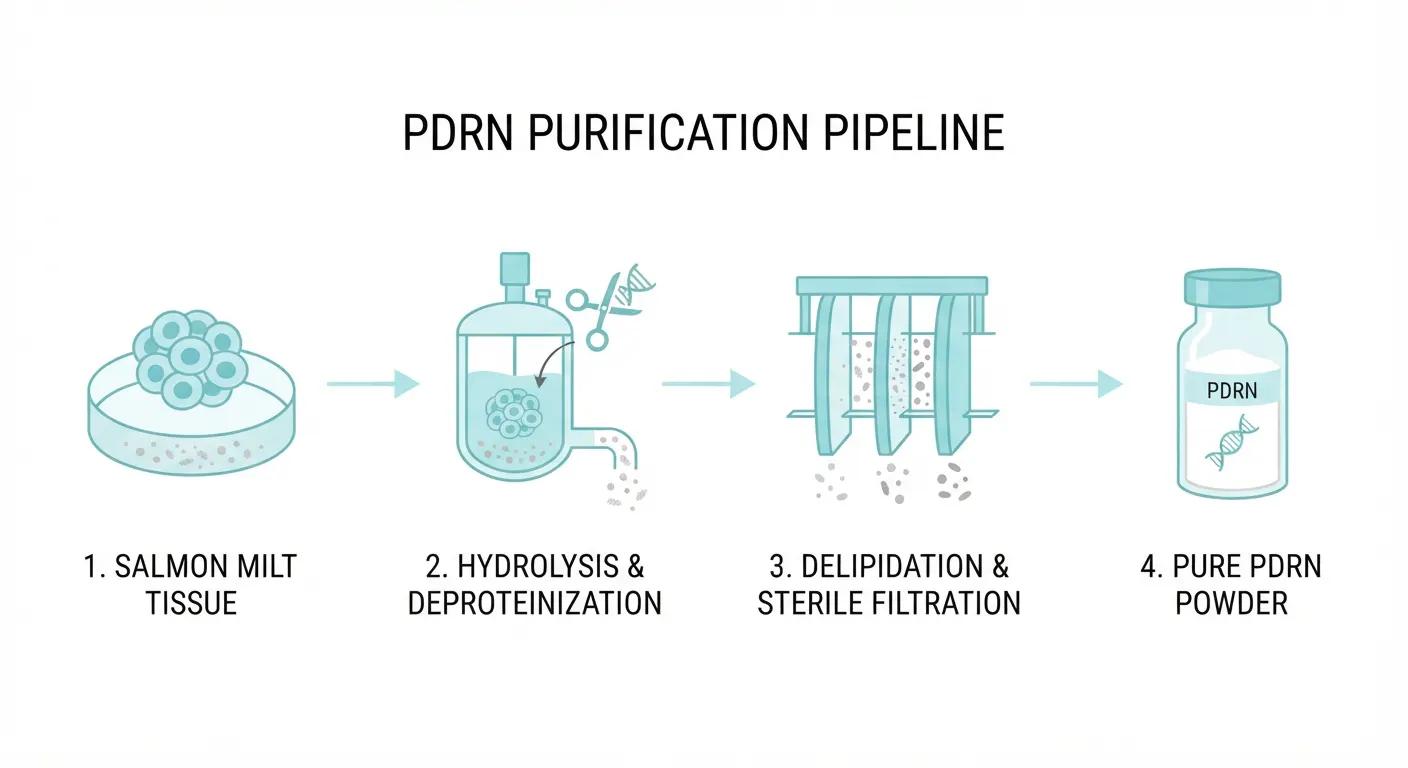 A pharmaceutical-grade PDRN ingredient is specified as >95% pure DNA fragments, with molecular weights typically between 50 and 1,500 kDa (Squadrito et al., Frontiers in Pharmacology, 2017). The purification process is designed to remove everything that is not nucleotide polymer:
- Proteins and peptides — removed to below detectable limits. This is the critical step for safety, because proteins are what trigger immune reactions.
- Lipids — removed.
- Cellular debris and reproductive material — removed.
- Microbial contamination — controlled by sterile filtration and endotoxin testing.
What remains is a white, water-soluble powder: a sterile, cell-free nucleotide polymer. It has no fish odor, no cellular structure, and no biological activity beyond the DNA fragments themselves. The final product is closer to a purified pharmaceutical excipient than to anything you would recognize as "fish tissue."
This matters for two reasons. First, it explains why PDRN is biocompatible — DNA is structurally universal across species, so a salmon-derived nucleotide polymer is not fundamentally different from a human-derived one at the molecular level. Second, it is the basis for the safety profile: if there is no protein, there is no protein allergy.
Is It Safe? The Allergen Reality
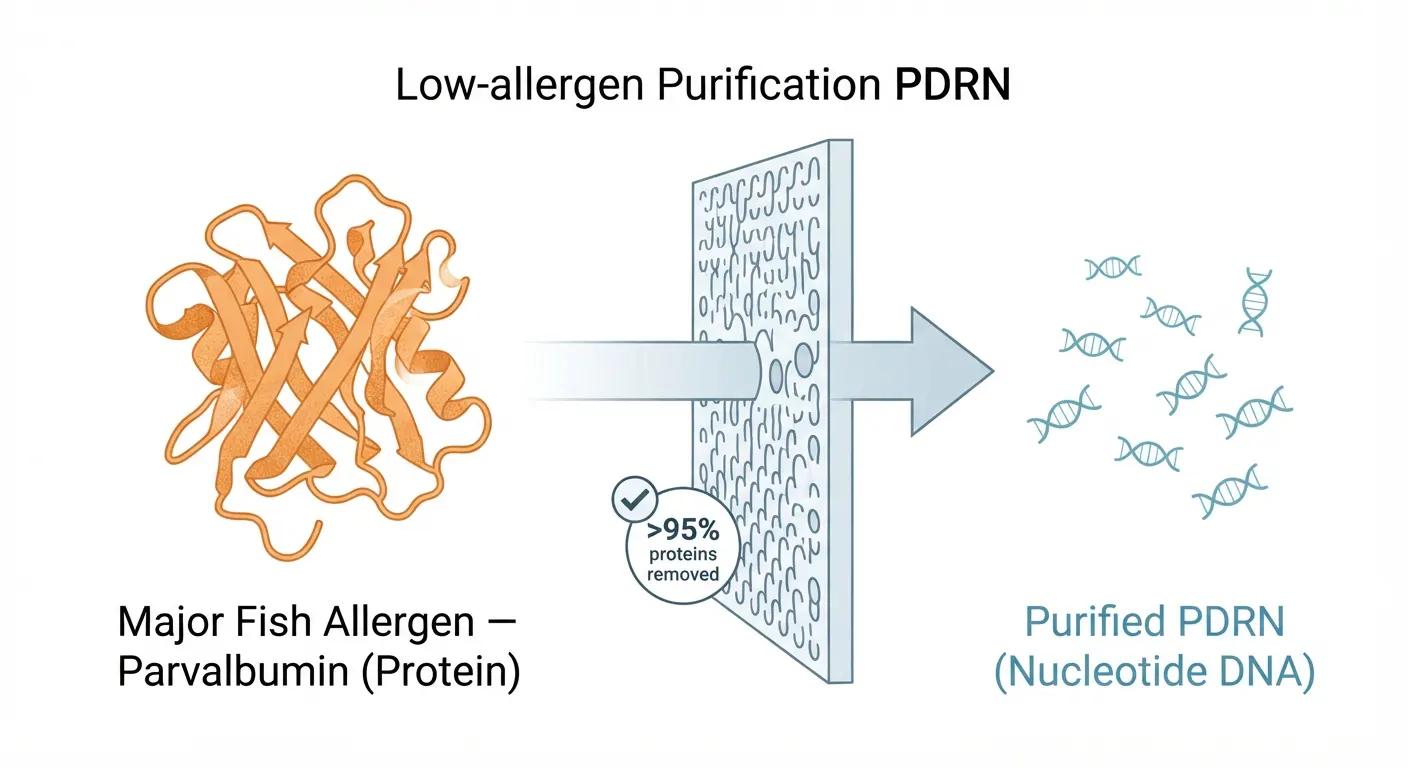 This is the question compliance and regulatory teams hear most often from brand buyers: can a fish-allergic consumer use a PDRN product?
The short answer: the risk is very low, but not zero, and it depends on purification quality.
The allergen mechanism. Fish allergy affects approximately 1% of the global population, with higher rates (up to 7%) in pediatric cohorts (PMC12486362). The major fish allergen is parvalbumin — a small (10–12 kDa), heat-stable calcium-binding protein found in fish muscle. Salmon happens to be in the "least allergenic" tier of the fish allergenicity ladder, but it still carries parvalbumin, and sensitive individuals can react to very low doses.
Why PDRN is different. PDRN purification is specifically designed to remove proteins. The extraction process uses high-temperature treatment and enzymatic hydrolysis to destroy any proteins or peptides that could cause immune reactions, leaving a >95% pure nucleotide mixture. The purification standard for pharmaceutical-grade PDRN (the grade used in injectables like Rejuran and Placentex) is stringent precisely because the product was originally designed for injection into human tissue.
The clinical evidence. A 2025 review in the Korean Medical Journal summarized it directly: "because proteins are the usual allergens and PDRN contains negligible amounts of protein, it is generally considered safe even in these individuals [fish-allergic patients]... No cases of allergic anaphylaxis due to PDRN have been documented in the literature" (e-kmj 2025). Across the largest published trial — 216 patients with diabetic foot ulcers, injected intramuscularly five times a week for eight weeks — there were no adverse event differences between the PDRN and placebo groups (PMC13264829).
The caveat. That safety record applies to pharmaceutical-grade PDRN. Cosmetic-grade PDRN — the kind that goes into topical serums — is not always held to the same manufacturing standard. Purification quality varies between suppliers, and a lower-grade extract may carry more residual protein than the pharmaceutical specification. For topical use, the intact skin barrier further reduces systemic exposure, so the practical risk is minimal. But if you are formulating for a fish-allergy-sensitive market, the responsible steps are:
- Request residual-protein test data from your supplier (it should be on the COA).
- Choose a supplier with pharmaceutical-grade manufacturing credentials (GMP, ISO 22000) — our pharmaceutical-grade PDRN is specified >95% pure with full COA disclosure.
- Include a patch-test recommendation on your product labeling for consumers with known fish allergies.
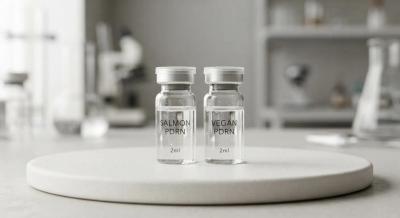
- If your buyer absolutely cannot tolerate any fish-derived input — even at negligible residual levels — a vegan PDRN grade from plant or microbial sources is the cleanest path.
For brands exploring whether topical PDRN can deliver meaningful results at all, our does-topical-PDRN-work analysis breaks down the delivery and evidence questions separately.
Myths vs Facts
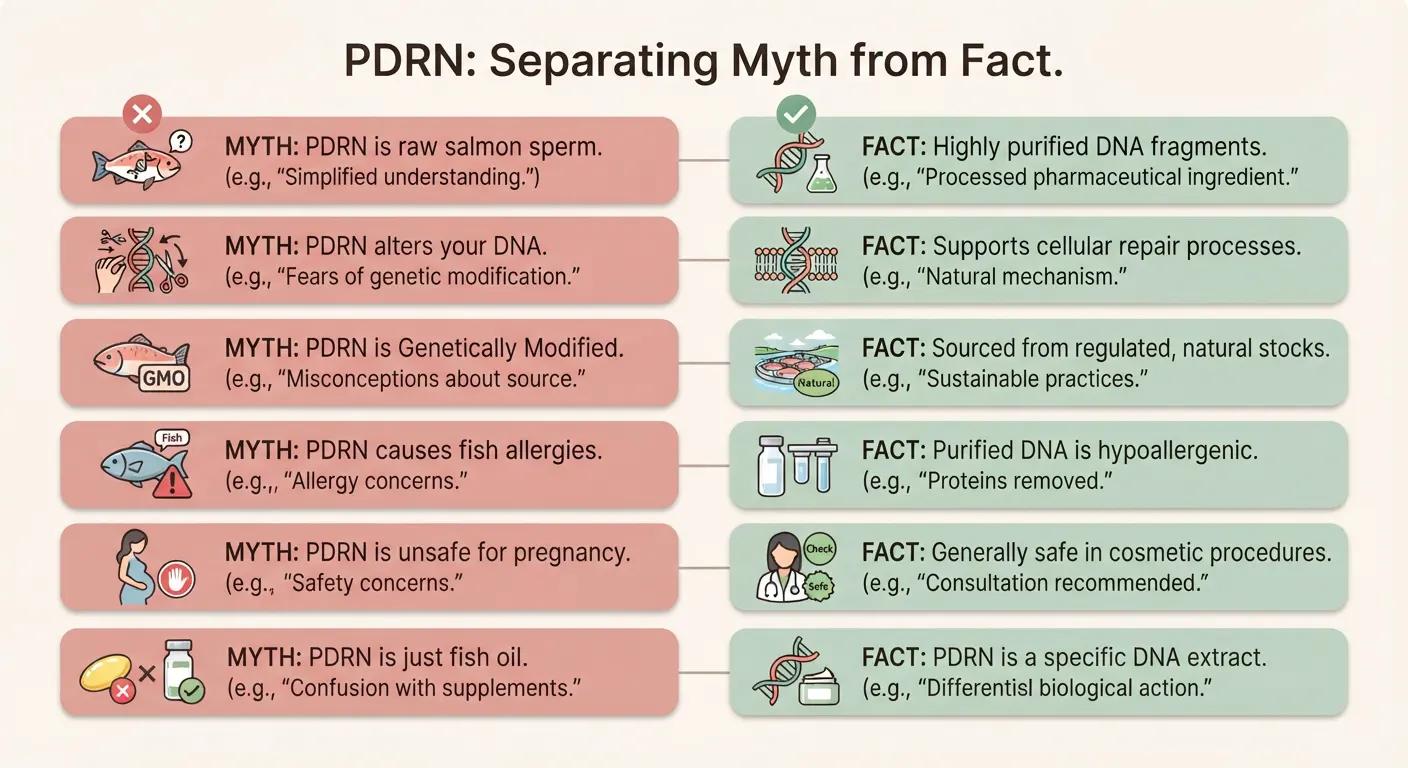
| Myth | Fact |
|---|---|
| "PDRN is salmon sperm." | The source tissue is salmon milt. The finished ingredient is a purified DNA fragment polymer — zero reproductive cells, zero proteins, zero biological debris. |
| "PDRN can alter your DNA." | PDRN fragments (50–2,000 base pairs) are too short to encode functional genes and lack the integration machinery (integrase/transposase) needed to insert into chromosomes. They are broken down by nucleases into generic nucleotide building blocks and recycled via the salvage pathway. |
| "PDRN is a GMO ingredient." | PDRN is extracted and purified from natural salmon milt. No genetic engineering is involved. The DNA is fragmented by enzymatic hydrolysis, not modified. |
| "If you're allergic to fish, you can't use PDRN." | The major fish allergen (parvalbumin) is a protein; PDRN purification removes >95% of proteins. No PDRN-induced anaphylaxis has been reported. Risk is very low but not zero — patch-test if severely allergic, and demand residual-protein data from your supplier. |
| "PDRN is unsafe during pregnancy." | There is no specific reproductive-toxicology data for PDRN. This is a standard "no data" precaution, not a known risk. Most clinicians defer injectable PDRN during pregnancy; topical use has minimal systemic exposure but should still be discussed with a doctor. |
| "PDRN is the same as fish oil." | Fish oil is a lipid (triglyceride) extract. PDRN is a nucleotide polymer. They share nothing chemically except the source animal. |
Regulatory Status
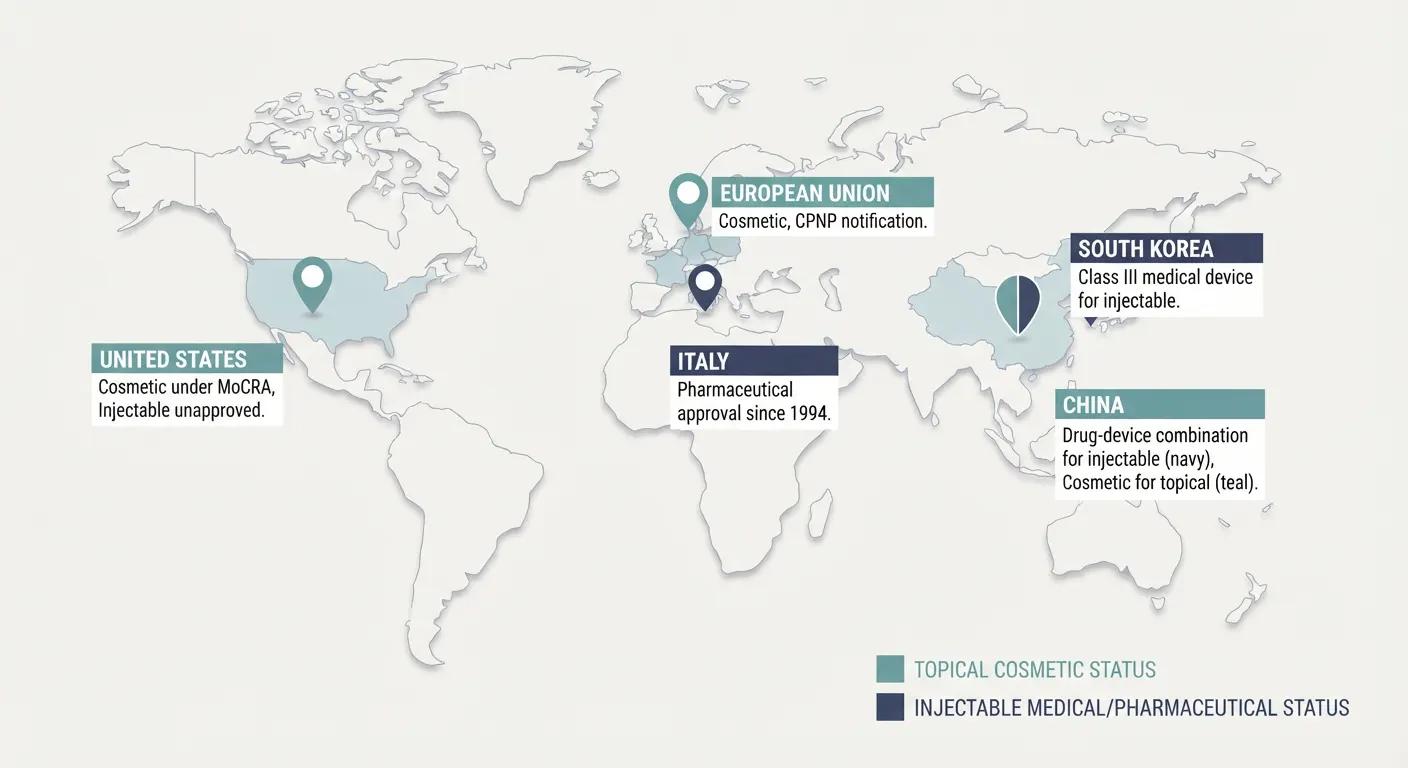 PDRN's regulatory identity changes depending on two variables: the form (topical vs injectable) and the claim (cosmetic vs pharmacological). Here is how the major markets handle it.
European Union. PDRN is not specifically listed in any Annex (II–VI) of the Cosmetics Regulation (EC) No 1223/2009, meaning it is neither prohibited nor restricted as a cosmetic ingredient (Cosmeservice). Products containing PDRN must be notified via the CPNP and must include a Cosmetic Product Safety Report (CPSR) with a qualified toxicologist's assessment. The critical boundary: cosmetic formulations cannot claim pharmacological or tissue-healing effects. Claims like "regenerates tissue" or "repairs DNA" risk pushing the product into borderline (drug) classification. Safe claims include "supports skin barrier," "improves hydration," and "helps skin look smoother."
United States. Topical PDRN products are regulated as cosmetics under MoCRA (Modernization of Cosmetics Regulation Act). Manufacturers must complete facility registration and product listing, ensure safety substantiation, and avoid medical claims. No pre-market approval is required. Injectable PDRN, however, is not FDA-approved for any cosmetic indication. Any injectable product claiming to "promote tissue repair" or "improve wrinkles" would be regulated as a drug or biological product, requiring an IND or BLA pathway — a route no PDRN product has completed for aesthetic use (chinamedglobal regulatory review).
South Korea. Korea is the most mature PDRN market. MFDS (the Korean FDA) regulates injectable PDRN as a Class III medical device, requiring clinical validation and KGMP audit. Topical PDRN products are cosmetics. Rejuran (the best-known injectable PDRN/PN brand) has been one of the most in-demand aesthetic procedures in Korea for years.
Italy. PDRN was approved by AIFA (the Italian Medicines Agency) as a pharmaceutical — Placentex, for wound healing — back in 1994. This is the oldest regulatory approval for PDRN anywhere, and the basis for three decades of clinical safety data.
China. NMPA classifies injectable PDRN as a drug-device combination product (药械组合). Topical PDRN is regulated as a cosmetic ingredient under the INCI name "DNA 钠" (Sodium DNA). As of 2024, over 13,000 cosmetic products containing DNA sodium were registered in China — a 655% increase from 2022.
 The practical takeaway for brands: topical PDRN is a cosmetic everywhere, but claims must stay cosmetic. If your marketing crosses into "tissue repair," "wound healing," or "DNA repair," you are claiming a pharmacological effect — and in every market, that changes your regulatory category and your compliance burden.
Related Articles
- Does Topical PDRN Actually Work? — The evidence for topical PDRN efficacy, delivery, and realistic expectations.
- Salmon vs Vegan PDRN — Plant-based PDRN grades for fish-allergic, halal, and vegan-positioned brands.
- Where Does PDRN Come From? — The full source, extraction, and purity process (companion to this article).