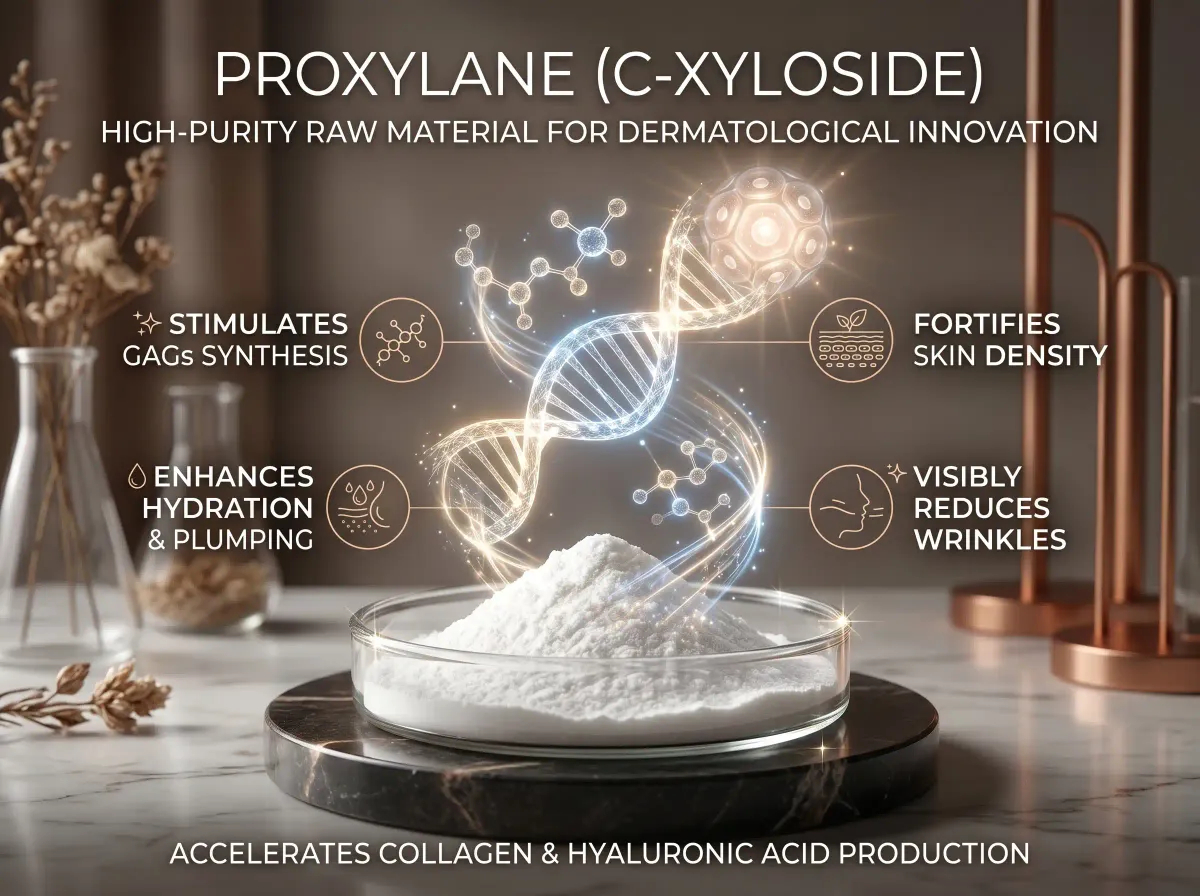
Proxylane — Hydroxypropyl Tetrahydropyrantriol (HTP), L'Oréal Xylose-Derived C-Glycoside
Fagus sylvatica (beechwood xylose derivative)
Proxylane (Hydroxypropyl Tetrahydropyrantriol) is L'Oréal's patented C-glycoside that primes GAG biosynthesis to restore papillary dermis and strengthen the dermal-epidermal junction. Clinically validated for skin restructuring at 3–10%. Purity ≥98%. B2B bulk raw material.
Module A: Ingredient Identity, Patent Origin & Nomenclature
What Is Proxylane?
Proxylane — chemical name Hydroxypropyl Tetrahydropyrantriol (HTP) — is a patented bioactive C-glycoside developed by L'Oréal Research & Innovation and introduced commercially in 2006 through Lancôme's Absolue range. Its CAS registry number is 868156-46-1, molecular formula C₈H₁₆O₅, and molecular weight 192.21 g/mol.
The name Proxylane is a deliberate portmanteau: Pro (promote / stimulate) + xyl (xylose, the starting sugar) + ane (chemical suffix for saturated hydrocarbons). This naming encodes the ingredient's core mechanism — it promotes biological activity downstream of xylose biochemistry.
Natural Origin: Xylose from Beechwood Hemicellulose
Proxylane is synthesized from D-xylose — a pentose sugar that is the primary building block of hemicellulose in plant cell walls. L'Oréal's proprietary two-step green chemistry process (Cavezza et al., Bioorganic & Medicinal Chemistry Letters, 2009) converts xylose to the C-glycoside in aqueous media with no organic solvents:
- C-glycosidation: Xylose reacts with acetylacetone in water to form the C-xyloside intermediate
- Hydrogenation: Catalytic hydrogenation reduces the intermediate to the final hydroxypropyl-tetrahydropyran structure
This process earned Proxylane the distinction of being the first "green chemical" in cosmetics, certified to ISO 16128 natural origin standards. The xylose feedstock is sourced from beechwood (Fagus sylvatica) hemicellulose — the most abundant renewable xylose source in Europe.
Nomenclature: INCI Name & Terminology Guide
| Term | Meaning |
|---|---|
| INCI | Hydroxypropyl Tetrahydropyrantriol |
| Proxylane™ | L'Oréal registered trademark |
| HTP | Abbreviation of the INCI name |
| C-Xyloside / C-Glycoside | Chemical class descriptor |
| Pro-Xylane | Alternative spelling (hyphenated) |
| 波色因 / Boseyin | Chinese transliteration |
| プロキシラン | Japanese transliteration |
Patent Status
L'Oréal's foundational composition-of-matter patents on Proxylane have expired, enabling third-party manufacturers to produce generic Hydroxypropyl Tetrahydropyrantriol. However, L'Oréal retains active patents on specific formulation technologies (e.g., Pro-Xylane Pro concentration systems, dual-penetration micropump delivery) and brand-specific product formulations. GINKVORA supplies high-purity generic HTP suitable for B2B formulation development.
Proxylane vs Flavo-Proxylane: The Evolution
Flavo-Proxylane is not a chemically modified Proxylane molecule — it is a combination system of Proxylane + wild fruit flavonoids (primarily blueberry-derived anthocyanins and polyphenols). L'Oréal/SkinCeuticals markets this as a dual-action system:
- Proxylane (10.5–12.5% active): Stimulates GAG synthesis and DEJ protein deposition
- Wild Fruit Flavonoids (4.25–4.6%): Inhibit reactive oxygen species (ROS), reduce AGE formation, and suppress MMP activity to protect newly synthesized ECM
A 2026 split-face clinical study (Dermatology and Therapy, Jiang et al., 2026) demonstrated that the Flavo-Proxylane regimen alone reduced facial skin laxity by −16% at 4 weeks, with 58% of participants achieving visible improvement vs 28% for placebo — validating the synergistic potential of this approach.
Proxylane Pro & Proxylane GX
- Pro-Xylane Pro: A concentrated formulation variant of Proxylane — same molecule, higher active concentration — marketed by L'Oréal Paris in the Revitalift Filler series. "Pro" stands for "profusion" (abundance), not a different chemical entity.
- Proxylane GX: L'Oréal's internal code for specific Proxylane formulation grades — these are application-specific delivery optimizations, not chemically distinct molecules.
Module B: Papillary Dermis Remodeling Mechanism (Core Scientific Narrative)
The Papillary Dermis: Skin Architecture's Critical Layer
The papillary dermis is the superficial-most layer of the dermis, directly interdigitating with the epidermal basal layer through an intricate system of finger-like projections called rete ridges. This layer is:
- The hydration reservoir — rich in GAGs (hyaluronic acid, chondroitin sulfate, dermatan sulfate) that bind water up to 1,000 times their weight
- The structural anchor — houses Collagen IV, Collagen VII, Laminin-332, and Perlecan at the dermal-epidermal junction (DEJ)
- The age-sensitive zone — the rete ridge architecture flattens with age, reducing DEJ surface area by up to 50%, directly correlating with skin sagging, loss of elasticity, and dullness
The Xylosyltransferase Bottleneck
GAG biosynthesis follows a tightly regulated pathway:
Core Protein → Xylosyltransferase (rate-limiting) → Galactosyltransferases → GAG chain polymerization
The enzyme xylosyltransferase adds the first xylose residue to the serine residue of the core protein — this is the committed, rate-limiting step. With aging, xylosyltransferase activity declines significantly, creating a biosynthetic bottleneck that limits GAG production regardless of upstream signaling.
Proxylane's Bypass Strategy
Proxylane functions as an exogenous xyloside primer — it enters the GAG assembly line downstream of the rate-limiting xylosyltransferase step, providing a pre-formed xylose anchor that galactosyltransferases and glucuronyltransferases can directly extend:
- Cellular uptake: The small molecule (192 Da) diffuses through aqueous channels to dermal fibroblasts
- Xyloside priming: Proxylane's C-xyloside moiety mimics the xylose-serine linkage, acting as a false substrate that jump-starts GAG chain polymerization
- Chain elongation: Galactosyltransferases (GalT-I, GalT-II) and glucuronyltransferases (GlcAT-I) add repeating disaccharide units to the Proxylane primer
- GAG secretion: Nascent GAG chains are processed, sulfated, and secreted into the extracellular matrix (ECM)
Four GAG Types Stimulated
| GAG Type | Function | Proxylane Effect |
|---|---|---|
| Hyaluronic Acid (HA) | Water binding, tissue volume, diffusion matrix | ^ Increased free HA in ECM |
| Chondroitin Sulfate (CS) | Collagen fiber organization, compressive resistance | ^ Chain length & sulfation degree |
| Dermatan Sulfate (DS) | Collagen fibril spacing (via Decorin), tensile strength | ^ DS-Decorin complex formation |
| Heparan Sulfate (HS) | Growth factor sequestration (Perlecan at DEJ), cell signaling | ^ HS-Perlecan at lamina lucida |
(Vassal-Stermann et al., PLoS One, 2012 — demonstrated C-xyloside-induced modifications in GAG chain length, sulfation pattern, and HGF binding properties)
DEJ Reconstruction: The Clinical Evidence
L'Oréal's peer-reviewed research has mapped a multi-target DEJ restoration profile:
In vitro / Ex vivo (Reconstructed Skin Models — Sok et al., EJD, 2008):
- ^ Collagen IV deposition at the lamina densa
- ^ Collagen VII (anchoring fibrils) expression
- ^ Laminin-5 (Laminin-332) at the lamina lucida
- ^ Pro-collagen I and Fibrillin-1 in the sub-DEJ dermis
In vivo / Clinical (Deloche et al., EJD, 2011):
- 60–75-year-old postmenopausal women
- 10% Proxylane, 2×/day, 3 months on forearm skin
- Ultrastructural results: More uniform basal lamina, reduced lamina densa reduplication, restored hemidesmosome density
- Immunohistochemistry: Significant increase in α6-integrin, Laminin-332, and CD44 expression
Multi-center RCT (Bouloc et al., Acta Dermato-Venereologica, 2017):
- 3% Proxylane complex in postmenopausal women
- Significant improvements: Facial sagging ↓, nasolabial folds ↓, skin radiance ↑, complexion evenness ↑
- Skin lipid profile restoration: Total lipids ↑, squalene ↑, sterols ↑, free fatty acids ↑
Positioning Among Anti-Aging Actives
Proxylane occupies a distinct and complementary position in the dermal remodeling landscape:
| Active | Primary Target | Proxylane Complementarity |
|---|---|---|
| Matrixyl 3000 | Collagen I/III synthesis (TGF-β pathway) | Proxylane provides the GAG matrix scaffold that collagen fibers organize around |
| Argireline / SYN-AKE | Neuromuscular junction (wrinkle relaxation) | Proxylane rebuilds the dermal substrate — filling the volume that expression lines indent |
| Adifyline | Subcutaneous adipogenesis (fat volume) | Proxylane acts on the papillary dermis above the fat layer — complementary depth targeting |
| Retinol | Epidermal renewal + collagen stimulation | Proxylane strengthens the DEJ, improving barrier tolerance to retinol irritation |
| Hyaluronic Acid (topical) | Transient surface hydration | Proxylane stimulates endogenous HA synthesis — lasting vs temporary hydration |
Module C: Proxylane vs Flavo-Proxylane Evolution
Generation Comparison
| Parameter | Proxylane (1st Gen) | Flavo-Proxylane (2nd Gen) |
|---|---|---|
| Active Ingredient(s) | HTP single molecule | HTP + Wild Fruit Flavonoids (blueberry anthocyanins, polyphenols) |
| Primary Mechanism | GAG primer → ECM biosynthesis | GAG primer + Antioxidant protection + AGE inhibition |
| Target Pathways | Xylosyltransferase bypass → GAG → DEJ proteins | Same + ROS scavenging + MMP suppression + AGE reduction |
| Commercial Concentration | 3–10% HTP (per formulation) | 10.5–12.5% HTP + 4.25–4.6% flavonoids |
| Clinical Data (standalone) | 10% 3mo → DEJ ultrastructure improvement | 4 weeks → skin laxity −16% (N=25, p<0.001 vs baseline) |
| Clinical Data (combined) | 3% 3mo → facial sagging ↓ | 12 weeks + ultrasound → laxity −44%, marionette lines −34% |
| Key Products | Lancôme Absolue, Vichy LiftActiv | SkinCeuticals A.G.E. Interrupter (Ultra Serum + Advanced Cream) |
The Synergy Logic
Flavo-Proxylane represents an evolution in strategy rather than chemistry:
- Proxylane builds: Triggers GAG synthesis and ECM protein deposition
- Flavonoids protect: Wild fruit polyphenols neutralize ROS that would otherwise degrade newly synthesized ECM, inhibit MMP enzymes that break down collagen, and reduce AGE (advanced glycation end-product) formation that cross-links and stiffens existing matrix proteins
This "build + protect" dual mechanism explains the superior clinical outcomes of Flavo-Proxylane systems. GINKVORA supplies the core HTP raw material — formulators can replicate the Flavo-Proxylane strategy by combining HTP with blueberry extract or other flavonoid-rich botanical actives.
L'Oréal Brand Product Line Correspondence
| L'Oréal Sub-brand | Product Line | Proxylane Variant |
|---|---|---|
| L'Oréal Paris | Revitalift Filler [HA] | Pro-Xylane Pro (concentrated) |
| Lancôme | Absolue Soft Cream | Proxylane (original) |
| SkinCeuticals | A.G.E. Interrupter | Flavo-Proxylane (Proxylane + blueberry flavonoids) |
| La Roche-Posay | Substiane / Substiane [+]/Serum | Proxylane |
| Vichy | LiftActiv | Proxylane + Rhamnose |
Module D: Specifications & Formulation Parameters
Raw Material Specifications
| Parameter | Specification |
|---|---|
| Appearance | White to off-white powder (pure) or colorless to pale yellow viscous liquid (30% aqueous solution) |
| INCI Name | Hydroxypropyl Tetrahydropyrantriol |
| CAS Number | 868156-46-1 |
| Molecular Formula | C₈H₁₆O₅ |
| Molecular Weight | 192.21 g/mol |
| Purity (HPLC) | ≥98% |
| Solubility | Water-soluble (≥250 mg/mL) — fully miscible in aqueous phase |
| pH Stability Range | 4.0–8.0 (widest of common anti-aging actives) |
| Thermal Stability | Stable up to 40°C. Avoid sustained heating above 40°C (acid/base-catalyzed pyran ring opening) |
| Recommended Formulation Concentration | 1.0–3.0% (optimal); 3–5% (L'Oréal clinical level); <1.0% below detectable ECM effect threshold |
| Storage | Cool, dry place. Standard sealed packaging. No light sensitivity. No oxidation risk. |
| Form | Powder or 30% aqueous solution |
Formulation Compatibility
| Aspect | Guidance |
|---|---|
| Addition Phase | Cooling phase of emulsions (≤40°C) or aqueous phase at room temperature. Direct addition — no pre-dissolution needed. |
| Penetration | Diffuses through aqueous channels to DEJ and superficial dermis. No lipid carrier required (unlike palmitoyl peptides). |
| Peptide Compatibility | Fully compatible with GHK-Cu (no Cu²⁺ chelation issue). Compatible with Matrixyl 3000, Argireline, SYN-AKE, SNAP-8. |
| Retinol Compatibility | Compatible — Proxylane strengthens DEJ and improves barrier tolerance to retinol irritation. |
| Hyaluronic Acid Compatibility | Excellent — Proxylane stimulates endogenous HA production, complementing topical HA. |
| AHAs/BHA/LHA | Compatible in pH range 4.0–8.0. LHA (L'Oréal's lipo-hydroxy acid) + Proxylane is an L'Oréal-validated "three-layer repair" logic (epidermal renewal + DEJ reinforcement). |
| Metal Compatibility | Does not chelate metal ions. Safe with any metal-containing actives. |
| Packaging | Standard sealed containers. No vacuum or opaque packaging required unless formulated with GHK-Cu (which requires vacuum-opaque). |
Optimal Formula Types
- Serums/Essences: Water-phase addition, 2–3% HTP → high-bioavailability delivery to papillary dermis
- Emulsions/Creams: Cooling phase addition, 2–5% HTP → sustained-release from oil-water interface
- Eye Creams/Gels: 1–3% HTP → low-irritancy, compatible with delicate periorbital skin
- Sheet Masks: 1–2% HTP in essence → occlusive effect enhances penetration
- Foundations/BB Creams: 0.5–1% HTP → skincare-makeup hybrid (L'Oréal has clinical precedent)
Module E: Safety Declaration
Core Safety Profile
Proxylane (Hydroxypropyl Tetrahydropyrantriol) has an exceptional safety record, underpinned by:
| Assessment | Finding |
|---|---|
| EWG Skin Deep® Rating | All hazard categories: LOW (Cancer: LOW, Allergies & Immunotoxicity: LOW, Developmental & Reproductive Toxicity: LOW, Use Restrictions: LOW) |
| CIR (Cosmetic Ingredient Review) | Assessed safe for use in cosmetics at current practice concentrations (CIR 2023 Final Report) |
| Dermal Irritation | Non-irritating at standard use concentrations |
| Dermal Sensitization | Non-sensitizing |
| Phototoxicity | No phototoxic potential |
| Genotoxicity | Non-genotoxic |
| Systemic Toxicity | Minimal percutaneous absorption (192 Da, highly water-soluble → limited transdermal penetration). No systemic toxicity reported. |
| ISO 16128 | Certified natural origin. Readily biodegradable (xyloside ring is substrate for microbial glycosidases). No bioaccumulation or ecotoxicity. |
Pregnancy & Lactation
L'Oréal markets multiple Proxylane-containing products (Lancôme Absolue, SkinCeuticals A.G.E. Interrupter, Vichy LiftActiv, La Roche-Posay Substiane) as standard cosmetic products — not restricted from use during pregnancy. However, no dedicated controlled clinical studies have specifically evaluated Proxylane use during pregnancy or lactation. As a precautionary principle, we recommend consulting a physician before use during pregnancy or breastfeeding.
Specific Note on "retinol proxylane LHA" Combinations: LHA (Lipo-Hydroxy Acid, a salicylic acid derivative) carries pregnancy-related precautions due to the salicylate moiety. Retinol (vitamin A) at high concentrations is contraindicated during pregnancy. When formulating combination products, evaluate each ingredient independently for pregnancy suitability.
Not a Drug, Not a Hormone
Proxylane is a cosmetic ingredient — a sugar-derived C-glycoside. It contains:
- No hormones or endocrine-active substances
- No pharmaceutical active ingredients
- No prescription-required compounds
- No animal-derived components (beechwood xylose source)
It functions exclusively as a topical cosmetic active ingredient through GAG biosynthesis stimulation.
Contraindications & Warnings (Español / Português)
¿Tiene Proxylane contraindicaciones? No se conocen contraindicaciones específicas para Proxylane (Hidroxipropil Tetrahidropirantriol) en uso cosmético tópico. Es un derivado de azúcar (xilosa) y no contiene ingredientes farmacéuticos activos. Consulte a un médico si tiene condiciones cutáneas específicas.
O Proxylane tem contraindicações? Não são conhecidas contraindicações específicas para Proxylane (Hidroxipropil Tetrahidropirantriol) em uso cosmético tópico. É um derivado de açúcar (xilose) e não contém ingredientes farmacêuticos ativos. Consulte um médico se tiver condições cutâneas específicas.
Ingredient Transparency Statement
Proxylane from GINKVORA is manufactured to pharmaceutical-grade purity standards (≥98% by HPLC) with full traceability documentation. Unlike some commercially marketed "Proxylane" products where the actual active ingredient concentration and purity are undisclosed, we provide batch-specific certificates of analysis (CoA) for every shipment.
Preguntas frecuentes
Solicitar cotización o muestra
Envíe su consulta y nuestro representante comercial se pondrá en contacto con usted en un plazo de 24 horas.
Ir al formulario de consulta →