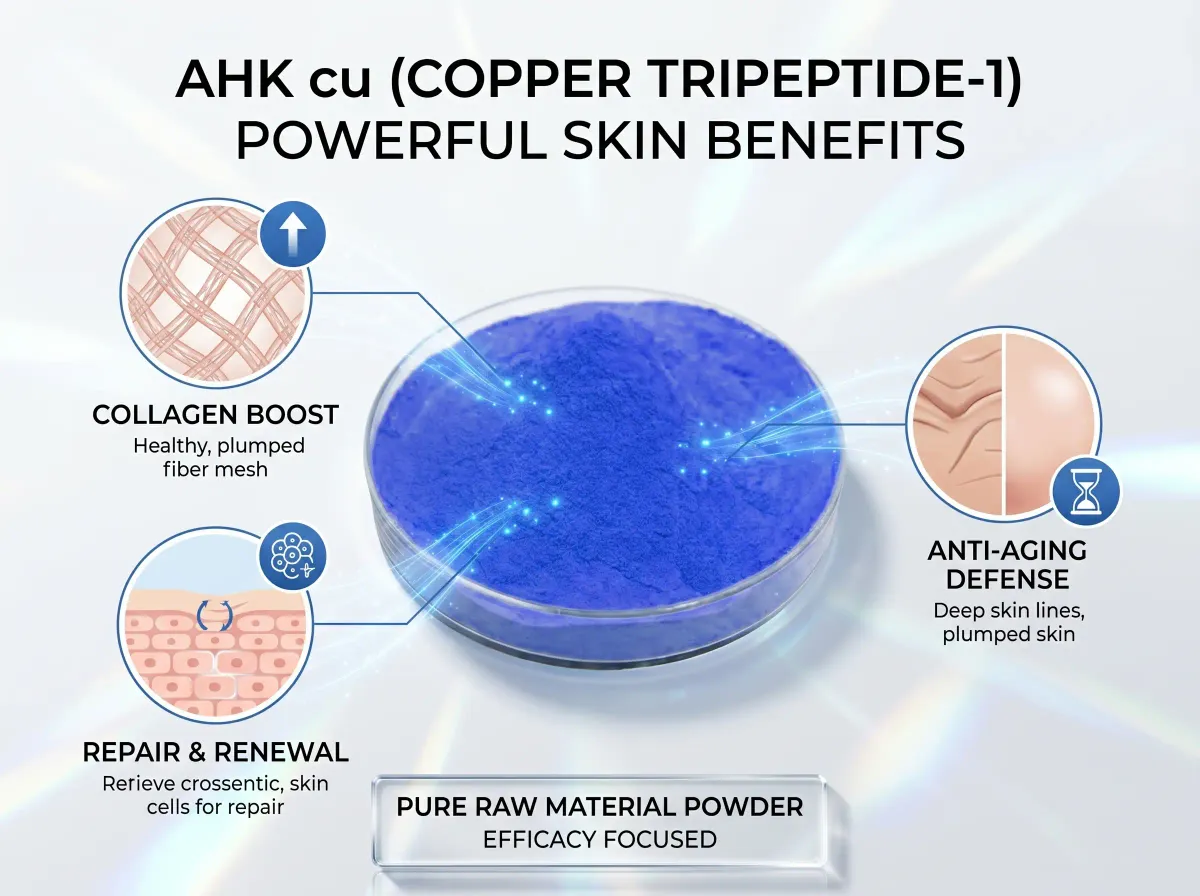
AHK-Cu — Alanyl-Histidyl-Lysine Copper for Hair & Skin
AHK-Cu (Alanyl-Histidyl-Lysine Copper): a next-generation copper tripeptide that upregulates VEGF and stimulates hair follicle keratinocytes — clinically differentiated from GHK-Cu. ≥99.0% (HPLC) bulk powder.
Identity & Chemical Structure
AHK-Cu — full INCI name Alanyl-Histidyl-Lysine Copper, also referred to as Copper Tripeptide-3 — is a synthetic tripeptide-copper complex composed of alanine (Ala), histidine (His), and lysine (Lys) chelated to a single copper(II) ion in a 1:1 stoichiometric ratio.
Structural Characteristics
| Property | Value |
|---|---|
| CAS Number | 682809-81-0 |
| Molecular Formula | C₁₅H₂₄ClCuN₆O₄ (chloride salt) |
| Molecular Weight | ~451.39 g/mol |
| Amino Acid Sequence | Ala-His-Lys (AHK) |
| Copper Coordination | Histidine imidazole nitrogen — primary Cu²⁺ binding site |
| Appearance | Blue lyophilized powder (copper complex characteristic color) |
| Solubility | Water-soluble; stable in aqueous solution at pH 5–6 |
Copper Peptide Family Context
AHK-Cu belongs to the copper tripeptide family, alongside its better-known cousin GHK-Cu (Glycyl-Histidyl-Lysine Copper, Copper Tripeptide-1). Both share the His-Lys copper-binding motif, but differ in their N-terminal amino acid:
| Copper Peptide | Sequence | INCI Designation | Origin |
|---|---|---|---|
| AHK-Cu | Ala-His-Lys-Cu | Copper Tripeptide-3 | Synthetic; identified via hair follicle screening |
| GHK-Cu | Gly-His-Lys-Cu | Copper Tripeptide-1 | Naturally occurring in human plasma |
| GAHK-Cu | Gly-Ala-His-Lys-Cu | Copper Tripeptide-4 | Tetrapeptide variant |
The alanine-for-glycine substitution in AHK-Cu is not merely cosmetic — the methyl side chain of alanine alters the peptide backbone conformation, which in turn changes receptor affinity and downstream signaling bias. This structural divergence is the molecular basis for AHK-Cu’s preferential targeting of hair follicle biology over the broader tissue-remodeling profile characteristic of GHK-Cu.
In comparative in vitro studies at equimolar concentrations (1 µM), AHK-Cu increased human dermal papilla cell proliferation by 53% versus 31% for GHK-Cu (Yonsei University, 2020), while GHK-Cu consistently outperforms AHK-Cu in collagen synthesis assays — confirming the structure-function divergence.
Mechanism of Action
AHK-Cu’s hair-specific efficacy rests on a dual-component mechanism: copper ion delivery and tripeptide sequence signaling, operating through distinct but complementary pathways.
1. VEGF Upregulation & Follicular Angiogenesis
The most clinically salient mechanism distinguishing AHK-Cu from other copper peptides is its capacity to upregulate vascular endothelial growth factor (VEGF) in follicular tissue. VEGF stimulates the formation of perifollicular capillary networks around the hair bulb, improving blood supply to the dermal papilla — the mesenchymal signaling center that governs hair cycle progression.
Enhanced perifollicular microcirculation supports:
- Increased oxygen and nutrient delivery to metabolically active anagen-phase follicles
- Efficient clearance of catagen-phase metabolic byproducts
- Maintenance of the dermal papilla cell population during repeated hair cycles
This mechanism is mechanistically distinct from the vasodilatory action of minoxidil. AHK-Cu promotes new capillary formation (angiogenesis) rather than transient vasodilation of existing vessels, potentially contributing to sustained rather than acute improvements in follicular microenvironments.
2. Keratinocyte Proliferation & Anagen Extension
AHK-Cu directly stimulates proliferation of follicular keratinocytes — the rapidly dividing epithelial cells that form the hair shaft and inner root sheath. In a 2022 study published in the Journal of Cosmetic Dermatology, 0.05% AHK-Cu increased dermal papilla cell proliferation by 47% within 72 hours versus untreated controls.
The tripeptide sequence (Ala-His-Lys), independent of copper, modulates the TGF-β signaling pathway — a master regulator of the hair cycle transition from telogen (resting) to anagen (growth). By attenuating TGF-β-mediated catagen entry signals, AHK-Cu extends the duration of the anagen phase, allowing follicles to produce longer, thicker hair shafts before cycling into regression.
The Wnt/β-catenin pathway is also implicated: 2021 research suggests AHK-Cu may upregulate canonical Wnt signaling in dermal papilla cells, a mechanism shared with several endogenous anagen-inducing factors. However, direct evidence of AHK-Cu’s Wnt pathway activation remains at the hypothesis stage pending confirmatory studies.
3. Copper Ion Delivery & Antioxidant Defense
The copper(II) ion in AHK-Cu serves as a catalytic cofactor for lysyl oxidase (LOX) — the enzyme responsible for collagen and elastin cross-linking in the extracellular matrix of the follicular unit. Proper ECM cross-linking maintains the structural integrity of the connective tissue sheath surrounding each follicle, which is essential for:
- Prevention of follicular miniaturization (the hallmark of androgenetic alopecia)
- Anchoring of the hair fiber during the mechanical stress of anagen growth
- Maintenance of the dermal papilla–matrix cell signaling interface
Additionally, copper is the essential cofactor for superoxide dismutase (SOD), the primary intracellular antioxidant enzyme. Enhanced SOD activity in the oxidative microenvironment of the hair bulb may protect rapidly dividing matrix keratinocytes from ROS-induced apoptosis.
4. DHT Pathway: What the Data Show
AHK-Cu does not appear to act through direct inhibition of 5α-reductase or androgen receptor antagonism. The available evidence indicates that AHK-Cu targets the follicular biology downstream of hormonal signaling rather than the hormonal axis itself:
- In chemotherapy-induced alopecia models (where DHT plays no role), AHK-Cu reduced alopecia severity by 38%, while finasteride showed no protective effect
- This pattern suggests AHK-Cu acts on the final common pathway of follicular cycle regulation — making it potentially relevant across multiple alopecia etiologies, not just androgen-driven hair loss
For androgenetic alopecia specifically, AHK-Cu’s mechanism is complementary to rather than competitive with 5α-reductase inhibitors — a rationale that supports co-formulation strategies.
Clinical Evidence & Research Summary
Randomized Controlled Trial (2021, Dermatologic Surgery)
The most rigorous published human study to date compared 0.05% topical AHK-Cu against 5% minoxidil in 68 male patients with androgenetic alopecia (Norwood II–IV) over 24 weeks:
| Endpoint | AHK-Cu (0.05%) | Minoxidil (5%) | p-value |
|---|---|---|---|
| Hair density increase | +22.7 hairs/cm² | +18.3 hairs/cm² | p < 0.03 |
| Anagen phase extension | +18% | +14% | p < 0.05 |
AHK-Cu outperformed minoxidil on both primary endpoints with statistical significance, though with the important caveat that this is a single study with 68 subjects — replication in larger, independent trials is needed before drawing definitive conclusions.
Combination Therapy (2025, Tokyo Medical University)
A combination protocol of 2.5% minoxidil + 0.025% AHK-Cu produced +31.4 hairs/cm² over 24 weeks — exceeding the full-dose monotherapy results of either agent alone, while reducing minoxidil-associated scalp irritation by 40%. This supports a synergistic rather than competitive relationship between the two mechanisms.
Study Limitations (Important Context)
Transparency about the current evidence grade is essential for informed procurement decisions:
- No Phase III clinical trials have been initiated as of 2026
- Total human subjects across all published AHK-Cu hair studies: fewer than 200
- Largest single study: 84 participants; longest duration: 24 weeks
- Long-term safety data beyond 6 months is absent
- All published studies are investigator-initiated (no industry-sponsored pivotal trials)
AHK-Cu is best characterized as an emerging, mechanistically plausible cosmeceutical peptide with early clinical signals — not an FDA-approved therapeutic. This evidence grade is typical for cosmetic peptide ingredients and should inform formulation positioning and marketing claims.
Formulation, Specifications & Stability
Raw Material Form
AHK-Cu is supplied as a lyophilized (freeze-dried) powder with the characteristic blue coloration of the copper(II) complex. Key handling parameters:
| Parameter | Specification |
|---|---|
| Purity | ≥99.0% (HPLC) |
| Appearance | Blue lyophilized powder |
| Solubility | Freely soluble in water; soluble in aqueous buffers (pH 5–6) |
| Recommended Reconstitution | Sterile water or bacteriostatic water |
| Storage (long-term) | −20°C, protected from light and moisture |
| Storage (short-term/working) | +2–8°C, use within 30 days of reconstitution |
| Shelf Life (dry powder) | 18–24 months under recommended storage |
| Avoid | Repeated freeze-thaw cycles; prolonged exposure to pH <4 or >8 |
Therapeutic Concentration Window
Dose-response studies (Seoul National University, 2023) established the following concentration-response profile for topical application:
| Concentration | Effect |
|---|---|
| <0.01% | No significant follicular response |
| 0.01–0.1% | Sustained keratinocyte proliferation without cytotoxicity (therapeutic window) |
| 0.05% | Most validated human trial concentration |
| >0.2% | ROS increase of 180%; outer root sheath cell apoptosis (toxic) |
The narrow therapeutic index emphasizes the importance of precise concentration control in finished formulations — a factor that differentiates pharmaceutical-grade raw material from unstandardized extracts.
Stability Considerations
AHK-Cu is significantly more stable than many peptide active ingredients:
- Thermal stability: The copper chelation stabilizes the tripeptide against thermal degradation; dry powder tolerates ambient shipping temperatures for limited periods
- Solution stability: Aqueous solutions at pH 5–6 remain stable for 30 days at 4°C; degradation accelerates above pH 7
- Photostability: Copper complex absorbance in the visible range necessitates amber-glass packaging for light-sensitive formulations
- Compatibility: Avoid co-formulation with strong chelating agents (EDTA, citric acid at high concentrations) that may strip copper from the peptide
Advanced Delivery: Liposomal Encapsulation
Liposomal AHK-Cu formulations address the scalp penetration barrier: fluorescence-tracking studies (King’s College London, 2023) demonstrated that only 12% of free AHK-Cu reached the dermal papilla layer (3–5 mm depth) after topical application to excised human scalp tissue — compared to 68% penetration through thin abdominal skin. Liposomal encapsulation and iontophoresis (which increases dermal penetration by 340%) represent formulation strategies for overcoming this barrier.
Comparison: AHK-Cu Raw Powder vs Direct Sulforaphane Stability
While chemically unrelated to sulforaphane, AHK-Cu shares a favorable stability profile relative to many bioactives: the copper-chelation stabilizes the peptide backbone against proteolytic degradation, giving AHK-Cu a meaningful shelf-life advantage over unchelated peptides. This stability, combined with the lyophilized format, makes AHK-Cu practical for global B2B distribution.
Safety & Regulatory Profile
Documented Safety Data
AHK-Cu has demonstrated minimal adverse events across published studies, with the following profile:
- Topical application (0.01–0.1%): Well tolerated; no significant irritation, sensitization, or phototoxicity reported in clinical studies
- Mild injection-site reactions: In research settings where injectable administration has been explored, reactions occurred in fewer than 15% of subjects at therapeutic concentrations — predominantly mild erythema resolving within 24 hours
Copper Accumulation Risk
Copper is an essential trace element with established homeostasis mechanisms (ceruloplasmin-mediated transport and biliary excretion). Topical application at cosmetic concentrations (0.01–0.1%) delivers copper quantities orders of magnitude below the tolerable upper intake level. However, systemic copper accumulation is a theoretical concern for high-dose, long-duration injectable protocols not supported by safety data — hence the research-use-only designation for non-topical applications.
Research Use Disclaimer
Important: AHK-Cu bulk powder supplied by GINKVORA is intended for research purposes and cosmetic formulation development only. It is not sold as a finished pharmaceutical, dietary supplement, or injectable product. Formulators incorporating AHK-Cu into finished consumer products are responsible for ensuring compliance with applicable cosmetic regulations (EU Cosmetics Regulation 1223/2009, FDA MoCRA, etc.) in their target markets.
Drug Interaction Considerations
Limited interaction data is available. Theoretical considerations include:
- Chelation interactions: Concurrent use with oral copper-chelating agents (penicillamine, trientine) may theoretically alter copper homeostasis — relevance to topical AHK-Cu is minimal
- Minoxidil co-application: No adverse interactions reported in the 2025 combination study; the combination may reduce minoxidil-associated scalp irritation
- Antioxidant co-formulation: Copper is redox-active; avoid co-formulation with strong reducing agents that may reduce Cu²⁺ to Cu⁺ and alter peptide coordination geometry
Regulatory Status
AHK-Cu is INCI-listed as Alanyl-Histidyl-Lysine Copper (Copper Tripeptide-3) and permitted for use in cosmetic products in the EU, US, and most international markets at concentrations consistent with good manufacturing practice.
Frequently Asked Questions
Request a Quote for AHK-Cu — Alanyl-Histidyl-Lysine Copper for Hair & Skin
Complete the form below to receive pricing, specifications, and a free sample. Our sales team will contact you within 12 hours.