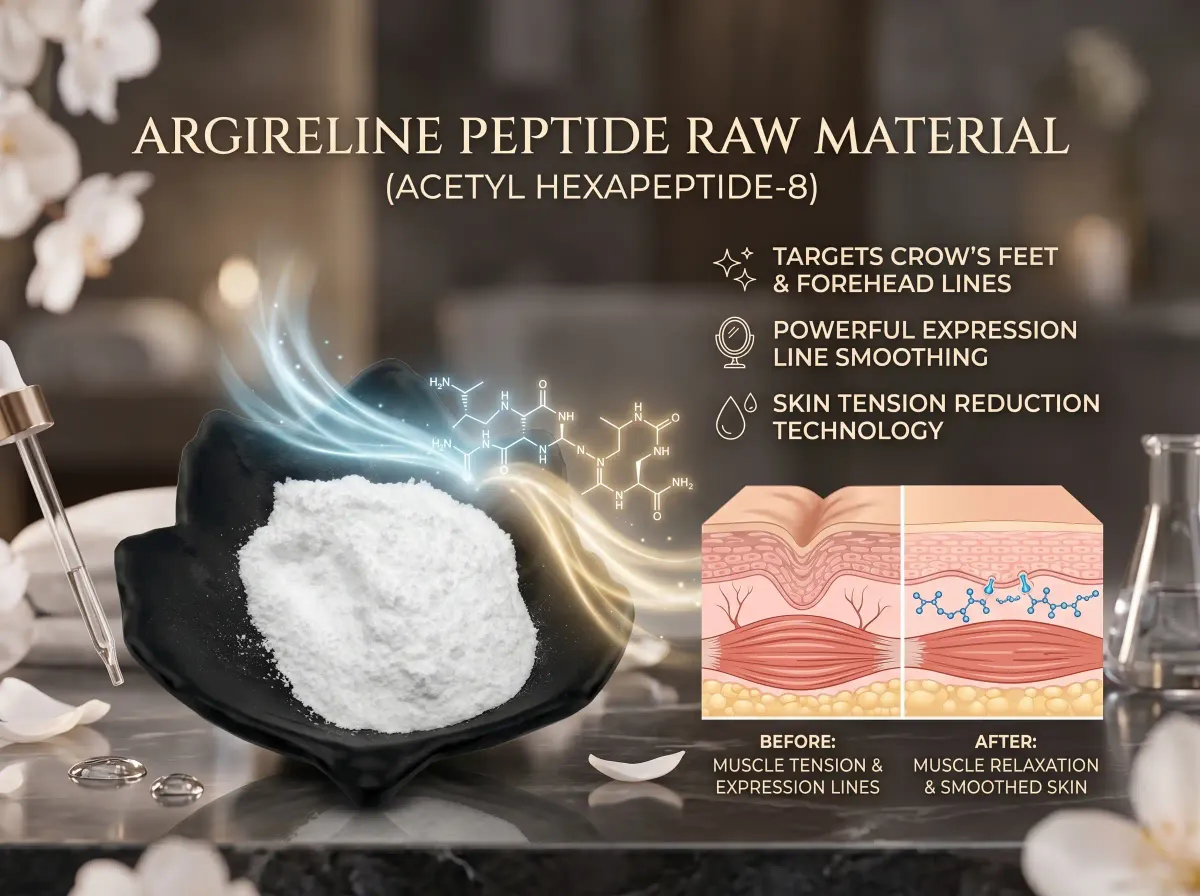
Argireline (Acetyl Hexapeptide-3 / Acetyl Hexapeptide-8) — Lipotec Anti-Expression-Line Peptide
Argireline (Acetyl Hexapeptide-8) - the original anti-wrinkle peptide by Lipotec, targeting the SNARE complex to reduce expression lines. 98%+ pure powder for cosmetic formulation. B2B bulk supply.
Product Overview: Argireline — The Original Anti-Expression-Line Peptide
Argireline (Acetyl Hexapeptide-8, CAS 616204-22-9) is the cosmetic industry's first and most clinically studied peptide targeting expression wrinkles. Developed by Lipotec S.A. (now part of Lubrizol Life Science Beauty), Argireline works through a unique SNARE-complex inhibition mechanism that reduces the intensity of facial muscle contractions — delivering visible wrinkle reduction without injections.
GINKVORA supplies pharmaceutical-grade Argireline as ≥98% pure lyophilized powder, suitable for serums, creams, and professional cosmetic formulations. Available in bulk quantities with full documentation support for B2B buyers, contract manufacturers, and independent formulators worldwide.
Nomenclature & Ingredient Identity
Argireline is a registered trademark of Lipotec / Lubrizol — the name itself denotes the branded, research-backed peptide, not a generic chemical. Understanding the naming system is essential for procurement, formulation documentation, and regulatory compliance.
| Identifier | Value | Notes |
|---|---|---|
| Brand/Trade Name | Argireline® | Registered trademark of Lipotec (Lubrizol Life Science Beauty) |
| INCI Name (Current) | Acetyl Hexapeptide-8 | Updated IUPAC-aligned nomenclature; used in modern regulatory filings |
| INCI Name (Historical) | Acetyl Hexapeptide-3 | Original INCI registration; still valid and widely recognized |
| Chemical Name | Acetyl glutamyl-glutamyl-methionyl-glutaminyl-arginyl-arginine amide | Full IUPAC-style systematic name |
| Amino Acid Sequence | Ac-Glu-Glu-Met-Gln-Arg-Arg-NH₂ | Acetylated N-terminus, amidated C-terminus; 6 residues |
| Abbreviated Sequence | Ac-EEMQRR-NH₂ | Standard single-letter code |
| CAS Number | 616204-22-9 | Unique chemical identifier |
| Molecular Formula | C₃₄H₆₀N₁₄O₁₂S | — |
| Molecular Weight | 888.91 Da | Verified against ChemicalBook and Baidu Encyclopedia |
| Supplier (Originator) | Lipotec S.A. / Lubrizol Life Science Beauty | Barcelona, Spain — the original developer and patent holder |
Why two INCI names? Acetyl Hexapeptide-3 was the original INCI designation. When peptide naming conventions were refined, it was reclassified as Acetyl Hexapeptide-8. Both names refer to the identical molecule. In practice, Acetyl Hexapeptide-8 is the current preferred term for new product documentation, while Acetyl Hexapeptide-3 remains commonly encountered on older labels and legacy INCI databases. GINKVORA certifies Argireline under both identifiers for maximum regulatory compatibility.
What the "acetyl" prefix means: The N-terminal acetylation (Ac-) and C-terminal amidation (-NH₂) are critical structural modifications that protect the peptide from rapid enzymatic degradation in topical formulations and enhance its stability during storage. These modifications are essential for functional activity — unmodified Glu-Glu-Met-Gln-Arg-Arg would be rapidly cleaved by skin peptidases and show negligible cosmetic effect.
Mechanism of Action: SNARE Complex Inhibition
The Biology of Expression Wrinkles
Expression wrinkles — crow's feet, forehead lines, glabellar frown lines — form when repeated facial muscle contractions fold the overlying skin. Each contraction is triggered by a precise molecular cascade:
- A nerve impulse arrives at the neuromuscular junction
- Synaptic vesicles containing acetylcholine (ACh) dock at the presynaptic membrane
- SNARE proteins (SNAP-25, syntaxin, synaptobrevin/VAMP) form a coiled-coil complex that pulls the vesicle and membrane together
- Membrane fusion releases ACh into the synaptic cleft
- ACh binds receptors on the muscle fiber, triggering contraction
- The skin above the muscle folds → an expression line forms
Repeat this cycle millions of times over years, and the transient fold becomes a persistent wrinkle.
How Argireline Interrupts This Cascade
Argireline mimics the N-terminal domain of SNAP-25 (amino acids 12–17) — the region responsible for SNARE complex assembly. When applied topically and absorbed through the skin, Argireline competitively embeds itself into the forming SNARE complex at the position normally occupied by SNAP-25.
The result: the ternary SNARE bundle (SNAP-25 + syntaxin + synaptobrevin) cannot achieve its fully zippered, fusogenic conformation. Vesicle docking efficiency decreases, less ACh is released per nerve impulse, and muscle contraction intensity is attenuated — without complete paralysis.
Argireline vs Botox: Mechanism Comparison
This is the most common question about Argireline — and the comparison reveals fundamental differences:
| Dimension | Argireline (Topical Peptide) | Botox (Injectable Botulinum Toxin) |
|---|---|---|
| Active Agent | Acetyl Hexapeptide-8 (6 amino acids, 888.91 Da) | Botulinum Toxin Type A (150 kDa protein complex) |
| Mechanism | Competitive SNARE binding; reversible | Proteolytic cleavage of SNAP-25; near-irreversible |
| Route | Topical (cream/serum) | Intramuscular injection |
| Onset | 1–4 weeks of daily use | 3–7 days post-injection |
| Duration | Continuous with daily application | 3–6 months per injection |
| Effect Magnitude | Wrinkle depth reduction ~17–27% | Near-complete muscle paralysis in treated area |
| Reversibility | Fully reversible upon discontinuation | Gradually reversible as new SNAP-25 is synthesized |
| Risk Profile | Topical irritation only (rare) | Injection-site pain, bruising, ptosis, asymmetry |
| Regulatory | Cosmetic ingredient | Prescription drug / medical procedure |
Why Argireline is called "Botox in a bottle": The phrase captures the conceptual parallel — both target the neuromuscular junction — but dramatically oversimplifies. Argireline does not inject, does not paralyze, and does not require medical supervision. It is better understood as a cosmetic neuromodulator that modestly attenuates muscle contraction rather than abolishing it.
GINKVORA note on responsible claims: We do not use the "Botox in a bottle" marketing label. Argireline's value proposition is precisely that it occupies a different category — accessible, self-administered, and fully reversible — not that it replicates an injectable neurotoxin. For brands formulating with Argireline, we recommend focusing on its unique mechanism rather than borrowed comparisons.
Clinical Evidence
Lipotec's original development program included multiple human efficacy studies. Key findings:
- Crow's feet (periorbital wrinkles): 10% Argireline solution applied twice daily for 28 days produced a 27% reduction in wrinkle depth vs baseline, measured by silicon replica profilometry (Lipotec clinical report, 2005)
- Forehead lines: A separate study using the same protocol reported approximately 30% reduction in forehead wrinkle depth over 30 days
- Onset timing: Visible improvement detectable from day 14; maximum effect at day 28–30 with continued twice-daily use
- Tolerability: Excellent across all studies; no adverse events attributed to the peptide
Important context on clinical data: All published efficacy studies were sponsored by Lipotec (the manufacturer). Independent, peer-reviewed randomized controlled trials remain limited. The foundational mechanistic study by Blanes-Mira et al. (Int J Cosmet Sci. 2002;24(5):303–310) established the molecular basis for SNARE inhibition by Ac-EEMQRR-NH₂ in vitro, and subsequent formulation studies have replicated wrinkle-reduction effects in human subjects — but the evidence base is smaller than for long-established active ingredients like retinol. Argireline's clinical data, while positive, should be understood as manufacturer-generated and modest in scale (total N ≈ 100–120 across all studies).
Specifications, Concentration & Raw Material Forms
Physical & Chemical Specifications
| Parameter | Specification |
|---|---|
| Appearance | White to off-white lyophilized powder |
| Purity (HPLC) | ≥98% |
| Molecular Weight | 888.91 Da |
| Molecular Formula | C₃₄H₆₀N₁₄O₁₂S |
| CAS Number | 616204-22-9 |
| Sequence | Ac-Glu-Glu-Met-Gln-Arg-Arg-NH₂ |
| Solubility | Freely soluble in water; compatible with water-phase formulations |
| pH Stability Range | 4–7 (optimal stability); degradation accelerates outside this range |
| Storage | -20°C, sealed, protected from light and moisture |
Raw Material Forms
Argireline is commercially available in two primary raw material forms:
| Form | Description | Best For |
|---|---|---|
| Lyophilized Powder | Freeze-dried pure peptide; highest stability, longest shelf life | Bulk procurement, long-term storage, custom concentration formulations |
| Solution (Stock) | Pre-dissolved aqueous solution (typically 0.05% w/w peptide); e.g., Argireline Solution NP from Lubrizol | Ready-to-use blending, small-batch manufacturing |
GINKVORA supplies Argireline in lyophilized powder form — the most versatile and stable format for B2B buyers who require precise control over final product concentration.
Argireline NP (Nanoparticle Version): Lubrizol's Argireline® peptide solution NP is a commercial stock solution containing Acetyl Hexapeptide-8 at ~0.05% (w/w) in a water base with phenoxyethanol and potassium sorbate as preservatives. The "NP" designation refers to the nano-encapsulation delivery system designed to enhance skin penetration. GINKVORA's lyophilized powder provides the same active peptide — formulators can achieve equivalent or superior penetration through their own delivery system choices (liposomes, penetration enhancers, microneedle-compatible formulations).
Concentration Guide
Understanding Argireline concentration is critical — and frequently misunderstood:
| Concentration | Context | What It Means |
|---|---|---|
| 0.5–1% (of pure peptide) | Clinical study range | The concentrations used in Lipotec's original efficacy trials |
| 2–10% (of commercial stock solution) | Lubrizol recommended use level | This is the recommended percentage of Lubrizol's Argireline solution (which itself is ~0.05% peptide) in the final product |
| 10% | Consumer product labeling (e.g., The Ordinary) | Typically refers to 10% of the commercial stock solution in the final formula — the industry convention for "10% Argireline" |
| 5–20% | DIY / high-concentration market | Concentrations seen in compounder and B2B formulations; efficacy above the clinical range is not established by published data |
Is higher concentration better? This is the most common question from formulators. The short answer: Lipotec has not published clinical data demonstrating improved efficacy above their standard use levels. The peptide operates through competitive binding to the SNARE complex — a saturable target. Once available binding sites are occupied, additional peptide provides diminishing returns. Standard formulation at 5–10% of stock solution (or 0.025–0.05% of active peptide) aligns with the evidence base. Concentrations of 20%+ are used in some markets but lack clinical validation.
Water-phase compatibility: Argireline is water-soluble and integrates easily into aqueous serums, toners, and gel-cream formulations. It should be added to the water phase during cool-down (<40°C) to preserve peptide integrity. The optimal pH for Argireline stability is 4–7 — avoid prolonged exposure to strongly acidic formulations (pH < 3.5) which can accelerate hydrolysis.
Safety Profile
EWG Skin Deep Assessment
Acetyl Hexapeptide-8 carries a low overall hazard score in the EWG Skin Deep database, with the following organ-system ratings:
| Endpoint | EWG Rating |
|---|---|
| Cancer | LOW |
| Allergies & Immunotoxicity | LOW |
| Developmental & Reproductive Toxicity | LOW |
| Use Restrictions | LOW |
Noted concerns (EWG):
- Contamination (HIGH): EWG flags potential contamination from phenoxyethanol, methylparaben, ethylparaben, propylparaben, butylparaben, and isobutylparaben — preservatives used in commercial stock solutions. GINKVORA's lyophilized powder form eliminates this concern entirely — no preservatives are present in the pure peptide.
- Neurotoxicity (LOW, in vitro): One or more in vitro tests on mammalian cells demonstrate neurotoxicity at high concentrations. This is consistent with the peptide's mechanism of action (SNARE inhibition) and does not indicate a safety concern at topical cosmetic use levels.
- Enhanced skin absorption: Acetyl Hexapeptide-8 is designed to penetrate the skin — this is a functional feature, not a hazard. CIR (Cosmetic Ingredient Review) and peer-reviewed literature confirm absorption.
- Biochemical/cellular changes (LOW): Animal studies show cellular changes at high doses where human health implications are not yet well understood (CIR assessment).
EWG VERIFIED status: Products containing Acetyl Hexapeptide-8 are allowed in EWG VERIFIED but must meet use restrictions and warnings based on EWG review of company data.
Topical Safety Data
Based on available published evidence and manufacturer safety assessments:
- No systemic toxicity reported at cosmetic topical doses
- No carcinogenicity, mutagenicity, or reproductive toxicity signals in available data
- Dermal irritation: Rare and mild when it occurs; typically formulation-related rather than peptide-related
- No phototoxicity or photosensitization reported
Addressing the "Sagging" Concern
Does long-term Argireline use cause facial sagging or muscle atrophy?
This concern arises from confusion with Botox pharmacology. Botulinum toxin produces near-complete, prolonged muscle paralysis that can — in extreme or poorly administered cases — lead to compensatory muscle changes and a "frozen" appearance. There is no clinical evidence that topical Argireline causes facial sagging, muscle atrophy, or irreversible muscle weakness:
- Magnitude difference: Argireline modestly attenuates contraction (~17–27% wrinkle depth reduction); Botox eliminates it (near-100% paralysis in treated muscle). The partial inhibition achieved by topical Argireline is insufficient to cause disuse atrophy.
- Pharmacokinetics: The amount of peptide reaching the neuromuscular junction after topical application is orders of magnitude lower than that achieved by intramuscular injection. The concentration gradient from stratum corneum to deep dermal muscle is extreme.
- Reversibility: Argireline's competitive binding is inherently reversible — the peptide dissociates, and normal SNARE function resumes. There is no covalent modification and no permanent alteration of the SNARE machinery.
Injectable Use: Critical Safety Warning
Argireline is a cosmetic ingredient designed exclusively for topical application. It must NOT be injected.
GINKVORA explicitly states that our Argireline powder is cosmetic-grade raw material for topical formulation only. It is not:
- Sterile or pyrogen-free for parenteral use
- Manufactured under injectable GMP standards
- Approved by any regulatory agency for injection
- Tested for injection safety in any clinical trial
The high CPC (cost-per-click) for "argireline injection" search terms indicates that some users actively seek injectable peptide information. We strongly advise against any off-label injection use. For those seeking injectable wrinkle treatment, FDA-approved botulinum toxin products administered by licensed medical professionals are the only evidence-based option.
Pregnancy & Breastfeeding Safety
This is the largest safety-concern keyword cluster in the Argireline search dataset (30+ variants, 300+/mo combined search volume), reflecting a real information gap that deserves a direct, evidence-based response.
What We Know
- No human pregnancy or lactation studies exist for Acetyl Hexapeptide-8. The peptide has never been tested in pregnant or breastfeeding populations.
- Theoretical considerations: As a 6-amino-acid peptide (888.91 Da) applied topically, systemic absorption is expected to be extremely low. The molecular weight is below the ~500 Da "Rule of Five" threshold for efficient passive permeation, but the peptide's charged residues (Arg, Glu) and hydrogen-bonding capacity significantly reduce its effective permeability through intact stratum corneum and into systemic circulation.
- EWG developmental toxicity rating: LOW — based on absence of signals in available data, not on affirmative safety studies.
Clinical Guidance
In the absence of pregnancy-specific safety data, the standard precautionary approach applies:
For pregnant individuals: Consult your obstetrician or dermatologist before using Argireline-containing products. While the theoretical risk is extremely low (minimal systemic absorption of a small peptide), no ingredient should be introduced during pregnancy without medical consultation.
For breastfeeding individuals: The same consultation principle applies. The extremely low likelihood of meaningful systemic absorption makes transfer into breast milk implausible, but in the absence of direct lactation studies, medical guidance is the appropriate standard.
What GINKVORA Recommends to Brand Partners
When formulating consumer products containing Argireline:
- Include standard pregnancy/breastfeeding precautionary labeling ("Consult your physician if pregnant or nursing")
- Do not make affirmative pregnancy-safety claims — this would exceed the available evidence
- Do not make restrictive claims that exaggerate risk — "Not safe during pregnancy" is also unsupported by evidence
- Focus messaging on the established topical safety profile for the general adult population
The honest, compliant position is: no evidence of harm + no evidence of safety = consult your doctor. This satisfies regulatory expectations (FTC, EU Cosmetics Regulation, CFDA/NMPA) while respecting the legitimate information needs of pregnant and breastfeeding consumers.
Source pharmaceutical-grade Argireline from GINKVORA for your cosmetic formulations. Every batch is HPLC-verified at ≥98% purity with full documentation. B2B bulk quantities available from 1g to 1kg.
Frequently Asked Questions
Request a Quote for Argireline (Acetyl Hexapeptide-3 / Acetyl Hexapeptide-8) — Lipotec Anti-Expression-Line Peptide
Complete the form below to receive pricing, specifications, and a free sample. Our sales team will contact you within 12 hours.