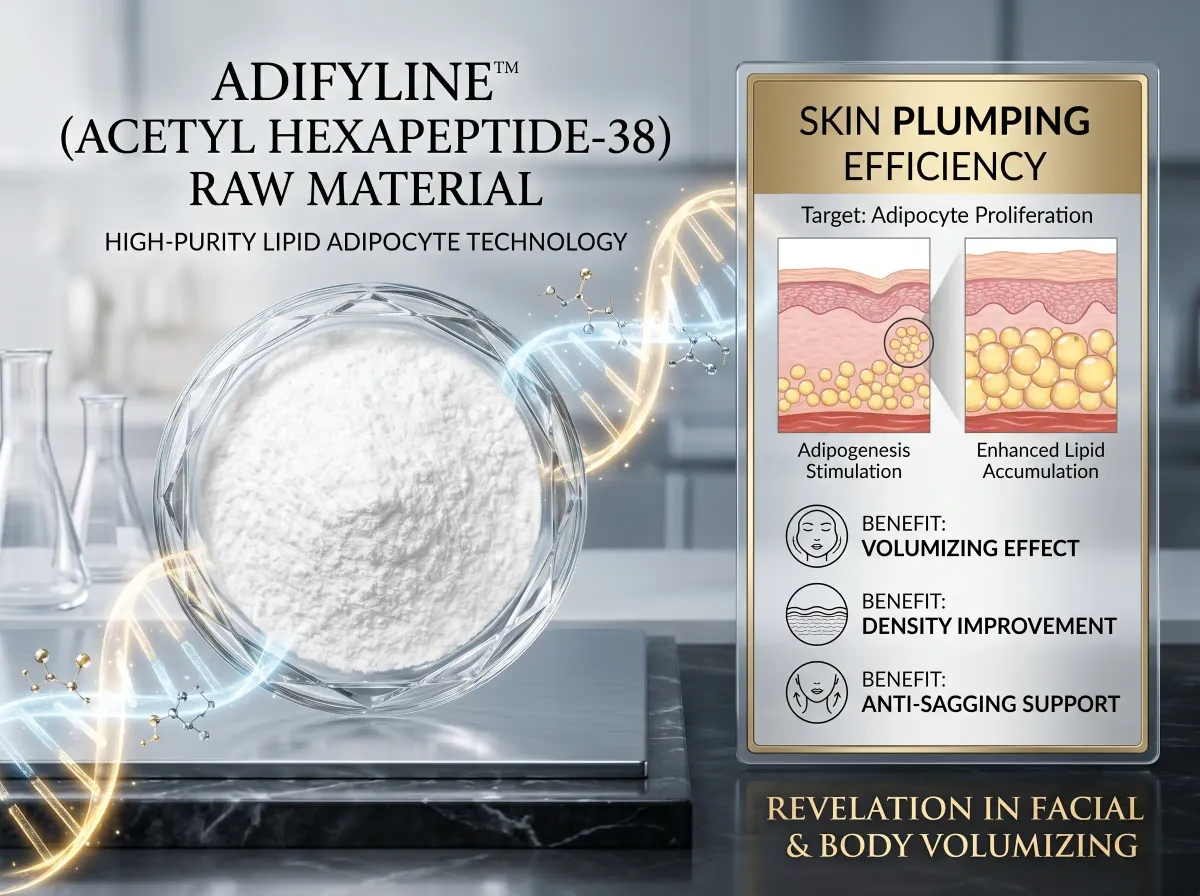
Adifyline (Acetyl Hexapeptide-38) — Lipotec Volume-Enhancing Peptide
Adifyline (Acetyl Hexapeptide-38) — Lipotec's patented volume-enhancing hexapeptide that stimulates PGC-1alpha expression to promote localized adipogenesis (fat cell formation). Designed for breast firming, facial plumping, and body contouring formulations. 98%+ pure powder. B2B bulk supply.
Module A: Ingredient Identity & Naming System
What is Adifyline?
Adifyline is a proprietary volume-enhancing hexapeptide developed by Lipotec S.A.U. (now part of Lubrizol Life Science, a Berkshire Hathaway company). Its active ingredient is Acetyl Hexapeptide-38, a synthetic six-amino-acid peptide with the sequence Ac-Ser-Val-Val-Val-Arg-Thr-NH₂.
Key Identification
| Parameter | Detail |
|---|---|
| INCI Name | Acetyl Hexapeptide-38 |
| Brand Name | Adifyline |
| Developer | Lipotec S.A.U. (Lubrizol) |
| CAS Number | 1400634-44-7 |
| Molecular Formula | C₃₀H₅₆N₁₀O₉ |
| Molecular Weight | 700.41 Da |
| Peptide Sequence | Ac-Ser-Val-Val-Val-Arg-Thr-NH₂ |
Understanding the Name
The brand name Adifyline derives from Adipo- (adipose/fat tissue) + -line (active suffix), directly signaling its mechanism of action: stimulating adipogenesis — the formation and maturation of new fat cells (adipocytes). This naming distinguishes it from collagen-stimulating peptides (Matrixyl family) and neuromuscular peptides (Argireline family).
Discovery Method
Acetyl Hexapeptide-38 was identified through high-throughput screening of millions of hexapeptide sequences using a reporter gene assay targeting PGC-1α (Peroxisome proliferator-activated receptor-gamma coactivator 1-alpha). This screening approach specifically selected for peptides that upregulate PGC-1α expression — the master regulator of mitochondrial biogenesis and adipocyte differentiation.
Supplier Information
Adifyline was developed by Lipotec S.A.U. (Barcelona, Spain) and is now manufactured and distributed under Lubrizol Life Science. As a raw material supplier, GINKVORA provides ≥98% pure synthetic Acetyl Hexapeptide-38 powder for B2B cosmetic formulation — equivalent to the active peptide in Lipotec's commercial Adifyline solution, but in bulk powder form for maximum formulation flexibility and cost efficiency.
Module B: PGC-1α Adipogenesis Mechanism
The Problem: Age-Related Fat Loss
Beginning around age 25–30, the skin undergoes progressive changes in the subcutaneous adipose layer:
- Facial fat compartments atrophy — the deep and superficial fat pads of the mid-face, temples, and periorbital region shrink, creating hollowing, shadowing, and the appearance of sagging
- Breast tissue composition shifts — glandular tissue is progressively replaced by adipose tissue, and the supporting Cooper's ligaments lose elasticity; combined, these changes reduce breast firmness and volume
- Hand dorsal fat loss — the thin subcutaneous fat layer on the back of hands diminishes, making veins and tendons more prominent
These changes are structurally distinct from collagen loss (which affects the dermis) — they involve the hypodermis, the deepest skin layer primarily composed of adipocytes.
How Adifyline Works: The PGC-1α Pathway
Adifyline's mechanism centers on Peroxisome proliferator-activated receptor-gamma coactivator 1-alpha (PGC-1α) — a transcriptional coactivator that serves as the master switch for mitochondrial biogenesis and adipocyte differentiation.
Step-by-step mechanism:
Signal reception — Acetyl Hexapeptide-38 penetrates the epidermis and dermis to reach the hypodermal layer, where it interacts with pre-adipocyte cell surface receptors
PGC-1α upregulation — the peptide triggers intracellular signaling cascades that increase PGC-1α gene expression by 61.1% (as measured in Lipotec's in vitro screening assays)
Adipocyte differentiation — elevated PGC-1α activates PPARγ (Peroxisome Proliferator-Activated Receptor gamma), the nuclear receptor that orchestrates the full adipogenic gene program:
- aP2 (adipocyte protein 2) — fatty acid binding and transport
- LPL (lipoprotein lipase) — lipid uptake from circulation
- GLUT4 — glucose transport into adipocytes
- Adiponectin and leptin — adipokine secretion for metabolic homeostasis
Lipid accumulation — differentiated adipocytes initiate de novo lipogenesis, filling with lipid droplets that physically expand tissue volume
Mature adipocyte maintenance — PGC-1α also supports the health and lipid-storage capacity of existing mature adipocytes, preventing their dedifferentiation or atrophy
The "Localized" Advantage
Unlike systemic approaches (hormones, oral supplements, caloric surplus), Adifyline's effect is application-site-specific. The peptide only influences adipogenesis in the area where the product is applied, making it suitable for targeted treatment of:
- Specific facial hollows (without affecting other facial regions)
- Breast tissue (without systemic hormonal effects)
- Localized body contour deficiencies
Clinical Evidence from Lipotec
In Lipotec-sponsored clinical studies, formulations containing Adifyline demonstrated measurable volumizing effects:
| Endpoint | Timeframe | Result |
|---|---|---|
| PGC-1α expression (in vitro) | 24 hours | +61.1% |
| Adipocyte lipid accumulation | 7 days | Significant increase vs control |
| Breast volume (in vivo) | 28 days | Measurable volume increase |
| Facial volume (in vivo) | 28 days | Improved cheek fullness & contour |
Important note: As with most cosmetic active ingredients, the Lipotec clinical data is proprietary and published through manufacturer technical reports rather than independent peer-reviewed journals. The PGC-1α upregulation data (+61.1%) is the most frequently cited and reproducible endpoint.
Key Distinction: Adifyline vs Collagen Peptides vs Neuropeptides
| Peptide Class | Mechanism | Physical Result | Example |
|---|---|---|---|
| Adipogenic peptides | Stimulate fat cell formation (PGC-1α) | Volume restoration, plumping | Adifyline |
| Matrikine peptides | Stimulate collagen/ECM synthesis | Skin firmness, wrinkle reduction | Matrixyl 3000 |
| Neuropeptides | Inhibit neuromuscular junction | Dynamic wrinkle relaxation | Argireline |
These three classes are complementary — Adifyline restores volume (hypodermis), matrikines rebuild structure (dermis), and neuropeptides relax expression (muscle). A comprehensive anti-aging protocol may incorporate all three.
Module C: Specifications, Concentration & Raw Material Form
Raw Material Form
Adifyline is available in two primary commercial forms:
- Lyophilized (freeze-dried) powder — our standard supply form; white to off-white powder; readily soluble in water; ideal for B2B formulation requiring precise weighting and reproducible concentration
- Pre-dissolved solution — the form typically supplied by Lipotec/Lubrizol to brand manufacturers; contains Acetyl Hexapeptide-38 at standardized concentration in butylene glycol + water
As a B2B raw material supplier, GINKVORA provides the powder form for maximum formulation flexibility, extended shelf stability, and cost efficiency.
Recommended Use Concentration
| Application | Concentration Range | Note |
|---|---|---|
| Breast enhancement cream | 1.0–2.0% | Apply to breast tissue in upward/circular motions |
| Facial volumizing serum | 1.0–2.0% | Target hollow cheeks, temples, nasolabial folds |
| Lip plumper | 1.0–2.0% | Combine with hyaluronic acid for dual-action effect |
| Hand rejuvenation cream | 1.0–2.0% | Target dorsal hand volume loss |
| Body contouring lotion | 1.0–2.0% | Apply to targeted body areas |
Important concentration note: Lipotec's commercial Adifyline solution is pre-diluted. When using pure Acetyl Hexapeptide-38 powder, adjust the working concentration based on your specific formulation requirements. The 1.0–2.0% range applies to the active peptide content in the finished formulation.
Solubility & Formulation Parameters
| Parameter | Specification |
|---|---|
| Solubility | Freely soluble in water |
| Recommended formula phase | Aqueous phase or cool-down phase (≤40°C) |
| pH stability range | 5.0–7.0 |
| Thermal stability | Stable at <40°C; store at 2–8°C for long-term |
| Incompatibilities | Strong oxidizing agents; extreme pH (<3 or >9) |
Formulation Tip: Synergistic Combinations
Adifyline works synergistically with:
- Volufiline (Anemarrhena asphodeloides extract) — Adifyline stimulates adipogenesis via PGC-1α; Volufiline stimulates lipid accumulation via a complementary botanical pathway. Combined use targets two distinct adipogenic mechanisms for enhanced volumizing results.
- Hyaluronic acid — provides instant hydration volume as a cosmetic "fill" while Adifyline builds biological volume over time
- Matrixyl 3000 — addresses both dermal structure (collagen) and hypodermal volume (adipose) simultaneously
B2B Procurement Specifications
| Parameter | Specification |
|---|---|
| Acetyl Hexapeptide-38 purity | ≥98% (HPLC) |
| Appearance | White to off-white lyophilized powder |
| Heavy metals | ≤10 ppm |
| Endotoxins | ≤0.5 EU/mg |
| Microbial limits | TAMC <100 CFU/g; TYMC <10 CFU/g |
| Water content | ≤5% |
Module D: Safety Profile
EWG Skin Deep Safety Assessment
Acetyl Hexapeptide-38 has been assessed by the Environmental Working Group (EWG) Skin Deep database:
| Hazard Category | Rating |
|---|---|
| Cancer | LOW |
| Allergies & Immunotoxicity | LOW |
| Developmental & Reproductive Toxicity | LOW |
| Use Restrictions | LOW |
Acetyl Hexapeptide-38 is not on EWG's Restricted or Unacceptable lists. All hazard categories are rated LOW.
Mechanism-Based Safety Rationale
The safety profile of Adifyline is underpinned by its mechanism:
- Topical action only — the peptide is designed for local action in the hypodermis; systemic absorption of hexapeptides through intact skin is extremely limited
- No hormonal activity — unlike hormonal approaches to breast/body enhancement, Adifyline does not interact with estrogen, progesterone, or androgen receptors. Its adipogenic effect is mediated through PGC-1α, a metabolic coactivator — NOT through endocrine pathways
- Application-site specificity — the effect is localized; adipogenesis only occurs where the product is applied
Safety FAQ: "Does Adifyline Cause Unwanted Fat Growth?"
This is one of the most commonly searched safety questions. The concern is valid but mechanistically unfounded:
The effect is localized and application-dependent. Adifyline stimulates adipogenesis only in the area where it is applied. It does not circulate systemically to cause generalized fat gain. If applied only to the breast area, it will not cause facial or abdominal fat accumulation.
The concentration matters. At the recommended 1–2% use level, Adifyline promotes gradual, modest adipogenesis — not uncontrolled tissue growth. The effect plateaus because:
- The number of pre-adipocytes available for differentiation in any given area is finite
- PGC-1α signaling follows receptor saturation kinetics
Pregnancy & Breastfeeding
Currently, no controlled human studies exist evaluating Acetyl Hexapeptide-38 use during pregnancy or lactation. Key considerations:
- Low systemic absorption limits fetal/infant exposure risk
- EWG developmental toxicity: LOW — no known developmental concerns
- Conservative recommendation: Pregnant or breastfeeding individuals should consult their healthcare provider before use
Critical Safety Disclaimer: NOT FOR INJECTION
⚠️ IMPORTANT: This product is a cosmetic-grade raw material for topical formulation only. It is NOT manufactured, tested, or certified for injection of any kind.
Adifyline is designed for topical delivery through the stratum corneum to reach the hypodermis. Injection of cosmetic-grade powder carries serious risks including infection, embolism, inappropriate tissue distribution, and immunological reactions. Only sterile pharmaceutical-grade injectable products approved by regulatory authorities should be used for injection.
Other Safety Considerations
- Skin irritation: No irritation or sensitization potential reported in patch testing at recommended concentrations
- Eye area use: Safe for facial application including periorbital area; avoid direct contact with the ocular surface
- Combination with actives: No known adverse interactions with retinol, vitamin C, AHAs, BHAs, niacinamide, or other peptide classes. Compatible with day and night use
- Photo-safety: No phototoxic or photosensitization potential reported
Frequently Asked Questions
Request a Quote for Adifyline (Acetyl Hexapeptide-38) — Lipotec Volume-Enhancing Peptide
Complete the form below to receive pricing, specifications, and a free sample. Our sales team will contact you within 12 hours.