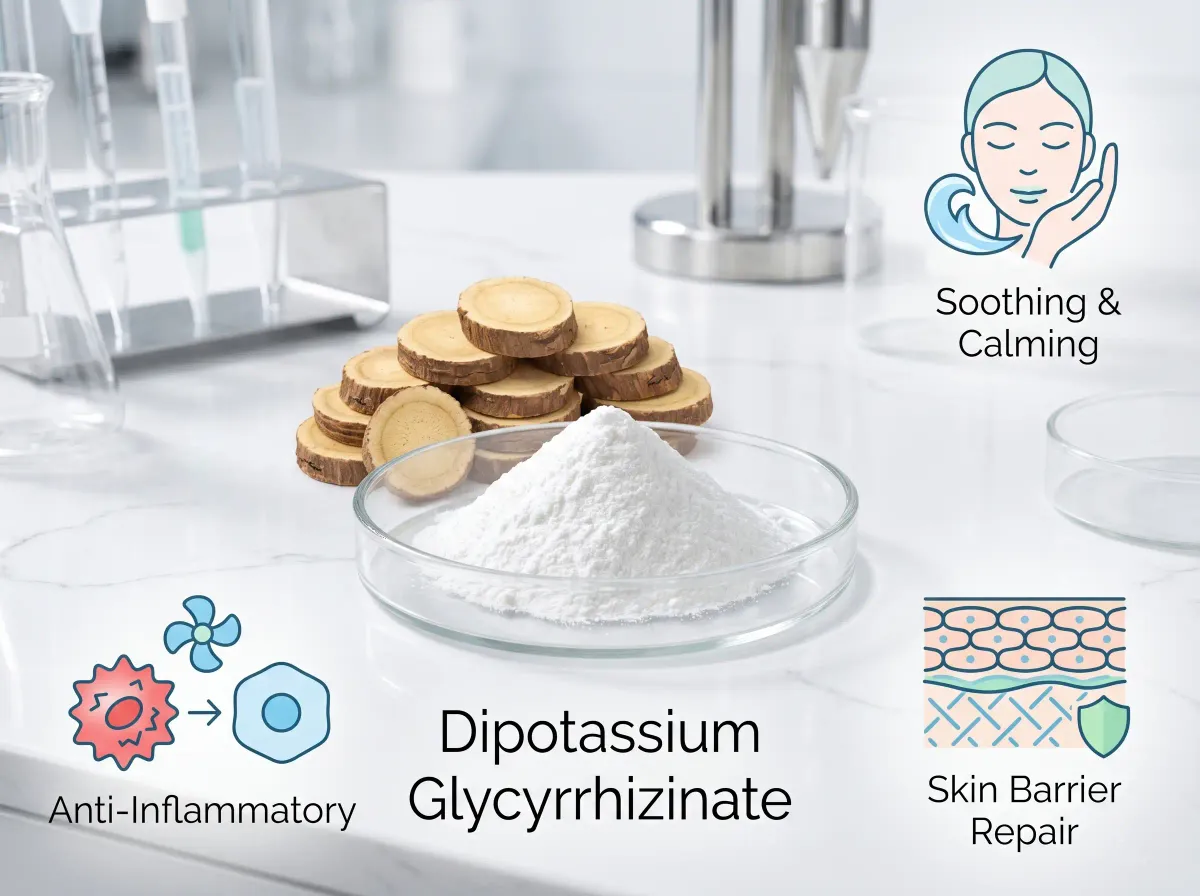
Dipotassium Glycyrrhizinate — Bulk Raw Material
Glycyrrhiza glabra L.
Our GINKVORA Dipotassium Glycyrrhizinate is standardized to **≥98% purity by HPLC**, produced under cGMP from traceable licorice root, and available in bulk quantities for cosmetic manufacturers, supplement brands, and pharmaceutical compounding.
What Is Dipotassium Glycyrrhizinate?
Dipotassium Glycyrrhizinate (DG) — also listed as Glycyrrhizinate Dipotassium — is the dipotassium salt of glycyrrhizic acid. It is a triterpenoid saponin glycoside isolated from the root of licorice (Glycyrrhiza glabra L., Fabaceae). Through alkaline hydrolysis and potassium salification, glycyrrhizic acid is converted into a water-soluble, stable crystalline powder that retains the full anti-inflammatory activity of the parent compound while overcoming its solubility limitations.
Chemical Identity:
- CAS Number: 68797-35-3
- INCI Name: Dipotassium Glycyrrhizinate
- Molecular Formula: C₄₂H₆₀K₂O₁₆
- Molecular Weight: 899.13 g/mol
- EWG Safety Rating: 1 (lowest hazard)
DG is distinct from other licorice derivatives. While Glabridin targets melanogenesis (whitening), DG specializes in anti-inflammatory and soothing pathways — it is the ingredient formulators reach for when "calming" is the primary claim, not "brightening."
How Dipotassium Glycyrrhizinate Works: Anti-Inflammatory Mechanism
DG's anti-inflammatory effects operate through three complementary pathways:
| Pathway | Mechanism | Result |
|---|---|---|
| Hyaluronidase Inhibition | Suppresses the enzyme that degrades hyaluronic acid in extracellular matrix | Preserves skin barrier integrity, reduces transepidermal water loss |
| Phospholipase A₂ Inhibition | Blocks arachidonic acid release from membrane phospholipids | Downstream reduction in prostaglandins and leukotrienes — fewer pro-inflammatory signals |
| COX-2 and 5-LOX Inhibition | Dual-pathway suppression of cyclooxygenase-2 and 5-lipoxygenase | Broad-spectrum anti-inflammatory activity without COX-1 suppression (unlike NSAIDs), meaning no gastric side effects |
What makes DG particularly valuable: it shares structural and mechanistic similarities with cortisone (natural glucocorticoid), delivering cortisone-like calming effects without the immunosuppressive or skin-thinning side effects of topical corticosteroids. This is why DG has been a staple in Japanese quasi-drug formulations (处方药) for decades — especially in products labeled for "skin roughness" and atopic dermatitis adjunct care.
Clinical Evidence & Benefits
1. Anti-Inflammatory & Skin Soothing
DG is one of the most clinically studied natural anti-inflammatories in dermatology. In a randomized controlled patch test, 0.5% DG cream significantly reduced UVB-induced erythema by 47% compared to vehicle control within 24 hours. Multiple studies confirm DG's efficacy in reducing redness, itching, and irritation across skin types — including sensitive and atopic skin.
Target keywords: dipotassium glycyrrhizinate anti-inflammatory, dipotassium glycyrrhizinate skin
2. Eye Drop Compatibility
DG's excellent water solubility and safety profile make it one of the few botanical active ingredients suitable for ophthalmic formulations. In Japan, DG is a common component in over-the-counter eye drops approved for allergic conjunctivitis and eye fatigue. The minimum irritative concentration in ocular tissues is well above the typical usage level (0.1%–0.5%), providing a wide safety margin.
Target keyword: dipotassium glycyrrhizinate eye drops
3. Sensitive Skin & Barrier Repair
By inhibiting hyaluronidase, DG preserves endogenous hyaluronic acid levels in the extracellular matrix, supporting the skin's natural moisture retention and barrier function. Combined with its anti-inflammatory action, this positions DG as an ideal active for sensitive-skin formulations — from cleansers and toners to leave-on serums.
4. Aftershave & Post-Procedure Care
Because DG suppresses post-inflammatory erythema without inducing photosensitivity or epidermal thinning, it is widely used in aftershave balms, post-waxing lotions, and post-procedure (microneedling, laser, chemical peel) recovery formulations.
5. Acne Adjunct Care
DG's ability to suppress both COX-2 and 5-LOX pathways makes it particularly useful in acne-prone skin formulations. Rather than targeting Cutibacterium acnes directly (like benzoyl peroxide or salicylic acid), DG addresses the inflammatory cascade that turns comedones into inflamed papules and pustules — providing a gentle, non-drying complement to standard acne treatments.
6. Synergy with Other Actives
DG pairs exceptionally well with other anti-inflammatory and barrier-supporting ingredients:
| Combination | Synergy |
|---|---|
| DG + Niacinamide | Dual-pathway anti-inflammatory + sebum regulation for acne/rosacea |
| DG + Centella Asiatica (Madecassoside) | Broad-spectrum soothing; DG targets COX/LOX, Centella targets collagen synthesis |
| DG + Ceramides | Anti-inflammatory + barrier lipid replenishment for atopic skin |
| DG + Panthenol (B5) | Hydration + anti-inflammatory for post-procedure recovery |
| DG + Allantoin | Classic OTC calmative pair for sensitive skin and baby products |
Dipotassium Glycyrrhizinate vs. Other Licorice Derivatives
| Ingredient | Primary Function | Water Solubility | Typical Usage | EWG |
|---|---|---|---|---|
| Dipotassium Glycyrrhizinate | Anti-inflammatory / Soothing | High (>100 mg/mL) | 0.1%–1.0% | 1 |
| Glabridin | Tyrosinase inhibition / Whitening | Very low (oil-soluble) | 0.1%–0.5% | 1 |
| Glycyrrhetinic Acid | Anti-inflammatory (aglycone) | Very low | 0.05%–0.1% | 1 |
| Monoammonium Glycyrrhizinate | Anti-inflammatory / Sweetener | Moderate | 0.1%–0.5% | 1 |
| Licorice Root Extract (crude) | Multifunctional (low potency) | Moderate | 1%–5% | 1 |
Key advantage: DG is the only licorice derivative that combines high water solubility, high potency (purified salt), and EWG 1 safety — making it uniquely suited for aqueous formulations where solubility is a formulation constraint.
Formulation Guide
Recommended Incorporation
DG is a cold-process-friendly ingredient due to its excellent water solubility. It can be added at the aqueous phase stage:
- Water Phase: Dissolve DG in purified water at 25–40°C with gentle stirring. Complete dissolution occurs within minutes.
- Optimal pH: Formulate in pH 5.0–6.5 range for maximum stability. Avoid prolonged exposure to pH <4.0 or >8.0.
- Temperature Stability: Stable up to 80°C. Avoid prolonged heating above 80°C.
Formulation Compatibility
- Compatible: Water, glycerin, propylene glycol, ethanol, most surfactants, hyaluronic acid, niacinamide, panthenol, allantoin, ceramides, peptides
- Caution: Strong oxidizing agents (H₂O₂), highly alkaline environments (pH >8.0)
- Synergistic Pairs: See synergy table above
Solubility at a Glance
| Solvent | Solubility (25°C) |
|---|---|
| Water | >100 mg/mL |
| Ethanol (95%) | 50–60 mg/mL |
| Glycerin | 40–50 mg/mL |
| Propylene Glycol | 60–80 mg/mL |
| Oil (mineral/vegetable) | Practically insoluble |
Product Applications
Dipotassium Glycyrrhizinate can be formulated into the following product types:
| Product Type | Typical Usage % | Key Consumer Claim |
|---|---|---|
| Calming Serum | 0.2%–0.5% | Soothes redness, strengthens barrier |
| Sensitive Skin Toner | 0.1%–0.3% | Gentle anti-inflammatory hydration |
| Eye Cream | 0.1%–0.2% | Reduces puffiness and periorbital irritation |
| Eye Drops | 0.05%–0.1% | Anti-allergic, anti-fatigue (ophthalmic grade) |
| Aftershave Balm | 0.2%–1.0% | Calms razor burn, reduces post-shave erythema |
| Post-Procedure Cream | 0.2%–0.5% | Supports skin recovery after microneedling/laser |
| Acne Spot Treatment | 0.1%–0.3% | Anti-inflammatory adjunct, non-drying |
| Baby / Sensitive Skin Lotion | 0.05%–0.2% | Ultra-mild protection for delicate skin |
| Sheet Mask Essence | 0.1%–0.3% | Instant soothing for irritated skin |
Safety & Regulatory
- EWG Verified: Hazard score 1 (lowest)
- CIR (Cosmetic Ingredient Review) Panel: Assessed as safe in cosmetic formulations at concentrations up to 1%
- Japan MHLW: Approved as quasi-drug active ingredient for anti-inflammatory indications
- EU CosIng: Listed and permitted
- Pregnancy/Nursing: No known restrictions; generally regarded as safe in topical use
- Eye Irritation: Non-irritating at ophthalmic-grade concentrations
Quality Control & Certifications
GINKVORA Dipotassium Glycyrrhizinate is manufactured under ISO 9001 and cGMP standards with full traceability from licorice root harvest to final powder:
| QC Parameter | Specification | Test Method |
|---|---|---|
| Purity (HPLC) | ≥ 98.0% | In-house HPLC |
| Glycyrrhizic Acid Equiv. | 68.0–72.0% | USP/EP |
| Heavy Metals | Pb ≤ 10, As ≤ 2, Cd ≤ 1, Hg ≤ 0.1 ppm | ICP-MS |
| Loss on Drying | ≤ 5.0% | USP <731> |
| pH (1% aq.) | 5.5–6.5 | Potentiometric |
| Microbial Limits | TAMC < 1,000 CFU/g, TYMC < 100 CFU/g | USP <61>/<62> |
FAQ
Q: What is dipotassium glycyrrhizinate? A: Dipotassium glycyrrhizinate (DG) is the dipotassium salt of glycyrrhizic acid, a triterpenoid saponin extracted from licorice root (Glycyrrhiza glabra). It is a water-soluble, EWG-rated 1 anti-inflammatory ingredient used in cosmetics, eye drops, and sensitive-skin products to soothe redness, irritation, and inflammation.
Q: What is the INCI name for dipotassium glycyrrhizinate? A: The INCI name is precisely "Dipotassium Glycyrrhizinate." It may also be referenced as Glycyrrhizinate Dipotassium in some regulatory filings; both refer to the same substance, CAS 68797-35-3.
Q: Is dipotassium glycyrrhizinate safe for skin? A: Yes. With an EWG hazard score of 1 (lowest risk), a favorable CIR safety review at up to 1% cosmetic use, and decades of safe use in Japanese quasi-drug and prestige skincare formulations, DG is one of the most well-established safe natural anti-inflammatory ingredients available to formulators.
Q: Can dipotassium glycyrrhizinate be used in eye drops? A: Yes. DG is approved in Japan for use in over-the-counter eye drops for allergic conjunctivitis and eye fatigue. Its high water solubility and non-irritating profile at ophthalmic concentrations make it suitable for ocular formulations when manufactured under appropriate GMP conditions.
Q: What is the solubility of dipotassium glycyrrhizinate? A: DG is highly water-soluble (>100 mg/mL at 25°C). It is also soluble in ethanol (50–60 mg/mL), glycerin (40–50 mg/mL), and propylene glycol (60–80 mg/mL). DG is practically insoluble in fixed oils and mineral oil.
Q: What is the difference between dipotassium glycyrrhizinate and glycyrrhetinic acid? A: Dipotassium glycyrrhizinate is the dipotassium salt of glycyrrhizic acid (the glycoside), while glycyrrhetinic acid is the aglycone (sugar-removed form). DG is highly water-soluble and preferred for aqueous formulations; glycyrrhetinic acid is oil-soluble and typically used at lower concentrations (0.05%–0.1%). DG has broader safety data in leave-on and ophthalmic applications.
Q: What is dipotassium glycyrrhizinate made from? A: DG is a semi-synthetic derivative — it starts with glycyrrhizic acid naturally occurring in licorice (Glycyrrhiza glabra) root, which undergoes alkaline hydrolysis followed by potassium salification to form the dipotassium salt. The final product is a ≥98% pure white crystalline powder.
Q: How should dipotassium glycyrrhizinate be formulated? A: DG dissolves readily in the aqueous phase at 25–40°C. Add at 0.1%–1.0% for topical formulations. Maintain pH 5.0–6.5 for optimal stability. Compatible with niacinamide, panthenol, ceramides, hyaluronic acid, and most peptides. Avoid prolonged exposure to strong oxidizers and pH extremes.
Frequently Asked Questions
Request a Quote for Dipotassium Glycyrrhizinate — Bulk Raw Material
Complete the form below to receive pricing, specifications, and a free sample. Our sales team will contact you within 12 hours.