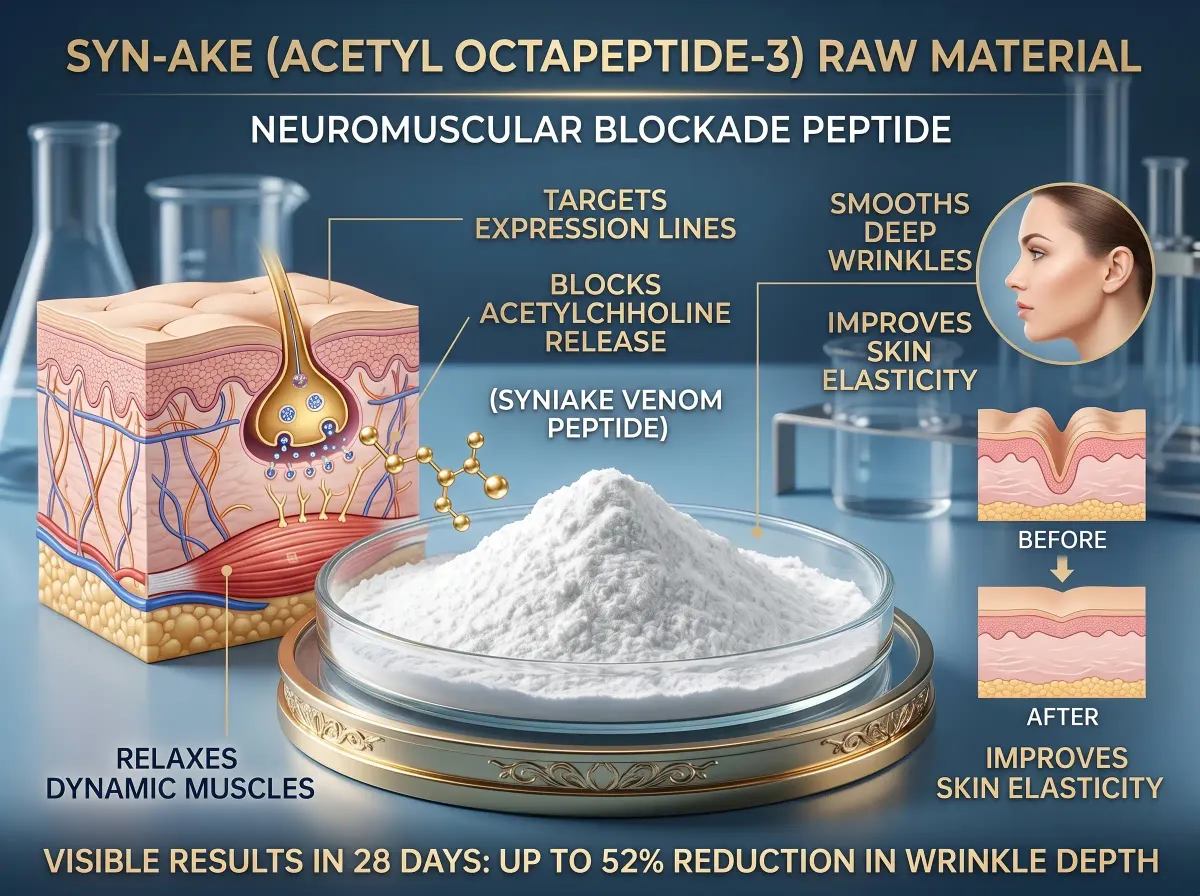
SYN-AKE — Pentapharm Snake Venom Anti-Wrinkle Dipeptide
SYN-AKE by Pentapharm/DSM: Waglerin-1 mimetic dipeptide targeting postsynaptic nAChR. Clinically validated at 4% with 52% wrinkle reduction in 28 days. Water-soluble. >=98% purity. B2B bulk raw material.
Module A: Ingredient Identity, Nomenclature & Origin
What Is SYN-AKE?
SYN-AKE is a synthetic dipeptide (INCI: Dipeptide Diaminobutyroyl Benzylamide Diacetate; also classified as Tripeptide-3 under alternative INCI naming) developed in 2006 by Pentapharm Ltd., a Swiss biotechnology company now operating as part of DSM-Firmenich. It is a functional mimetic of Waglerin-1, a 22-amino acid neurotoxic peptide found in the venom of the Temple Viper (Tropidolaemus wagleri), a snake native to Southeast Asia.
The chemical structure — β-Ala-Pro-Dab-NHBn — deliberately simplifies Waglerin-1's complex pharmacophore into a tripeptide-scale molecule (molecular weight: 495.57 Da, below 500 Da), preserving the receptor-binding activity while eliminating toxicity. The key structural features include:
- Diaminobutyroyl (Dab) residue: Provides the positively charged amine group essential for nAChR receptor interaction
- Benzylamide C-terminal cap: Mimics the aromatic π-stacking interactions that confer receptor binding affinity
- β-Ala-Pro backbone: Supplies conformational constraint for receptor recognition
Name Clarification: Not to Be Confused with Argireline or Other "Acetyl Hexapeptides"
The INCI nomenclature "Dipeptide Diaminobutyroyl Benzylamide Diacetate" should not be confused with other dipeptide-class ingredients. The commercial trade name "SYN-AKE" is a registered trademark of DSM-Firmenich. The ingredient is sometimes referred to as "Tripeptide-3" in formulation databases, reflecting the β-Ala-Pro-Dab backbone. The naming has no relationship to Argireline (Acetyl Hexapeptide-8) or SNAP-8 (Acetyl Octapeptide-3) — these belong to entirely different mechanistic classes (see Module B).
Supplier & Commercial Background
| Detail | Information |
|---|---|
| Original Developer | Pentapharm Ltd. (Switzerland) |
| Current Supplier | DSM-Firmenich (post-acquisition) |
| Commercial Name | SYN-AKE® |
| Year of Introduction | 2006 |
| Key Recognition | Swiss Technology Award 2006 (awarded for innovation in peptide synthesis and snake venom protein research) |
| Global Retail Channel | LotionCrafter (USA, DIY formulators) |
| Product Form | Glycerin-based aqueous solution (preservative-free); also available as lyophilized powder |
| Vegan Status | Vegan-friendly (fully synthetic, no animal-derived components) |
The Waglerin-1 Connection: From Snake Venom to Cosmeceutical
Waglerin-1 is a 22-amino acid peptide isolated from Temple Viper venom that acts as a selective antagonist at the muscular nicotinic acetylcholine receptor (nAChR). In nature, Waglerin-1 paralyzes prey by blocking neuromuscular signal transmission. Pentapharm's innovation was isolating the minimal pharmacophore responsible for receptor binding — then chemically synthesizing it as a safe, stable, reversible cosmetic active. SYN-AKE contains no actual snake venom, no snake-derived proteins, and no animal-derived components. It is a fully synthetic molecule produced via standard solid-phase peptide synthesis.
Module B: Postsynaptic nAChR Antagonism — Core Scientific Narrative
The Neuromuscular Junction as an Anti-Wrinkle Target
Expression wrinkles (dynamic wrinkles) result from repeated contraction of facial mimetic muscles — forehead lines from frontalis contraction, crow's feet from orbicularis oculi, glabellar lines from corrugator supercilii. The neuromuscular junction (NMJ) is the synapse where motor neuron signals are translated into muscle contraction. Interrupting this signal at the NMJ is the pharmacological basis of Botox (botulinum toxin). SYN-AKE targets the same junction but through a distinctly different mechanism and with a reversible, topical delivery route.
SYN-AKE's Mechanism: Postsynaptic nAChR Competitive Antagonism
SYN-AKE exerts its anti-wrinkle effect through a three-step process at the skin's neuromuscular interface:
Step 1 — Topical Penetration: The small molecular weight (<500 Da) and water-soluble character enable penetration through the stratum corneum and dermal layers to reach the superficial neuromuscular junctions of facial mimetic muscles.
Step 2 — Receptor Binding: SYN-AKE competitively binds to the muscular nicotinic acetylcholine receptor (mnAChR) at the α1/ε subunit interface on the postsynaptic membrane. This is the same binding site targeted by Waglerin-1 in nature.
Step 3 — Signal Blockade: By occupying the ACh binding pocket, SYN-AKE prevents endogenous acetylcholine from activating the receptor. The ion channel remains closed, Na⁺ influx is blocked, the end-plate potential fails to reach threshold, and muscle contraction is attenuated. The effect is reversible and concentration-dependent — the receptor is not destroyed, only temporarily occupied.
Critical Mechanistic Distinction: Presynaptic vs. Postsynaptic
This is the most important differentiating feature of SYN-AKE in the cosmetic peptide landscape:
| Peptide | Target Site | Mechanism | Reversibility |
|---|---|---|---|
| SYN-AKE | Postsynaptic nAChR (α1/ε) | Competitive receptor antagonism | Fully reversible |
| SNAP-8 / Argireline | Presynaptic SNARE complex | Vesicle fusion inhibition (prevents ACh release) | Fully reversible |
| Botox (botulinum toxin) | Presynaptic SNARE (SNAP-25) | Enzymatic cleavage of SNARE protein | Irreversible (requires neuronal regeneration) |
SYN-AKE and SNAP-8/Argireline target different nodes of the same signaling chain. SYN-AKE blocks the receiver (postsynaptic receptor); SNAP-8/Argireline block the transmitter (presynaptic vesicle release). This mechanistic complementarity is the rationale for their synergistic use in combination formulations — a triple-combination approach can simultaneously reduce ACh release quantity AND postsynaptic receptor sensitivity.
In Vitro Validation
Pentapharm's original in vitro studies on cultured human muscle cells demonstrated:
- 250 ppm (approximately 570 μM) SYN-AKE reduced muscle cell contraction frequency by up to 82% after 2 hours of exposure
- The effect was selective for the muscular nAChR subtype (not neuronal nAChR), confirming targeted action
- The antagonism was concentration-dependent, reversible upon washout, and showed no cytotoxicity at tested concentrations
Clinical Evidence: 28-Day Human Study
A manufacturer-sponsored clinical study (DSM-Firmenich data) involving 100 volunteers (25 per group, including placebo control) evaluated SYN-AKE at 4% in a topical cream applied twice daily for 28 days:
| Endpoint | Measurement | Result |
|---|---|---|
| Wrinkle depth (Rz) | Profilometry on crow's feet | Up to 52% reduction vs. placebo |
| Skin roughness (Ra) | Profilometry | Significant improvement in surface smoothness |
| Overall wrinkle severity (Rt) | Profilometry | Statistically significant decrease |
Key study details:
- Female volunteers aged 40–65
- Application: twice daily (morning and evening) to crow's feet area
- Assessments at baseline, day 14, and day 28
- High subject satisfaction scores for both wrinkle reduction and skin smoothness
- The effect was described as "immediate and lasting relaxation of mimic wrinkles"
Important Clinical Context
SYN-AKE primarily addresses dynamic wrinkles (expression-dependent lines caused by muscle contraction). For static wrinkles (persistent lines visible at rest), combination with collagen-stimulating peptides (e.g., Matrixyl 3000) is the optimal approach. SYN-AKE is not a filler, does not volumize, and does not directly stimulate ECM protein synthesis — its effect is entirely neuromuscular.
Module C: Specifications & Formulation Parameters
Raw Material Specifications
| Parameter | Specification |
|---|---|
| INCI Name | Dipeptide Diaminobutyroyl Benzylamide Diacetate |
| CAS Number | 823202-99-9 |
| Molecular Formula | C₂₃H₃₇N₅O₇ |
| Molecular Weight | 495.57 g/mol (<500 Da) |
| Sequence | β-Ala-Pro-Dab-NHBn |
| Purity (HPLC) | ≥98% |
| Appearance | White to off-white lyophilized powder; or clear aqueous solution |
| Solubility | Water-soluble (easily incorporated into aqueous-phase formulations) |
| pH Stability | 3.0–8.0 (stable across typical cosmetic formulation range) |
| Storage (Bulk) | 2–8°C (refrigerated), protect from prolonged light exposure |
| Storage (Finished Product) | Room temperature |
| Shelf Life | 24 months under recommended conditions |
| Preservative | None (preservative-free, DSM-Firmenich standard) |
| Vegan | Yes (fully synthetic) |
Recommended Formulation Concentration
| Application | Concentration (% of SYN-AKE in finished product) |
|---|---|
| Clinical standard (Pentapharm/DSM) | 4% (the concentration used in the 28-day clinical study) |
| Anti-wrinkle serums | 1–4% |
| Eye contour treatments | 2–4% |
| Daily anti-aging creams | 1–3% |
| Sheet masks | 2–4% |
| Professional/spa treatments | 3–5% |
Formulation Guidelines
- Phase incorporation: Add to the aqueous phase during formulation. For emulsions, incorporate during the cooling phase (below 40°C) for optimal peptide stability.
- pH adjustment: Maintain final formulation pH between 5.0–7.0. Avoid strong acidic or alkaline conditions.
- Heat sensitivity: Avoid prolonged exposure to temperatures above 40°C. Do not add during hot emulsification.
- Compatible with: Hyaluronic acid, glycerin, propylene glycol, most emulsifiers, antioxidants (vitamin C, vitamin E), retinol, niacinamide, peptides.
- Incompatibilities: Strong oxidizing agents, EDTA at very high concentrations (may chelate), extreme pH (<3 or >8).
- Synergistic combinations: See Applications section for detailed peptide combination protocols.
Solubility & Vehicle Considerations
SYN-AKE is freely water-soluble, making it ideal for:
- Aqueous serums and essences
- O/W emulsions (added to water phase)
- Gel-based formulations (carbomer, xanthan gum)
- Sheet mask impregnation solutions
- Hydrogel eye patches
For multi-peptide formulations containing both water-soluble peptides (SYN-AKE, SNAP-8, Argireline) and oil-soluble actives (Volufiline, retinol), separate phase addition with proper emulsification is required.
Module D: Safety Profile & Transparency Declaration
EWG Safety Assessment
The Environmental Working Group (EWG) Skin Deep database rates Dipeptide Diaminobutyroyl Benzylamide Diacetate with ALL LOW hazard scores across every evaluated category:
| Hazard Category | EWG Rating |
|---|---|
| Cancer | LOW |
| Allergies & Immunotoxicity | LOW |
| Developmental & Reproductive Toxicity | LOW |
| Use Restrictions | LOW |
CIR Expert Panel Review (2023)
The Cosmetic Ingredient Review (CIR) Expert Panel published its 2023 Final Safety Assessment on Dipeptide Diaminobutyroyl Benzylamide Diacetate. Key findings:
- Dermal irritation: Very low; well-tolerated in standard patch testing programs
- Dermal sensitization: No significant sensitization potential reported
- Phototoxicity: None demonstrated
- Genotoxicity: Negative in standard Ames and micronucleus assays
- Ocular irritation: Low potential; suitable for periorbital formulations
- Systemic toxicity: No systemic effects expected given topical route and minimal transdermal absorption
Important Safety Declaration: NOT Snake Venom, NOT a Drug, NOT a Hormone
One of the most common consumer misconceptions about SYN-AKE arises from the "snake venom peptide" marketing terminology used by many finished cosmetic brands. This ingredient requires explicit clarification:
SYN-AKE contains ZERO actual snake venom. It is a fully synthetic molecule — a simplified chemical mimetic of a specific peptide fragment from Waglerin-1. No snakes are involved in its production. No snake-derived proteins, enzymes, or biological materials are present.
SYN-AKE is a cosmetic active ingredient, NOT a pharmaceutical. It is not a drug, not a hormone, not a steroid, and does not require a prescription. It is designed exclusively for topical cosmetic use.
SYN-AKE is NOT injectable. It is formulated for external application only. Do not inject. The mechanism (reversible, competitive nAChR antagonism) is fundamentally different from injectable botulinum toxin, which enzymatically and irreversibly cleaves SNARE proteins.
SYN-AKE is NOT a contraceptive. Do not confuse the ingredient name with unrelated pharmaceutical products.
Pregnancy & Lactation
As with most cosmetic peptides, no controlled clinical studies exist on SYN-AKE use during pregnancy or breastfeeding. The standard precaution is to consult a healthcare provider before use. Given the low systemic absorption and reversible topical mechanism, risk is presumed minimal, but data are lacking.
Source Authentication — The Pentapharm/DSM Difference
The global market contains numerous products labeled "snake venom peptide" or "snake venom essence" from brands with opaque supply chains and unverified ingredient sourcing. Professional-grade SYN-AKE from GINKVORA is:
- Sourced from manufacturers operating under ISO 9001 and GMP quality management systems
- Verified to the INCI standard: Dipeptide Diaminobutyroyl Benzylamide Diacetate (CAS 823202-99-9)
- Consistent with the Pentapharm/DSM-Firmenich reference material used in all published clinical studies
- Delivered with Certificate of Analysis (COA) documenting HPLC purity ≥98% and identity confirmation
When evaluating any SYN-AKE-containing product, the INCI name on the ingredient list is the only verifiable proof of ingredient identity. Generic "snake venom peptide" labeling without a specific INCI declaration does not guarantee the presence of authentic SYN-AKE.
Preguntas frecuentes
Solicitar cotización o muestra
Envíe su consulta y nuestro representante comercial se pondrá en contacto con usted en un plazo de 24 horas.
Ir al formulario de consulta →