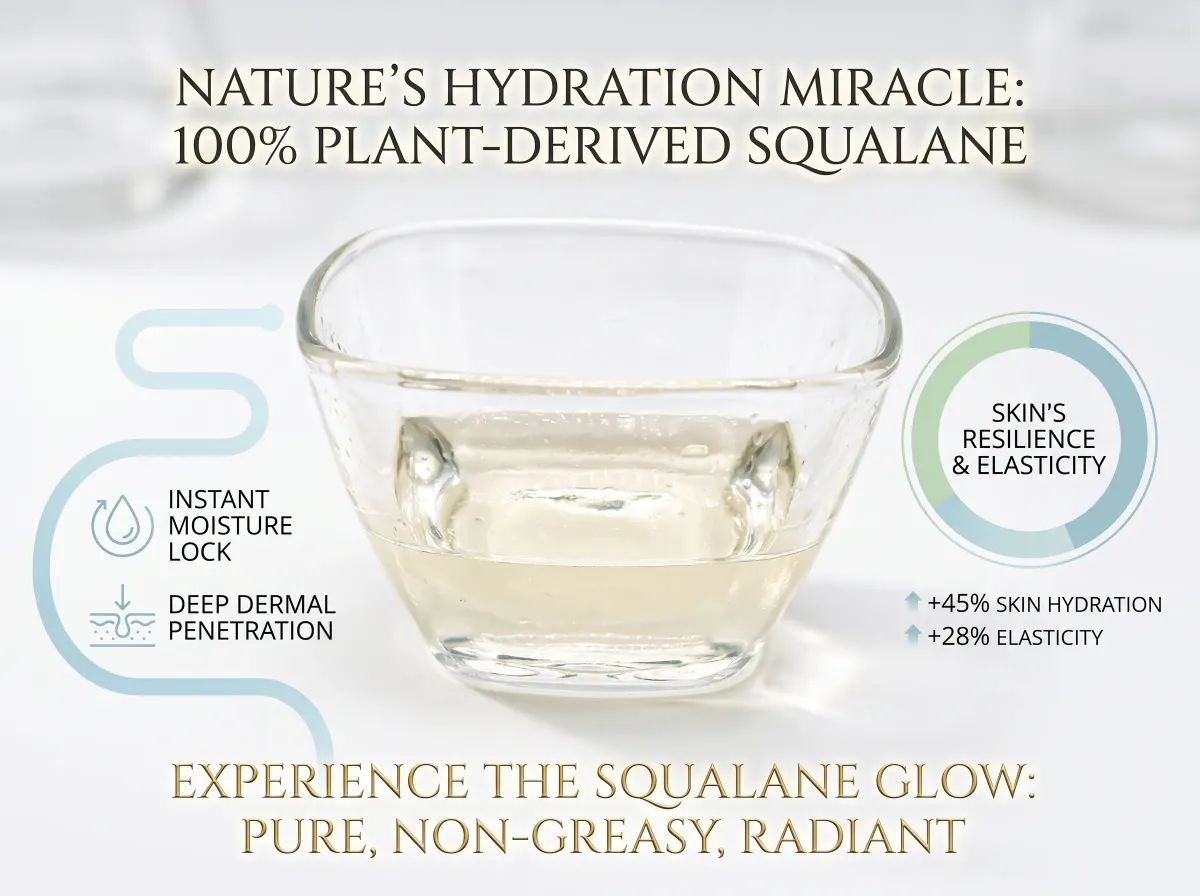
Squalane — Plant-Derived Stable Hydrocarbon Emollient for Skin Barrier & Moisture Lock
Squalane — hydrogenated squalene from Olea europaea (olive) or Saccharum officinarum (sugarcane)
Factory-direct plant-derived Squalane bulk oil (≥99% purity). Stable saturated hydrocarbon — bioidentical to human sebum squalene. Non-comedogenic, lightweight emollient for skin barrier repair and moisture lock. Olive or sugarcane sourced, 100% vegan. COA per batch.
Squalane — Stable Hydrocarbon Emollient for Modern Cosmetics
Squalane is a fully saturated hydrocarbon (C₃₀H₆₂) produced by hydrogenating plant-derived squalene. Supplied as a high-purity bulk liquid for cosmetic manufacturers, private-label skincare brands, and CDMOs. As a bioidentical analogue of human sebum squalene — your skin's own natural emollient — squalane delivers unmatched skin barrier compatibility without the oxidative instability that makes natural squalene unusable in commercial formulations.
Why Manufacturers Choose Squalane
- Bioidentical barrier emollient — molecular structure mirrors native human sebum squalene; skin "recognizes" it as self, zero rejection response
- Chemically stable — fully saturated (no double bonds); does not oxidize, yellow, or develop rancidity in finished products — unlike natural squalene
- Dual moisturization mechanism — occlusive film reduces transepidermal water loss (TEWL) + emollient action fills intercorneocyte lipid gaps for barrier repair
- Non-comedogenic (rating 0–1) — lightweight molecular profile penetrates quickly without clogging pores; safe for acne-prone and oily skin types
- 100% plant-derived & vegan — olive (Olea europaea) or sugarcane (Saccharum officinarum) sourced; no shark-derived squalene — ethical supply chain
- Retinol-compatible carrier — chemical inertness makes it the ideal delivery vehicle for retinol and other oxidation-sensitive actives (see Applications)
Module A: Squalane vs. Squalene — The Critical Distinction
One of the most common formulation errors is confusing squalane with squalene. They are chemically related but fundamentally different ingredients:
| Property | Squalene | Squalane |
|---|---|---|
| Chemical structure | C₃₀H₅₀ — unsaturated (6 double bonds) | C₃₀H₆₂ — fully saturated (0 double bonds) |
| Source in nature | Human sebum (~12% of sebum lipids), shark liver oil, olives | Produced by hydrogenating squalene |
| Oxidative stability | Extremely unstable — oxidizes within hours of air exposure | Highly stable — no oxidation, no rancidity |
| Shelf life in formulation | Days to weeks (requires antioxidant packaging) | 24+ months (standard cosmetic packaging) |
| Use in cosmetics | Unsuitable (oxidized squalene is comedogenic and pro-inflammatory) | Ideal — the industry-standard form |
| Historical sourcing | Shark liver oil (deep-sea sharks) — environmental concern | Plant-derived (olive, sugarcane) — sustainable |
The hydrogenation process: Squalene → +H₂ (catalyst) → Squalane. All six carbon-carbon double bonds are saturated with hydrogen, converting an unstable polyunsaturated hydrocarbon into a perfectly stable, fully saturated emollient.
Common misspellings and confusions: "squaline" (incorrect), "squalene" (the unsaturated precursor — not formulation-grade), "squalane" (correct — pronunciation: skwuh-LAYN). These confusion terms collectively generate 10,000+ searches/month — education is a critical part of the purchasing journey.
Module B: Skin Barrier Biomimetic Mechanism
Squalane's core value proposition lies in its biomimetic compatibility with human skin:
1. Sebum bioidentical action Human sebum naturally contains ~12% squalene by weight. Squalane's molecular structure (C₃₀H₆₂) is the hydrogenated — but structurally near-identical — analogue. When applied topically, the skin recognizes squalane as a native lipid component. There is no immune recognition, no foreign-body response, and no barrier disruption.
2. Occlusive moisturization (TEWL reduction) Squalane forms an ultra-thin, breathable lipid film on the stratum corneum surface. This film reduces transepidermal water loss (TEWL) without the heavy, suffocating feel of petrolatum or mineral oil. The film thickness is molecular-scale — imperceptible to touch but functionally occlusive.
3. Emollient barrier repair Between corneocytes, squalane molecules fill micro-gaps in the intercellular lipid matrix. This is critical for compromised barrier conditions (eczema, retinoid-induced dryness, post-procedure recovery). The linear hydrocarbon structure allows seamless integration into the lipid bilayer architecture.
4. Squalane vs. Hyaluronic Acid — complementary, not competitive
| Mechanism | Hyaluronic Acid | Squalane |
|---|---|---|
| Type | Humectant (water-attracting) | Occlusive + emollient (water-locking) |
| Solubility | Water-soluble | Oil-soluble |
| Action layer | Deep epidermis / dermis | Stratum corneum surface |
| Feel | Hydrating, plumping | Soft, velvety, non-greasy |
| Best pairing | Apply HA first (hydrate) → squalane second (lock in) | — |
Module C: Source & Ethics — Plant vs. Shark
The squalane supply chain has undergone a fundamental transformation over the past two decades:
Historical source: Shark liver oil Deep-sea sharks (primarily Centrophorus species) accumulate exceptionally high concentrations of squalene in their livers — an evolutionary adaptation for buoyancy regulation at extreme depths. Historically, this was the dominant industrial source of squalene for hydrogenation into squalane. Environmental concerns (bycatch, population decline, CITES listing of several deep-sea shark species) have driven the cosmetic industry's wholesale shift to plant-derived alternatives.
Modern plant-derived sources:
| Source | Process | Purity | Cost | Notes |
|---|---|---|---|---|
| Olive (Olea europaea) | Unsaponifiable fraction extraction + hydrogenation | ≥99% | Higher | Premium source; co-product of olive oil industry; traditional European supply chain |
| Sugarcane (Saccharum officinarum) | Fermentation-derived squalene → hydrogenation | ≥99% | Moderate | Patented by Amyris/Biossance®; scalable; high batch consistency |
| Palm oil derivative | Fractionation + hydrogenation | 95–98% | Lower | Sustainability concerns (deforestation); lower purity; not recommended for premium formulations |
Verification of plant-derived claims:
- C¹⁴ radiocarbon dating (ASTM D6866): distinguishes plant-derived (biogenic) from petroleum-derived (fossil) carbon
- Supply chain traceability documentation: country of origin, extraction facility, hydrogenation facility
- Vegan certification (Vegan Society / Cruelty-Free International)
GINKVORA supplies 100% plant-derived squalane from verified olive or sugarcane sources. Full traceability documentation provided.
Module D: Hemi-Squalane & Technical Specifications
Hemi-Squalane (C₁₅H₃₂) Hemi-squalane is a half-length analogue (C₁₅H₃₂ vs. C₃₀H₆₂ for full squalane) — chemically classified as hydrogenated polyisobutene. Key differences:
| Property | Squalane (C₃₀H₆₂) | Hemi-Squalane (C₁₅H₃₂) |
|---|---|---|
| Molecular weight | 422.81 | ~226 |
| Viscosity | Medium-light | Very light (near-water consistency) |
| Volatility | Non-volatile | Semi-volatile |
| Skin feel | Velvety, soft finish | Ultra-light, fast-absorbing, silicone-like |
| Best application | Face oils, creams, serums, retinol carrier | Hair oils (no buildup), ultra-light facial mists, silicone replacement |
| Spreadability | Excellent | Superior (smaller molecule = faster spreading) |
Standard specifications for bulk squalane:
| Parameter | Specification | Method |
|---|---|---|
| Purity | ≥ 99.0% | GC |
| Appearance | Colorless to pale yellow, clear | Visual |
| Specific Gravity (20°C) | 0.810–0.820 | Densitometer |
| Refractive Index (20°C) | 1.452–1.458 | Refractometer |
| Acid Value | ≤ 0.5 mg KOH/g | Titration |
| Iodine Value | ≤ 2.0 g I₂/100g | Titration (confirms full saturation) |
| Saponification Value | ≤ 1.0 mg KOH/g | Titration |
Recommended use concentrations in finished products:
- Facial oils & serums: 5–100% (can be used neat)
- Moisturizers & creams: 3–10%
- Hair oils & serums: 1–5%
- Lip balms & treatments: 3–10%
- Retinol carrier oils: 50–100% (with 0.2–1.0% retinol dissolved)
Module E: Safety Profile — Pores, Acne & Pregnancy
Comedogenicity Squalane has a comedogenic rating of 0–1 on the standard 0–5 scale — placing it in the "non-comedogenic" to "minimally comedogenic" category. This is unusual for an oil-phase ingredient and is attributable to its small molecular size, linear structure, and rapid absorption profile. Unlike heavier botanical oils (coconut oil: rating 4; wheat germ oil: rating 5), squalane does not form occlusive plugs in follicular openings.
Oily & acne-prone skin compatibility Because squalane is structurally identical to sebum lipids, it does not trigger the "excess oil → overproduction" feedback loop common with heavy occlusives. Many acne-prone users find that squalane actually helps regulate sebum production by signaling "sufficient barrier lipids present" to sebocytes. The key differentiator from comedogenic oils: squalane absorbs within seconds, leaving a dry-touch velvet finish rather than a greasy film.
Eczema & sensitive skin Squalane's barrier repair mechanism directly addresses the core pathology of atopic dermatitis — a defective stratum corneum lipid matrix. By filling intercorneocyte lipid gaps, squalane reduces TEWL and environmental irritant penetration. Clinical-grade squalane is used in dermatology post-procedure protocols (microneedling, chemical peels, laser resurfacing) specifically for its non-irritating barrier support. The eczema-related search cluster has a CPC of $2.25 — indicating high commercial intent from consumers actively seeking barrier repair solutions.
Pregnancy safety Squalane is a pure hydrocarbon (C₃₀H₆₂) — no hormonal activity, no endocrine disruption potential, no teratogenic risk. It is widely considered safe for topical use during pregnancy and breastfeeding by dermatologists. Unlike retinoids, salicylic acid (>2%), and certain essential oils, squalane has no pregnancy-related contraindications. However, standard medical guidance recommends consulting a healthcare provider for any skincare regimen during pregnancy.
"Squalane brainrot" (TikTok Gen Z interest) The term "squalane brainrot" (390 searches/month) is a TikTok-native meme indicating obsessive interest in the ingredient among Gen Z skincare enthusiasts. This signals a demographic opportunity: younger consumers discovering squalane through social platforms are entering the market with high ingredient literacy and brand-switching behavior. Formulating with squalane positions brands to capture this digitally native, ingredient-conscious consumer segment.
Source plant-derived squalane for your next formulation — contact GINKVORA for bulk pricing and samples.
Preguntas frecuentes
Solicitar cotización o muestra
Envíe su consulta y nuestro representante comercial se pondrá en contacto con usted en un plazo de 24 horas.
Ir al formulario de consulta →