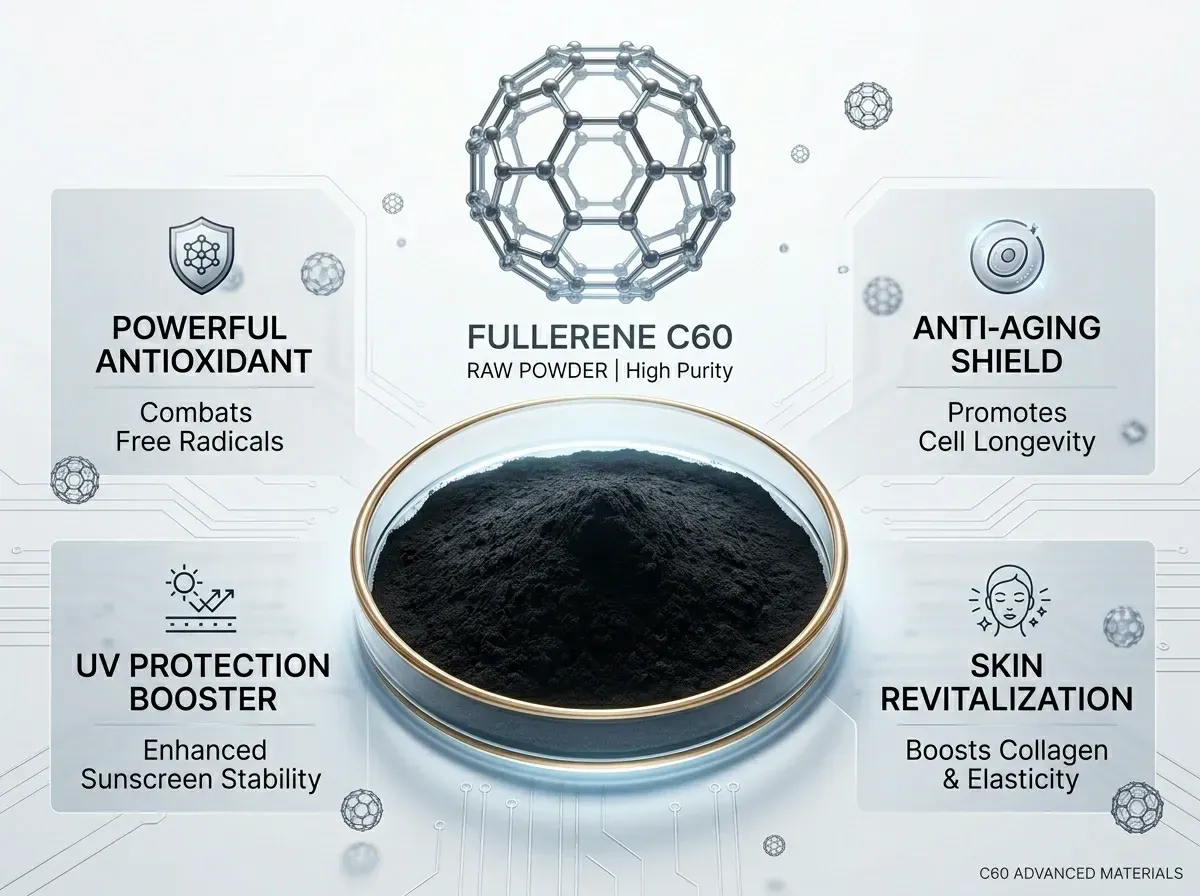
Fullerene C60 — Bulk Raw Material
Fullerene C60 (synthetic carbon allotrope; discovered 1985, Nobel Prize in Chemistry 1996)
Fullerene C60 is a Nobel Prize-winning carbon nanomaterial with a unique spherical cage structure that acts as a "radical sponge," neutralizing free radicals with up to 172× the antioxidant capacity of Vitamin C.
Fullerene C60: The Nobel Prize Antioxidant for Advanced Anti-Aging Skincare
Yes, Fullerene C60 is one of the most potent antioxidants known, with 172× the free radical scavenging capacity of Vitamin C. Clinical evidence supports its anti-wrinkle efficacy — a randomized double-blind trial demonstrated significant improvement at 8 weeks (p<0.05). However, purity is critical: only solvent-free, high-purity material ensures safety in cosmetic formulations.
What Is Fullerene C60?
Fullerene C60, also known as Buckminsterfullerene or "Buckyball," is a molecule composed entirely of 60 carbon atoms arranged in a hollow spherical cage — resembling a soccer ball at the nanoscale. Discovered in 1985 by Kroto, Curl, and Smalley (earning them the 1996 Nobel Prize in Chemistry), C60 represents a unique all-carbon allotrope alongside diamond and graphite.
The molecule's defining feature is its 30 reactive double bonds distributed across 12 pentagons and 20 hexagons, enabling it to absorb and neutralize dozens of free radicals per molecule. This "radical sponge" mechanism is fundamentally different from conventional antioxidants like Vitamin C, which can neutralize only one radical before being consumed.
Key Attributes:
- Molecular Formula: C60
- Molecular Weight: 720.64 g/mol
- Appearance: Dark brown to black crystalline powder
- Melting Point: >280°C
- Solubility: Soluble in organic solvents (toluene, squalane); insoluble in water
- LogP: 5.800 (estimated) — highly lipophilic
- Purity: ≥99.5% (HPLC) standard; ≥99.9% (HPLC) premium
Key Benefits of Fullerene C60 for Skincare
1. Unmatched Antioxidant Protection
Fullerene C60 neutralizes free radicals through a catalytic mechanism — it can absorb up to 34 methyl radicals before saturation, compared to 1 radical per Vitamin C molecule. This translates to 172× the antioxidant capacity of Vitamin C in electrochemical assays (Journal of Computational and Theoretical Nanoscience). Unlike Vitamin C, which degrades rapidly when exposed to light, air, and heat, C60 remains chemically stable throughout product shelf life, ensuring consistent potency in cosmetic formulations.
2. Clinically Proven Anti-Wrinkle Efficacy
In a landmark 2010 randomized, double-blind, placebo-controlled trial (Kato et al., Journal of Nanoscience and Nanotechnology), 23 Japanese women (mean age ~39) applied a cream containing 278 ppm LipoFullerene (C60 dissolved in squalane) twice daily for 8 weeks. Results showed:
- Significant anti-wrinkle improvement vs. placebo at week 8 (p < 0.05)
- Enhanced skin moisture and stratum corneum hydration
- Improved viscoelasticity (suppleness and elasticity)
- Reduced trans-epidermal water loss (TEWL)
- No severe side effects reported
3. Broad-Spectrum ROS Scavenging
C60 effectively neutralizes all major reactive oxygen species (ROS) relevant to skin aging: superoxide anion (O₂⁻), hydroxyl radical (•OH), singlet oxygen (¹O₂), and peroxyl radicals (ROO•). This broad-spectrum activity addresses multiple oxidative stress pathways simultaneously — UV-induced damage, pollution stress, and intrinsic aging.
4. Anti-Inflammatory Properties
C60 has been shown to reduce pro-inflammatory mediators including TNF-α, IL-6, and COX-2, helping calm irritated skin and reduce redness. This makes it suitable for sensitive skin formulations and post-procedure recovery products.
5. Collagen Preservation & Pore Refinement
By neutralizing matrix metalloproteinases (MMPs)-inducing ROS, C60 helps preserve dermal collagen and elastin. Users report improved skin texture, reduced pore appearance, and overall skin rejuvenation with consistent use.
Fullerene C60 vs Vitamin C vs Astaxanthin vs CoQ10: Which Antioxidant Is Best?
| Dimension | Fullerene C60 | Vitamin C (L-Ascorbic Acid) | Astaxanthin | CoQ10 (Ubiquinone) |
|---|---|---|---|---|
| Antioxidant Capacity | 172× Vitamin C equivalent; neutralizes ~34 radicals/molecule | Baseline (1×); 1 radical/molecule | ~6,000× Vitamin C (singlet oxygen quenching) | Moderate; electron transport chain role |
| Mechanism | Catalytic "radical sponge"; 30 reactive double bonds | Stoichiometric H-atom donor; single-use | Lipid peroxidation chain-breaker; membrane-bound | Mitochondrial electron carrier; moderate ROS scavenger |
| Stability | Excellent; chemically stable in formulation | Poor; degrades rapidly with light/air/heat; requires stabilizers | Moderate; sensitive to light and oxygen | Fair; stabilizes in liposomal delivery |
| UV Protection | Absorbs UV + neutralizes UV-induced ROS | Weak direct UV absorption; antioxidant only | Internal sunscreen effect; reduces UV erythema | Limited direct UV protection |
| Clinical Anti-Wrinkle Evidence | 8-week RCT (n=23): significant wrinkle reduction (p<0.05) | Multiple RCTs; 12-week studies show wrinkle improvement | 8-week RCT: improved skin elasticity and moisture | Limited direct anti-wrinkle RCTs |
| Skin Penetration | Excellent lipophilicity (LogP 5.8); penetrates stratum corneum | Requires low pH (≤3.5) and L-AA form for penetration | Lipid-soluble; penetrates all skin layers | Large molecule; needs liposomal delivery |
| Collagen Impact | Preserves collagen by inhibiting MMPs | Stimulates collagen synthesis (pro-collagen I) | Reduces collagen degradation via MMP-1 suppression | Supports cellular energy for collagen production |
| Safety Profile | Pure C60 no acute toxicity; SCCS flags genotoxicity data gap | Well-established safety; irritation at high concentrations | GRAS; well-tolerated; no known toxicity | Excellent safety; human tolerance confirmed |
| Nobel Prize Recognition | 1996 Nobel Prize in Chemistry (discovery) | 1937 Nobel Prize (Szent-Györgyi, isolation) | None | 1978 Nobel Prize (Mitchell, chemiosmosis — not directly) |
| Cosmetic Concentration Range | 0.001–0.1% (10–1000 ppm) | 5–20% (L-AA); 1–10% (derivatives) | 0.01–0.1% | 0.01–1.0% |
How to Use Fullerene C60 in Cosmetic Formulations
Recommended Usage Levels:
- Anti-aging serums: 0.01–0.1% (100–1000 ppm)
- Eye creams: 0.005–0.05% (50–500 ppm)
- Daily moisturizers: 0.001–0.05% (10–500 ppm)
- Sheet masks / ampoules: 0.005–0.1% (50–1000 ppm)
Formulation Tips:
- Pre-dissolve C60 powder in squalane, caprylic/capric triglyceride, or other cosmetic oils before incorporating into the formula
- C60 is insoluble in water; use oil-phase incorporation or nano-dispersion technologies
- Store formulations in opaque, airtight containers; while C60 is stable, protect from excessive UV exposure
- Test compatibility with other active ingredients; C60 pairs well with hyaluronic acid, peptides, and ceramides
- Avoid strong reducing agents that may alter C60's electronic structure
Technical Specifications
Our Fullerene C60 bulk raw material meets the highest purity standards for cosmetic formulation:
- Purity (HPLC): ≥99.5% standard grade; ≥99.9% premium grade
- Residual Solvents: ≤100 ppm (USP <467> compliant)
- Heavy Metals: ≤10 ppm total; Pb ≤1 ppm, As ≤1 ppm, Hg ≤0.1 ppm
- Appearance: Dark brown to black crystalline powder
- Particle Size: D50 ≤50 μm (micronized); nano-dispersion available
- Storage: Keep in dark place, inert atmosphere, room temperature (≤25°C)
Fullerene C60 from GINKVORA is available in research-to-commercial quantities with full documentation including Certificate of Analysis (CoA), SDS, and technical data sheets. Our raw material is produced under strict quality control with batch-to-batch consistency.
Related Articles
- EGCG 98% Purity vs Green Tea Extract: How to Evaluate Quality — A parallel framework for comparing purified vs. extract-grade cosmetic antioxidants
- Glabridin Before and After: 16× Kojic Acid Whitening Power — Another high-potency cosmetic active with clinical skin-brightening evidence
- Is Ferulic Acid Effective for Skin Anti-Aging and UV Protection? — A complementary antioxidant that doubles photoprotection when paired with Vitamins C+E
Always consult with a healthcare provider or qualified cosmetic formulator before incorporating Fullerene C60 into products intended for human use. While pure C60 has demonstrated an excellent safety profile in published research, the European Commission's Scientific Committee on Consumer Safety (SCCS) has noted that genotoxicity data for fullerenes (C60 and C70) remains incomplete. Ensure your formulations use only solvent-free, high-purity C60 (>99.5% HPLC) from reputable suppliers, as earlier toxicity findings were attributed to solvent impurities. Pregnant or nursing individuals should exercise caution. These statements have not been evaluated by the FDA, and this product is not intended to diagnose, treat, cure, or prevent any disease.
Preguntas frecuentes
Solicitar cotización o muestra
Envíe su consulta y nuestro representante comercial se pondrá en contacto con usted en un plazo de 24 horas.
Ir al formulario de consulta →