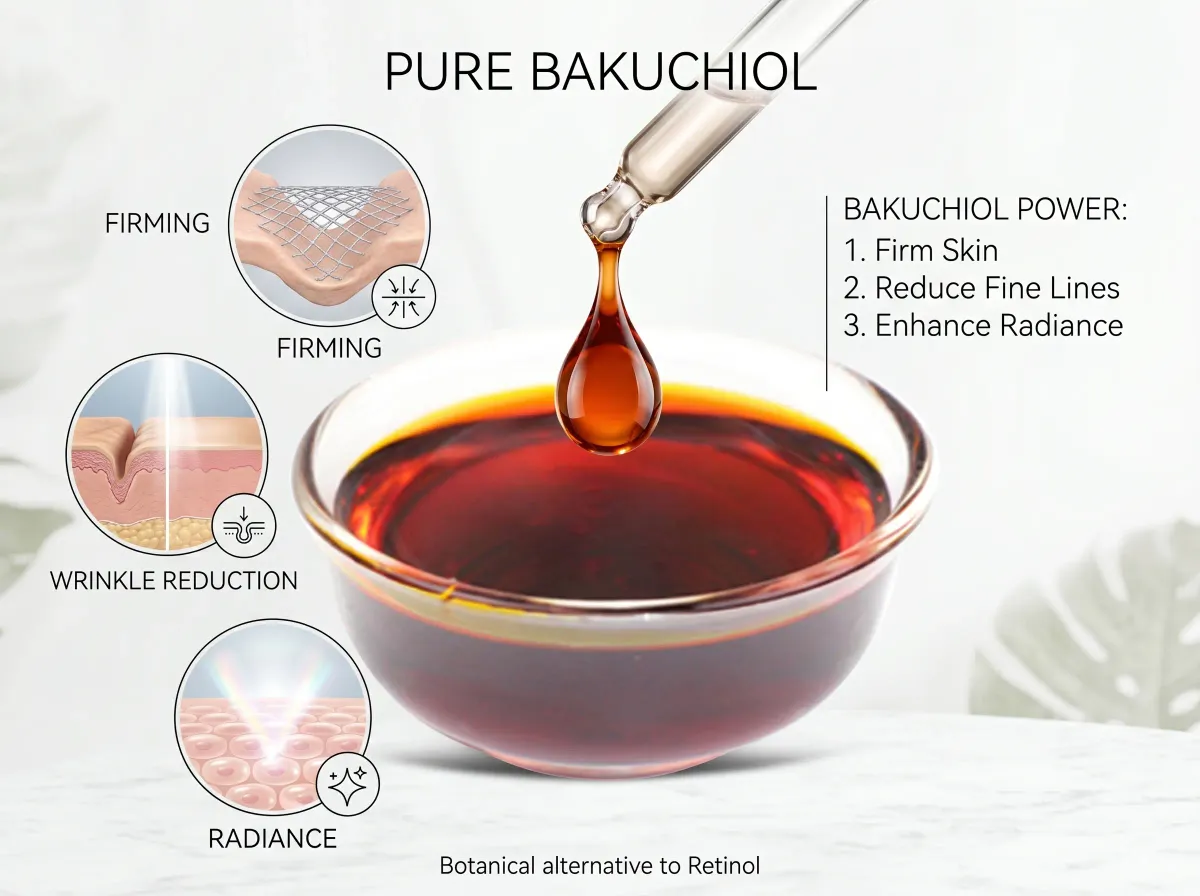
Bakuchiol — Bulk Cosmetic Raw Material
Bakuchiol (from Psoralea corylifolia L. seeds)
GINKVORA Bakuchiol powder (≥98% HPLC) is a plant-derived retinol alternative extracted from Psoralea corylifolia seeds. Clinically proven to reduce wrinkles and improve skin tone — without the irritation of retinol.
Bakuchiol — The Science-Backed Retinol Alternative for Modern Cosmetic Formulation
Bakuchiol (CAS 10309-37-2; INCI: Bakuchiol) is a meroterpene phenol derived from the seeds of Psoralea corylifolia (babchi plant), a flowering herb used in traditional Ayurvedic and Chinese medicine for centuries. Unlike retinol — a vitamin A derivative that frequently causes photosensitivity, dryness, and peeling — bakuchiol delivers functionally comparable anti-aging results through an entirely different molecular pathway, making it the fastest-growing ingredient in prestige skincare formulation.
In a landmark double-blind, randomised clinical trial published in the British Journal of Dermatology (Dhaliwal et al., 2019), 0.5% bakuchiol applied twice daily performed equivalently to 0.5% retinol in reducing fine lines, wrinkles, pigmentation, and elasticity — but with significantly fewer adverse events. This positions our high-purity bakuchiol powder as the gold-standard ingredient for brands targeting sensitive-skin, pregnancy-safe, and clean-beauty consumers.
Why Formulators Choose GINKVORA Bakuchiol
- ≥98% purity by HPLC — suitable for premium clinical-grade serums and cosmeceuticals
- Full documentation suite: COA, MSDS, TDS provided on every batch; third-party testing available
- Stable across pH 4.5–7.5: compatible with a broad range of cosmetic formulation bases
- Broad solvation profile: dissolves readily in ethanol, squalane, plant oils, and glycol-based carriers — enabling clear serums, face oils, and emulsions
- No photosensitization: unlike retinol, bakuchiol is suitable for both AM and PM application
- Pregnancy-safe plant origin: plant-derived, not a vitamin A derivative — increasingly the standard for maternal skincare lines
Target Applications
- Anti-aging serums and ampoules (retinol-alternative positioning)
- Bakuchiol face oils and dry oils
- Pregnancy-safe skincare lines
- Clean beauty and vegan-certified formulations
- Eye creams and neck creams (gentle enough for periorbital use)
- Night creams and repair moisturizers
- Acne-prone skin serums (antimicrobial + anti-inflammatory dual action)
Bakuchiol vs. Retinol — Side-by-Side Comparison
| Attribute | Bakuchiol | Retinol |
|---|---|---|
| Mechanism | Retinol-like gene expression (via retinoic acid receptors) | Direct retinoic acid receptor agonist |
| Irritation Risk | Very low — well-tolerated by sensitive skin | Moderate to high — common redness, peeling |
| Photosensitivity | None — AM & PM use safe | Significant — PM use only recommended |
| Pregnancy Safety | ✓ Safe — plant-derived phenol | ✗ Contraindicated — vitamin A derivative |
| Suitable Skin Types | All types, including sensitive, dry, rosacea | Normal to resilient; caution for sensitive |
| Stability | Stable at pH 4.5–7.5 | Degrades rapidly in light, air, high pH |
| Vegan / Natural Origin | ✓ Plant-derived | Synthetic or animal-derived |
| Clinical Equivalence | Proven vs. 0.5% retinol (BJD, 2019) | Reference standard |
| Formulation Complexity | Low — dissolves in oils and low-polarity carriers | High — requires encapsulation or stabilizers |
6 Core Benefits of Bakuchiol — Clinical Evidence Overview
1. Retinol-Like Anti-Aging Action
Bakuchiol upregulates collagen synthesis genes (COL1A1, COL3A1) and downregulates matrix metalloproteinases (MMPs) — the same pathways activated by retinoic acid — reducing fine lines and improving skin firmness without irritation.
2. Antioxidant Protection
As a meroterpene phenol, bakuchiol scavenges free radicals and reduces UV-induced oxidative stress, protecting the extracellular matrix from photo-aging damage.
3. Antimicrobial & Acne-Clearing
Bakuchiol exhibits activity against Propionibacterium acnes and Staphylococcus epidermidis, making it highly effective in acne-targeting formulations where retinol would be too irritating.
4. Hyperpigmentation & Skin-Tone Correction
Clinical data demonstrates statistically significant improvements in skin pigmentation, comparable to retinol — suitable for melanin-modulating serums and uneven skin-tone products.
5. Pregnancy-Safe Positioning (High Commercial Value)
Because bakuchiol is not a vitamin A derivative, it carries none of the teratogenicity risk associated with retinoids. This unlocks the high-CPC "pregnancy-safe skincare" keyword cluster — a premium segment growing rapidly in DTC and clinical channels.
6. Zero Photosensitization — AM & PM Compatibility
Unlike retinol — which requires PM-only protocols due to UV degradation — bakuchiol is stable in light and does not increase photosensitivity, enabling simpler AM/PM usage instructions and daytime serum formulations.
Formulation Guide for Cosmetic Chemists
Recommended Addition Phase
- Cold process (preferred): Add bakuchiol to the oil phase at room temperature, pre-dissolved in squalane or caprylic/capric triglyceride (CCT) at the desired concentration
- Hot process (if required): Bakuchiol is stable up to 80°C; add at end of hot phase, before emulsification, to minimize exposure time
Recommended Use Level
| Product Type | Typical Loading |
|---|---|
| Anti-aging serum | 0.5%–1.0% |
| Face oil | 1.0%–2.0% |
| Night cream / moisturizer | 0.5%–1.0% |
| Eye cream | 0.5% |
| Body lotion | 0.5%–1.0% |
Synergistic Ingredient Combinations
- Vitamin C (L-Ascorbic Acid / SAP / MAP): Dual antioxidant + retinol-like collagen stimulation — the bakuchiol + vitamin C combination is one of the most searched cosmetic formulas online
- Niacinamide (Vitamin B3): Brightening + anti-inflammatory synergy; niacinamide reduces the erythema risk to near zero, making it ideal for sensitive-skin products
- Hyaluronic Acid: Moisture compensation in anti-aging serums; offsets the mild drying that some users experience at higher concentrations
- Peptides (e.g., Palmitoyl Tripeptide-1, Matrixyl): Collagen-stimulation synergy for premium clinical formulations
- EGCG / Green Tea Extract: Antioxidant + anti-inflammatory layering — potentiates bakuchiol's UV-protective benefits
- PDRN: Emerging combination for ultra-premium regenerative serums
Stability & Incompatibilities
- Avoid combining with high-pH (>7.5) formulations — may affect activity
- No known incompatibilities with common cosmetic preservatives, emulsifiers, or humectants
- Stable in ethanol-based toners and water-in-oil (W/O) emulsions
- Avoid prolonged exposure to UV light during manufacturing
Always consult with a qualified healthcare provider before using any ingredient in a therapeutic context. Regulatory status of cosmetic claims varies by jurisdiction — confirm with your local regulatory authority prior to marketing.
Preguntas frecuentes
Solicitar cotización o muestra
Envíe su consulta y nuestro representante comercial se pondrá en contacto con usted en un plazo de 24 horas.
Ir al formulario de consulta →