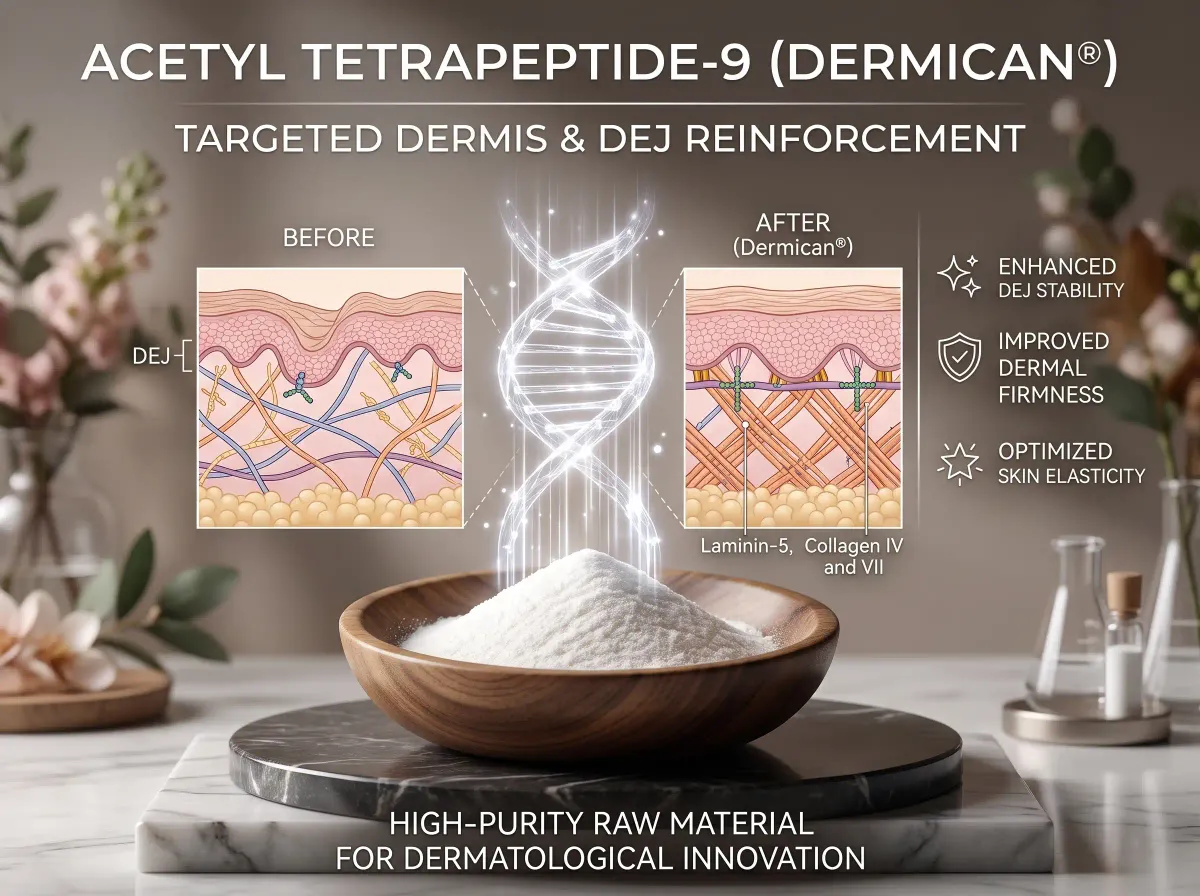
Acetyl Tetrapeptide-9 (Dermican®) — Lipotec Lumican-Stimulating Tetrapeptide
Acetyl Tetrapeptide-9 (Dermican) is Lipotec/Lubrizol matrikine tetrapeptide that upregulates Lumican proteoglycan to restore collagen fibril organization and dermal structural integrity. Clinically verified: 82% of volunteers reported noticeable firmness improvement at 8 weeks. Purity >=98% HPLC.
Module A — Ingredient Identity & Nomenclature
Acetyl Tetrapeptide-9 is a synthetic matrikine tetrapeptide developed by Lipotec (now Lubrizol Life Science Beauty) under the trade name Dermican®. It belongs to Lipotec's expanding portfolio of cosmetic peptides, sitting alongside:
- Argireline® (Acetyl Hexapeptide-8) — targeting expression lines via SNARE complex inhibition
- Eyeseryl® (Acetyl Tetrapeptide-5) — targeting periorbital puffiness via lymphatic drainage
- SNAP-8™ (Acetyl Octapeptide-3) — extended SNARE inhibition for deeper wrinkles
While Argireline and SNAP-8 target neuromuscular signaling and Eyeseryl addresses fluid dynamics, Dermican® occupies a unique position as an ECM structural organizer — it does not stimulate more collagen per se, but rather ensures that existing and newly synthesized collagen is assembled into optimally spaced, mechanically functional fiber networks.
Amino Acid Sequence: Ac-Gln-Asp-Val-His-OH
The tetrapeptide consists of four amino acid residues:
- Glutamine (Gln) — at position 1, provides hydrogen-bonding capacity for receptor recognition on fibroblast membranes
- Aspartic Acid (Asp) — at position 2, contributes to peptide solubility and ionic interaction with ECM components
- Valine (Val) — at position 3, hydrophobic residue that stabilizes the peptide's bioactive conformation
- Histidine (His) — at position 4, the imidazole side chain participates in metal-chelating antioxidant activity and pH-responsive conformational switching
The N-terminus is acetylated (Ac-) — a standard modification that confers resistance to aminopeptidase degradation and extends the functional half-life in topical formulations. The C-terminus is a free carboxylic acid (-OH).
Key Identifiers:
- CAS Number: 928006-50-2
- Molecular Formula: C22H33N7O9
- Molecular Weight: 539.54 g/mol
- FDA UNII: VMO8OOD3V0
- EWG Safety Rating: LOW across all categories (Cancer, Allergies & Immunotoxicity, Developmental & Reproductive Toxicity, Use Restrictions)
"9" Naming Convention: The "9" in Acetyl Tetrapeptide-9 is a sequential numeric designator assigned by the INCI naming system to acetylated tetrapeptides — it carries no structural meaning related to the peptide sequence. It should not be confused with Acetyl Tetrapeptide-5 (Eyeseryl®), which is a chemically distinct tetrapeptide (Ac-β-Ala-His-Ser-His-OH) targeting completely different biological pathways. The two ingredients target different anatomical zones, different molecular pathways, and different cosmetic indications — they are not interchangeable in formulation.
INCI Labeling: In finished cosmetic products, the ingredient appears on ingredient lists as "Acetyl Tetrapeptide-9." For products using the Lipotec commercial solution, the full listing includes the solvent system: "Glycerin (and) Water (and) Acetyl Tetrapeptide-9."
Module B — Lumican Upregulation & ECM Collagen Fibril Assembly (Core Scientific Narrative)
What is Lumican?
Lumican is a small leucine-rich repeat proteoglycan (SLRP family) that serves as a master organizer of collagen fibrillogenesis in the dermal extracellular matrix. In healthy, youthful skin, Lumican binds to the surface of nascent collagen molecules and regulates the critical geometric parameters of fiber assembly:
- Fibril diameter regulation — Lumican limits the lateral growth of collagen fibrils, maintaining a uniform ~60–80 nm cross-sectional diameter for Type I collagen fibers
- Interfibrillar spacing — Lumican controls the distance between adjacent collagen fibrils, creating a precisely spaced lattice that optimizes mechanical load distribution
- Fiber orientation — Lumican contributes to the basket-weave organization of collagen bundles in papillary dermis
When Lumican expression is sufficient, the dermal collagen network exhibits uniform fibril diameter, consistent spacing, and optimal light-scattering properties — the structural basis of smooth, firm, luminous skin.
Age-Related Lumican Decline
Scientific studies demonstrate that Lumican synthesis in dermal fibroblasts declines significantly with chronological aging and photoaging. The consequences are structurally catastrophic:
- Uncontrolled fibril growth — Without Lumican's regulatory constraint, collagen fibrils grow to abnormally large diameters (exceeding 120 nm), forming disorganized fiber bundles
- Irregular interfibrillar spacing — Gaps and crowding emerge between collagen fibers, disrupting the load-bearing capacity of the ECM
- Impaired light scattering — Irregularly organized collagen networks scatter light diffusely rather than uniformly, contributing to the "dull," lusterless appearance of aging skin
- Reduced mechanical resilience — Fibers with inconsistent diameters are mechanically weaker than uniform fibers, contributing to sagging and loss of firmness
This is a quality problem, not a quantity problem — the skin may contain adequate total collagen, but its structural organization has degraded to the point of functional failure.
Acetyl Tetrapeptide-9 Mechanism of Action
Acetyl Tetrapeptide-9 binds to specific receptors on dermal fibroblast membranes and activates a signaling cascade that upregulates two critical genes:
- LUM gene — encoding Lumican proteoglycan, the fibril-organizing protein
- COL1A1 gene — encoding the α1 chain of Type I collagen, the primary structural protein of the dermis
The dual upregulation produces a quality-plus-quantity outcome: increased Type I collagen synthesis provides the raw material, while elevated Lumican ensures that the newly synthesized collagen is assembled into properly organized, mechanically functional fiber networks.
Experimental Data (Lipotec Research):
- In vitro fibroblast assays confirmed significant upregulation of both COL1A1 and LUM gene expression after Acetyl Tetrapeptide-9 treatment
- Increased secreted levels of both Type I collagen and Lumican protein were measured in culture supernatant
- This dual mechanism distinguishes Dermican from single-pathway collagen stimulators — it addresses not just "how much collagen" but "how well is it organized"
Mechanism Comparison: Dermican® vs. Matrixyl® 3000
This is the most important mechanistic distinction in the cosmetic peptide landscape:
| Dimension | Dermican® (Acetyl Tetrapeptide-9) | Matrixyl® 3000 (Palmitoyl Tripeptide-1 + Palmitoyl Tetrapeptide-7) |
|---|---|---|
| Primary Target | Lumican (collagen organization) | TGF-β pathway (collagen synthesis) |
| Core Mechanism | Restores collagen fibril quality & arrangement | Stimulates new collagen quantity (Type I, III, IV) |
| Metaphor | Architect — ensures every brick is correctly placed | Builder — delivers more bricks to the construction site |
| Output | Uniform, well-organized fibers = elasticity + luminosity | Increased total collagen mass = volume + density |
| Unique Value | Fixes the "quality decay" of aging ECM | Addresses age-related collagen loss |
The two mechanisms are complementary, not competing. More collagen without proper organization is like adding bricks to a poorly designed wall — it may add mass but does not restore mechanical function. Proper organization without sufficient collagen is like a perfect blueprint without enough materials. Together, they deliver a complete ECM restoration.
Lipotec Clinical Data (17 Volunteers, 16-Week Study)
| Metric | Result | Timeframe | Method |
|---|---|---|---|
| Skin firmness improvement | 82% of volunteers reported noticeable improvement | 8 weeks | Clinical palpation + patient self-assessment |
| Skin thickness increase | Positive change (measurable) | 16 weeks | High-frequency ultrasound (20 MHz) |
| Dermal density | Significant improvement | 16 weeks | Ultrasound densitometry |
| Overall skin restructuring | Confirmed | 16 weeks | Integrated clinical scoring |
Study Design: 17 female volunteers aged 45–55, cream containing 0.9% Dermican™, applied twice daily for 16 weeks. Measurements included high-frequency ultrasound (20 MHz) for dermal thickness/density and blinded clinical palpation assessment of skin firmness.
Module C — Specifications & Formulation Parameters
Raw Material Form
Acetyl Tetrapeptide-9 is commercially available in two primary forms:
Lipotec Dermican® LS 9837 (Commercial Solution): A glycerin/water-based solution of Acetyl Tetrapeptide-9 at a standardized concentration. This is the reference formulation used in Lipotec's published clinical studies. It is designed for direct addition to the water phase of emulsion formulations.
Powder Form (GINKVORA Supply): Lyophilized powder, ≥98% purity by HPLC, supplied with batch-specific Certificate of Analysis. The powder form provides maximum formulation flexibility — it can be reconstituted in the formulator's solvent of choice and is compatible with both water-phase and glycol-phase addition during emulsion preparation.
Technical Specifications
| Parameter | Specification |
|---|---|
| Appearance | White to off-white lyophilized powder |
| Purity | ≥ 98.0% (HPLC, single-peak at 220 nm) |
| Molecular Formula | C22H33N7O9 |
| Molecular Weight | 539.54 g/mol |
| CAS Number | 928006-50-2 |
| Sequence | Ac-Gln-Asp-Val-His-OH |
| Solubility | Water-soluble; readily soluble in butylene glycol, propylene glycol, glycerin, and aqueous-alcoholic systems |
| pH (1% aqueous solution) | 5.0–7.0 |
| Recommended Use Level (pure peptide) | 0.01–0.05% in finished formulations (equivalent to 2–5% of the commercial Dermican® LS 9837 solution) |
| Storage | 2–8°C, sealed container, protect from light and moisture |
Note on Use Level: The Lipotec clinical study used a cream containing 0.9% of the commercial Dermican® LS 9837 solution. The pure peptide's recommended use level (0.01–0.05%) is based on the estimated active concentration in that solution. Formulators transitioning from the commercial solution to pure powder should conduct stability and efficacy testing at their target concentration.
Formulation Compatibility & Synergies
The Complete ECM Restoration Quad:
| Co-Active | Function | Synergy with Dermican® |
|---|---|---|
| Matrixyl® 3000 (Palmitoyl Tripeptide-1 + Palmitoyl Tetrapeptide-7) | Collagen quantity (Type I/III synthesis) | Dermican organizes the collagen that Matrixyl builds — quality × quantity synergy |
| GHK-Cu (Copper Tripeptide-1) (0.05–0.5%) | Collagen synthesis, wound repair, anti-inflammatory | GHK-Cu accelerates tissue remodeling; Dermican ensures the remodeled tissue is structurally sound |
| Proxylane (Hydroxypropyl Tetrahydropyrantriol) (3–10%) | Dermal-epidermal junction (DEJ) reinforcement | Proxylane fixes the "foundation" (DEJ); Dermican fixes the "framework" (dermal collagen) — two structural layers, two complementary solutions |
| Matrixyl® Synthe'6® (Palmitoyl Tripeptide-38) | 6 ECM targets (Collagen I/III/IV + Fibronectin + HA + Laminin-5) | Synthe'6 covers broad-spectrum ECM synthesis; Dermican adds the Lumican-specific organization pathway — zero mechanistic overlap |
pH Compatibility: Stable at pH 5.0–7.0. Avoid formulations below pH 4.0 (risk of peptide hydrolysis at the Asp residue). The peptide is compatible with standard cosmetic preservative systems (phenoxyethanol, sodium benzoate, potassium sorbate, benzyl alcohol).
Thermal Stability: Add to the water phase at ≤40°C during the cooling stage of emulsion preparation. Do not expose to temperatures above 60°C for extended periods. The lyophilized powder is stable for 24 months at 2–8°C in unopened containers.
Module D — Safety & Regulatory Declaration
EWG Skin Deep® Assessment
Acetyl Tetrapeptide-9 has been assessed by the Environmental Working Group (EWG) Skin Deep® database and scored LOW across all evaluated categories:
| Concern Category | Rating |
|---|---|
| Cancer | LOW |
| Allergies & Immunotoxicity | LOW |
| Developmental & Reproductive Toxicity | LOW |
| Use Restrictions | LOW |
The ingredient is currently utilized in over 60 registered cosmetic products including facial moisturizers (16), foundations (18), serums (10), eye creams (6), and masks (3) — with no adverse event signals in post-market surveillance.
Topical Peptide Safety Profile
Acetyl Tetrapeptide-9 is a tetrapeptide with a molecular weight of 539.54 Da — within the range where dermal penetration is possible but deep transdermal absorption is limited. Key safety characteristics:
- No systemic toxicity: Peptides of this size are rapidly degraded by dermal peptidases into constituent amino acids before reaching systemic circulation
- Low immunogenicity: Short synthetic peptides rarely trigger immune responses in topical application
- Non-comedogenic: Does not occlude pores or disrupt sebaceous gland function
- Non-photosensitizing: No phototoxic or photoallergic reactions reported; compatible with daytime SPF formulations
"Acetyl Tetrapeptide-9 Botox" Clarification
Search data reveals the query "acetyl tetrapeptide-9 botox" — indicating that some consumers compare this ingredient to botulinum toxin injections. This is a fundamental misconception that must be addressed:
| Aspect | Acetyl Tetrapeptide-9 (Dermican®) | Botulinum Toxin (Botox®) |
|---|---|---|
| Target | Lumican proteoglycan (ECM structural protein) | SNARE proteins at neuromuscular junction |
| Mechanism | Upregulates collagen fiber organization | Blocks acetylcholine release → muscle paralysis |
| Effect | Restored skin firmness, elasticity, luminosity | Temporary muscle relaxation → wrinkle smoothing |
| Anatomical Site | Dermal extracellular matrix | Neuromuscular synapse |
| Risk Profile | Topical peptide, negligible systemic exposure | Injectable neurotoxin, systemic spread risk |
Dermican® is a pure ECM repair peptide with zero neuromuscular activity. It does not relax muscles, does not paralyze facial expression, and carries none of the risks associated with botulinum toxin. The two are mechanistically unrelated.
Pregnancy & Lactation Guidance
No dedicated safety studies have been conducted on Acetyl Tetrapeptide-9 use during pregnancy or lactation. Given the peptide's molecular weight (539.54 Da) and topical application route, systemic exposure is expected to be negligible. However, in the absence of pregnancy-specific safety data, consultation with a healthcare provider is recommended before use during pregnancy or while breastfeeding.
Preguntas frecuentes
Solicitar cotización o muestra
Envíe su consulta y nuestro representante comercial se pondrá en contacto con usted en un plazo de 24 horas.
Ir al formulario de consulta →