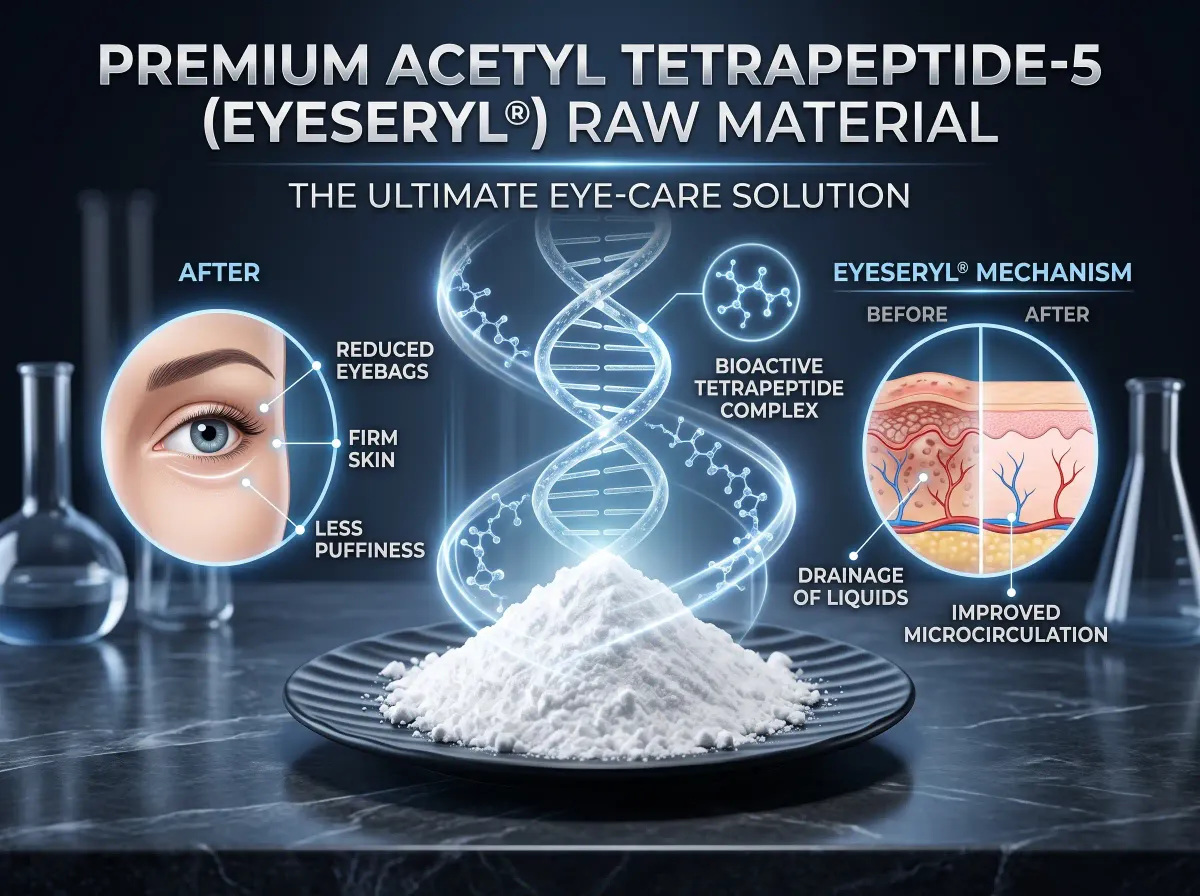
Acetyl Tetrapeptide-5 (Eyeseryl®) — Lipotec Anti-Puffiness Tetrapeptide for the Periorbital Zone
Acetyl Tetrapeptide-5 (Eyeseryl) is Lipotec/Lubrizol anti-puffiness tetrapeptide with triple-mechanism periorbital action: aquaporin lymphatic drainage, capillary wall reinforcement, and GAG turnover regulation. Clinically proven 32% reduction in under-eye bag volume at 60 days. Purity >=98% HPLC.
Module A — Ingredient Identity & Nomenclature
Acetyl Tetrapeptide-5 (INCI name) is a synthetic tetrapeptide developed by Lipotec (now Lubrizol Life Science) under the trade name Eyeseryl®. It belongs to a distinguished family of Lipotec cosmetic peptides — alongside Argireline® (Acetyl Hexapeptide-8), targeting SNARE-mediated expression lines, and SNAP-8™ (Acetyl Octapeptide-3, an elongated SNARE inhibitor). While Argireline and SNAP-8 target neuromuscular transmission to reduce dynamic wrinkles, Eyeseryl® was designed from the ground up for a fundamentally different purpose: the specific anatomy and pathophysiology of the periorbital zone.
Amino Acid Sequence: Ac-β-Ala-His-Ser-His-OH
The tetrapeptide comprises four amino acid residues:
- β-Alanine (β-Ala) — a non-proteinogenic amino acid at the N-terminus, providing enhanced enzymatic stability via non-standard peptide backbone geometry
- Histidine (His) ×2 — two histidine residues positioned at positions 2 and 4, critical for capillary wall collagen stabilization and antioxidant activity
- Serine (Ser) — positioned at position 3, contributing to the peptide's water solubility and hydrogen-bonding capacity with aquaporin channel proteins
The N-terminus is acetylated (Ac-), a modification that confers protease resistance and prolongs the peptide's functional half-life in topical formulations. The C-terminus is a free carboxylic acid (-OH), consistent with the peptide's native biochemical activity profile.
Key Identifiers:
- CAS Number: 820959-17-9
- Molecular Formula: C₂₀H₂₈N₈O₇
- Molecular Weight: 492.49 g/mol
- FDA UNII: Y1DFQ308G8
- EWG Safety Rating: LOW across all categories (Cancer, Allergies & Immunotoxicity, Developmental Toxicity)
The Ordinary connection: Search data reveals users querying "acetyl tetrapeptide-5 the ordinary" — consumers familiar with mass-market brands containing this ingredient are actively seeking ingredient-level understanding and sourcing options. This signals a mature consumer base that already values the ingredient and is looking for reliable supply — a cohort GINKVORA's B2B model serves directly.
Family positioning within Lipotec's portfolio:
| Lipotec Peptide | INCI / Trade Name | Mechanism | Primary Target |
|---|---|---|---|
| Eyeseryl® | Acetyl Tetrapeptide-5 | Anti-edema + anti-glycation | Periorbital puffiness & eye bags |
| Argireline® | Acetyl Hexapeptide-8 | SNARE complex inhibition | Expression lines (forehead, crow's feet) |
| SNAP-8™ | Acetyl Octapeptide-3 | Extended SNARE inhibition | Deeper dynamic wrinkles |
| Leuphasyl® | Pentapeptide-18 | Enkephalin receptor modulation | Fine lines around eyes and lips |
Eyeseryl® occupies a unique niche in this portfolio — it is the only Lipotec peptide specifically designed for edema-driven eye concerns rather than neuromuscular wrinkle formation.
Module B — The Triple Mechanism of Periorbital Puffiness Reduction
Periorbital puffiness (under-eye bags) arises from three converging pathophysiological processes. Acetyl Tetrapeptide-5 addresses all three simultaneously — a mechanistic breadth that distinguishes it from single-target alternatives.
Mechanism 1: Lymphatic Drainage Restoration
The periorbital zone contains the densest lymphatic network in human skin, yet these vessels are uniquely fragile. With aging, UV exposure, and circadian disruption, lymphatic drainage efficiency declines — interstitial fluid accumulates in the loose connective tissue beneath the eyes, creating the characteristic "puffy" appearance of morning edema.
Acetyl Tetrapeptide-5 stimulates aquaporin expression — water channel proteins embedded in cell membranes that regulate transcellular water transport. By upregulating aquaporin activity in the periorbital connective tissue, the peptide facilitates fluid reabsorption into the lymphatic capillaries, accelerating drainage of accumulated interstitial fluid.
Clinical observation: In Lipotec's controlled study (N=20, 60-day protocol), periorbital puffiness height was reduced by 32% after 60 days of twice-daily application at 1% concentration. The draining effect became measurable within 15 days, with 70% of volunteers showing visible improvement by day 28.
Mechanism 2: Capillary Wall Reinforcement
Periorbital capillaries are the thinnest-walled vessels in the integumentary system — approximately 0.5 mm in diameter with single-layer endothelial lining. Oxidative stress, UV radiation, and glycation progressively weaken the capillary basement membrane, increasing permeability. Plasma proteins and fluid leak into the interstitial space, contributing to both puffiness and the bluish discoloration characteristic of dark circles.
Acetyl Tetrapeptide-5 contains two histidine (His) residues, which serve dual structural functions:
- Collagen stabilization: Histidine is a key substrate amino acid for Type IV collagen — the primary structural protein of capillary basement membranes. By supplying histidine-rich peptide fragments, Eyeseryl® supports ongoing capillary wall repair and reinforcement.
- Metal chelation: The imidazole side chains of histidine residues chelate transition metal ions (Fe²⁺, Cu²⁺) that catalyze Fenton-type oxidative reactions, providing localized antioxidant protection at the capillary endothelial surface.
The combined effect: decreased vascular permeability → reduced protein and fluid extravasation → measurable reduction in periorbital edema volume.
Mechanism 3: Glycosaminoglycan (GAG) Turnover Regulation
Hyaluronic acid (HA) — the dominant glycosaminoglycan in periorbital connective tissue — can hold up to 1,000 times its weight in water. Under normal conditions, HA undergoes regulated synthesis and degradation via hyaluronidase enzymes. With aging and oxidative stress, HA fragments accumulate abnormally, creating hyper-osmotic pockets that draw and retain excess water — producing persistent, non-draining puffiness that does not resolve with sleep or lymphatic massage alone.
Acetyl Tetrapeptide-5 modulates hyaluronidase activity, restoring balanced GAG turnover. By promoting the clearance of fragmented, water-logged HA while preserving functional high-molecular-weight HA, the peptide reduces abnormal fluid retention without compromising the skin's natural hydration capacity.
Anti-Glycation: The Fourth Dimension
Beyond edema control, Acetyl Tetrapeptide-5 demonstrates significant anti-glycation activity — inhibiting the Maillard reaction between reducing sugars and dermal proteins. In vitro testing showed 48% inhibition of AGE (Advanced Glycation End-product) formation in a collagen glycation assay. This mechanism directly protects periorbital collagen and elastin from glycation-induced cross-linking, stiffness, and yellowing — preserving the mechanical integrity of the already-thin under-eye skin.
Triple Mechanism Summary
Lymphatic Drainage           Capillary Integrity         GAG Metabolism
(Aquaporin Upregulation)     (Collagen Reinforcement)    (Hyaluronidase Modulation)
        ↓                            ↓                           ↓
  Reduced fluid stasis      Reduced protein leakage       Normalized water binding
        ↓                            ↓                           ↓
        └────────────────────────┬──────────────────────────────┘
                                 ↓
                    MEASURABLE PUFFINESS REDUCTION
                     (32% volume reduction, 60 days)
Module C — Specifications & Formulation Parameters
Raw Material Form
Acetyl Tetrapeptide-5 is commercially available in two primary forms:
Solution form (Lipotec Eyeseryl® commercial standard): Dissolved in butylene glycol (1,3-butanediol) at standardized concentration. This is the form most commonly referenced in formulation guides and is compatible with aqueous and hydroalcoholic systems.
Powder form (GINKVORA supply): Lyophilized powder, ≥98% purity by HPLC, supplied with batch-specific Certificate of Analysis. The powder form offers formulation flexibility — it can be reconstituted in the formulator's solvent of choice and is compatible with both water-phase and glycol-phase addition during emulsion preparation.
Keyword insight: The search term "butylene glycol and acetyl tetrapeptide-5" confirms that formulators actively associate this peptide with glycol-based delivery systems. Providing the powder form allows cosmetic chemists to select their own solvent system rather than being locked into a pre-dissolved proprietary solution.
Technical Specifications
| Parameter | Specification |
|---|---|
| Appearance | White to off-white lyophilized powder |
| Purity | ≥ 98.0% (HPLC) |
| Molecular Formula | C₂₀H₂₈N₈O₇ |
| Molecular Weight | 492.49 g/mol |
| CAS Number | 820959-17-9 |
| Sequence | Ac-β-Ala-His-Ser-His-OH |
| Solubility | Water-soluble; freely soluble in butylene glycol, propylene glycol, glycerin, and aqueous-alcoholic systems |
| pH (1% aqueous solution) | 5.0–7.0 |
| Recommended Use Level | 1–3% in finished eye cream/serum (up to 5% for intensive treatment formulations) |
| Storage | 2–8°C, airtight container, protected from light and moisture |
Formulation Compatibility & Synergies
Primary recommended combinations — the periorbital anti-aging matrix:
| Co-Active | Target | Synergy with Eyeseryl® |
|---|---|---|
| Caffeine (1–3%) | Vasoconstriction, microcirculation | Caffeine constricts dilated capillaries (reducing dark circle discoloration); Eyeseryl® reinforces capillary walls (reducing leakage). Complementary vascular mechanisms. |
| GHK-Cu (Copper Tripeptide-1) (0.05–0.5%) | Collagen synthesis, capillary repair | GHK-Cu stimulates Type IV collagen deposition in capillary basement membranes — the same structural target Eyeseryl®'s histidine residues support. Combined effect: faster capillary repair. |
| Proxylane (Hydroxypropyl Tetrahydropyrantriol) (3–10%) | Dermal-epidermal junction (DEJ) reinforcement | Strengthens the structural foundation beneath periorbital skin, enhancing the tissue matrix that Eyeseryl® protects from edema stress. |
| SNAP-8 (Acetyl Octapeptide-3) (3–5%) | SNARE complex inhibition (crow's feet) | Eyeseryl® targets puffiness; SNAP-8 targets expression lines. Together they cover the two most visible periorbital aging concerns. |
| Niacinamide (2–4%) | Barrier repair, ceramide synthesis | Reinforces the stratum corneum barrier to complement Eyeseryl®'s deeper connective tissue effects. |
"Powder made in China" keyword insight: The appearance of this search term reveals that formulators are actively searching for alternative powder sources — likely comparing cost, purity, and supply chain options. GINKVORA's HPLC-verified ≥98% purity powder offers a quality-controlled alternative to pre-dissolved commercial solutions, with the added benefit of solvent-choice flexibility.
pH Stability & Processing Guidelines
- pH range: Stable at pH 5.0–7.0. Avoid formulations below pH 4.0 (risk of peptide hydrolysis).
- Temperature: Add to the water phase at ≤40°C during cool-down phase of emulsion preparation. Do not expose to temperatures above 60°C for extended periods.
- Chelating agents: Compatible with EDTA and phytic acid at standard use levels (0.05–0.1%) — recommended for formulations containing transition metal-sensitive ingredients.
- Preservative compatibility: Compatible with standard cosmetic preservative systems (phenoxyethanol, sodium benzoate, potassium sorbate, benzyl alcohol).
Module D — Safety & Regulatory Declaration
EWG Skin Deep® Assessment
Acetyl Tetrapeptide-5 has been evaluated by the Environmental Working Group (EWG) Skin Deep® database and is classified as LOW risk across all assessed categories:
| Concern Category | Rating |
|---|---|
| Cancer | LOW |
| Allergies & Immunotoxicity | LOW |
| Developmental & Reproductive Toxicity | LOW |
| Use Restrictions | LOW |
The ingredient is not listed on EWG's Restricted or Unacceptable Lists. It is currently used in over 200 registered cosmetic products across categories including eye creams (49), concealers (57), masks (42), and serums (16) — with no reported adverse event signals in post-market surveillance.
Ocular & Periorbital Safety
The periorbital skin presents unique safety requirements: it is approximately 0.5 mm thick compared to 2.0 mm for average facial skin — a 4× difference. This anatomical reality makes eye-area ingredients approximately 4× more susceptible to penetration-related irritation than facial ingredients.
Acetyl Tetrapeptide-5 was specifically designed for this sensitive anatomy:
- Non-irritating: No stinging, burning, or sensitization reported in clinical patch testing
- Non-comedogenic: Does not clog periorbital pores or meibomian glands
- Ocular safety: The tetrapeptide's molecular weight (492.49 Da) limits deep transdermal penetration, reducing the risk of intraocular exposure
- Tear film compatibility: pH 5.0–7.0 range aligns with physiological tear pH (6.5–7.6), minimizing lacrimal irritation upon incidental contact
Toxicology & NOAEL
The search term "acetyl tetrapeptide-5 NOAEL" appearing in the dataset indicates that professional formulators and regulatory specialists are seeking toxicological reference values. While Lipotec's full safety assessment is available through authorized distributors, key findings include:
- Dermal irritation: Non-irritating (comparable to saline control in human repeat insult patch testing)
- Dermal sensitization: Non-sensitizing (no positive reactions in HRIPT)
- Ocular irritation: Minimal to none (validated via HET-CAM alternative assay)
- Phototoxicity: No phototoxic potential (validated via 3T3 NRU phototoxicity assay)
MSDS / SDS Availability
The presence of "acetyl tetrapeptide-5 MSDS" in search data confirms that B2B procurement professionals require safety documentation as part of their vendor qualification process. GINKVORA provides:
- Material Safety Data Sheet (MSDS/SDS) — available upon request with every batch shipment
- Certificate of Analysis (CoA) — batch-specific, including HPLC purity chromatogram, residual solvents analysis, heavy metals (Pb ≤ 2 ppm, As ≤ 1 ppm, Hg ≤ 0.1 ppm, Cd ≤ 1 ppm), and microbial limits
- Technical Data Sheet (TDS) — formulation guidance, solubility data, and stability parameters
Regulatory Status
- INCI Listing: Acetyl Tetrapeptide-5 (INCI registered)
- China Cosmetics Ingredient: Listed in the Inventory of Existing Cosmetic Ingredients in China (IECIC 2021)
- EU Cosmetics Regulation (EC 1223/2009): Compliant; no restrictions or annex listings
- US FDA: Cosmetic ingredient — no pre-market approval required under the FD&C Act
Preguntas frecuentes
Solicitar cotización o muestra
Envíe su consulta y nuestro representante comercial se pondrá en contacto con usted en un plazo de 24 horas.
Ir al formulario de consulta →