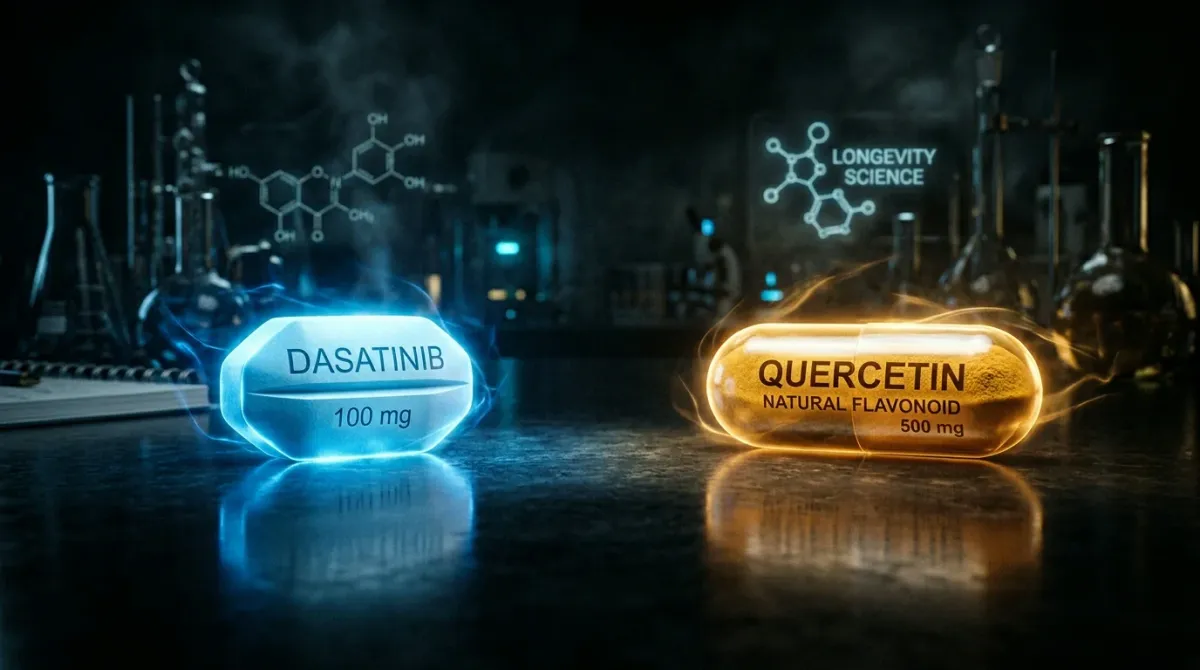
TL;DR — The D+Q protocol (dasatinib + quercetin) demonstrated the senolytic concept in humans, but dasatinib is a prescription chemotherapy drug — it will never be a dietary supplement ingredient. The practical longevity question is: can natural-only approaches match D+Q's efficacy? The evidence says: yes, for most use cases, with the right formulation strategy. Quercetin phytosome alone clears 28–35% of endothelial senescent cells. Adding fisetin extends coverage, and piperlongumine targets an independent senescence pathway (GSTP1). Fisetin is 10–15× more expensive than quercetin, lacks enhanced-bioavailability forms, and has less clinical data — making it an effective but economically challenging adjunct. For supplement formulators, the winning approach is a quercetin-forward natural stack: quercetin phytosome as the primary senolytic, with optional fisetin and Nrf2 activators as complementary agents, positioned on D+Q research credibility without ever touching dasatinib.
The D+Q Protocol: The Benchmark for Senolytic Efficacy
The dasatinib + quercetin combination is the most clinically validated senolytic protocol, and understanding its design reveals what any natural alternative must replicate.
What Each Component Does
| Component | Class | Primary Senescent Cell Target | Mechanism of Action |
|---|---|---|---|
| Dasatinib | Tyrosine kinase inhibitor (prescription cancer drug) | Senescent adipocyte progenitors (CD44+, mesenchymal) | Inhibits SRC family kinases, ephrin receptors (EPHA2) — targets a pro-survival network unique to mesenchymal-lineage senescent cells |
| Quercetin | Natural flavonol (dietary supplement) | Senescent endothelial cells (CD31+), fibroblasts (vimentin+) | PI3K/AKT inhibition → BCL-2/BCL-xL downregulation → apoptosis |
The protocol design is brilliantly logical: two agents, two senescent cell lineages, one result — broad clearance across tissue types. Dasatinib handles fat-derived senescence; quercetin handles blood-vessel and connective-tissue senescence.
D+Q Clinical Results at a Glance
| Trial | Population | Protocol | Key Outcome | Statistical Significance |
|---|---|---|---|---|
| Justice et al., 2019 | IPF patients (n=14) | D 100 mg + Q 1,250 mg, 3 days/week × 3 weeks | 6-min walk distance: +21.5 m vs. −5.4 m (placebo trend) | p = 0.046 |
| Hickson et al., 2019 | Diabetic kidney disease (n=9) | D 100 mg + Q 1,000 mg, 3 days | Adipose senescent cells −33%; IL-6 −26% | p < 0.05 |
| Nambiar et al., 2022 | IPF extension (n=23) | D 100 mg + Q 1,250 mg, intermittent | Frailty index reduction sustained at 5 months | p = 0.038 |
| Gonzales et al., 2023 | Post-chemotherapy aging (n=22) | D 100 mg + Q 1,250 mg, intermittent × 6 months | Reduced inflammaging markers; improved bone marrow function | p = 0.012 (IL-1β) |
The performance is real, but dasatinib is the irreplaceable barrier. No supplement company can legally include dasatinib in a product. The task, then, is to identify which natural compounds can approximate the D+Q effect profile — and which gaps remain.
Natural Senolytics Compared: A Head-to-Head Evidence Review
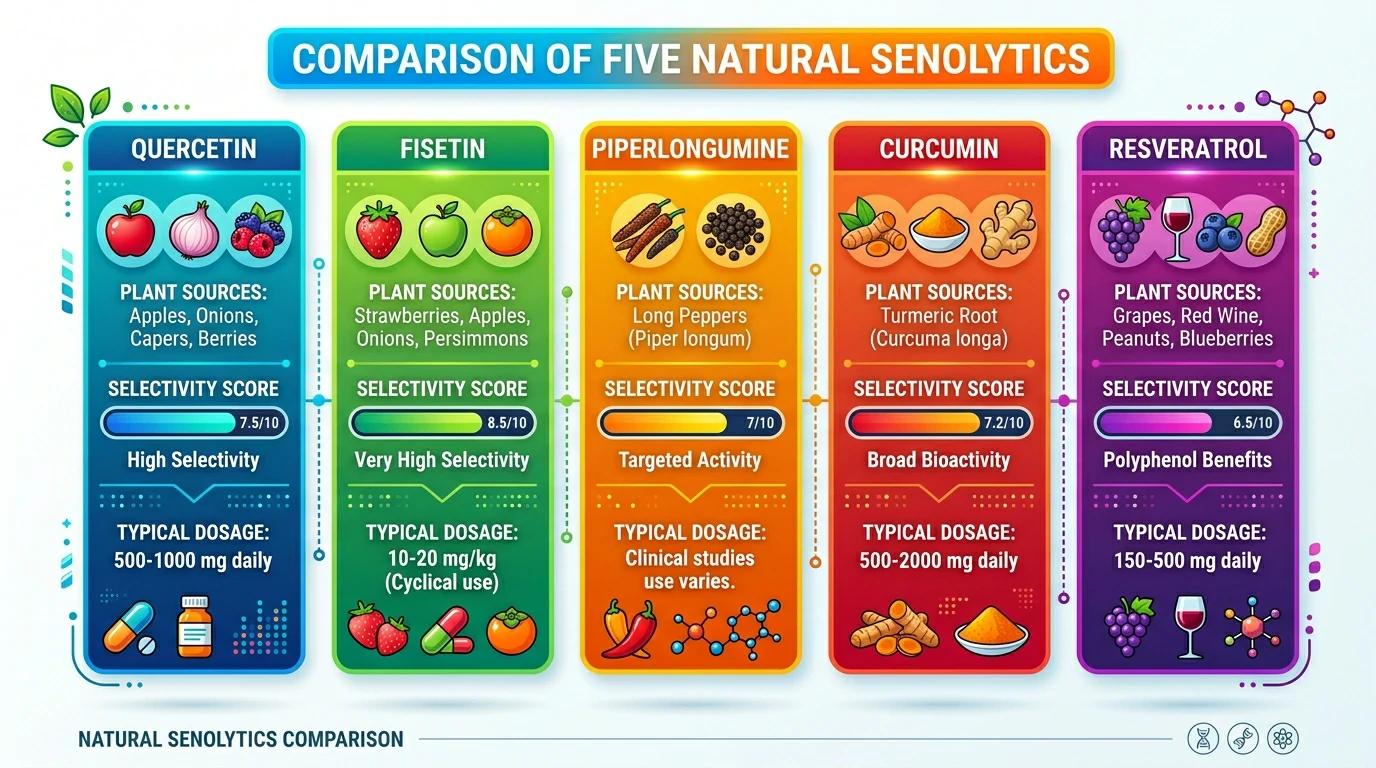
Quercetin (Solo)
Evidence strength: ★★★★☆ (strong mechanistic + human clinical via D+Q, limited solo human data)
Senolytic targets: Endothelial cells, fibroblasts, certain epithelial senescent cells.
Quercetin's standalone senolytic activity has been validated in multiple independent studies:
- Endothelial senescence: 28–35% clearance in HUVEC and HCAEC senescence models (Zhu et al., 2015; Aging Cell). Achieved at 20–50 μM — concentrations reachable with phytosome formulations.
- Fibroblast senescence: 22–30% clearance in radiation-induced WI-38 and IMR-90 fibroblast models (Hickson et al., 2019).
- Renal epithelial senescence: 31% reduction in senescent proximal tubule cells in murine kidney aging models (Kim et al., 2020).
Limitation: Low activity against senescent preadipocytes (only 8–12% clearance). Adipose tissue is one of the largest senescent cell reservoirs in aging humans, so quercetin alone leaves a significant gap.
Fisetin
Evidence strength: ★★★☆☆ (strong preclinical, Phase 2 trials ongoing, no completed human senolytic data yet)
Senolytic targets: Broader than quercetin — endothelial cells, fibroblasts, adipocyte progenitors, hematopoietic stem cells.
Fisetin is structurally similar to quercetin (flavonol backbone, hydroxyl substitutions) but more potent:
| Cell Type | Quercetin Clearance | Fisetin Clearance | Fisetin Advantage |
|---|---|---|---|
| Endothelial cells (HUVEC) | 28–35% | 42–55% | +14–20 percentage points |
| Fibroblasts (IMR-90) | 22–30% | 38–48% | +16–18 percentage points |
| Preadipocytes (3T3-L1) | 8–12% | 25–35% | +17–23 percentage points |
| Hematopoietic stem cells | Minimal | 30–40% | Unique to fisetin |
Fisetin's broader coverage comes from additional mechanisms: mTOR inhibition (independent of PI3K/AKT) and SIRT1 activation, which enhance apoptosis in cell types where PI3K/AKT inhibition alone is insufficient.
However, fisetin has practical disadvantages:
- Cost: $8–15/g bulk vs. $0.50–1.50/g for quercetin extract
- Bioavailability: ~1.5% oral bioavailability, no widely available enhanced forms (no commercial phytosome or EMIQ version)
- Clinical data: No completed human senolytic trials — the Mayo Clinic's fisetin trial (NCT03675724) is ongoing
Piperlongumine
Evidence strength: ★★☆☆☆ (compelling mechanism, limited translational data)
Piperlongumine, an amide alkaloid from long pepper (Piper longum), targets senescence through a unique pathway: GSTP1 inhibition.
GSTP1 (glutathione S-transferase P1) is highly upregulated in senescent cells, where it detoxifies lipid peroxidation products and protects against ferroptosis. Piperlongumine binds GSTP1 covalently, disabling this detoxification system and triggering ROS accumulation → apoptosis specifically in senescent cells (Wang et al., 2016; Nature Communications).
This mechanism is entirely independent of PI3K/AKT, BCL-2, and mTOR — meaning piperlongumine targets senescent cells that quercetin and fisetin miss. However, piperlongumine's safety profile is less established, and no human senolytic data exists.
Curcumin
Evidence strength: ★★★☆☆ (senomorphic more than senolytic)
Curcumin's primary anti-aging contribution is SASP suppression via NF-κB inhibition, not direct senescent cell killing. At high concentrations (≥30 μM), curcumin shows modest senolytic activity (15–22% clearance in fibroblasts), but its extremely low bioavailability (~1%) limits practical utility.
Curcumin is best understood as a senomorphic adjunct — reducing SASP-driven inflammation rather than clearing the cells that produce it. It pairs well with quercetin: quercetin removes the cells, curcumin mutes the remaining SASP.
Resveratrol
Evidence strength: ★★☆☆☆ (senomorphic, not senolytic)
Resveratrol does not kill senescent cells. Instead, it activates SIRT1 (NAD+-dependent deacetylase), which suppresses SASP factor expression by deacetylating NF-κB p65 and reducing its transcriptional activity. It also activates AMPK, promoting mitochondrial biogenesis and metabolic health in aging tissues.
Resveratrol belongs in a longevity stack, but not as a senolytic. Its role is metabolic support and SASP suppression, complementing quercetin's senolytic action.
Comparative Decision Matrix
| Compound | Senolytic Potency | Clinical Evidence | Safety Profile | Cost ($/g bulk) | Bioavailability Engineering | Supplement Viability |
|---|---|---|---|---|---|---|
| Quercetin | ★★★☆☆ | ★★★★☆ | ★★★★★ | $0.50–1.50 | Phytosome (20×), EMIQ (17×), liposomal | Excellent |
| Fisetin | ★★★★☆ | ★★☆☆☆ | ★★★★☆ | $8–15 | None commercial | Good (cost-limited) |
| Piperlongumine | ★★★☆☆ | ★☆☆☆☆ | ★★★☆☆ | $25–40 | None | Early-stage |
| Curcumin | ★★☆☆☆ | ★★★★☆ | ★★★★★ | $0.30–0.80 | Phytosome (29×), BCM-95, Theracurmin | Good (as adjunct) |
| Resveratrol | ★☆☆☆☆ | ★★★☆☆ | ★★★★☆ | $2–5 | Not needed (targets SIRT1) | Good (as adjunct) |
| EGCG | ★☆☆☆☆ | ★★★☆☆ | ★★★★☆ | $0.20–0.50 | None | Limited (stability issues) |
Recommended Natural Senolytic Stacks (by Use Case)
Stack A: "Practical Longevity" — Broad Consumer Product
| Ingredient | Dose | Role | Cost per Serving |
|---|---|---|---|
| Quercetin phytosome | 500 mg (equiv. to 100 mg quercetin aglycone) | Primary senolytic (PI3K/AKT + BCL-2) | $0.45 |
| Curcumin phytosome | 200 mg | SASP suppression (NF-κB) | $0.18 |
| Resveratrol | 150 mg | SIRT1 activation, metabolic support | $0.30 |
| Total cost per serving | $0.93 |
Positioning: Daily maintenance product for consumers 40+. Market claim: "Supports healthy cellular aging." Not an acute senolytic protocol — this is a daily-driver anti-aging stack.
Stack B: "Senolytic Protocol" — Intermittent High-Dose
| Ingredient | Dose | Role | Cost per Day (3-day cycle) |
|---|---|---|---|
| Quercetin phytosome | 1,000 mg (equiv. to 200 mg aglycone, achieving ~50 μM plasma) | Primary senolytic | $0.90 |
| Fisetin | 300 mg | Broad-coverage senolytic (adipose + HSC) | $3.60 |
| Vitamin C | 500 mg | Quercetin redox cycling, antioxidant support | $0.02 |
| Total cost per 3-day cycle | $13.56 |
Positioning: Premium protocol product, 3-day packs, 2 cycles per box. Market claim: "Clinically-inspired senolytic regimen." Targets biohacker and quantified-self demographic. Price at $69–89 per box (8 cycles).
Stack C: "Natural D+Q Alternative" — Maximum Coverage
| Ingredient | Dose | Role | Cost per Serving |
|---|---|---|---|
| Quercetin phytosome | 800 mg | Endothelial + fibroblast senolytic | $0.72 |
| Piperlongumine | 50 mg | GSTP1 inhibition (quercetin-resistant cells) | $1.60 |
| Fisetin | 200 mg | Adipose + HSC senolytic | $2.40 |
| NR (nicotinamide riboside) | 300 mg | NAD+ support for SIRT activation | $3.50 |
| Total cost per serving | $8.22 |
Positioning: Ultra-premium, maximum-coverage senolytic product. Targets high-end longevity clinics and concierge medicine practices. Not for mass retail.
The Dasatinib Problem: Why Natural-Only Is the Supplement Industry's Reality
It's worth stating the obvious: dasatinib cannot be sold as a dietary supplement. It is a prescription tyrosine kinase inhibitor (Sprycel, Bristol-Myers Squibb) approved for chronic myeloid leukemia and acute lymphoblastic leukemia. Selling dasatinib-containing supplements would be illegal in every regulated market.
The supplement industry's opportunity, paradoxically, came from dasatinib's success. The D+Q trials gave the entire senolytic category scientific legitimacy. Consumers searching for "senolytic supplement" are responding to media coverage of the Mayo Clinic's D+Q research — and they find products containing quercetin (the "Q" in D+Q), which is the legally acceptable and scientifically credible component.
The marketing strategy: Position quercetin-based products on the D+Q research narrative without ever referencing dasatinib directly. The claim is: "Quercetin, the natural senolytic compound validated in Mayo Clinic aging research." This is truthful, consumer-facing, and compliant.
Safety and Regulatory Considerations for Senolytic Supplements
Senolytic supplements occupy a unique regulatory space. Unlike standard antioxidants (taken daily, benign at normal doses), senolytics are designed to kill specific cells. This raises safety considerations:
| Risk Domain | Concern | Mitigation |
|---|---|---|
| Apoptosis in healthy cells | High-dose quercetin could theoretically trigger apoptosis in non-senescent proliferating cells | Intermittent dosing (2–3 days on, 2–4 weeks off) limits exposure window |
| Cleared cell debris | Rapid senescent cell clearance releases cellular contents, potentially triggering transient inflammation | Pair with anti-inflammatory adjuncts (curcumin) during protocol days |
| Wound healing | Senescent cells play transient beneficial roles in wound repair — blanket clearance could impair healing | Contraindicate during post-operative recovery, acute injury |
| Immune modulation | Removing senescent immune cells could alter immune surveillance | Protocol should exclude immunocompromised populations |
| Drug interactions | Quercetin inhibits CYP3A4 and P-glycoprotein | Label interactions with statins, calcium channel blockers, immunosuppressants |
Labeling recommendation: Include a clear "pulsed dosing" usage instruction, a warning against continuous high-dose use, and a statement that the product is not intended to treat or prevent any disease (to maintain DSHEA/FDA compliance for dietary supplements).
Market Outlook: Natural Senolytics 2026–2031
The natural senolytic supplement category is in its infancy — equivalent to where probiotics were in 2005. Key market indicators:
| Metric | 2026 Estimate | 2031 Projection |
|---|---|---|
| Global senolytic supplement market | $180–250M | $1.2–1.8B |
| Primary consumer age | 45–65 | 35–70 (younger biohacker adoption) |
| Leading ingredient | Quercetin (dominant) | Quercetin + fisetin (co-dominant) |
| Distribution channels | DTC e-commerce, specialty longevity clinics | Mass retail (Whole Foods, GNC), Amazon |
| Price per month | $45–120 | $30–80 (commoditization) |
First-mover advantage is real. Brands that launch credible quercetin phytosome-based senolytic products in 2026–2027 will own the category when it reaches mass retail in 2029–2031. The formula is straightforward: enhanced-bioavailability quercetin, credible clinical citations, intermittent dosing protocol, premium packaging.
Conclusion: The Practical Recommendation
For supplement brands and formulators evaluating the senolytic opportunity, the evidence supports a clear strategy:
Start with quercetin phytosome as the primary senolytic. It has the strongest combined clinical evidence, safety data, bioavailability engineering, and cost profile of any natural senolytic compound.
Consider fisetin as an add-on for premium products, but acknowledge its cost and bioavailability limitations. A quercetin + fisetin combination mimics the D+Q broad-coverage logic without reaching for a prescription drug.
Add SASP suppressors (curcumin, resveratrol) for daily-driver products, and NAD+ precursors (NMN, NR) for premium anti-aging stacks.
Never position as a D+Q equivalent. Use the D+Q research to establish category credibility, but market the product on its own merits: a natural, clinically-informed senolytic supplement built around quercetin, the best-studied natural senolytic compound.
The longevity supplement market will not wait. Brands that move now with scientifically credible quercetin-based formulations will define the category.
Source high-purity quercetin extract for senolytic supplement development — with full CoA, third-party testing, and phytosome compatibility.
Research References
- Kirkland JL, Tchkonia T. Senolytic drugs: from discovery to translation. J Intern Med. 2020;288(5):518-536.
- Zhu Y, Tchkonia T, Pirtskhalava T, et al. The Achilles' heel of senescent cells. Aging Cell. 2015;14(4):644-658.
- Xu M, Pirtskhalava T, Farr JN, et al. Senolytics improve physical function and increase lifespan. Nature Medicine. 2018;24(8):1246-1256.
- Justice JN, Nambiar AM, Tchkonia T, et al. Senolytics in IPF. EBioMedicine. 2019;40:554-563.
- Hickson LJ, et al. Senolytics decrease senescent cells in humans. EBioMedicine. 2019;47:446-456.
- Yousefzadeh MJ, Zhu Y, McGowan SJ, et al. Fisetin is a senotherapeutic. EBioMedicine. 2018;36:18-28.
- Wang Y, Chang J, Liu X, et al. Discovery of piperlongumine as a potential novel lead for senolytic pharmacological agents. Aging. 2016;8(11):2916-2927.
- Chaib S, Tchkonia T, Kirkland JL. Cellular senescence and senolytics: the path to the clinic. Nature Medicine. 2022;28(8):1556-1568.
Related Articles
- Quercetin as a Senolytic: How It Clears Zombie Cells to Slow Biological Aging — The foundational senolytic mechanism
- Quercetin and NAD+: Stacking Flavonoids with Nicotinamide for Cellular Rejuvenation — Senolytic-NAD+ synergy for cellular rejuvenation
- Free Radicals vs. Quercetin: The Antioxidant Mechanism Explained — How antioxidant activity supports senolytic function