The 10,000-Hit Problem: What Free Radicals Actually Do
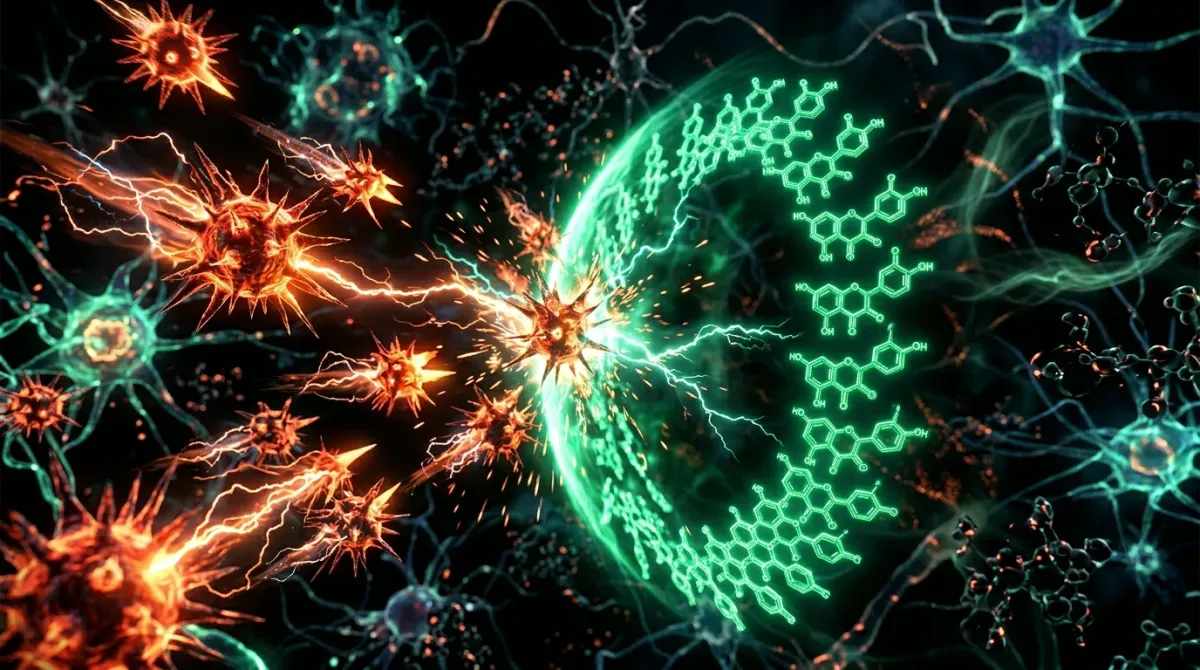
Think of your cells as a city of 37 trillion buildings. Every day, each building suffers approximately 10,000 small fires — sparks that can damage walls, melt wiring, and weaken foundations. These sparks are free radicals: unstable molecules missing an electron, desperately seeking one from anything nearby.
When a free radical steals an electron from your DNA, it can cause a mutation. When it steals from a cell membrane, it disrupts cellular communication. When it steals from a protein, it can disable an enzyme your body needs. This process is called oxidative stress, and it is now recognized as a fundamental driver of:
- Aging itself — the Free Radical Theory of Aging, proposed by Denham Harman in 1956, remains one of the most validated frameworks in biogerontology
- Cardiovascular disease — oxidized LDL cholesterol is the form that actually builds arterial plaque
- Neurodegeneration — the brain consumes 20% of the body's oxygen, producing enormous ROS loads
- Cancer — oxidative DNA damage drives mutations
- Diabetes — pancreatic beta cells are exquisitely sensitive to oxidative stress
- Skin aging — UV radiation generates ROS that degrade collagen and elastin
Where Free Radicals Come From
Free radicals are not foreign invaders — they are produced by your own body as byproducts of normal metabolism, plus external sources:
| Source | Type of Radicals | Approximate Contribution |
|---|---|---|
| Mitochondrial respiration | Superoxide (O₂•⁻) | 90% of endogenous ROS |
| Immune cell oxidative burst | Superoxide, H₂O₂, HOCl | Infection/inflammation-driven |
| UV radiation | Singlet oxygen, hydroxyl radical | Skin aging, DNA damage |
| Pollution / cigarette smoke | Peroxynitrite, various | Lung and cardiovascular damage |
| High blood sugar | Advanced glycation end-products (AGEs) | Diabetic complications |
| Intense exercise | Superoxide, hydrogen peroxide | Muscle damage, temporary |
| Alcohol metabolism | Acetaldehyde, ROS | Liver damage |
| Chronic psychological stress | Cortisol-induced oxidative stress | Systemic |
The key concept: oxidative stress = free radical production − antioxidant defenses. When production exceeds defenses, damage accumulates.
How Quercetin Neutralizes Free Radicals: The Molecular Advantage
The Structural Secret: Catechol + Double Bond
Quercetin's antioxidant power comes from its chemical structure. It has two critical features that most antioxidants lack:
1. The catechol group (B-ring): Two adjacent hydroxyl (-OH) groups that can each donate a hydrogen atom (H•) to a free radical. This turns the radical into a stable, harmless molecule. After donating, quercetin itself becomes a radical — but a stable one, because the unpaired electron is delocalized across the entire flavonoid ring system.
2. The C2-C3 double bond (C-ring): This conjugated double bond system acts as an "electron highway," allowing the unpaired electron to spread across the molecule. The more the electron is spread out, the more stable the quercetin radical becomes — and the less likely it is to cause secondary damage.
             OH
              |
    HO ──── C ──── OH    ← Catechol group: two adjacent -OH
         //          \
        C            C
        |            |
        C == C -- OH  ← C2-C3 double bond + 3-OH
        |            |
        C == O       C    ← 4-keto group
        \          //
         C ──── C
              |
             OH
This structure makes quercetin one of the most efficient free radical scavengers in nature.
Measured Antioxidant Power: ORAC and DPPH
Two standard laboratory tests quantify antioxidant capacity:
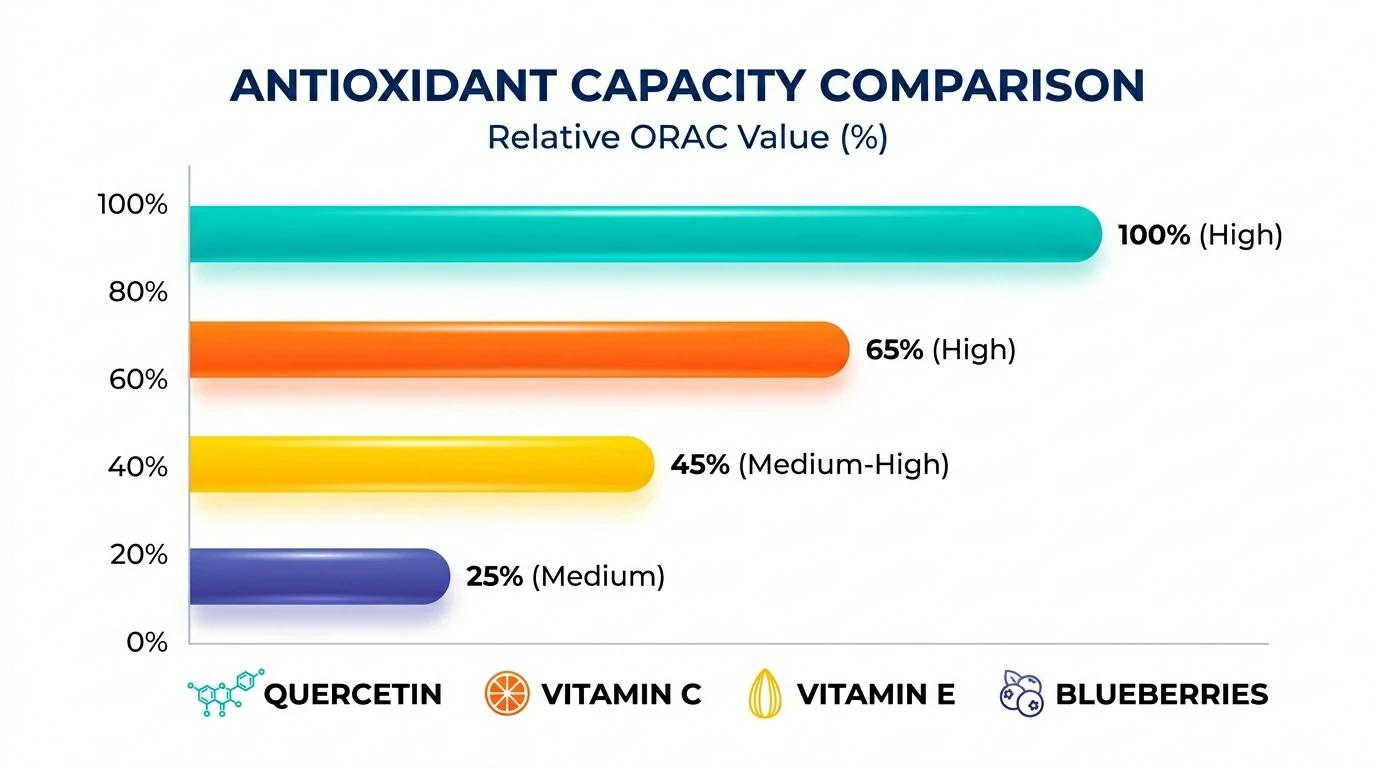
ORAC (Oxygen Radical Absorbance Capacity): Measures how effectively a compound neutralizes peroxyl radicals — the most common type in the body.
| Antioxidant | ORAC Value (μmol TE) | Relative to Quercetin |
|---|---|---|
| Quercetin | 12,000–14,000 | 1× (baseline) |
| Resveratrol | 8,000–10,000 | 0.6–0.7× |
| Vitamin C | 1,800–2,300 | 0.13–0.16× |
| Vitamin E (α-tocopherol) | 1,500–2,000 | 0.11–0.14× |
| Glutathione | Indirect (enzymatic) | Not directly comparable |
Quercetin demonstrates 6–8× the peroxyl radical scavenging capacity of vitamin C and approximately 7× that of vitamin E on a per-molecule basis.
DPPH Assay IC50: Measures the concentration needed to neutralize 50% of DPPH radicals — a lower value means higher potency.
| Compound | DPPH IC50 (μg/mL) |
|---|---|
| Quercetin | 2–5 (most potent) |
| Resveratrol | 5–10 |
| Vitamin C | 10–20 |
| Vitamin E | 15–25 |
Quercetin requires only 2–5 μg/mL to neutralize half of the radicals in the system — substantially more efficient than either vitamin C or E.
The Nrf2 Pathway: Teaching Cells to Defend Themselves
If direct scavenging is like putting out fires one by one, activating the Nrf2 pathway is like building a fire station in every cell — complete with trained firefighters, water trucks, and smoke detectors. This is quercetin's second, arguably more powerful, antioxidant mechanism.
How Nrf2 Works
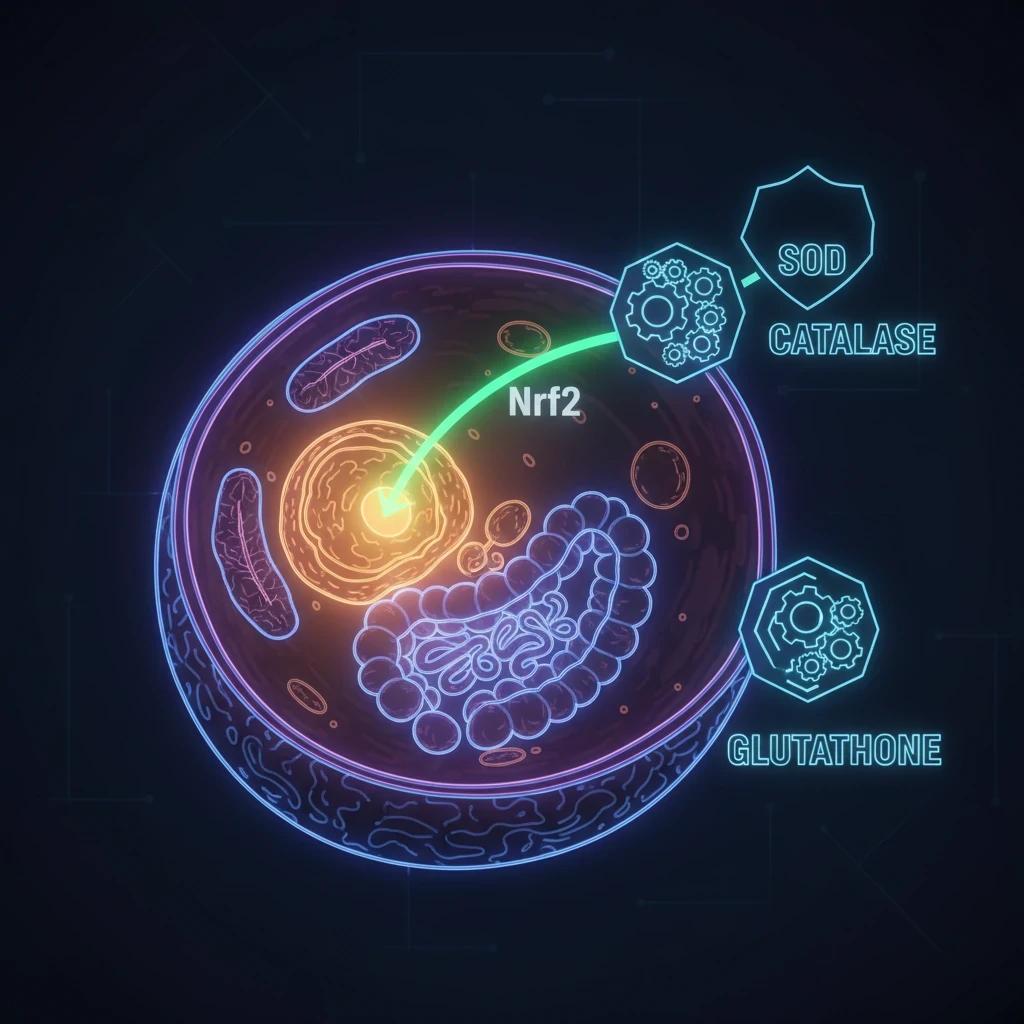
Under normal conditions, Nrf2 (Nuclear factor erythroid 2-related factor 2) is trapped in the cytoplasm by its inhibitor protein, Keap1. Keap1 constantly tags Nrf2 for degradation — keeping cellular Nrf2 levels low.
When quercetin enters the cell, it modifies Keap1's cysteine residues, causing Keap1 to release Nrf2. Free Nrf2 then:
- Translocates to the nucleus
- Binds to ARE (Antioxidant Response Elements) on DNA
- Triggers transcription of over 200 cytoprotective genes
Quercetin → Keap1 modification → Nrf2 release → Nuclear translocation
                                                         ↓
                                          Nrf2 + ARE (DNA binding)
                                                         ↓
                          ┌──────────────┬──────────────┬──────────────┐
                          │              │              │              │
                       SOD ↑       Catalase ↑    Glutathione ↑   HO-1 ↑
                    (Superoxide   (H₂O₂ → H₂O)   Peroxidase ↑  (Heme → CO
                     → H₂O₂)                                   + bilirubin)
The enzymes produced include:
| Enzyme | Full Name | What It Does |
|---|---|---|
| SOD | Superoxide Dismutase | Converts superoxide (O₂•⁻) → hydrogen peroxide (H₂O₂) |
| Catalase | Catalase | Converts H₂O₂ → water (H₂O) + oxygen (O₂) |
| GPx | Glutathione Peroxidase | Reduces lipid peroxides and H₂O₂ using glutathione |
| HO-1 | Heme Oxygenase-1 | Degrades pro-oxidant heme → bilirubin (potent antioxidant) + CO |
| NQO1 | NAD(P)H Quinone Oxidoreductase 1 | Reduces quinones, preventing redox cycling |
| GCL | Glutamate-Cysteine Ligase | Rate-limiting enzyme for glutathione synthesis |
A 2024 study published in Nature Scientific Reports confirmed that quercetin treatment significantly decreased Keap1 expression while increasing Nrf2 accumulation in a concentration-dependent manner (2.5–10 μg/mL). At the same time, quercetin reduced intracellular ROS levels from approximately 70% (LPS group, 24h) to progressively lower levels — confirming that Nrf2 pathway activation translates directly to reduced oxidative burden.
The 2023 review in ScienceDirect further emphasized that quercetin enhances expression of Cu/Zn SOD, Mn SOD, catalase, and glutathione peroxidase across multiple tissue types, including brain, liver, heart, and kidney — demonstrating systemic Nrf2-mediated protection, not just local effects.
Why This Matters: Direct vs. Indirect — The Two-Punch System
| Mechanism | What It Does | Timescale | Limitation |
|---|---|---|---|
| Direct scavenging | Quercetin molecule donates electron to radical → both neutralized | Immediate (seconds–minutes) | Each quercetin molecule can only neutralize a few radicals before being consumed |
| Nrf2 activation | Cell produces its own antioxidant enzymes | Hours–days to ramp up; sustained for days–weeks | Requires consistent quercetin presence to maintain Nrf2 activation |
The combination is what makes quercetin unique:
- Immediate protection: Direct radical scavenging neutralizes existing oxidative stress
- Sustained protection: Nrf2 activation builds the cell's own long-term defense infrastructure
This is fundamentally different from taking vitamin C alone — which provides immediate scavenging but does not significantly activate Nrf2, and is rapidly excreted once blood levels saturate.
The Antioxidant Network: Quercetin's Synergy with Vitamins C and E
Antioxidants do not work in isolation — they form an interconnected redox network. The key interaction:
Quercetin regenerates vitamin E. When vitamin E (α-tocopherol) neutralizes a lipid peroxyl radical in a cell membrane, it becomes the tocopheroxyl radical — oxidized and inactive. Quercetin, positioned at the membrane-water interface due to its amphipathic structure, can donate an electron back to the tocopheroxyl radical, restoring vitamin E to its active form.
Vitamin C regenerates quercetin. When quercetin becomes oxidized after donating electrons, vitamin C (ascorbate) can reduce it back — recycling quercetin for another round of radical scavenging.
Lipid peroxyl radical (LOO•)
         │
         ↓ (Vitamin E donates H•)
  Tocopheroxyl radical (Vit E•)
         │
         ↓ (Quercetin donates e⁻, regenerates Vit E)
  Quercetin radical (semi-stable)
         │
         ↓ (Vitamin C donates e⁻, regenerates quercetin)
  Dehydroascorbate (oxidized Vit C)
         │
         ↓ (Glutathione or enzymatic reduction)
  Ascorbate (Vit C, restored)
This network means that quercetin supplementation extends the functional lifespan of both vitamin C and vitamin E in the body — a multiplier effect that single-antioxidant supplements cannot achieve.
Practical Antioxidant Strategy with Quercetin
| Goal | Protocol | Expected Outcome |
|---|---|---|
| General oxidative stress reduction | 500 mg/day quercetin phytosome or EMIQ | Nrf2 enzyme induction within 2–4 weeks |
| Skin aging / UV protection | 500–1,000 mg/day + topical vitamin C | Reduced UV-induced collagen degradation |
| Exercise recovery | 500 mg 60 min pre-workout | Attenuated post-exercise ROS spike |
| Cognitive protection | 500–1,000 mg/day quercetin phytosome | Nrf2-mediated neuroprotection, HO-1 in brain |
| Cardiovascular antioxidant support | 500 mg/day + CoQ10 (100 mg) | Reduced LDL oxidation, endothelial protection |
Form matters critically. Standard quercetin dihydrate has ~2% oral bioavailability — you absorb only 20 mg from a 1,000 mg dose. Quercetin phytosome (lecithin-complexed, such as Quercefit) and EMIQ (enzymatically modified isoquercitrin) achieve 20–40% bioavailability — delivering 10–20× more quercetin to tissues where it can activate Nrf2 and scavenge radicals.
The vitamin C synergy tip: Taking 250–500 mg vitamin C alongside quercetin not only recycles oxidized quercetin but also stabilizes quercetin in the gastrointestinal tract, preventing oxidative degradation before absorption. This simple addition can meaningfully increase the net antioxidant effect of a quercetin supplement.
Last updated: May 2026. This article is for informational purposes and does not constitute medical advice. Always consult a healthcare professional before starting any supplement regimen.
Source: This article references peer-reviewed research published in Nature Scientific Reports (2024), PMC Antioxidants (2019), ScienceDirect (2023), and the IntechOpen monograph on quercetin antioxidant properties (2024).
Related Articles
- Quercetin and Inflammation: How This Flavonoid Inhibits NF-κB — The antioxidant-to-anti-inflammatory pathway
- What Foods Contain the Most Quercetin? Top 15 Dietary Sources Ranked — Dietary antioxidants and quercetin food sources
- EGCG Stability: What Green Tea Catechins Actually Need — Comparing flavonoid antioxidant mechanisms
Explore high-purity quercetin extract from Sophora japonica at ginkvora.com/products/quercetin — ideal for antioxidant formulations with consistent potency and Nrf2-activating capacity.