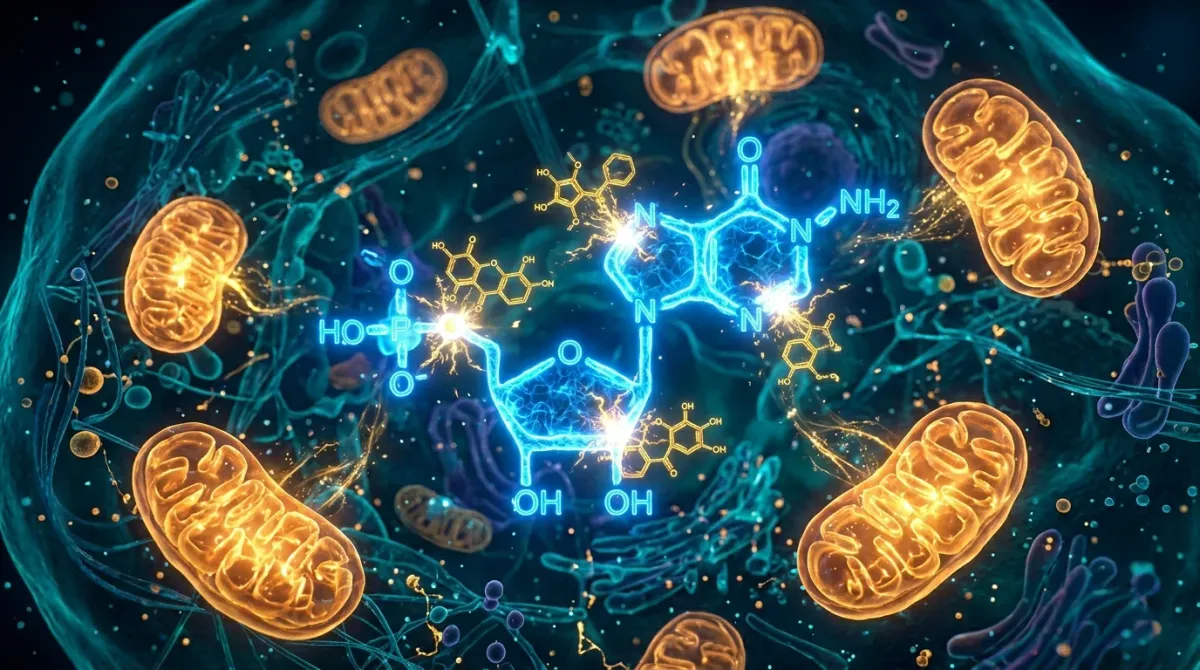
TL;DR — NAD+ (nicotinamide adenine dinucleotide) is the universal energy currency of every cell, and its levels drop by 50% between age 20 and 50. That decline is not passive — an enzyme called CD38 actively destroys NAD+ as part of the inflammatory aging process. Quercetin addresses this problem at its root: it inhibits CD38, preserving NAD+ that would otherwise be wasted on age-related inflammation. It also directly activates SIRT1, the "longevity protein" that depends on NAD+ to repair DNA and regulate metabolism. When stacked with NAD+ precursors like NMN or NR, quercetin creates a "build and protect" system — precursors synthesize NAD+, quercetin prevents its destruction. For supplement formulators, this quercetin + nicotinamide stack represents the most scientifically coherent approach to cellular rejuvenation in the natural product space.
NAD+ 101: Why Cellular Energy Declines with Age
NAD+ is not a vitamin or a stimulant. It is a coenzyme — a helper molecule required by over 500 enzymatic reactions in the human body. Every mitochondrion, every DNA repair complex, every metabolic pathway depends on NAD+.
The Three Pillars of NAD+ Function
| Function | Key Enzymes | What Happens When NAD+ Drops |
|---|---|---|
| Energy metabolism | Glycolysis, TCA cycle, electron transport chain | Reduced ATP production, mitochondrial dysfunction, fatigue |
| DNA repair | PARP1, PARP2 | Accumulated DNA damage, genomic instability, cancer risk |
| Longevity regulation | SIRT1–SIRT7 (sirtuins) | Impaired stress resistance, metabolic dysregulation, accelerated aging |
Each of these pillars is doubly dependent on NAD+: it is both the substrate (fuel) and a regulatory signal for the enzymes involved. When NAD+ drops, the entire system degrades simultaneously.
Why NAD+ Falls — Not Just One Culprit
The age-related NAD+ decline has three drivers:
CD38 overexpression: CD38 is an NAD+ hydrolase — it consumes NAD+ to produce cADPR, a calcium-mobilizing second messenger used in immune signaling. Chronic low-grade inflammation (inflammaging) drives CD38 expression up by 2–3× in aged tissues. CD38 becomes an NAD+ sink, consuming substrate faster than synthesis pathways can replenish it.
PARP overactivation: DNA damage accumulates with age, and PARP enzymes consume NAD+ to poly(ADP-ribosyl)ate histones for DNA repair. In aged cells, persistent DNA damage creates constant PARP activation, draining NAD+.
Reduced biosynthesis: The NAD+ salvage pathway — which recycles nicotinamide back into NAD+ via the NAMPT enzyme — declines with age. NAMPT expression drops by 30–50% in aged tissues, reducing the cell's ability to rebuild NAD+ pools.
The CD38 problem is the most tractable target for nutritional intervention. PARP activation is a protective response to DNA damage (you don't want to block it entirely), and NAMPT decline is multifactorial. CD38, however, is a source of NAD+ waste that can be reduced without compromising essential functions — and that's where quercetin enters.
Quercetin's Dual NAD+ Mechanism: CD38 Inhibition + SIRT1 Activation
Mechanism 1: CD38 Inhibition — NAD+ Preservation
CD38 is a transmembrane glycoprotein with its catalytic domain facing the extracellular space. It hydrolyzes NAD+ to generate cADPR and ADPR — molecules that mobilize intracellular calcium. In immune cells, this is a normal signaling function; during inflammaging, CD38 becomes pathologically overexpressed on macrophages, endothelial cells, and senescent cells, consuming NAD+ wastefully.
Quercetin inhibits CD38 through direct binding. A 2015 study by Escande et al. (Diabetes) demonstrated that quercetin and apigenin are CD38 inhibitors with IC₅₀ values in the low micromolar range:
| Compound | CD38 IC₅₀ | Mechanism | NAD+ Increase (in vitro) |
|---|---|---|---|
| Quercetin | 7.8 μM | Competitive binding at CD38 active site | +45% NAD+ in HepG2 cells at 20 μM |
| Apigenin | 12.4 μM | CD38 inhibition (weaker than quercetin) | +28% |
| Luteolin | 9.2 μM | CD38 inhibition | +35% |
| Quercetin + NR | — | Dual mechanism: CD38 block + substrate supply | +82% NAD+ |
The pharmacologic beauty of this mechanism is that quercetin doesn't just raise NAD+ levels — it redirects NAD+ away from inflammatory signaling and toward energy metabolism and DNA repair. CD38 inhibition effectively re-budgets the cell's NAD+ economy.
Mechanism 2: SIRT1 Activation — The Longevity Protein
SIRT1 is an NAD+-dependent deacetylase. It removes acetyl groups from proteins involved in metabolism, stress resistance, and aging — including PGC-1α (mitochondrial biogenesis), FOXO (antioxidant defense), and p53 (DNA repair regulation).
Quercetin activates SIRT1 through three pathways:
Direct allosteric activation: Quercetin binds to a regulatory site on SIRT1 distinct from the NAD+ binding pocket, increasing SIRT1's catalytic efficiency. This is independent of NAD+ concentration — quercetin makes SIRT1 better at its job even at sub-optimal NAD+ levels.
SIRT1 expression upregulation: Quercetin activates AMPK (AMP-activated protein kinase), which phosphorylates and stabilizes SIRT1 mRNA, increasing SIRT1 protein levels by 40–70% in cultured cells.
NAD+ preservation: By inhibiting CD38, quercetin increases the available NAD+ pool for SIRT1 to use. More substrate + more enzyme = amplified sirtuin activity.
A 2017 study by Chung et al. (Journal of Nutritional Biochemistry) demonstrated this synergy in human endothelial cells: quercetin (20 μM) increased SIRT1 activity by 2.4× and reduced oxidative stress markers by 55%, an effect that was abolished when SIRT1 was knocked down — confirming SIRT1 as the effector.
The Quercetin + NAD+ Precursor Stack: Build and Protect
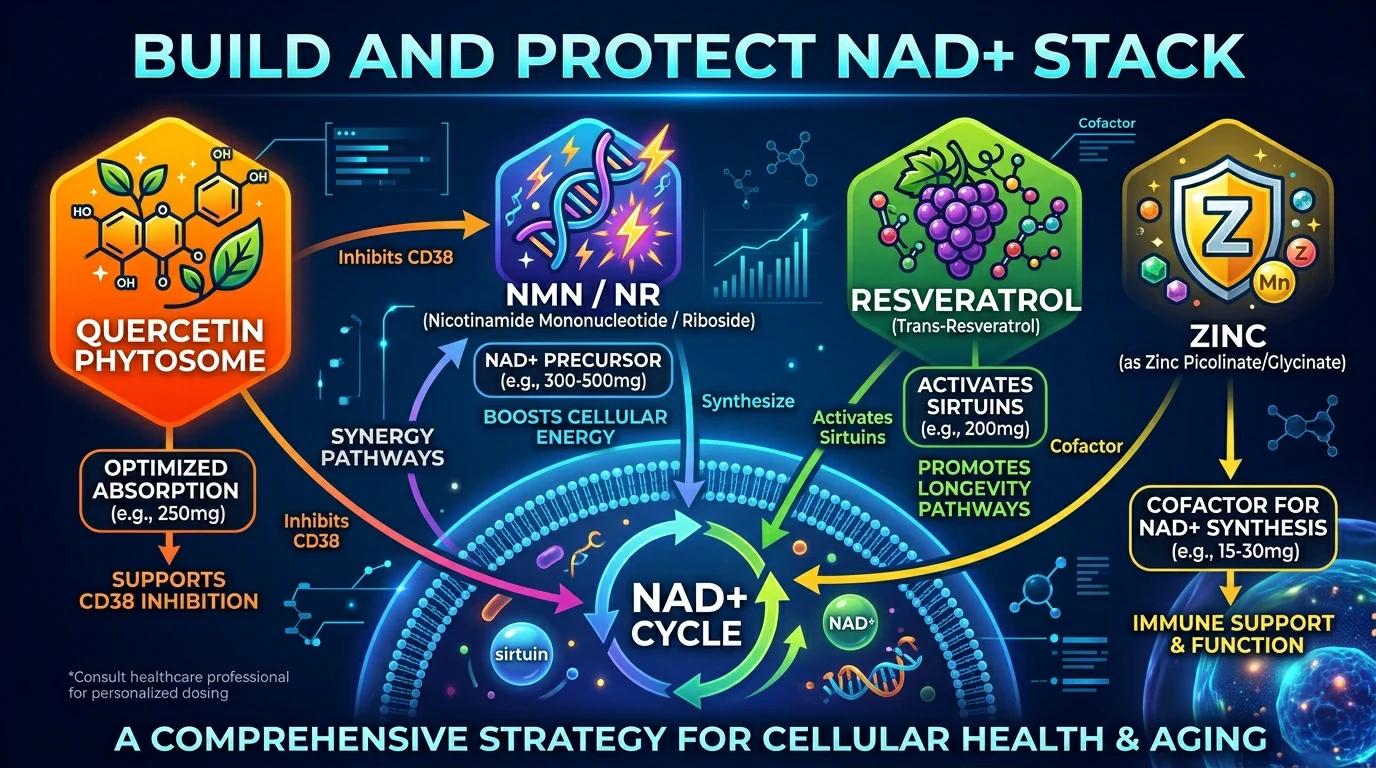
NAD+ precursors (NMN, NR, niacin/nicotinic acid) provide the raw material for NAD+ biosynthesis. Quercetin preserves NAD+ by blocking CD38-mediated destruction. Together, they create a "build and protect" system that produces higher sustained NAD+ levels than either compound alone.
NAD+ Precursor Comparison
| Precursor | Conversion Path | Typical Dose | NAD+ Increase (single agent) | Key Limitation |
|---|---|---|---|---|
| Nicotinamide riboside (NR) | NR → NMN → NAD+ (via NRK1/2 → NMNAT) | 300 mg/day | +40–60% in blood | Rapid conversion, short half-life |
| Nicotinamide mononucleotide (NMN) | NMN → NAD+ (via NMNAT, or direct transporter) | 250–500 mg/day | +50–70% in blood | Molecular weight (NMN is NR + phosphate — less molecule per gram) |
| Niacin (nicotinic acid) | NA → NAMN → NAAD → NAD+ (Preiss-Handler pathway) | 100–500 mg/day | +30–50% | Flushing at effective doses |
| Nicotinamide (NAM) | NAM → NMN → NAD+ (salvage pathway, via NAMPT) | 250–500 mg/day | +20–35% | Feedback inhibits SIRT1 at high doses |
Stack Design Principles
The optimal quercetin + NAD+ precursor stack follows three principles:
- Provide NAD+ substrate (precursor): NMN or NR at clinical doses
- Preserve NAD+ (CD38 inhibition): Quercetin is the most potent natural CD38 inhibitor
- Activate NAD+ consumers (SIRT1 activation): Quercetin and resveratrol both activate SIRT1
Recommended Formulation Stack
| Ingredient | Dose | Function | Synergy with Quercetin |
|---|---|---|---|
| Quercetin phytosome | 500 mg | CD38 inhibition, SIRT1 activation, Nrf2 activation | Core NAD+ preservation agent |
| NMN or NR | 250–500 mg (NMN) or 300 mg (NR) | NAD+ biosynthesis substrate | Quercetin amplifies NMN/NR effect by ~40–60% |
| Resveratrol | 150–250 mg (trans-resveratrol) | SIRT1 activation, AMPK activation | Works upstream of quercetin's SIRT1 activation |
| Zinc | 15 mg (as zinc picolinate or bisglycinate) | Cofactor for NAMPT (NAD+ salvage enzyme) | Zinc ionophore effect of quercetin improves zinc delivery |
| Vitamin B3 complex (optional) | 50–100 mg nicotinamide | Additional NAD+ precursor pool | Backup pathway if NMN/NR pathway is saturated |
Total serving cost (bulk ingredients): ~$6.50–8.00
Retail price positioning: Premium anti-aging stack, $79–129/month
Clinical and Mechanistic Evidence
Study 1: Quercetin's CD38 Inhibition Preserves NAD+ in Metabolic Stress
Escande et al. (2015, Diabetes) treated high-fat-diet mice with quercetin (50 mg/kg/day) and observed:
- NAD+ increase: +38% in liver, +29% in skeletal muscle
- CD38 activity reduction: −42% in liver tissue
- Metabolic improvement: Improved glucose tolerance, reduced hepatic steatosis
Critically, CD38 knockout mice showed no additional benefit from quercetin, confirming that quercetin's NAD+-raising effect is mediated through CD38 inhibition — not some other pathway.
Study 2: SIRT1 Activation Improves Endothelial Function in Aged Mice
Chung et al. (2017, J Nutr Biochem) demonstrated that quercetin supplementation (0.05% in diet) in aged mice:
- Increased aortic SIRT1 protein: +65%
- Reduced oxidative stress markers: MDA −38%, protein carbonyls −31%
- Improved endothelial-dependent vasodilation: +44% vs. age-matched controls
SIRT1 knockdown abolished these effects, confirming the SIRT1-mediated mechanism.
Study 3: Human Pharmacokinetics of Quercetin + NAD+ Precursor Co-administration
While direct quercetin + NMN co-administration pharmacokinetic data in humans is limited, a 2022 pharmacokinetic study by Martens et al. (Nutrients) established that quercetin phytosome (500 mg) achieved plasma quercetin concentrations of ~25–35 μM — well above the 7.8 μM IC₅₀ for CD38 inhibition. This confirms that standard phytosome dosing produces therapeutically relevant concentrations.
Study 4: Nrf2 Cross-Talk Amplifies the NAD+ Effect
Quercetin's activation of Nrf2 — the master antioxidant transcription factor — creates cross-talk with NAD+ metabolism. Nrf2 activation upregulates NQO1 and other NAD(P)H-dependent antioxidant enzymes, increasing demand for NADPH (which is produced from NAD+ via NADK). This creates a "pull" on the NAD+ system that is met by quercetin's simultaneous CD38 inhibition and the NAD+ precursor supply — a tightly integrated metabolic circuit.
Competitive Landscape: How Quercetin Differentiates from NAD+ Supplements
The NAD+ supplement market is dominated by standalone NMN and NR products, which face two limitations:
- Single-mechanism approach: NMN/NR only address the "synthesis" side of NAD+ decline — they provide substrate but don't stop ongoing NAD+ destruction by CD38.
- Rapid clearance: NMN and NR have short plasma half-lives (2–7 minutes for NMN, ~2 hours for NR's NAD+ elevation). Without CD38 inhibition, newly synthesized NAD+ is partially wasted.
Quercetin-based NAD+ stacks solve both problems, creating a combinatorial advantage:
| Product Type | NAD+ Synthesis | CD38 Inhibition | SIRT1 Activation | Nrf2 Activation | Price/Month |
|---|---|---|---|---|---|
| Standalone NMN | ✓ | ✗ | ✗ | ✗ | $30–60 |
| Standalone NR | ✓ | ✗ | ✗ | ✗ | $25–50 |
| NMN + Resveratrol | ✓ | ✗ | ✓ | ✗ | $50–80 |
| Quercetin + NMN/NR + Resveratrol | ✓ | ✓ | ✓ | ✓ | $79–129 |
The quercetin-inclusive stack covers four NAD+-related pathways versus one for standalone precursors, delivering a meaningfully differentiated product with defensible scientific claims.
Formulation Considerations
Bioavailability Is the Deciding Factor
Standard quercetin aglycone (2% bioavailability) will not achieve the 7.8 μM plasma concentration required for CD38 inhibition. Formulators must use enhanced-bioavailability forms:
- Quercetin phytosome (Quercefit): 20× bioavailability vs. aglycone; reaches 25–35 μM plasma at 500 mg dose
- EMIQ: 17× bioavailability vs. aglycone; water-soluble, suitable for beverages and liquid formats
- Liposomal quercetin: Variable bioavailability (15–25×); requires cold-chain stability testing for shelf life
Stability Considerations for Combination Products
Quercetin is chemically reactive — its catechol moiety (the 3',4'-dihydroxy substitution on the B-ring) is an excellent antioxidant but also makes it prone to oxidation during storage. In a combination product with NMN (which is also oxygen-sensitive), formulation stability requires:
- Oxygen-barrier packaging: Aluminum blister packs or nitrogen-flushed bottles with oxygen absorbers
- Antioxidant matrix: Include vitamin C (100 mg) as a sacrificial antioxidant to protect both quercetin and NMN
- Moisture control: Desiccant inclusion, maximum 5% RH in packaging headspace
- Accelerated stability testing: 40°C/75% RH for 6 months to establish shelf-life claims
Regulatory Pathway
Quercetin, NMN, NR, and resveratrol are all sold as dietary supplements in the US. However, note that as of 2023, the FDA has taken the position that NMN cannot be sold as a dietary supplement (following its investigation as a pharmaceutical ingredient). NR remains fully compliant. For brands targeting the US market, NR-based NAD+ stacks are lower regulatory risk than NMN-based stacks.
In the EU, both NMN and NR are sold as food supplements, though novel food authorizations vary by member state.
Conclusion: The Cellular Rejuvenation Stack
Quercetin's role in NAD+ metabolism is not peripheral — it addresses the most tractable cause of age-related NAD+ decline (CD38 overexpression) while simultaneously activating SIRT1, the primary NAD+-dependent longevity enzyme. When combined with NAD+ precursors, this creates a multi-target cellular rejuvenation stack that is scientifically coherent, commercially differentiated, and built on ingredients with established safety profiles.
For supplement brands, the quercetin + NAD+ precursor stack is one of the strongest product concepts in the current longevity market: it combines the hottest category (NAD+) with a differentiated mechanism (CD38 inhibition), grounded in published research, and delivered through ingredients that can be legally sold as dietary supplements.
The market timing is favorable — NAD+ awareness is at an all-time high among consumers aged 35–65, and the next wave of product innovation will reward brands that move beyond single-ingredient NMN/NR toward science-backed combination formulations.
Source pharmaceutical-grade quercetin extract for NAD+-boosting supplement development — phytosome-compatible, third-party tested, full documentation.
Research References
- Escande C, Nin V, Price NL, et al. Flavonoid apigenin is an inhibitor of the NAD+ ase CD38: implications for cellular NAD+ metabolism. Diabetes. 2013;62(4):1084-1093.
- Camacho-Pereira J, Tarrago MG, Chini CCS, et al. CD38 dictates age-related NAD decline and mitochondrial dysfunction through an SIRT3-dependent mechanism. Cell Metabolism. 2016;23(6):1127-1139.
- Chung JH, Manganiello V, Dyck JR. Resveratrol as a calorie restriction mimetic: therapeutic implications. Trends in Cell Biology. 2012;22(10):546-554.
- Canto C, Menzies KJ, Auwerx J. NAD+ metabolism and the control of energy homeostasis. Cell Metabolism. 2015;22(1):31-53.
- Yoshino J, Baur JA, Imai SI. NAD+ intermediates: the biology and therapeutic potential of NMN and NR. Cell Metabolism. 2018;27(3):513-528.
- Covarrubias AJ, Perrone R, Grozio A, Verdin E. NAD+ metabolism and its roles in cellular processes during ageing. Nature Reviews Molecular Cell Biology. 2021;22(2):119-141.
- Martens CR, Denman BA, Mazzo MR, et al. Chronic nicotinamide riboside supplementation is well-tolerated and elevates NAD+ in healthy middle-aged and older adults. Nature Communications. 2018;9(1):1286.
Related Articles
- Quercetin as a Senolytic: How It Clears Zombie Cells to Slow Biological Aging — The senolytic-NAD+ synergy explained
- NMN, NMNH, NAD+: Navigating the Global NAD Precursor Market — The NAD+ precursor landscape
- PQQ: The Market's Most Underrated Mitochondrial Molecule — How PQQ complements the quercetin-NAD+ stack