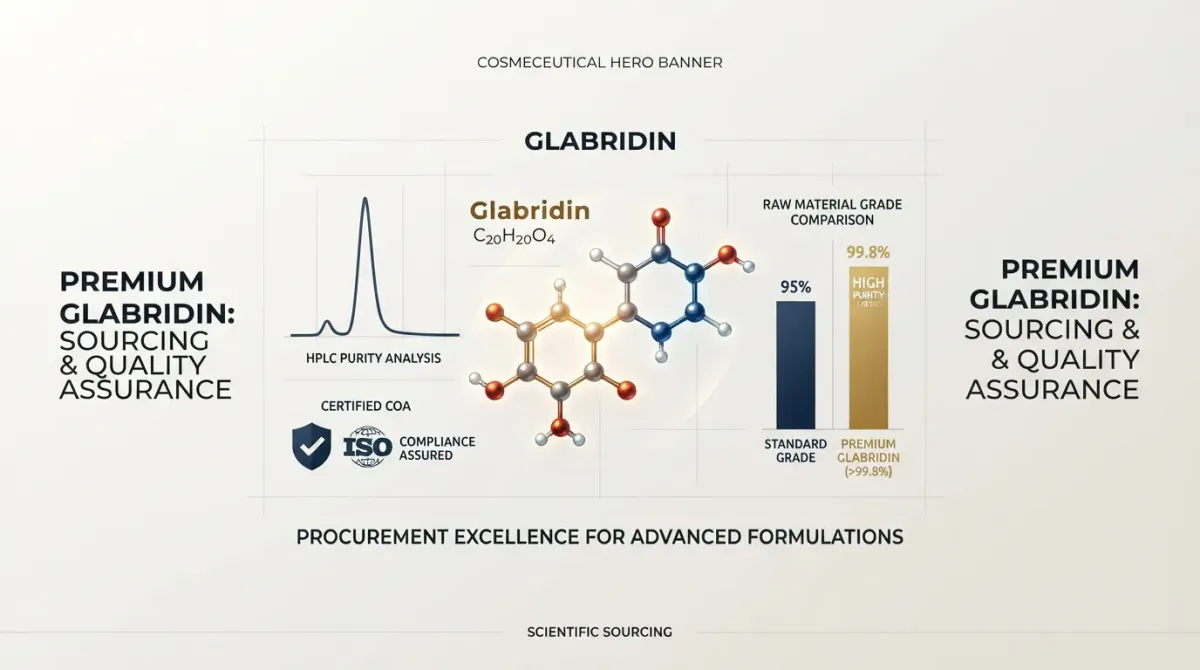
TL;DR
You're sourcing glabridin for a cosmetic formula. You have quotes from three suppliers. One offers "40% glabridin powder" at $X/kg, another "98% HPLC" at $4X/kg, and the third won't even give you a price without an NDA. How do you decide?
This guide gives you the framework: understand what each grade actually contains (they're not interchangeable), learn which COA items matter and which don't, evaluate suppliers on consistency \u2014 not just first-batch performance \u2014 and negotiate smarter with knowledge of what drives real cost.
The Two Glabridin Grades: 40% Extract vs 98% Isolate
The single most common sourcing mistake with glabridin is treating all "glabridin" as equivalent. These are fundamentally different materials.
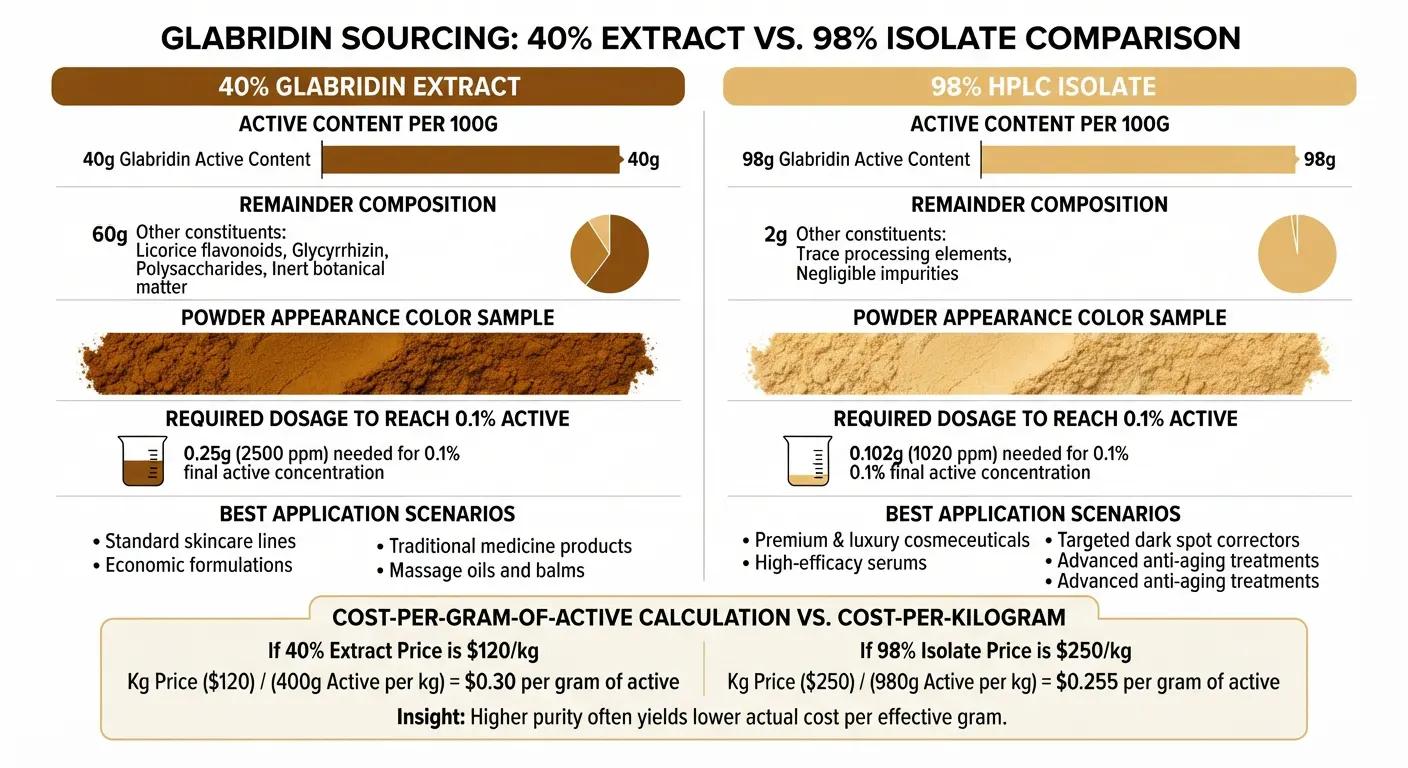
40% Glabridin \u2014 Licorice Root Extract Standardised to 40%
This is a botanical extract, not a purified compound. Per 100g purchased:
| Parameter | Value |
|---|---|
| Active Glabridin | 40g per 100g |
| Remainder (60%) | Co-extracted licorice components: isoflavonoids, glycyrrhizic acid derivatives, plant matrix |
| Appearance | Deep brown / amber powder |
| Dosing to achieve 0.1% active | 0.25% of extract in formula |
| Best application | Tinted products, night creams, formulations where color is acceptable |
The hidden cost: At first glance, 40% grade appears cheaper per kilogram. But to deliver 0.1% glabridin active in your formula, you need 0.25% of the 40% extract \u2014 versus 0.1% of the 98% isolate. Calculate cost per gram of active glabridin delivered, not cost per kilogram of raw material. The 40% grade is often more expensive on a cost-in-use basis once the 2.5\u00d7 dilution factor is applied. And you get 60% non-glaboridin material loaded into your formula alongside the active \u2014 including glycyrrhizic acid derivatives that can contribute to formula odor, color, and preservative challenge.
98% Glabridin \u2014 HPLC-Verified Isolate
This is a near-single-compound purified isolate:
| Parameter | Value |
|---|---|
| Active Glabridin | \u226598g per 100g by HPLC |
| Remainder (<2%) | Minor related isoflavonoids only, well-characterised |
| Appearance | Off-white to light yellow-brown powder |
| Dosing to achieve 0.1% active | 0.1% of ingredient in formula |
| Best application | Premium serums, light-colored emulsions, any formula where color precision matters |
The real advantage is control, not just purity. With the 98% grade, 0.1% ingredient = 0.1% glabridin active, every time. With the 40% grade, you are dosing 60% unknown co-extract alongside your active, with batch-to-batch variation in that co-extract composition. For regulated markets (EU CosIng, China IECIC), the cleaner impurity profile also simplifies safety documentation.
Decision rule: If your formula tolerates amber-brown color (night creams, tinted moisturizers, BB creams) and your dosing protocol accounts for the 2.5\u00d7 factor, 40% works. For everything else \u2014 and especially for premium serums in airless pumps where color stability is a selling point \u2014 use 98%.
Glabridin Purity Grades Beyond 40% and 98%
The market also has intermediate and premium grades:
| Grade | Description | Typical Use |
|---|---|---|
| 40% (G40) | Licorice extract, standardised | Mass-market creams, color-tolerant formulas |
| 90% | Partially purified | Mid-tier brightening products |
| 98% | HPLC-verified, \u226598% | Premium serums, precision formulations |
| 99% | Ultra-high purity | Research-grade, luxury skincare, nutraceutical applications |
The jump from 90% to 98% is not linear in price \u2014 it reflects the additional purification cost of removing the last 8% of impurities. For most cosmetic applications, the difference between 98% and 99% is not functionally meaningful. 98% HPLC-verified is the sweet spot: cleaner impurity profile than 40% or 90%, without the significant price premium of 99%.
CAUTION: A grade labeled as "98% glabridin" is only as credible as the HPLC data behind it. Misrepresentation \u2014 40% or 90% material sold as 98% \u2014 is a known commercial risk in this ingredient market. Always verify via independent third-party HPLC before committing to volume orders. See the COA section below for exactly what to check.
The 12-Point COA Verification Checklist
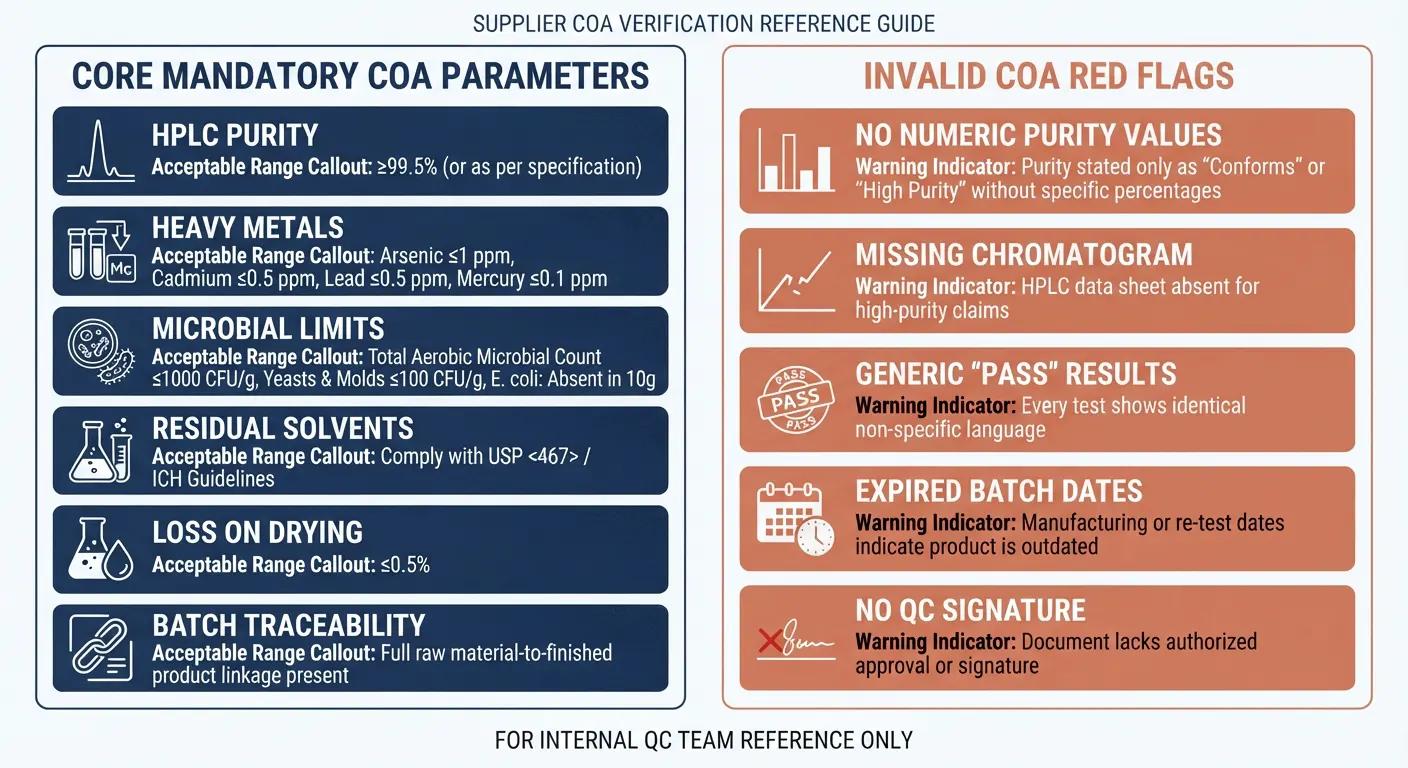 A Certificate of Analysis (COA) is the single most important document in glabridin sourcing. But not all COAs are created equal. Here's what a credible COA must include \u2014 and the red flags that signal trouble.
Mandatory COA Items (do not accept a COA without these)
| # | Parameter | What to Verify | Acceptable Range |
|---|---|---|---|
| 1 | CAS Number | Must be exactly 59870-68-7 | Non-negotiable |
| 2 | HPLC Purity | Request the chromatogram, not just the number | \u226598% for 98 grade; \u226540% for 40 grade |
| 3 | Appearance | Request a photograph of the actual batch | White to light yellow-brown for 98%; deep amber-brown for 40% |
| 4 | Heavy Metals (Pb, As, Cd, Hg) | Demand quantitative values, not "Pass" | Pb \u226410 ppm, As \u22642 ppm, Cd \u22641 ppm, Hg \u22640.1 ppm (ICH Q3D) |
| 5 | Microbial Limits | TAMC, TYMC, specified pathogens | TAMC \u22641,000 CFU/g; TYMC \u2264100 CFU/g; E. coli, Salmonella: Absent |
| 6 | Residual Solvents | Named solvent + measured level | Below ICH Q3C Class 2 or Class 3 limits |
| 7 | Loss on Drying / Water Content | Critical for cost calculation | \u22645% typical |
| 8 | Batch Production Date | Must support your production timeline | Within last 6 months preferred; max 24-month shelf life from production |
| 9 | Storage Condition | Sealed, cool (<25\u00b0C), dry, away from light | Non-negotiable |
| 10 | Heavy Metals Method | ICP-MS or AAS, not "visual comparison" | Method must be named |
| 11 | HPLC Method | Column, mobile phase, detection wavelength | C18 column, UV detection at 280 nm typical |
| 12 | Signature & Date | QC manager signature, not just a stamp | Dated within production month |
Red Flags on a COA
- "Glabridin content: Pass" \u2014 without a numeric percentage, this is a placeholder COA, not a real one.
- "Heavy metals: conforms" \u2014 same issue. Demand quantitative values.
- Chromatogram shows multiple large peaks on a "98%" COA \u2014 this is likely 90% or lower material being sold as 98%. A genuine 98% COA chromatogram should show one dominant peak (>98% area) with minor impurity peaks individually below 2%.
- Batch date older than 12 months \u2014 glabridin degrades over time, particularly if storage conditions were not ideal. Old material may show reduced active content and deepened colour even if the COA at time of production was acceptable.
- COA dated more than 6 months before shipment \u2014 the material has been sitting somewhere. Ask what happened to it in the interim.
- Supplier refuses to provide the chromatogram alongside the COA \u2014 this is the single most critical piece of technical evidence. There is no legitimate reason to withhold it.
How to Vet a Glabridin Supplier: Beyond the COA
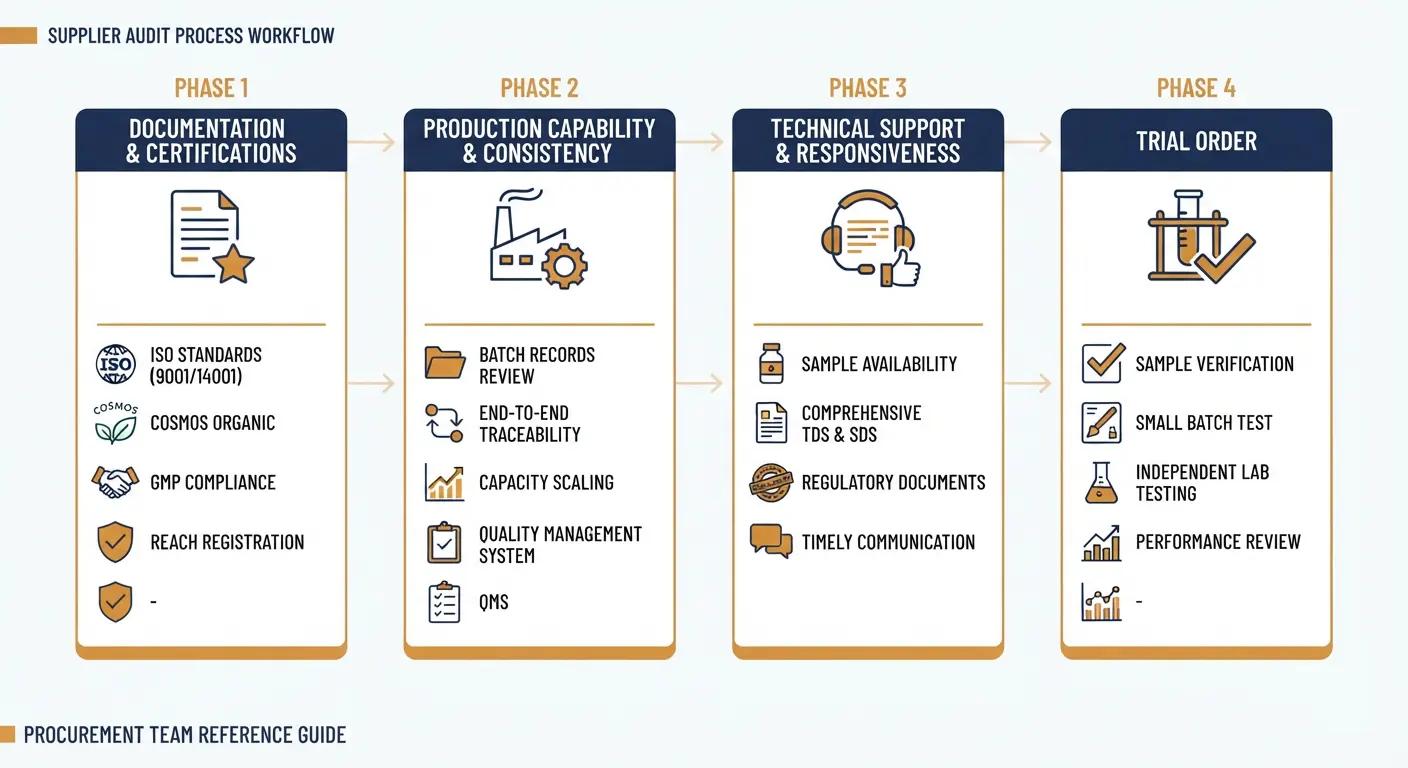 A COA proves one batch was acceptable at one point in time. It does not prove the supplier can repeat that performance across every future shipment. Here is the framework for evaluating consistency, reliability, and long-term partnership quality.
Phase 1: Documentation & Certifications
| Criteria | What to Ask | What a Credible Answer Looks Like |
|---|---|---|
| ISO 9001 | "Can you provide your certificate number and scope?" | Active certificate, verifiable on certifier's website |
| COSMOS / Ecocert | "Is your glabridin COSMOS-certified?" | Yes + certificate number (important for EU natural cosmetic claims) |
| HALAL / KOSHER | "Do you have HALAL/KOSHER certification?" | Yes, if targeting Middle East or specific consumer segments |
| GMP | "Do you manufacture under GMP?" | Ideally ISO 22716 (cosmetic GMP) or pharmaceutical GMP |
| REACH Registration | "Is this material REACH-registered for EU import?" | Yes, with registration number (essential for EU customers) |
Certification verification tip: Always cross-check certificate numbers on the issuing body's website. A supplier that lists an expired or unverifiable certification should be disqualified immediately.
Phase 2: Production Capability & Consistency
| Criteria | What to Ask | Red Flag |
|---|---|---|
| Batch-to-batch consistency | "Can you provide COAs for your last three production batches?" | Only shows one batch; significant variation between batches |
| Extraction method | "What solvent and extraction process do you use?" | Vague answer; "proprietary" without explanation |
| Raw material traceability | "Where is your licorice root sourced from?" | Cannot name region or country of origin |
| Annual capacity | "What is your annual production capacity for glabridin?" | Unclear or inconsistent answer |
| Lead time consistency | "What is your typical lead time and has it been stable?" | Lead time varies by >50% between quarters |
| Retained sample policy | "Do you retain samples from every batch and for how long?" | No retained sample program |
Phase 3: Technical Support & Responsiveness
| Criteria | What to Ask | Red Flag |
|---|---|---|
| Sample availability | "Can I receive a sample with a current COA before placing an order?" | Charges for samples or refuses pre-order sampling |
| Technical documentation | "Can you provide a full technical data sheet (TDS) and SDS?" | TDS is one page with no application data |
| Regulatory support | "Can you provide documentation for [your target market] registration?" | Cannot or takes >1 week to respond |
| Response quality | Send a technical question (e.g., "What is the peak retention time on your HPLC?") | Generic sales response; cannot answer technical questions |
| Complaint handling | "How do you handle a quality complaint?" | No documented complaint procedure |
Phase 4: The Trial Order
Before committing to a commercial-scale order:
- Request a sample from the current production batch (not a "golden sample" from a showcase batch).
- Send the sample to an independent third-party lab for HPLC verification and heavy metals testing.
- Run a small-scale formulation trial \u2014 verify solubility behavior, color impact, and compatibility with your preservative system.
- If the sample passes, place a small commercial order (e.g., 1kg for 98% grade) before scaling to full production volumes.
Critical: The sample you test should come from the same batch the supplier will ship for your production order. If the supplier sends you a sample from batch A but delivers batch B for your full order, you have not actually verified the material you are receiving.
Pricing Factors: What Drives Glabridin Cost
Glabridin pricing is not transparent \u2014 quotes vary widely between suppliers. Understanding what drives cost helps you evaluate whether a quote is competitive or suspiciously low.
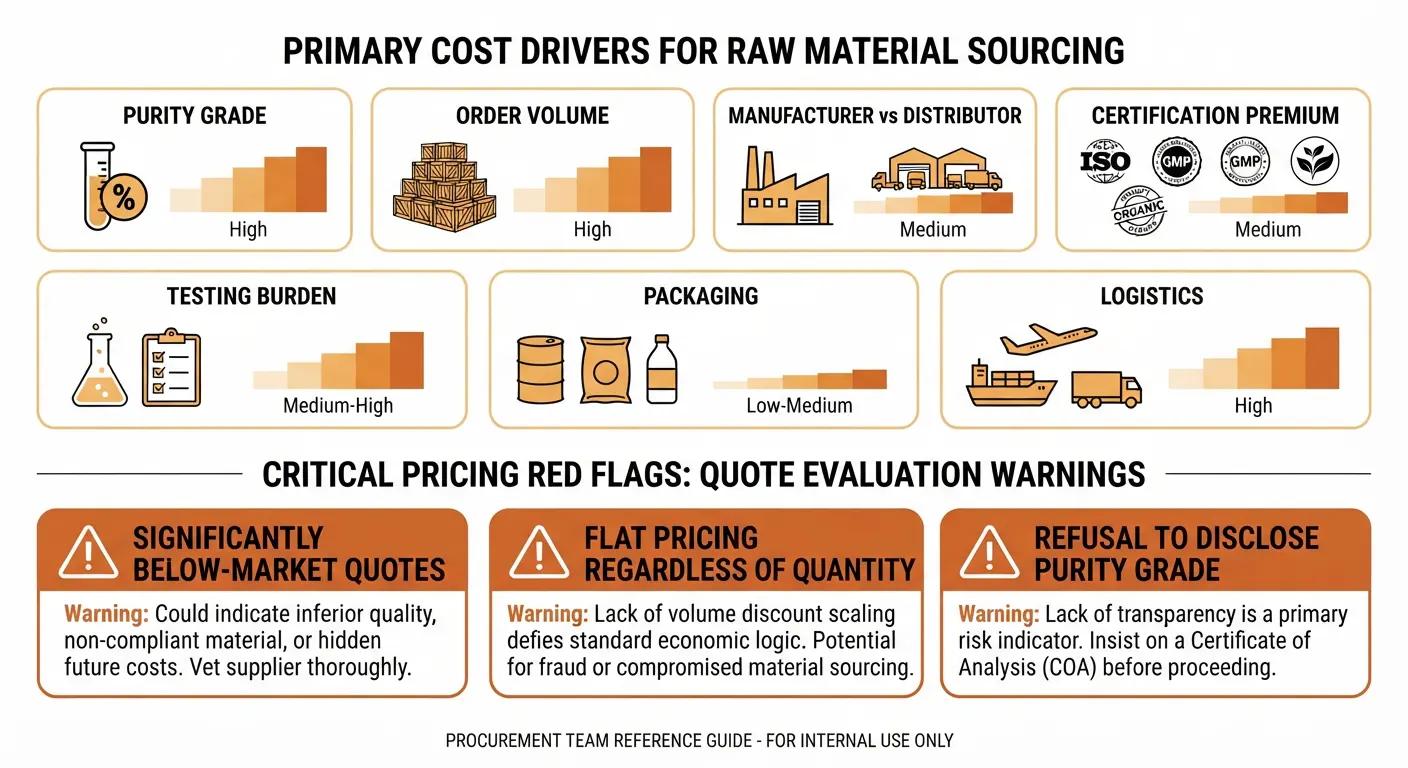
Primary Cost Drivers
| Factor | Impact on Price | Notes |
|---|---|---|
| Purity grade | 98% costs 3-5\u00d7 more per kg than 40% | But cost-per-gram-of-active is often comparable |
| Order volume | Bulk pricing tiers at 1kg, 5kg, 25kg | Significant step-downs at each tier |
| Manufacturer vs distributor | Direct manufacturer 20-40% cheaper | Distributors add margin without adding quality |
| Certification premium | COSMOS/organic adds 15-30% | Required for natural/organic claims in EU |
| Testing burden | Full heavy metals + microbial + residual solvents adds cost | This is the supplier's cost, not an optional extra |
| Packaging | Vacuum-sealed, nitrogen-flushed costs more | Required for premium 98% grade to prevent oxidation |
| Logistics | Temperature-controlled shipping adds cost | Essential for shipments to hot climates |
Pricing Red Flags
- Quote significantly below market: If three suppliers quote $X and one quotes $0.4X, the cheap supplier is almost certainly selling a lower grade or degraded material. Glabridin is a high-value, low-volume ingredient \u2014 genuine 98% HPLC-verified material cannot be dramatically cheaper.
- Fixed price for "any quantity": Legitimate suppliers have tiered pricing. A flat per-kg price regardless of order volume indicates a distributor reselling without volume benefits.
- Refusal to disclose grade: If a supplier cannot clearly state "this is the 40% extract" or "this is the 98% isolate," do not order.
MOQ, Packaging & Logistics
Minimum Order Quantity (MOQ)
Typical MOQs in the glabridin market:
| Grade | Typical MOQ (Direct Manufacturer) | Typical MOQ (Distributor) |
|---|---|---|
| 40% Extract | 1 kg | 100g - 500g |
| 90% Isolate | 500g - 1 kg | 50g - 250g |
| 98% Isolate | 100g - 500g | 10g - 100g |
| 99% Isolate | 50g - 100g | 5g - 25g |
MOQ negotiation tip: For first-time buyers, ask if the supplier can accommodate a "trial order" at lower volume (e.g., 100g for 98% grade) to run formulation and stability testing. Most reputable manufacturers will accommodate this. If a supplier refuses any order below 1kg for 98% grade without explanation, it may indicate they are a distributor, not a manufacturer.
Packaging Specifications
| Packaging Type | When to Use | Notes |
|---|---|---|
| Aluminum foil bag, vacuum-sealed | 100g - 1kg orders | Standard for premium 98% grade |
| Aluminum foil bag, nitrogen-flushed | 500g - 5kg, sensitive applications | Reduced headspace oxygen, best oxidation protection |
| HDPE drum with inner aluminum foil liner | 5kg - 25kg bulk | Standard for commercial production volumes |
| Fiber drum with double PE liner | 25kg+ | Industrial bulk; ensure inner liner integrity |
Packaging verification: Always confirm the packaging type before shipment. Glabridin is sensitive to humidity, light, and oxygen. Vacuum-sealed or nitrogen-flushed packaging in an opaque outer layer is the minimum standard for 98% grade. If your supplier proposes a simple PE bag in a cardboard box, look elsewhere.
Storage & Transport
| Condition | Requirement | Reason |
|---|---|---|
| Temperature | Store below 25\u00b0C; avoid >30\u00b0C during transit | Thermal degradation accelerates above 45\u00b0C; color deepens |
| Humidity | Sealed, dry storage; RH <60% | Humidity-driven degradation documented at RH 75% and above |
| Light | Opaque packaging mandatory | UV exposure accelerates photo-oxidation and color deepening |
| Shelf life | 24 months from production date under correct storage | Verify batch production date before acceptance |
Shipping to hot climates: If you are importing glabridin into regions where ambient temperatures regularly exceed 30\u00b0C (Middle East, South Asia, Southeast Asia), specify temperature-controlled shipping in your purchase order. Material that sat in a container at 40-50\u00b0C for 2-3 weeks may show measurable degradation and color deepening, even if it was perfect when it left the manufacturer.
The China Manufacturer Landscape
China dominates glabridin production \u2014 over 90% of the world's glabridin supply originates from Chinese manufacturers, primarily in Shaanxi province (where Glycyrrhiza glabra is cultivated). Understanding this landscape helps you navigate sourcing decisions.
Types of China-Based Suppliers
| Supplier Type | Characteristics | Best For |
|---|---|---|
| Integrated manufacturer (extraction + purification) | Owns licorice cultivation base or long-term farm contracts; in-house extraction and HPLC QC; ISO/COSMOS certified | Direct procurement, consistent quality, competitive pricing at volume |
| Toll processor / contract manufacturer | Processes raw licorice into extract or isolate but may not own raw material source | Mid-volume, specific grade requirements |
| Trading company / distributor | Buys from manufacturers, repackages, resells | Low-volume, sample-level, fast delivery; higher price per unit |
| Platform seller (Alibaba, Made-in-China) | May or may not be a real manufacturer; listing quality varies widely | High risk without independent verification; use only after supplier audit |
How to Identify a Genuine Manufacturer vs Trading Company
- Ask for a factory tour (virtual is acceptable; refusal is not).
- Request the HPLC instrument model used for QC \u2014 a real manufacturer can answer immediately.
- Ask about production batch size \u2014 manufacturers talk in kilograms; traders talk in grams.
- Check the company registration \u2014 manufacturing license vs trading license.
- Verify on-site QC lab \u2014 manufacturers test in-house; traders send samples to third-party labs.
- Ask about extraction solvent recovery \u2014 manufacturers have solvent recovery systems; this is a capital investment trading companies do not make.
The Procurement Decision Framework
Here is a consolidated scorecard for evaluating glabridin suppliers. Weight the criteria based on your business scenario.
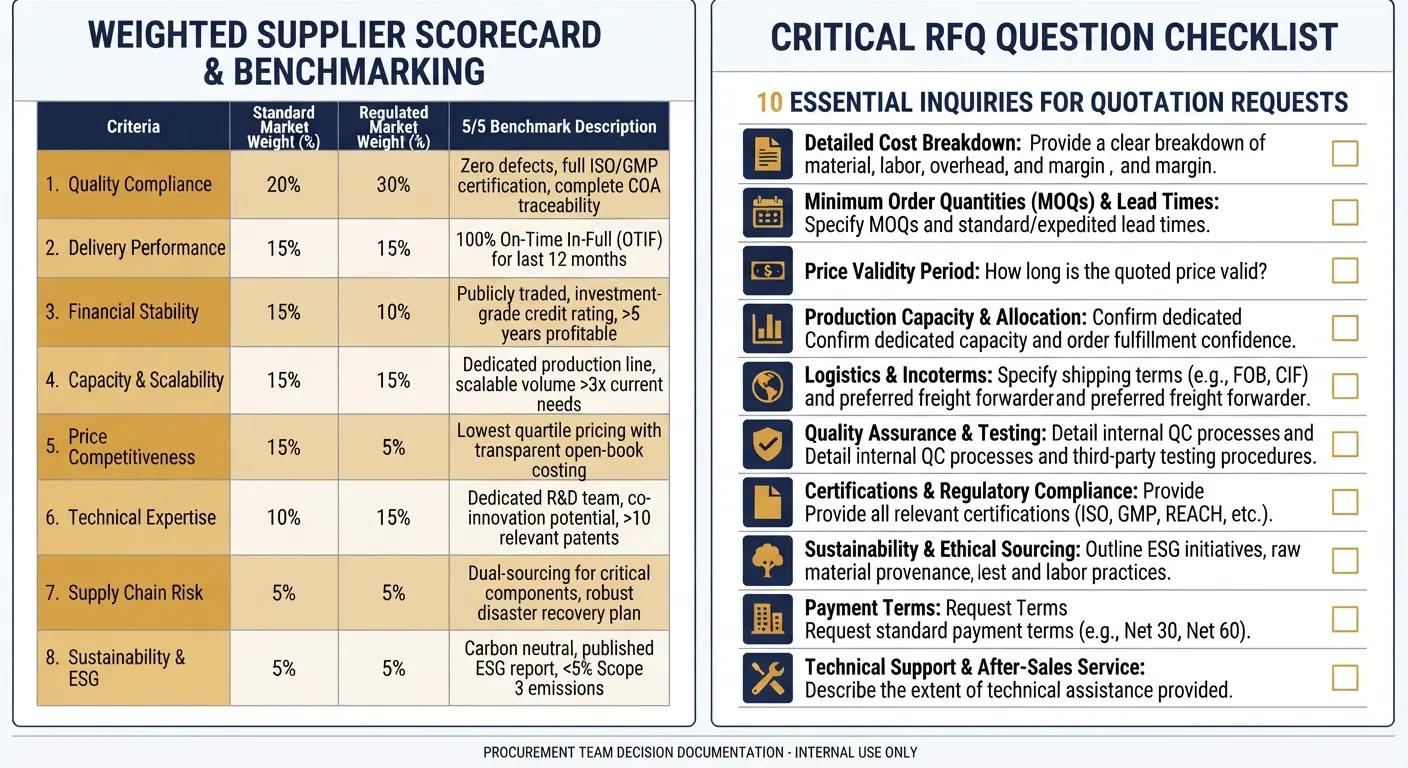
Supplier Scorecard (Rate 1-5 Each)
| Criterion | Weight (Standard) | Weight (Regulated Market) | What 5/5 Looks Like |
|---|---|---|---|
| COA completeness & transparency | 25% | 25% | All 12 COA items present; chromatogram provided; quantitative values |
| HPLC purity verification | 20% | 20% | Third-party HPLC confirms supplier COA within \u00b11% |
| Certifications (ISO, COSMOS, HALAL) | 10% | 15% | ISO 9001 + COSMOS + HALAL, all verifiable |
| Batch-to-batch consistency | 15% | 15% | 3 consecutive batch COAs show <2% purity variation |
| Regulatory documentation support | 10% | 15% | Provides REACH, CosIng, IECIC, TDS, SDS without delay |
| Pricing competitiveness | 10% | 5% | Within market range; not suspiciously low |
| Lead time & logistics reliability | 5% | 2.5% | Consistent lead time; temperature-controlled shipping available |
| Technical support quality | 5% | 2.5% | Answers technical questions within 24 hours with data, not marketing |
Total score interpretation:
- \u22654.0 / 5.0: Qualified supplier \u2014 proceed to trial order.
- 3.0-3.9 / 5.0: Acceptable with reservations \u2014 address weak areas before scaling.
- <3.0 / 5.0: Unacceptable \u2014 disqualify regardless of price.
Supplier Questions Checklist (Cut & Paste for Your RFQ)
Copy these questions into your Request for Quotation:
1. Is this the 40% licorice root extract or the 98% HPLC-verified
   isolate? What is the exact glabridin content per gram of supplied
   material?

2. Please provide an HPLC chromatogram for the current production
   batch, with the glabridin peak retention time and area% clearly
   identified.

3. What solvents are used in your extraction process, and what are
   the measured residual solvent levels in the current batch?

4. Please provide quantitative heavy metals data (Pb, As, Cd, Hg)
   with the analytical method used.

5. Can you provide a photograph and sample (~10g) from the current
   production batch before we place a volume order?

6. What packaging do you use, and is it nitrogen-flushed or
   vacuum-sealed?

7. How was this batch stored before shipping? What temperature and
   humidity conditions were maintained?

8. What is your MOQ and lead time? Do you offer tiered pricing for
   larger volumes?

9. Please provide your ISO 9001 certificate number (and COSMOS
   certificate, if applicable) for verification.

10. Do you retain samples from each production batch? For how long?
Glabridin for Your Next Formulation
Sourcing glabridin is a test of procurement discipline. The ingredient itself is well-characterised \u2014 the variable is the supplier's quality systems, transparency, and consistency. Apply the framework in this guide, and you will eliminate the suppliers whose COAs look good on paper but whose material fails on your formulation bench.
For R&D and procurement teams evaluating glabridin suppliers, GINKVORA's Glabridin is supplied as 98% HPLC-verified wholesale bulk powder with batch-specific COA, MSDS, and full technical documentation. Samples available for independent laboratory verification before volume commitment. Contact our technical team for current pricing, lead times, and documentation.
Related Articles
- Glabridin Complete Guide: Benefits, Mechanism & Clinical Evidence \u2014 Understand the science behind the ingredient before you source it.
- Glabridin Cream & Serum Formulation Guide \u2014 Concentration ranges, delivery systems, and step-by-step protocol for the material you are buying.
- Glabridin Safety, Side Effects & Regulatory Status \u2014 Safety dossier and global regulatory data for your product registration.