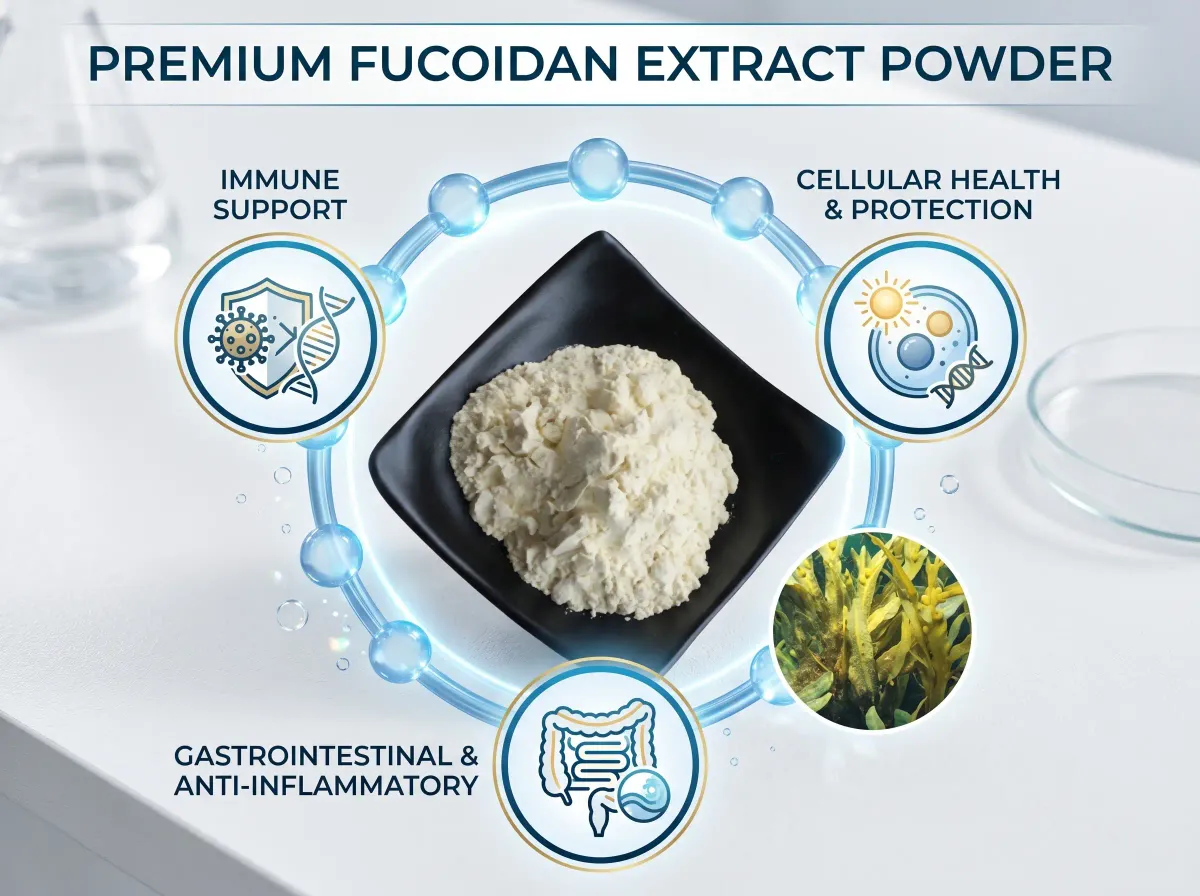
Fucoidan Powder — Okinawa Japan Brown Seaweed Extract | Premium Immune Support Supplement
Phaeophyceae (Brown Seaweed)
Japan-sourced Fucoidan bulk powder (98%) from Okinawa Mozuku brown seaweed. A sulfated polysaccharide for immune support, cellular health, and longevity research. Japanese-grade quality with full documentation. COA per batch.
What Is Fucoidan?
Fucoidan is a complex sulfated polysaccharide found primarily in the cell walls of brown seaweed species (Phaeophyceae), particularly Okinawa Mozuku (Cladosiphon okamuranus), Kombu (Laminaria japonica), Mekabu, and Wakame (Undaria pinnatifida). The fucoidan chemical structure is characterized by a backbone of L-fucose units with sulfate ester groups attached — these sulfate groups are the key structural features responsible for its broad-spectrum bioactivity.
As a fucoidan polysaccharide ingredient, it is rich in fucose and sulfate content, with a typical fucoidan molecular weight around 658.91 (C₄₂H₅₈O₆ for monomeric units). The definition of high-quality fucoidan powder in the supplement industry centers on purity (≥98%), sulfate content, and source authenticity — factors that directly influence its biological potency.
Source & Quality — Japan Okinawa Brown Seaweed Fucoidan
Why Japanese Fucoidan?
The world's highest-quality fucoidan comes from Japan, specifically from the pristine waters of Okinawa. The Okinawan diet — rich in Mozuku seaweed — is closely linked to the region's exceptional longevity statistics, drawing global scientific interest in fucoidan Japan as a dietary factor in healthy aging.
Our sourcing advantage:
- Okinawa Mozuku fucoidan: Our primary source, harvested off the coast of Okinawa, Japan — recognized for the highest sulfate content among brown seaweed species
- Mekabu fucoidan: The nutrient-dense sprout of Wakame, also sourced from Japanese waters
- Undaria pinnatifida fucoidan: Wakame-derived fucoidan with complementary polysaccharide profiles
- Made in Japan quality: Full traceability from harvest to finished bulk powder, processed under strict quality management
Product Specifications
Our Fucoidan bulk raw material is available in multiple forms to suit different formulation needs:
Fucoidan Powder (98% Purified)
| Parameter | Specification |
|---|---|
| Appearance | White powder |
| Fucoidan content | ≥ 98.0% (HPLC) |
| CAS Number | 9072-19-9 |
| Molecular formula | C₄₂H₅₈O₆ |
| Molecular weight | 658.91 |
| Solubility | Water-soluble |
| Mesh size | 80-100 mesh |
| Typical dosage range | 100-500 mg per serving |
Fucoidan Extract (Ratio Extracts)
| Parameter | Specification |
|---|---|
| Appearance | Brown-yellow powder |
| Available ratios | 10:1, 20:1, 30:1, 50:1 |
| Source | Brown seaweed (Mozuku, Kombu, Wakame) |
| Solubility | Water-soluble |
General Specifications
- Storage: 2-8°C, cool dry environment; protect from direct sunlight and moisture
- Shelf life: 24 months from manufacture date
- Heavy metals: ≤ 10 ppm
- Microbiology: USP/EP compliant
- Certificate of Analysis: Provided with every batch
Safety & Side Effects
Is Fucoidan Safe?
Fucoidan has a well-established safety profile, with centuries of dietary use in Japan and numerous clinical safety evaluations supporting its tolerability. However, informed use requires awareness of how it interacts with the body:
Fucoidan Side Effects — What to Know
Most people tolerate fucoidan well at standard serving sizes. Reported side effects of fucoidan are generally mild and may include:
- Mild digestive discomfort during initial use (typically resolves as the body adapts)
- Soft stools or looser bowel movements due to fucoidan's prebiotic fiber effects
- Potential blood-thinning interactions at very high intakes (due to heparin-like anticoagulant activity)
Important Safety Considerations
- Fucoidan and chemotherapy: While fucoidan is widely studied in cancer research, patients undergoing active chemotherapy should consult their oncologist before adding any supplement to their regimen, as hepatoprotective polysaccharides may interact with certain chemotherapeutic agents' mechanisms of action
- Blood-thinning medications: Those taking warfarin or other anticoagulants should exercise caution due to fucoidan's mild anticoagulant properties
- Fucoidan FDA status: Fucoidan is marketed as a dietary supplement ingredient in the United States. As with all dietary supplements, these statements have not been evaluated by the FDA, and this product is not intended to diagnose, treat, cure, or prevent any disease
- Pregnancy and nursing: As a precaution, insufficient safety data exists for use during pregnancy or lactation
Fucoidan Benefits & Research Applications
1. Immune System Support
Fucoidan acts as a potent immune modulator, activating key components of both innate and adaptive immunity:
- Activates natural killer (NK) cells and macrophages through toll-like receptor (TLR) pathways
- Enhances cytotoxic T-cell activity for broader immune surveillance
- Fucoidan AHCC combination: A well-studied immunomodulatory pairing — AHCC (a mushroom-derived extract) and fucoidan work through complementary pathways, with the fucoidan AHCC combination showing enhanced NK cell activation in research models. This combination is popular in advanced immune support formulations targeting the high-value supplement category
2. Cellular Health & Oncology Research
Fucoidan has been extensively studied in cancer research contexts for its selective bioactivity:
- Induces apoptosis (programmed cell death) in certain cancer cell lines through caspase activation
- Inhibits tumor angiogenesis — the formation of new blood vessels that tumors need to grow
- Demonstrates anti-metastatic properties in preclinical models
- Research spans fucoidan lung cancer, fucoidan prostate cancer, fucoidan breast cancer, and colorectal cancer models
- The question "can I take fucoidan during chemotherapy" reflects growing patient interest; while preclinical research supports fucoidan's potential as a supportive adjunct, all decisions regarding supplementation during cancer treatment must be made under physician supervision
Important: These statements describe scientific research findings. Fucoidan is a dietary supplement ingredient and is not intended to diagnose, treat, cure, or prevent any disease.
3. Anti-Inflammatory & Antioxidant Activity
Fucoidan demonstrates significant anti-inflammatory and antioxidant properties:
- Fucoidan anti inflammatory: Suppresses NF-κB signaling, a master regulator of inflammation; reduces pro-inflammatory cytokines including TNF-α, IL-6, and IL-1β
- Fucoidan antioxidant: Scavenges reactive oxygen species (ROS) directly while upregulating endogenous antioxidant enzymes (superoxide dismutase, catalase, glutathione peroxidase)
- Fucoidan antiviral: Blocks viral entry by binding to envelope glycoproteins; studied against influenza virus, herpes simplex virus (HSV), and in related contexts, fucoidan COVID research explored its viral entry-blocking potential
4. Liver Health & Metabolic Support
Emerging research supports fucoidan's role in metabolic and organ health:
- Fucoidan liver: Hepatoprotective effects demonstrated in toxin-induced liver injury models; supports liver detoxification pathways
- Fucoidan diabetes: Shown to improve insulin sensitivity and reduce fasting blood glucose in animal models of type 2 diabetes
- Fucoidan weight loss: May support healthy weight management through prebiotic modulation of gut microbiota and metabolic rate enhancement
- Fucoidan blood pressure: ACE-inhibitory peptides derived from fucoidan-containing seaweed extracts have shown blood pressure-regulating effects in hypertension models
5. Skin Health & Topical Applications
Fucoidan benefits for skin span both oral supplementation and topical formulation:
- Fucoidan skin care: Promotes collagen synthesis and inhibits matrix metalloproteinases (MMPs) that break down dermal structure
- Fucoidan collagen: Stimulates Type I procollagen production in dermal fibroblasts, supporting skin firmness and elasticity
- Fucoidan benefits for skin: Antioxidant protection against UV-induced photoaging; anti-inflammatory soothing for sensitive or reactive skin
- Fucoidan hair growth: Early research suggests fucoidan may support hair follicle health through improved microcirculation and reduced perifollicular inflammation
- Fucoidan cream: Suitable for anti-aging, post-procedure recovery, and barrier-repair topical formulations
6. Stem Cells & Frontier Research
Fucoidan is at the forefront of longevity and regenerative science:
- Fucoidan stem cells: Research demonstrates fucoidan's ability to mobilize hematopoietic stem cells from bone marrow into peripheral blood — a property being explored for stem cell transplantation support
- Fucoidan stem cell mobilization: The mechanism involves modulation of the SDF-1/CXCR4 axis, a key pathway in stem cell trafficking
- Fucoidan SIRT6: Recent studies indicate fucoidan may activate SIRT6, a longevity-associated sirtuin protein involved in DNA repair, metabolic regulation, and inflammation control — positioning fucoidan at the intersection of polysaccharide science and longevity research
How to Use Fucoidan — Dosage & Formulation
Fucoidan Dosage Guidelines
The appropriate fucoidan dosage depends on the intended application and formulation type:
| Application | Typical Fucoidan Daily Dosage |
|---|---|
| General immune support | 100-300 mg/day |
| Targeted support formulations | 300-500 mg/day |
| Research protocols | 500-1000 mg/day (under professional guidance) |
How to Take Fucoidan
- Capsules: The most common delivery format — encapsulate 100-500 mg of fucoidan powder per capsule
- Powder: Dissolve in water, juice, or smoothies; slight marine taste can be masked with citrus flavors
- Tablets: Direct compression or wet granulation compatible
- Liquid: Water-soluble; suitable for liquid supplement shots and functional beverages
Best Fucoidan Supplement — What to Look For
When sourcing fucoidan bulk powder or evaluating a finished fucoidan supplement:
- Source transparency: Verify Japanese Okinawa origin and seaweed species (Mozuku preferred for sulfate content)
- Purity certification: HPLC-verified fucoidan content ≥ 98%
- Third-party testing: COA with heavy metals, microbiology, and purity data per batch
- Documentation: Full MSDS, specification sheet, and stability data available
Quality Assurance
Every batch of GINKVORA Fucoidan bulk powder includes:
- HPLC purity verification and sulfate content analysis
- Full Certificate of Analysis (COA) with heavy metals, microbiology, and identity testing
- Material Safety Data Sheet (MSDS)
- Stability and storage condition documentation
- Complete traceability from Okinawa harvest to finished powder
Whether you're formulating a fucoidan supplement for immune support, developing an AHCC combination product, or conducting fucoidan cancer research, our Japanese-grade bulk powder provides the purity, documentation, and consistency your project demands.
Frequently Asked Questions
Request a Quote for Fucoidan Powder — Okinawa Japan Brown Seaweed Extract | Premium Immune Support Supplement
Complete the form below to receive pricing, specifications, and a free sample. Our sales team will contact you within 12 hours.