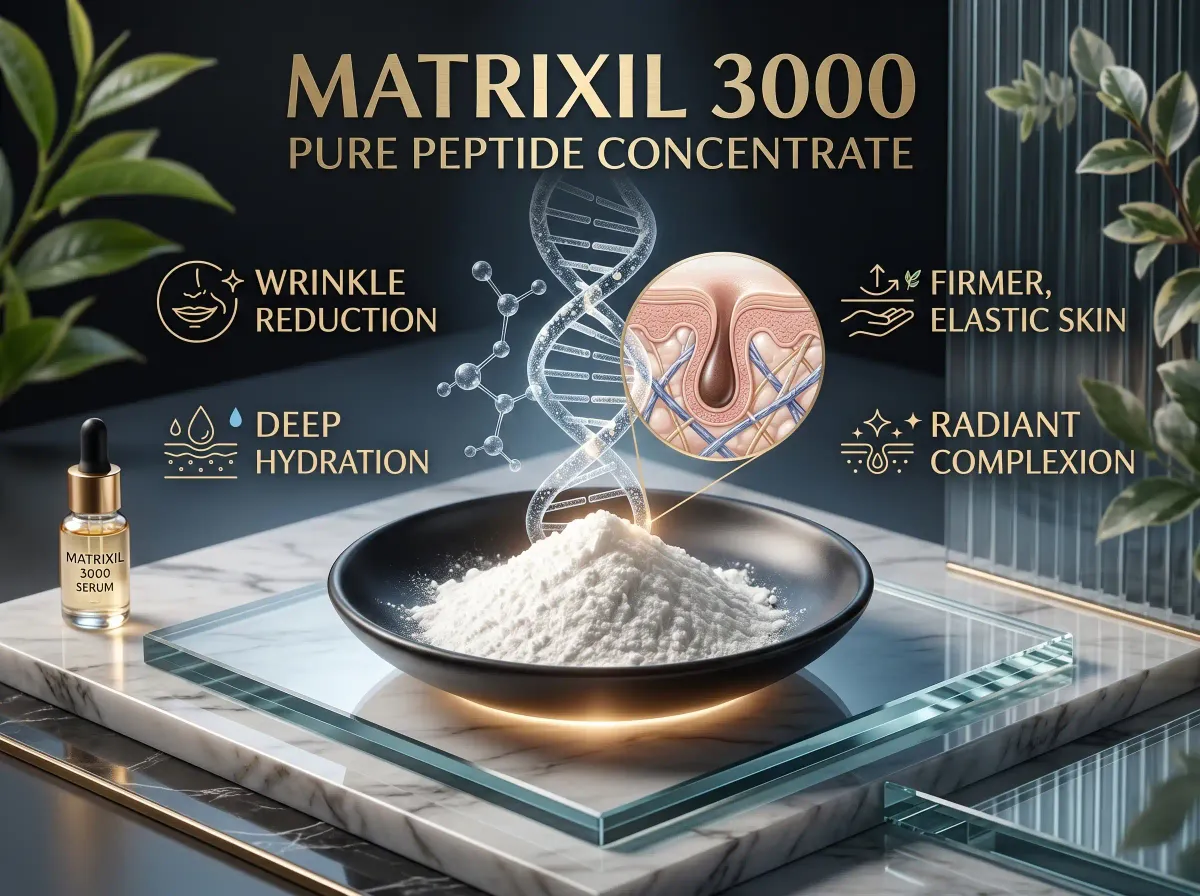
Matrixyl 3000 — Palmitoyl Tripeptide-1 + Tetrapeptide-7 Complex
Matrixyl 3000 — Sederma's dual-peptide anti-aging complex combining Palmitoyl Tripeptide-1 (collagen stimulator) and Palmitoyl Tetrapeptide-7 (ECM protector). 98%+ pure powder for cosmetic formulation. B2B bulk supply.
Module A: Ingredient Identity & Naming System
What is Matrixyl 3000?
Matrixyl 3000 is a proprietary dual-peptide anti-aging complex developed by Sederma (now part of Croda Beauty), consisting of two matrikine peptides in a 1:1 ratio:
| Component | INCI Name | CAS Number | Molecular Formula | Molecular Weight |
|---|---|---|---|---|
| Peptide 1 | Palmitoyl Tripeptide-1 | 147732-56-7 | C₃₀H₅₄N₆O₅ | 578.8 Da |
| Peptide 2 | Palmitoyl Tetrapeptide-7 | 221227-05-0 | C₃₄H₆₂N₈O₇ | 694.9 Da |
Understanding the Name
The "Matrixyl" brand name derives from Matrix (extracellular matrix) + yl (active suffix), signifying its mechanism of stimulating ECM renewal. The "3000" designation marks its position as the second-generation iteration — an upgrade from the original single-peptide Matrixyl (Palmitoyl Pentapeptide-4), offering dual-pathway targeting rather than single-pathway collagen stimulation.
The Palmitoyl Moiety
Both peptides feature an N-terminal palmitoyl (C16) fatty acid chain covalently linked to the peptide backbone. This lipophilic modification serves two critical functions:
- Enhanced skin penetration — the palmitoyl group increases the peptide's partition coefficient into the stratum corneum lipid matrix, substantially improving transdermal delivery compared to unmodified peptides
- Improved formulation stability — the fatty acid conjugation protects the peptide bond from rapid enzymatic degradation in cosmetic formulations
INCI Naming & Synonyms
In the International Nomenclature of Cosmetic Ingredients (INCI) system, the two active components are registered as:
- Palmitoyl Tripeptide-1 (also referred to as Pal-GHK, Palmitoyl-GHK)
- Palmitoyl Tetrapeptide-7 (also referred to as Pal-GQPR)
The combined complex is universally identified by its brand name Matrixyl 3000, though it may also appear in technical literature as:
- Palmitoyl Tripeptide-1 + Palmitoyl Tetrapeptide-7 Complex
- Sederma Matrixyl 3000 Peptide Complex
- Dual Matrikine Complex
Relationship to the Matrixyl Family
Matrixyl 3000 belongs to Sederma's broader Matrixyl peptide platform:
- Matrixyl (Palmitoyl Pentapeptide-4) — original single-peptide collagen stimulator
- Matrixyl 3000 — dual-peptide upgrade (collagen synthesis + ECM protection)
- Matrixyl Synthe'6 (Palmitoyl Tripeptide-38) — six-ECM-target matrikine, next generation
Supplier Information
Matrixyl 3000 was developed by Sederma SAS (France) and is now manufactured and distributed under Croda Beauty. As a raw material supplier, GINKVORA provides ≥98% pure synthetic peptide powder for B2B cosmetic formulation — equivalent to the INCI-grade peptides used in Sederma's commercial complex but in bulk powder form for formulation flexibility.
Module B: Dual-Pathway ECM Repair Mechanism
The Extracellular Matrix: What Ages Our Skin
The dermal extracellular matrix (ECM) is a three-dimensional scaffold of collagen fibers, elastin, glycosaminoglycans (mainly hyaluronic acid), and proteoglycans that gives skin its structural integrity, firmness, and elasticity. Two parallel processes drive ECM aging:
- Reduced synthesis — fibroblast senescence leads to declining collagen I/III production, starting as early as age 25
- Accelerated degradation — chronic low-grade inflammation ("inflammaging") upregulates matrix metalloproteinases (MMPs) that enzymatically digest existing collagen
Matrixyl 3000 is designed to address both processes simultaneously, which is the mechanistic logic behind its dual-peptide composition.
Pathway 1: Palmitoyl Tripeptide-1 — The Builder
Palmitoyl Tripeptide-1 (Pal-GHK) is a signal peptide that mimics the sequence of collagen-derived matrikines — bioactive fragments released during natural ECM turnover that signal fibroblasts to initiate repair.
Mechanism of action: Pal-GHK binds to specific receptors on dermal fibroblasts, activating intracellular signaling cascades that upregulate gene expression for:
- Collagen Type I — the primary structural fibrillar collagen of the dermis (accounts for ~80% of dermal collagen)
- Collagen Type III — the "young collagen" prevalent in healing and regenerating tissue
- Fibronectin — a glycoprotein that organizes ECM assembly and fibroblast attachment
- Hyaluronic acid — the major dermal glycosaminoglycan responsible for water retention and tissue volume
The net result is net positive ECM synthesis — new collagen deposition exceeding baseline turnover.
Pathway 2: Palmitoyl Tetrapeptide-7 — The Protector
While Tripeptide-1 builds new ECM, Palmitoyl Tetrapeptide-7 (Pal-GQPR) works to prevent existing ECM from being destroyed.
Mechanism of action: Pal-GQPR suppresses the release of interleukin-6 (IL-6) and other pro-inflammatory cytokines from dermal fibroblasts and keratinocytes. IL-6 is a master regulator of MMP (matrix metalloproteinase) expression. By reducing IL-6 signaling, Palmitoyl Tetrapeptide-7:
- Downregulates MMP-1 (collagenase-1) — the primary enzyme that cleaves collagen I/III fibrils
- Downregulates MMP-3 (stromelysin-1) — which degrades proteoglycans and activates other MMPs
- Downregulates MMP-9 (gelatinase B) — which further degrades already-cleaved collagen fragments
This anti-inflammatory/MMP-inhibitory function is particularly important for UV-exposed skin, where chronic solar damage drives sustained IL-6-mediated ECM destruction.
The "Build + Protect" Synergy
The dual-peptide design of Matrixyl 3000 is not simply additive — the two pathways are mechanistically synergistic:
| Pathway | Action | Without the Other |
|---|---|---|
| Pal-GHK (Build) | Stimulate collagen synthesis | New collagen would be rapidly degraded by active MMPs |
| Pal-GQPR (Protect) | Suppress MMP activity | ECM preservation without new synthesis = net zero gain |
Together, they create a net remodeling environment: more collagen is produced than degraded over time, leading to measurable improvements in wrinkle depth and skin firmness.
Clinical Evidence from Sederma
In a double-blind, placebo-controlled study conducted by Sederma, a formulation containing 3% Matrixyl 3000 applied twice daily for 56 days produced the following results measured by silicone replica profilometry:
- Wrinkle depth reduction: 27% (vs placebo)
- Wrinkle surface area reduction: 36% (vs placebo)
- Skin roughness parameter (Ra) improvement: 22%
- Skin elasticity improvement: statistically significant vs baseline
The clinical evidence supports Matrixyl 3000 as one of the most thoroughly validated cosmetic peptides in the matrikine class.
Key Distinction: Matrixyl 3000 vs Neuropeptides
It is essential to understand that Matrixyl 3000 operates through ECM remodeling, not neuromuscular junction inhibition. Unlike Argireline or SNAP-8 (which reduce dynamic expression lines by inhibiting acetylcholine release), Matrixyl 3000 works on static wrinkles — those visible at rest — by rebuilding the structural collagen network. This mechanistic distinction has important safety implications (see Module D).
Module C: Specifications, Concentration & Raw Material Form
Raw Material Form
Matrixyl 3000 is available in two primary commercial forms:
- Lyophilized (freeze-dried) powder — our standard supply form; white to off-white powder, readily soluble in water and aqueous-alcoholic systems; ideal for B2B formulation where precise weighting and reproducible concentration are required
- Aqueous solution — the form typically supplied by Sederma/Croda to brand manufacturers; pre-dissolved at standardized concentration for plug-and-play formulation
As a B2B raw material supplier, GINKVORA provides the powder form for maximum formulation flexibility, cost efficiency, and shelf stability.
Recommended Use Concentration
| Application | Concentration Range | Note |
|---|---|---|
| Leave-on serum | 2–4% | Sederma clinical study concentration |
| Eye cream | 2–3% | Periocular skin benefits from lower concentration |
| Day/night cream | 1–3% | Compatible with most emulsion systems |
| DIY formulation (retail) | 2–5% | Used in aqueous phase of serum/toner |
Is higher always better? Sederma's clinical data supports 3% as the optimal effective concentration. There is no peer-reviewed evidence that concentrations above 5% provide additional benefit. The dose-response curve for matrikine peptides follows receptor saturation kinetics — once fibroblast receptors are occupied, additional peptide does not increase collagen gene expression. Using excessive concentrations may introduce formulation compatibility issues without efficacy benefits.
Solubility & Formulation Parameters
| Parameter | Specification |
|---|---|
| Solubility | Freely soluble in water; soluble in propylene glycol/glycerin |
| pH stability range | 5.0–7.0 |
| Thermal stability | Stable at <40°C; store at 2–8°C for long-term |
| Recommended formula phase | Aqueous phase; add at ≤40°C during cool-down |
| Incompatibilities | Strong oxidizing agents; extreme pH (<3 or >9) |
B2B Procurement Specifications
Our Matrixyl 3000 powder meets the following quality parameters:
| Parameter | Specification |
|---|---|
| Palmitoyl Tripeptide-1 purity | ≥98% (HPLC) |
| Palmitoyl Tetrapeptide-7 purity | ≥98% (HPLC) |
| Ratio (Tripeptide-1:Tetrapeptide-7) | 1:1 (±5%) |
| Appearance | White to off-white lyophilized powder |
| Heavy metals | ≤10 ppm |
| Endotoxins | ≤0.5 EU/mg |
| Microbial limits | TAMC <100 CFU/g; TYMC <10 CFU/g |
Module D: Safety Profile
EWG Skin Deep Safety Assessment
Both active peptides in Matrixyl 3000 have been independently assessed by the Environmental Working Group (EWG) Skin Deep database:
| Component | EWG Hazard Score | Data Availability | Overall |
|---|---|---|---|
| Palmitoyl Tripeptide-1 | 1 (Low Hazard) | Fair | ✅ Safe |
| Palmitoyl Tetrapeptide-7 | 1 (Low Hazard) | Limited | ✅ Safe |
All cancer, immunotoxicity, developmental/reproductive toxicity, and use restriction concerns are rated LOW for both peptides.
CIR (Cosmetic Ingredient Review) Expert Panel Assessment
The Cosmetic Ingredient Review Expert Panel has reviewed the safety of Palmitoyl Tripeptide-1, Palmitoyl Tetrapeptide-7, and their structural analogs and concluded that these ingredients are safe in cosmetics at current use concentrations (CIR Final Report, 2018). The Panel noted that the low use concentrations and negative safety test data review obviate any safety concerns.
Common Safety Question: "Does Matrixyl 3000 Cause Sagging?"
No. This concern arises from confusion between ECM-targeting matrikine peptides and neuromuscular-inhibitor peptides.
The "sagging" concern is relevant for neuropeptides like Argireline (Acetyl Hexapeptide-8) and SNAP-8, which theoretically could influence muscle contraction at the neuromuscular junction with prolonged use — though even for those peptides, clinical evidence of topical sagging is absent.
Matrixyl 3000 operates through an entirely different mechanism — it stimulates fibroblasts to produce more collagen and suppresses enzymes that destroy collagen. The net effect is increased dermal structural support, which counteracts — not causes — skin sagging. There is no plausible mechanism by which ECM-stimulating matrikines would cause tissue laxity, and no clinical reports of such effects in over 20 years of market use.
Pregnancy & Breastfeeding Safety
Currently, no controlled human studies exist evaluating Matrixyl 3000 use during pregnancy or lactation. Key considerations:
- Low systemic absorption: Topical peptide powders have extremely low transdermal bioavailability; the palmitoyl modification improves dermal but not transdermal delivery (i.e., the peptide reaches the dermis but does not enter systemic circulation in meaningful amounts)
- CIR safety data: Both component peptides show LOW developmental/reproductive toxicity concern
- Conservative recommendation: Pregnant or breastfeeding individuals should consult their healthcare provider before use
Critical Safety Disclaimer: NOT FOR INJECTION
⚠️ IMPORTANT: This product is a cosmetic-grade raw material for topical formulation only. It is NOT manufactured, tested, or certified for injection of any kind.
Matrixyl 3000 has not been studied for injectable use. The peptides are designed for topical delivery to dermal fibroblasts via percutaneous absorption — not for systemic administration. Injection of cosmetic-grade powder carries serious risks including infection, embolism, inappropriate tissue distribution, and immunological reactions. Only sterile pharmaceutical-grade injectable products approved by regulatory authorities should be used for injection.
Other Safety Considerations
- Skin irritation: In patch testing, Matrixyl 3000 at 3% concentration showed no irritation or sensitization potential
- Eye area use: Safe for periocular application at 2–3%; avoid direct contact with the ocular surface
- Combination with actives: No known adverse interactions with retinol, vitamin C, AHAs, BHAs, niacinamide, or other peptides (see Applications section for detailed compatibility guide)
- Photo-safety: No phototoxic or photosensitization potential reported; compatible with daytime use
Preguntas frecuentes
Solicitar cotización o muestra
Envíe su consulta y nuestro representante comercial se pondrá en contacto con usted en un plazo de 24 horas.
Ir al formulario de consulta →