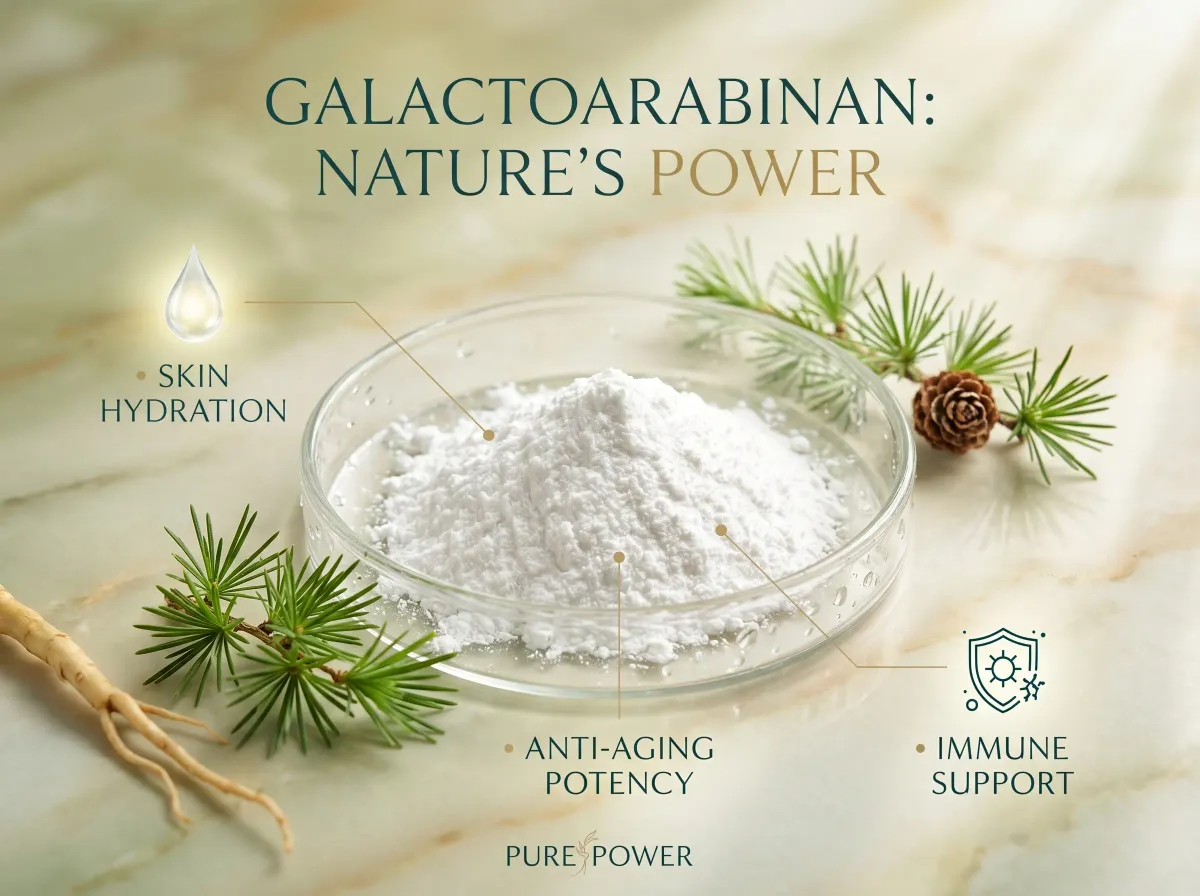
Galactoarabinan (Larch Tree Polysaccharide) — Skin & Hair Bioactive for ECM Support
Larix occidentalis
A naturally derived polysaccharide from Larix occidentalis (Western Larch) that reinforces the extracellular matrix, promotes collagen synthesis, and delivers multi-pathway anti-aging benefits for skin and hair. Bulk powder, cosmetic grade.
What Is Galactoarabinan?
Galactoarabinan is a naturally derived, highly branched polysaccharide extracted from the bark and wood of the Western Larch tree (Larix occidentalis). Composed primarily of arabinose and galactose monosaccharide units in a high molecular weight biopolymer structure, it functions as a multifunctional bioactive ingredient that operates at the intersection of gentle exfoliation, hydration, and — most critically — extracellular matrix (ECM) support.
Unlike many skincare ingredients that act on a single pathway, galactoarabinan engages the skin at multiple levels:
- As a signal polysaccharide, it communicates with dermal fibroblasts to upregulate ECM protein synthesis
- As a gentle biodesquamation agent, it removes surface dead cells without the irritation of hydroxy acids
- As a film-forming hydrator, its polyhydroxyl structure creates a moisture-retaining layer on the skin surface
INCI & Regulatory Identity
- INCI Name: Galactoarabinan
- Alternative Names: Arabinogalactan, Larch Arabinogalactan, Larch Tree Polysaccharide
- CAS Number: 9036-66-2
- Botanical Source: Larix occidentalis (Western Larch) and other Larix species
- Monosaccharide Composition: Arabinose (∼80%) and Galactose (∼20%)
- Molecular Weight Range: ∼20,000 Da (polydisperse polysaccharide)
- EWG Safety Rating: 1 (Low Hazard) — galactoarabinan ewg rating confirms its excellent safety profile
- Solubility: Fully water-soluble; compatible with aqueous-phase formulation
Source & Natural Origin
Galactoarabinan is harvested from the Western Larch, a coniferous tree native to the Pacific Northwest of North America. The polysaccharide is extracted through a water-based process from the tree's bark and wood — making it a renewable, plant-derived raw material with a clean sustainability profile. This botanical origin aligns with the growing consumer demand for naturally derived, eco-conscious cosmetic ingredients.
Commercial-grade galactoarabinan is available under brand names including LaraCare® A200 (Lonza), which clinical studies have shown to deliver measurable improvements in skin exfoliation, moisture retention, and fine line reduction. Galactoarabinan laracare a200 is specifically positioned as a clinically studied, multi-benefit polysaccharide for skin and hair care formulations.
What Does "Galactoarabinan" Mean?
The name reflects its chemical structure: galacto- (galactose sugar units) + arabinan (arabinose polysaccharide backbone). The term "galactoarabinan what is" and "galactoarabinan definition" searches indicate consumers and formulators seeking to understand what sets this ingredient apart from other polysaccharides — the answer lies in its unique high-branching structure and the resulting multi-functional bioactivity.
ECM Mechanism & Anti-Aging Science
Galactoarabinan and the Extracellular Matrix
The extracellular matrix (ECM) is the structural scaffold of the skin — a complex network of collagen, elastin, hyaluronic acid, fibronectin, and laminins that maintains skin firmness, elasticity, and hydration. As skin ages, ECM turnover slows, leading to wrinkle formation, sagging, and loss of dermal density.
Galactoarabinan supports the ECM through multiple complementary mechanisms:
1. Fibroblast Activation & Collagen Support Galactoarabinan acts as a signal polysaccharide that communicates with dermal fibroblasts — the ECM's primary maintenance cells. In vitro and clinical data from LaraCare® A200 studies demonstrate that galactoarabinan promotes fibroblast metabolic activity, leading to upregulated synthesis of collagen and other ECM structural proteins. This is not a simple "stimulation" but a nuanced cell-signaling interaction that helps restore the ECM's natural renewal rhythm.
2. Elastin Network Preservation The elastin fiber network provides skin with its ability to stretch and rebound. Galactoarabinan's polysaccharide structure interacts with the glycosaminoglycan (GAG) component of elastic fibers, helping maintain the hydrated micro-environment that elastin requires for proper mechanical function.
3. Hyaluronic Acid & Laminin Synergy Within the ECM, galactoarabinan works synergistically with endogenous hyaluronic acid (HA). Its polyhydroxyl structure creates hydrogen-bonding networks that stabilize HA within the dermal matrix, extending its moisture-binding capacity. Additionally, galactoarabinan supports the laminin-rich basement membrane zone, contributing to dermal-epidermal junction integrity — a critical factor in preventing wrinkle deepening.
4. Gentle Biodesquamation → ECM Renewal Galactoarabinan functions as a proprietary biodesquamation agent — it selectively loosens the bonds between surface corneocytes (dead skin cells) without the irritation profile of traditional chemical exfoliants (AHAs/BHAs). This gentle surface renewal triggers a cascade: removal of aged surface cells signals the deeper epidermis to accelerate cell turnover, which in turn stimulates fibroblast activity and ECM remodeling in the dermis below. This mechanism explains why "galactoarabinan exfoliant" and "galactoarabinan exfoliant for human skin" appear as search queries — formulators recognize this dual-pH, non-irritating exfoliation profile.
5. Multi-Pathway Anti-Aging Integration Unlike single-target actives (e.g., retinoids targeting only RAR/RXR receptors), galactoarabinan's polysaccharide structure allows it to engage multiple ECM-supportive pathways simultaneously: surface renewal → cell signaling → fibroblast activation → ECM protein synthesis → moisture matrix stabilization. This integrated mechanism makes it an ideal ECM-supportive backbone ingredient in anti-aging formulations, complementing peptides, antioxidants, and humectants.
LaraCare® A200 Clinical Data Summary
LaraCare® A200, the commercial galactoarabinan standard developed by Lonza, has been evaluated in clinical studies demonstrating:
- Exfoliation efficacy: Measurable improvement in skin surface smoothness and texture, comparable to mild AHAs but without irritation
- Moisture retention: Significant increase in skin hydration levels after 2–4 weeks of use
- Fine line reduction: Visible improvement in periorbital fine lines and overall skin smoothness
- Tolerance profile: Excellent tolerability across all skin types, including sensitive skin
These data establish galactoarabinan as a clinically substantiated bioactive polysaccharide — not merely a functional thickener or humectant, but a mechanism-driven ECM support ingredient.
Product Specifications & Formulation Parameters
Key Specifications
| Parameter | Value |
|---|---|
| INCI Name | Galactoarabinan |
| CAS Number | 9036-66-2 |
| Appearance | Off-white to light tan fine powder |
| Solubility | Fully water-soluble (≥10% at 25°C) |
| Molecular Weight | ~20,000 Da (polydisperse) |
| Monosaccharide Profile | Arabinose (∼80%), Galactose (∼20%) |
| Source | Larix occidentalis (Western Larch) bark/wood extract |
| Testing Method | HPLC, GPC (molecular weight), IR identification |
| Grade | Cosmetic Grade |
| Shelf Life | 24 months from date of manufacture |
| Storage | Cool, dry place (15–25°C); protect from moisture |
| Vegan | Yes (plant-derived, no animal inputs) |
| GMO-Free | Yes |
| EWG Rating | 1 (Low Hazard) |
Recommended Usage in Formulations
Galactoarabinan is typically incorporated at 0.5–5% in finished cosmetic formulations, depending on the target application and desired benefit intensity:
| Application | Recommended % | Primary Function |
|---|---|---|
| Anti-aging serum / essence | 2–5% | ECM support, collagen synthesis signaling |
| Exfoliating toner / lotion | 1–3% | Gentle biodesquamation, surface renewal |
| Day cream / moisturizer | 1–3% | Hydration film, ECM maintenance |
| Eye cream | 1–3% | Periorbital fine line smoothing |
| Facial mask (sheet / wash-off) | 2–5% | Intensive ECM treatment |
| Hair conditioner / mask | 1–3% | Cuticle smoothing, moisture retention |
| Leave-in hair serum | 0.5–2% | Lightweight film-forming protection |
Galactoarabinan Polyglucuronic Acid Crosspolymer (2QR Complex)
A specialized derivative worth noting for professional formulators: galactoarabinan polyglucuronic acid crosspolymer — also known as the 2QR complex — is a crosslinked polysaccharide matrix developed for enhanced bioadhesion and prolonged residence time on the skin. This crosspolymer form is distinct from standard galactoarabinan:
| Feature | Galactoarabinan | Galactoarabinan Polyglucuronic Acid Crosspolymer (2QR) |
|---|---|---|
| Structure | Natural linear/branched polysaccharide | Crosslinked polysaccharide matrix |
| Primary Function | ECM signaling, exfoliation, hydrating film | Bioadhesive barrier, microbial anti-adhesion |
| MW Range | ~20,000 Da | Higher (crosslinked) |
| Best For | Anti-aging serums, exfoliants, hair care | Barrier creams, intimate care, post-procedure protection |
Galactoarabinan polyglucuronic acid crosspolymer 2QR specifically targets the microbial anti-adhesion segment, while standard galactoarabinan targets ECM support and anti-aging. Formulators searching for both variants should select based on their application objective.
Formulation Compatibility
Galactoarabinan (INCI: galactoarabinan in cosmetics) is highly compatible with a broad range of cosmetic ingredients:
- pH Range: Stable across pH 3.0–8.0; optimal performance at pH 4.5–6.5
- Temperature Stability: Add during cool-down phase (below 50°C) for optimal polysaccharide integrity
- Aqueous Compatibility: Fully dispersible in water phase; compatible with water-based serums, gels, and emulsions
- Oil Compatibility: Can be incorporated into emulsions (O/W, W/O) via the water phase
- Active Ingredient Compatibility: Synergistic with hyaluronic acid, peptides, vitamin C, niacinamide, centella asiatica, and most botanical extracts
- Preservative Compatibility: Compatible with standard cosmetic preservative systems
MSDS / SDS Documentation
Comprehensive safety documentation — including galactoarabinan MSDS (Material Safety Data Sheet), Certificate of Analysis (COA), and technical data sheets — is available upon request. All shipments are accompanied by batch-specific COA documentation including HPLC purity verification, microbial testing, and heavy metal analysis.
Safety, Side Effects & Tolerability
Is Galactoarabinan Safe?
Yes. Galactoarabinan has an EWG safety rating of 1 (Low Hazard) — the highest safety classification — based on a comprehensive review of available toxicological data, absence of carcinogenicity/mutagenicity signals, and favorable dermatological testing outcomes.
The Cosmetic Ingredient Review (CIR) expert panel has evaluated arabinogalactan/galactoarabinan as part of polysaccharide safety assessments and found it safe for use in cosmetic formulations at typical concentrations.
Reported Side Effects
Galactoarabinan side effects are minimal and rare:
- Skin irritation: Extremely low incidence. In clinical evaluations of LaraCare® A200, galactoarabinan demonstrated irritation scores comparable to water controls — significantly lower than benchmark AHAs at equivalent exfoliation levels.
- Allergic reactions: As a plant-derived polysaccharide, galactoarabinan has very low allergenic potential. No significant sensitization has been reported in published literature.
- Phototoxicity / Photosensitivity: None reported. Galactoarabinan does not increase UV sensitivity; it is safe for daytime use (always pair with sunscreen for comprehensive anti-aging).
- Comedogenicity: Non-comedogenic. Its water-soluble polysaccharide structure does not clog pores.
The consistently low irritation profile makes galactoarabinan an excellent alternative to hydroxy acid exfoliants for sensitive skin types and consumers who have experienced irritation with AHAs or BHAs.
Safety During Pregnancy
Is galactoarabinan safe during pregnancy? Yes, based on available data. Galactoarabinan is a large-molecular-weight polysaccharide that functions topically without significant systemic absorption. Its EWG 1 rating, non-irritating profile, and plant-derived nature make it a cautious-choice-friendly ingredient. However, as with any cosmetic ingredient during pregnancy, we recommend consulting with your healthcare provider. The query "galactoarabinan pregnancy" indicates consumer awareness and caution — we support informed decision-making.
Skin Type Suitability
Galactoarabinan is universally suitable:
| Skin Type | Suitability | Notes |
|---|---|---|
| Normal | ✅ | Core ECM support ingredient |
| Dry | ✅ | Polyhydroxyl structure provides humectant film |
| Oily / Combination | ✅ | Non-comedogenic, lightweight aqueous-phase incorporation |
| Sensitive | ✅ | Exceptional tolerability; gentler than AHA/BHA alternatives |
| Mature / Aging | ✅ | Direct fibroblast/ECM mechanism targets structural aging |
| Acne-prone | ✅ | Gentle exfoliation without irritation; "galactoarabinan acne" interest confirms this positioning |
Application Domains
Theme 1 — Skin Anti-Aging & ECM Repair (Core Application)
Galactoarabinan for skin and galactoarabinan skin benefits are the most frequently searched application-specific queries, reflecting consumer and formulator interest in this ingredient's multi-target skin mechanism.
Gentle yet Effective Biodesquamation Unlike hydroxy acids that work through pH-dependent chemical peeling, galactoarabinan's exfoliation mechanism is biological — it selectively targets desmosomal bonds between surface corneocytes. This means:
- Comparable surface renewal to mild AHAs without the stinging, redness, or pH sensitivity
- Maintenance of the skin barrier during exfoliation (no "over-exfoliation" risk)
- Safe for daily use, including around the eye area
ECM Structural Support Galactoarabinan contributes to ECM integrity at the dermal level:
- Supports collagen and elastin network density through fibroblast signaling
- Stabilizes the HA moisture matrix within the dermal GAG network
- Contributes to basement membrane protein synthesis, reducing wrinkle deepening at the structural level
Moisture Matrix Enhancement The polysaccharide's abundant hydroxyl groups form a molecular water net at the skin surface — a breathable, non-occlusive hydration film that retains moisture without the heavy feel of petrolatum or silicones. This makes it ideal for lightweight, "glass skin" formulations and humid-climate moisturizers.
Clinical Observations:
- ∼15–20% improvement in skin moisturization after 2 weeks (LaraCare® A200 data)
- Measurable reduction in periorbital fine line visibility after 4 weeks
- Sustained smoothness improvement through continued ECM remodeling
Recommended Product Types:
- Anti-aging serums and essences
- Exfoliating toners and treatment lotions
- Sheet masks and overnight masks
- Eye creams and eye serums
- Day/night moisturizers
- BB/CC creams and skin tints with skincare benefits
Theme 2 — Hair & Scalp Application
Galactoarabinan for hair and galactoarabinan hair represent a distinct, growing application category with specific search demand. The ingredient's film-forming and moisturizing properties translate effectively to hair care:
Hair Shaft Protection & Smoothing Galactoarabinan forms a lightweight, flexible film along the hair cuticle that:
- Smooths raised cuticle scales, reducing frizz and improving combability
- Provides heat protection by forming a sacrificial polysaccharide layer
- Enhances shine by creating a uniform reflective surface on the hair shaft
- Reduces moisture loss from the hair cortex, preventing brittleness
Scalp ECM Microenvironment Support The scalp is an extension of facial skin, and its ECM health directly impacts hair follicle function. Galactoarabinan supports the scalp ECM through:
- Gentle biodesquamation of scalp stratum corneum, reducing flaking without irritation
- Maintaining the perifollicular moisture matrix for optimal follicle function
- Providing polysaccharide substrate for the scalp's GAG network
Galactoarabinan + Xylitol Synergy The search query "hair benefits of galactoarabinan xylitol" reveals a recognized formulation synergy. Xylitol, a sugar alcohol humectant, pairs with galactoarabinan to create a dual-moisture retention system:
- Xylitol attracts and binds water (humectant function)
- Galactoarabinan forms a protective film that locks in xylitol-bound moisture (film-forming function)
- Together, they create a breathable, long-lasting hydration matrix for hair
This combination is particularly effective in leave-in conditioners, hair serums, and anti-frizz treatments targeting high-porosity or chemically treated hair.
Recommended Hair Care Applications:
- Leave-in conditioners and detangling sprays
- Hair masks and deep conditioners
- Anti-frizz serums
- Scalp treatments and tonics
- Heat protectant sprays
Theme 3 — Formulator's Application Guide (B2B / Professional)
For formulators and brand developers seeking to incorporate galactoarabinan, the following technical guidance addresses common formulation questions:
Suitable Formulation Types
- Water-phase incorporation: Serums, essences, toners, mists (simplest incorporation)
- Emulsions: O/W and W/O creams, lotions (add to water phase before emulsification)
- Gels: Carbomer, xanthan, and cellulose-based gel systems
- Masks: Sheet mask essences, wash-off masks, overnight sleeping masks
- Hair care: Conditioners, leave-in treatments, styling products
- Anhydrous: Limited compatibility; pre-dispersion may be required
Active Ingredient Pairing Guide
| Active | Synergy | Notes |
|---|---|---|
| Hyaluronic Acid (HA) | ★★★★★ | Dual moisturization: galactoarabinan film + HA hydration |
| Peptides (Matrixyl®, Argireline®) | ★★★★★ | Complementary ECM signaling at different receptor pathways |
| Vitamin C (L-Ascorbic Acid) | ★★★★ | Collagen synthesis synergy; ensure pH compatibility |
| Niacinamide | ★★★★★ | Excellent pH compatibility; dual barrier + exfoliation support |
| Centella Asiatica / Madecassoside | ★★★★ | Combined ECM support + soothing; ideal for sensitive skin |
| Ceramides | ★★★★ | Barrier lipid + polysaccharide moisturization |
| Retinol / Retinoids | ★★★ | Galactoarabinan buffer may mitigate retinoid dryness |
| Salicylic Acid | ★★★ | Dual exfoliation: BHA + biodesquamation; monitor pH |
Acne-Prone Skin Compatibility The query "galactoarabinan acne" reflects consumer concern about whether this polysaccharide is suitable for acne-prone skin. The answer is yes — and it may even be beneficial:
- Non-comedogenic (water-soluble, large molecular weight)
- Gentle exfoliation helps prevent comedone formation without over-drying
- No occlusive film that traps sebum (breathable hydration)
- Anti-inflammatory properties may help calm active breakouts
- Excellent alternative to harsh acne exfoliants that compromise the barrier
Product Examples & Market Context The search "galactoarabinan paula's choice" (10/mo) reflects consumer awareness of this ingredient in premium skincare. While Paula's Choice formulations may feature galactoarabinan in specific products, the broader trend is clear: moisturizers with galactoarabinan and skincare products containing galactoarabinan are increasingly sought after by ingredient-conscious consumers who recognize its multi-functional ECM support profile.
For brands, this represents an opportunity to differentiate in the polysaccharide active space — offering a naturally derived, clinically studied alternative to synthetic polymers, with a compelling ECM narrative.
How to Use & Formulation Guide
Recommended Usage Protocol
For optimal ECM-supportive results in finished formulations:
- Concentration: 0.5–5% depending on application (see table above)
- Incorporation Phase: Add to water phase during cool-down (<50°C)
- pH Range: pH 3.0–8.0 (optimal 4.5–6.5)
- Pre-dispersion: For cold-process formulations, pre-disperse in a portion of the water phase before adding to the main batch
- Order of Addition: After preservatives, before fragrance/essential oils
- Compatibility Testing: Conduct small-batch stability testing when combining with charged polymers or high-electrolyte systems
End-User Application Guidance
For consumers using galactoarabinan-containing products:
- Frequency: 1–2 times daily (morning and/or evening)
- Application Order: After cleansing and water-based serums, before oils and heavier creams
- Eye Area: Safe for periorbital use (unlike many exfoliating acids)
- Sunscreen: Always follow with SPF 30+ for daytime use (standard anti-aging practice)
- Results Timeline: Surface smoothing visible within 1–2 weeks (exfoliation); ECM remodeling benefits accrue over 4–8+ weeks of consistent use
Purchase Information
For B2B buyers and professional formulators: we supply galactoarabinan as a bulk cosmetic raw material powder, extracted from Western Larch (Larix occidentalis). Available in sample quantities (10g+) through bulk production volumes (1kg–25kg+). All shipments include:
- Certificate of Analysis (COA) with HPLC and GPC characterization
- MSDS (Material Safety Data Sheet) / SDS documentation
- Technical data sheet with formulation guidance
- Microbial testing and heavy metal analysis
For inquiries about bulk galactoarabinan supply, customized particle size specifications, or formulation support, please contact our sales team.
Disclaimer: Statements on this page have not been evaluated by the FDA. This product is not intended to diagnose, treat, cure, or prevent any disease. LaraCare® is a registered trademark of Lonza. Our product is cosmetic-grade galactoarabinan raw material meeting the same INCI specification.
Preguntas frecuentes
Solicitar cotización o muestra
Envíe su consulta y nuestro representante comercial se pondrá en contacto con usted en un plazo de 24 horas.
Ir al formulario de consulta →