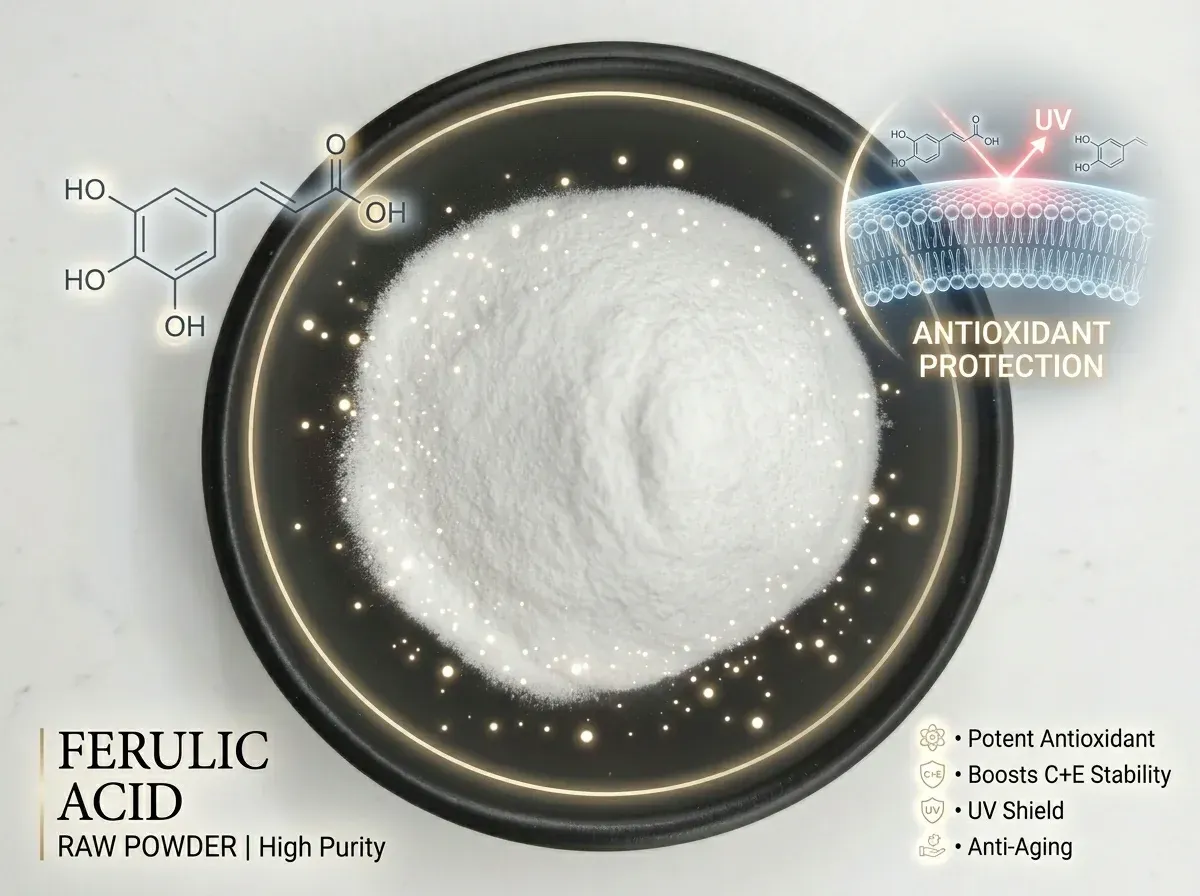
Ferulic Acid — Bulk Raw Material
Derived from rice bran (Oryza sativa), wheat (Triticum aestivum), and oats (Avena sativa)
Factory-direct Ferulic Acid bulk (≥98%) — the gold-standard phenolic antioxidant that doubles the photoprotective efficacy of Vitamins C and E (Lin 2005, JID). Clinically proven to boost SPF protection from 4× to 8× against UV-induced damage.
Is Ferulic Acid Effective for Skin Anti-Aging and UV Protection? Benefits, Dosage, Side Effects & Comparison
Yes, Ferulic Acid is a clinically proven plant-based antioxidant that doubles photoprotection when combined with Vitamins C and E — the gold-standard stabilizer in premium anti-aging serums for over two decades.
What Is Ferulic Acid?
Ferulic Acid (CAS 1135-24-6, C₁₀H₁₀O₄, MW 194.18 g/mol) is a naturally occurring hydroxycinnamic acid and phenolic antioxidant found abundantly in plant cell walls, particularly in rice bran, wheat, oats, and certain fruits. It belongs to the phenylpropanoid family and serves as a key structural component of lignocellulose in plants.
In cosmetic and dermatological science, Ferulic Acid has achieved iconic status since the landmark 2005 study by Lin et al. (Journal of Investigative Dermatology) demonstrated its unique ability to stabilize and double the photoprotective power of Vitamins C and E. This single study transformed modern antioxidant serum formulation.
GINKVORA supplies ≥98% purity Ferulic Acid as a high-quality bulk powder for cosmetic formulators, private-label skincare brands, and CDMOs.
Key Benefits & Mechanisms
- Doubles Photoprotection (Landmark 2005 Study): Lin et al. (JID, 2005) demonstrated that adding 0.5% Ferulic Acid to a solution of 15% L-Ascorbic Acid + 1% α-Tocopherol doubled photoprotection from ~4× to ~8× against solar-simulated UV radiation on human skin. The combination significantly reduced thymine dimer formation (DNA damage) and sunburn cell formation — establishing the C+E+Ferulic Acid combination as the dermatological gold standard for topical antioxidant protection.
- Potent Free Radical Scavenger: Neutralizes multiple reactive oxygen species (ROS) including superoxide, hydroxyl radical, and peroxyl radicals, as well as reactive nitrogen species (RNS). Provides broad-spectrum cellular defense exceeding single-mechanism antioxidants.
- Vitamin C & E Stabilization: The most well-documented antioxidant stabilizer in cosmetic science. Ferulic Acid chelates transition metal ions and donates electrons to oxidized vitamin C and E, dramatically extending their active shelf life — a critical advantage over standalone Vitamin C serums that oxidize within weeks.
- Skin Brightening: Inhibits tyrosinase — the rate-limiting enzyme in melanin synthesis — reducing hyperpigmentation and promoting even skin tone. A 2020 randomized controlled trial using Q-switched Nd:YAG laser showed significantly greater melanin index reduction on the antioxidant-treated side versus control.
- Anti-Aging & Collagen Protection: Inhibits matrix metalloproteinases (MMP-1, MMP-3, MMP-9) — enzymes that degrade collagen and elastin following UV exposure. By blocking MMP activation, Ferulic Acid preserves dermal structural integrity and prevents premature wrinkle formation.
- Anti-Inflammatory: Suppresses NF-κB nuclear translocation and downregulates COX-2, TNF-α, IL-1β, and IL-6 — providing broad inflammation control relevant to sensitive, reactive, and post-procedure skin. A 2025 randomized controlled trial confirmed improved post-laser recovery with reduced erythema and better hydration maintenance.
- UV Absorption & Photoprotection: Functions as a natural UV-absorbing chromophore, providing additive UVB/UVA protection when combined with sunscreen filters — an "SPF booster" effect that extends beyond its antioxidant activity.
- Cardiovascular & Neuroprotective: Preclinical evidence supports improved endothelial function, reduced LDL oxidation, and neuroprotection through blood-brain barrier penetration, though these benefits are primarily relevant for oral supplementation.
Ferulic Acid vs Vitamin C vs Resveratrol vs Niacinamide: Which Is Best?
| Dimension | Ferulic Acid | Vitamin C (L-Ascorbic Acid) | Resveratrol | Niacinamide |
|---|---|---|---|---|
| Primary Mechanism | Broad-spectrum ROS/RNS scavenger + antioxidant stabilizer | Direct free radical scavenger + collagen synthesis co-factor | SIRT1 activation + selective antioxidant | NAD+ precursor + anti-inflammatory + barrier support |
| UV Photoprotection | Doubles C+E protection from 4× to 8× (human skin, Lin 2005) | ~4× photoprotection alone (Lin 2005); unstable | Mild UV protection; degrades under UV light | No direct UV protection; supports DNA repair post-UV |
| Stability | Highly stable; resists oxidation; stabilizes other antioxidants | Very unstable — oxidizes within weeks in air/light | Moderately unstable; light and oxygen-sensitive | Highly stable; compatible with most actives |
| Skin Brightening | Tyrosinase inhibitor; melanin index reduction (RCT 2020) | Strongest tyrosinase inhibitor among these 4 | No significant melanin pathway activity | Inhibits melanosome transfer (different mechanism) |
| Anti-Aging (Collagen) | MMP-1/3/9 inhibition — protects existing collagen | Stimulates new collagen synthesis (pro-collagen upregulation) | SIRT1-mediated; indirect collagen support | No direct collagen synthesis; barrier support indirectly helps |
| Anti-Inflammatory | NF-κB, COX-2, TNF-α, IL-1β, IL-6 suppression | Moderate anti-inflammatory | COX-2 inhibition; inconsistent clinical results | 5% clinically validated for acne/rosacea inflammation |
| Synergy Role | Stabilizer & booster — makes other antioxidants work better and last longer | Primary active — delivers direct anti-aging results | Standalone or complementary to C+E | Versatile — pairs with virtually all actives |
| Recommended Concentration | 0.5%–1.0% | 10%–15% (L-AA) | 0.5%–2.0% | 2%–5% (cosmetic); 10% (max OTC) |
| Best Used | Morning, before sunscreen, in combination with Vitamin C + E | Morning, before sunscreen; requires opaque airtight packaging | Morning or evening; pairs with C+E+Ferulic | Morning or evening; universal compatibility |
Verdict: Ferulic Acid is not a standalone "hero" active — it is the force multiplier that makes hero ingredients work dramatically better. Without Ferulic Acid, high-potency Vitamin C serums degrade within weeks and deliver only half their potential photoprotection. Without Vitamin C, Ferulic Acid provides broad-spectrum antioxidant defense but lacks collagen synthesis stimulation. Together, C+E+Ferulic Acid represents the most clinically validated antioxidant combination in dermatology. For formulators building premium antioxidant serums, Ferulic Acid is the essential stabilizer that transforms a good formula into a gold-standard formulation.
How to Use Ferulic Acid — Formulation & Application
Topical (Cosmetic Formulations):
- Recommended concentration: 0.5%–1.0% w/w in water-based or water-alcohol serums
- Ideal combination: 15% L-Ascorbic Acid + 1% α-Tocopherol + 0.5% Ferulic Acid (the clinically validated C+E+Ferulic gold standard)
- Add to the water phase during formulation. Stable at formulation pH 2.5–4.0 (required for L-Ascorbic Acid penetration)
- Store finished products in opaque, airtight, airless pump packaging. Avoid jar packaging
- Shelf life: 3–4 months after opening for C+E+Ferulic combinations
- Oxidation signal: Color change from pale yellow to dark orange/brown indicates vitamin C has oxidized — discard
- Apply in the morning as the first step after cleansing, before moisturizer and sunscreen (SPF 30+)
Standalone Ferulic Acid Formulations:
- Can be formulated at 0.5%–1.0% in serums, toners, or emulsions without Vitamin C
- Stable at broader pH range (3.0–7.0) when used without L-Ascorbic Acid
- Pairs well with Niacinamide, Peptides, Ceramides, and Hyaluronic Acid for sensitive-skin formulations
Raw Material Storage:
- Store at 2–8°C in airtight, light-protected containers
- Minimize headspace in opened containers. Reseal immediately after each dispensing
- Keep away from heat, humidity, and strong oxidizing agents
- Aqueous solutions must be prepared fresh or stored light-protected under refrigeration
Medical Disclaimer: Always consult with a healthcare provider or dermatologist before starting any new skincare regimen containing high-concentration Ferulic Acid. While Ferulic Acid is generally well-tolerated with low irritation potential, individuals with known allergies to cinnamic acid derivatives, fragrance mixes, or related phenolic compounds should perform a patch test before use. Avoid use on active eczema, open dermatitis, sunburned skin, or compromised skin barriers. Not evaluated for use during pregnancy or lactation — consult your obstetrician. This product is intended for use as a raw material in finished cosmetic or nutraceutical formulations and is not for direct consumer application without appropriate formulation and labeling.
Source pharmaceutical-grade Ferulic Acid from GINKVORA — your partner in premium botanical cosmetic actives for science-backed skincare innovation.
Preguntas frecuentes
Solicitar cotización o muestra
Envíe su consulta y nuestro representante comercial se pondrá en contacto con usted en un plazo de 24 horas.
Ir al formulario de consulta →