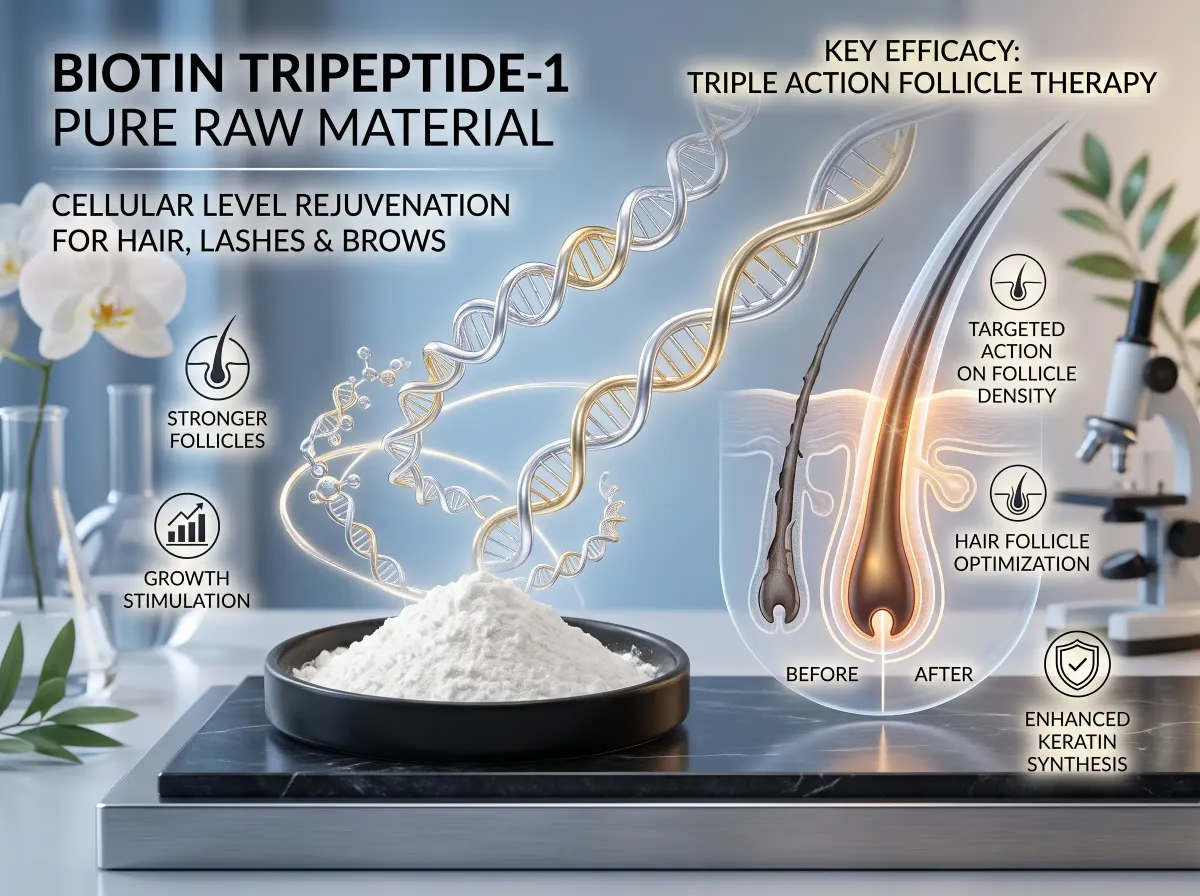
Biotinoyl Tripeptide-1
Biotinoyl Tripeptide-1 (Biotin-GHK) is a vitamin-bearing tripeptide that chemically conjugates Biotin (Vitamin B7) with the signaling Tripeptide-1 (GHK). Clinically verified: up to 121% in vitro hair growth stimulation, 79% self-perceived hair loss reduction. Purity >=99% HPLC.
Core Identity & Naming
Biotinoyl Tripeptide-1 (INCI name; also known as Biotinyl-GHK, Biotin-GHK, or BioGHK) is a vitamin-bearing matrikine tetrapeptide — chemically, it is a conjugate of Biotin (Vitamin B7 / Vitamin H) covalently linked to the N-terminus of the signaling tripeptide Tripeptide-1 (Gly-His-Lys, GHK). The full chemical name is N-biotinyl-glycyl-L-histidyl-L-lysine.
The GHK tripeptide was first discovered by Dr. Loren Pickart in 1973 and is one of the most extensively characterized matrikines in cosmetic science. GHK naturally occurs in human plasma as a copper-binding peptide that promotes extracellular matrix (ECM) remodeling, wound healing, and tissue regeneration. By conjugating biotin to GHK, Biotinoyl Tripeptide-1 achieves dual targeting:
- GHK domain: ECM signaling — stimulates collagen I/III, laminin-5, and collagen IV synthesis in dermal papilla fibroblasts and outer root sheath keratinocytes.
- Biotin domain: Keratin structural support — biotin is the essential cofactor for carboxylase enzymes that drive keratin intermediate filament synthesis, directly contributing to hair shaft strength and integrity.
In cosmetic ingredient labeling, Biotinoyl Tripeptide-1 appears simply as its INCI name. It is not a simple mixture of biotin and GHK — the covalent bond between the two moieties imparts superior stability, targeted peri-piliar zone localization, and sustained release kinetics (up to 12 hours, vs. 2–4 hours for free biotin).
Key distinction from standalone Biotin: While oral or topical free biotin supports hair health as a passive nutrient, Biotinoyl Tripeptide-1 acts as an active cell messenger — it penetrates the scalp and delivers the GHK signaling cascade directly to the hair bulb, resulting in significantly faster and more pronounced growth outcomes than topical biotin alone.
Mechanism of Action: How Biotinoyl Tripeptide-1 Fights Hair Loss
Hair loss (alopecia) is driven by three converging pathophysiological phenomena:
- Hormonal assault: Testosterone is converted to dihydrotestosterone (DHT) by 5-α-reductase in the scalp. DHT miniaturizes hair follicles, shortens the anagen (growth) phase, and pushes follicles prematurely into telogen (shedding).
- Insufficient perifollicular microcirculation: Reduced blood flow deprives rapidly dividing hair bulb keratinocytes of oxygen, nutrients, and signaling molecules.
- Degradation of follicular anchoring proteins: Loss of laminin-5 and collagen IV in the epithelial sheath weakens the physical grip that holds the hair shaft in the dermal papilla.
Biotinoyl Tripeptide-1 intervenes at all three levels:
2.1 Anchoring Molecule Synthesis — Laminin-5 & Collagen IV
Laminin-5 (laminin-332) is the primary glycoprotein of the anchoring filaments that mechanically connect the hair follicle's outer root sheath to the surrounding dermal extracellular matrix. Collagen IV forms the structural scaffold of the follicular basement membrane. In ex vivo human hair follicle studies, Biotinoyl Tripeptide-1 selectively upregulates both laminin-5 and collagen IV synthesis, maintaining the thickness of these anchoring layers over extended culture periods while untreated follicles lose these structural proteins entirely.
Fluorescent antibody staining confirmed that peptide-treated follicles preserved laminin-5 and collagen IV at levels comparable to freshly harvested tissue after 14 days in culture.
2.2 DHT Pathway Modulation
DNA microarray studies reveal that Biotinoyl Tripeptide-1 downregulates 5-α-reductase expression in scalp tissue. One study (2025) demonstrated that the peptide's effect on 5-α-reductase was comparable to that of minoxidil, the FDA-approved positive control, when tested under identical conditions. This reduces the conversion of testosterone to DHT locally in the follicle, preserving normal anagen-phase duration.
2.3 Hair Bulb Proliferation & Anagen Extension
At the cellular level, Biotinoyl Tripeptide-1 significantly increases Ki-67 expression — a nuclear protein marker of active cell division — in hair bulb keratinocytes. Ex vivo dose-response data:
| Concentration | Hair Growth Increase (vs. Untreated Control) |
|---|---|
| 2 ppm | +58% |
| 5 ppm | +121% |
The peptide also stimulates the proliferation of dermal papilla fibroblasts, the master regulator cells that orchestrate the entire hair follicle cycle. Gene activation studies show intense upregulation of adhesion complex proteins: vimentin (+90%), desmoglein (+60%), fibronectin receptor (+45%), and laminin-binding protein (+35%) over baseline.
2.4 Biotin-Mediated Keratin Support
The biotin moiety serves an additional structural role. As the cofactor for acetyl-CoA carboxylase and other carboxylases, biotin is rate-limiting for the synthesis of keratin intermediate filaments — the structural proteins that constitute approximately 85% of the hair shaft's dry weight. The covalent biotin-GHK conjugate ensures targeted delivery of biotin specifically to the peri-piliar zone, unlike systemic oral supplementation that distributes biotin throughout the body.
Biotinoyl Tripeptide-1 vs. Biotin — The Critical Comparison
| Dimension | Free Biotin (Vitamin B7) | Biotinoyl Tripeptide-1 (Biotin-GHK) |
|---|---|---|
| Structure | Single vitamin molecule | Biotin covalently conjugated to GHK tripeptide |
| Mechanism | Passive nutrient; carboxylase cofactor | Active cell messenger + nutrient delivery |
| Cellular signaling | None — no peptide signaling domain | GHK matrikine cascade: ECM protein synthesis, cell adhesion, DHT modulation |
| Targeting | Non-specific systemic distribution | Specific peri-piliar zone localization |
| Release kinetics | 2–4 hours (rapid clearance) | Up to 12 hours (sustained release) |
| pH stability | Degrades in acidic conditions | Stable across pH 4.0–7.0 |
| Ex vivo hair growth | Not demonstrated | +121% at 5 ppm |
| Clinical hair loss reduction | Limited evidence | 79% self-perceived improvement (6-month study) |
| Best use case | Oral supplementation for biotin deficiency | Topical serums, shampoos, and eyelash treatments for active hair regrowth |
Specifications & Technical Parameters
Raw Material Profile
| Parameter | Specification |
|---|---|
| INCI Name | Biotinoyl Tripeptide-1 |
| Synonyms | Biotinyl-GHK, Biotin-GHK, BioGHK |
| CAS Number | 299157-54-3 |
| Molecular Formula | C24H38N8O6S |
| Molecular Weight | 566.67 g/mol |
| Amino Acid Sequence | Biotin-Gly-His-Lys-OH (Biotin-GHK) |
| Appearance | White to off-white powder |
| Purity | >=99.0% (HPLC) |
| Solubility | Water-soluble (hydrophilic); compatible with aqueous and emulsion systems |
| pH Stability Range | 4.0–7.0 |
| Recommended Use Level | 1.0%–3.0% in leave-on formulations; 100–500 ppm as pure peptide equivalent |
| Processing Temperature | Add during cooling phase (<40°C / 104°F) to preserve maximum bioactivity |
| Storage | Cool, dry, ventilated; protect from light; store separately from acids and oxidizing agents |
Packaging Options
| Format | Typical Use Case |
|---|---|
| 1 g / 5 g vial | R&D, prototype formulation, small-batch production |
| 10 g / 25 g vial | Pilot batches, boutique brand production |
| 100 g / 500 g | Commercial production |
| 1 kg | Bulk manufacturing |
| Custom packaging | Available upon request |
Safety & Regulatory Profile
EWG Skin Deep Rating: Biotinoyl Tripeptide-1 carries a LOW hazard score across all assessed categories — Cancer (LOW), Allergies & Immunotoxicity (LOW), and Developmental & Reproductive Toxicity (LOW). It is not listed on any EWG Restricted or Unacceptable lists.
Safety foundation: As a topical cosmetic peptide with a molecular weight of 567 Da — slightly above the 500 Da threshold for passive transdermal absorption — systemic exposure from topical application is expected to be negligible. Both components (biotin and GHK tripeptide) are endogenous molecules naturally present in human physiology. No serious adverse events have been reported in published studies.
Eye-area safety: Unlike prostaglandin analog eyelash serums (bimatoprost/Latisse), Biotinoyl Tripeptide-1 has no reported risks of orbital fat atrophy (sunken-eye appearance), permanent iris darkening, conjunctival hyperemia, or periorbital hyperpigmentation.
Pregnancy & lactation: No dedicated safety studies exist for this population. However, given the low systemic absorption and the endogenous nature of both structural components, the risk profile is considered minimal. Consultation with a healthcare provider is recommended.
Not a Botox alternative: Biotinoyl Tripeptide-1 targets ECM anchoring proteins and keratin synthesis in the hair follicle — it has no neuromuscular junction activity and does not relax muscles. It is purely a hair follicle structural peptide, not a neuropeptide or muscle relaxant.
Preguntas frecuentes
Solicitar cotización o muestra
Envíe su consulta y nuestro representante comercial se pondrá en contacto con usted en un plazo de 24 horas.
Ir al formulario de consulta →