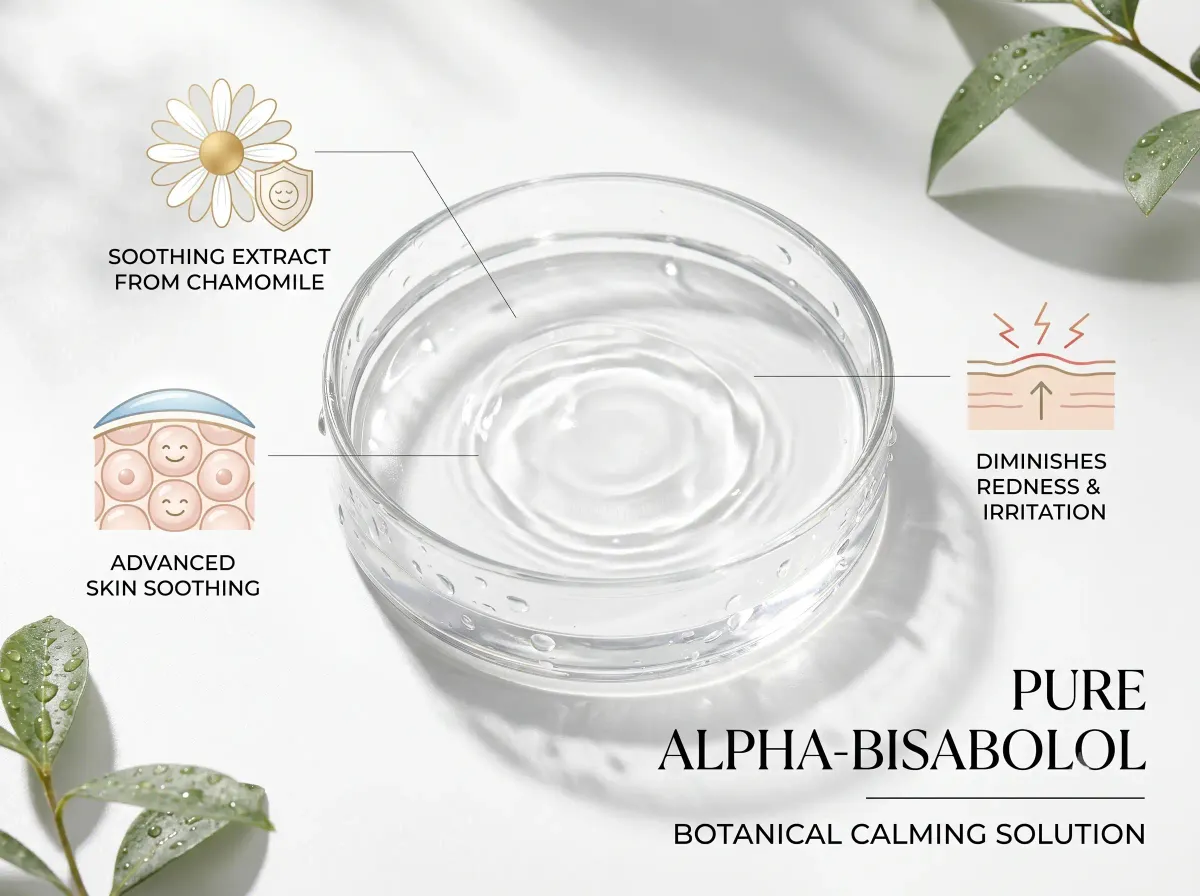
Alpha-Bisabolol — Bulk Raw Material
Matricaria chamomilla L. / Vanillosmopsis erythropappa (DC.) Sch.Bip.
GINKVORA α-Bisabolol is biosynthesized via solvent-free fermentation of engineered Saccharomyces cerevisiae, delivering high-purity (-)-α-Bisabolol. It avoids wild Candeia harvesting and synthetic chemical residues.
What Is Alpha-Bisabolol?
Alpha-Bisabolol — also referred to as (-)-α-Bisabolol, Levomenol, or simply Bisabolol (INCI) — is a naturally occurring monocyclic sesquiterpene alcohol. It is the principal bioactive constituent responsible for the anti-inflammatory, soothing, and antimicrobial properties of German Chamomile (Matricaria chamomilla L., Asteraceae) essential oil, where it can constitute up to 50% of the oil composition. It is also found in high concentrations in the essential oil of the Brazilian Candeia tree (Vanillosmopsis erythropappa (DC.) Sch.Bip.), the primary historical commercial source.
Chemical Identity:
| Parameter | Value |
|---|---|
| CAS Number | 515-69-5 (α-Bisabolol); 23089-26-1 ((-)-α-Bisabolol / Levomenol) |
| INCI Name | Bisabolol |
| Molecular Formula | C₁₅H₂₆O |
| Molecular Weight | 222.37 g/mol |
| Stereochemistry | Levorotatory — L-(-)-α-Bisabolol (active enantiomer) |
| Optical Rotation [α]D²⁰ | -58° to -55° |
| Appearance | Pale yellow to off-white oily liquid |
| Odor | Mild characteristic odor (floral, peppery, balsamic) |
| Density (20°C) | 0.93 g/mL |
| Refractive Index (nD²⁰) | 1.491–1.498 |
| Boiling Point | 154–156°C |
| Melting Point | ~25°C (may solidify below 10°C; warm gently) |
| Solubility | Oil-soluble, alcohol-soluble; insoluble in water |
⚠ Critical Note on Enantiomers: Bisabolol exists in two enantiomeric forms. The levorotatory (-)-α-Bisabolol (Levomenol) is the naturally occurring, biologically active form found in chamomile. Racemic (±)-bisabolol is synthetically produced and has significantly reduced biological activity. Our GINKVORA product is the pure levorotatory form, verified by optical rotation and GC analysis.
Biosynthetic Production: Fermentation, Not Extraction
GINKVORA Alpha-Bisabolol is produced via natural microbial fermentation — a biosynthetic process that uses engineered Saccharomyces cerevisiae (baker's yeast) strains to produce (-)-α-Bisabolol through the mevalonate pathway:
- Strain Engineering: S. cerevisiae is genetically optimized to express the bisabolol synthase gene (MrBBS) fused with the farnesyl diphosphate synthase gene (ERG20), directing carbon flux toward (-)-α-bisabolol biosynthesis.
- Aerobic Fermentation: The yeast is cultured in a controlled bioreactor with glucose as the primary carbon source, producing (-)-α-bisabolol as a secondary metabolite.
- Downstream Processing: The bisabolol is recovered via solvent-free separation and purified to ≥98% by molecular distillation.
- Quality Control: Every batch is tested by GC for purity, identity, and stereochemical integrity (optical rotation).
Why fermentation over plant extraction?
- Sustainability: No wild-harvesting of Candeia trees from Brazilian ecosystems. No agricultural land competition.
- Consistency: Purity and enantiomeric excess are batch-independent. No seasonal variation in chamomile essential oil composition.
- Purity: No plant-derived contaminants, pesticide residues, or heavy metal carryover from soil.
- Scalability: Fermentation volumes can scale to meet bulk demand without ecological constraints.
This is fundamentally different from synthetic (±)-bisabolol (chemically synthesized from farnesol or nerolidol via acid-catalyzed cyclization), which yields a racemic mixture with reduced biological activity. Our biosynthetic route produces authentic (-)-α-bisabolol that is chemically and stereochemically identical to the natural chamomile constituent.
How Alpha-Bisabolol Works: Anti-Inflammatory Mechanisms
Alpha-Bisabolol's multi-target anti-inflammatory action has been extensively characterized:
| Pathway | Mechanism | Clinical Relevance |
|---|---|---|
| 5-Lipoxygenase (5-LOX) Inhibition | Suppresses leukotriene synthesis (LTB4, LTC4) | Reduces inflammatory leukotrienes implicated in psoriasis, atopic dermatitis, and UV-induced erythema |
| COX Pathway Modulation | Downregulates cyclooxygenase activity | Reduces prostaglandin production (PGE2), a key mediator of pain, erythema, and edema |
| TNF-α Suppression | Inhibits tumor necrosis factor-alpha expression | Blocks the master pro-inflammatory cytokine upstream of the inflammatory cascade |
| IL-1α / IL-6 Suppression | Reduces interleukin-1α and interleukin-6 release | Attenuates downstream inflammatory signaling in keratinocytes and fibroblasts |
| MMP Inhibition | Downregulates MMP-2 and MMP-9 expression | Protects extracellular matrix collagen and elastin from enzymatic degradation |
In a validated 3D skin model, α-Bisabolol significantly reduced PMA-induced LTB4 and IL-1α production. In animal models, it reduced carrageenan-induced paw edema (rat), UV-induced erythema (guinea pig), and chemical irritant dermatitis (NaOH/SDS on human skin). These findings establish α-Bisabolol as one of the most clinically substantiated natural anti-inflammatory actives available to formulators.
Key Benefits for Cosmetic Formulators
1. The Gold Standard Natural Soothing Active
Alpha-Bisabolol is universally recognized as the most effective natural soothing ingredient in cosmetic science. It is the active principle behind chamomile's millennia-old reputation as a skin-calming botanical. Unlike whole chamomile extracts — which vary in composition and contain potential allergens (e.g., pollen-derived proteins) — purified (-)-α-Bisabolol delivers consistent, predictable anti-inflammatory activity without allergenic risk.
Clinical evidence: In a human patch-test study, a 0.5% α-Bisabolol cream significantly reduced surfactant-induced (SLS) skin irritation, with measurable reductions in erythema, transepidermal water loss (TEWL), and subjective discomfort scores compared to placebo.
2. Penetration Enhancer for Co-Formulated Actives
One of α-Bisabolol's most valuable — and frequently underappreciated — properties is its ability to enhance transdermal penetration of other active ingredients. As a lipophilic sesquiterpene alcohol, it reversibly disrupts the lipid bilayer organization of the stratum corneum, temporarily increasing membrane fluidity and permeability. This allows co-formulated actives — vitamin C (ascorbic acid), retinoids, peptides, niacinamide — to reach deeper epidermal layers more effectively.
This makes α-Bisabolol a strategic dual-purpose ingredient: it provides its own anti-inflammatory benefits while boosting the efficacy of every other active in the formula.
3. Anti-Microbial & Acne-Relevant Activity
α-Bisabolol exhibits antimicrobial activity against skin-relevant pathogens:
- Staphylococcus aureus — implicated in infected eczema, atopic dermatitis flares, and secondary wound infections
- Candida albicans — fungal opportunistic pathogen in intertriginous and mucosal skin
- Propionibacterium acnes (reclassified as Cutibacterium acnes) — the primary bacterium associated with acne vulgaris
For acne-prone formulations, α-Bisabolol provides a gentle, non-drying alternative to benzoyl peroxide and salicylic acid — reducing inflammation-driven lesion formation without disrupting the skin barrier.
4. Wound Healing & Post-Procedure Recovery
α-Bisabolol accelerates wound healing through multiple mechanisms:
- Fibroblast proliferation — stimulates the primary collagen-producing cells of the dermis
- Collagen synthesis — upregulates Type I and Type III collagen production at wound sites
- Re-epithelialization — promotes keratinocyte migration across wound beds
This makes it an indispensable ingredient in post-procedure recovery formulations — after microneedling, chemical peels, laser resurfacing, and microdermabrasion — where rapid, inflammation-controlled healing is the primary performance metric.
5. Skin Brightening via Tyrosinase Inhibition
At concentrations of 0.5% and above, α-Bisabolol inhibits tyrosinase activity and suppresses α-MSH-induced melanogenesis through the cAMP/CREB pathway in melanocytes. In a controlled clinical study, daily application of a 0.5% α-Bisabolol cream to UV-induced hyperpigmentation sites on human subjects resulted in statistically significant skin lightening compared to placebo over 4 weeks.
This dual soothing + brightening profile makes α-Bisabolol uniquely suited for formulations targeting post-inflammatory hyperpigmentation (PIH) — the dark spots left after acne lesions heal — where both calming the residual inflammation and fading the pigment are required.
6. Antioxidant & Preservative-Boosting Effects
α-Bisabolol scavenges reactive oxygen species (ROS) and reduces UV-induced oxidative stress in keratinocytes and fibroblasts. In formulation, it also acts as a preservative booster — enhancing the antimicrobial efficacy of cosmetic preservation systems at low concentrations, potentially allowing for reduced preservative load in "clean" formulations.
7. Anti-Perspirant & Deodorant Applications
α-Bisabolol has documented anti-perspiration effects — reducing sweat production when applied topically — making it a functional active in natural deodorant and anti-perspirant formulations.
Alpha-Bisabolol vs. Allantoin vs. Panthenol: Soothing Active Comparison
| Attribute | Alpha-Bisabolol | Allantoin | Panthenol (Pro-Vitamin B5) |
|---|---|---|---|
| Primary Mechanism | 5-LOX/COX inhibition, TNF-α suppression | Keratinocyte proliferation, desquamation | Conversion to pantothenic acid (CoA precursor) |
| Best For | Anti-inflammatory soothing, penetration enhancement | Wound healing, cell turnover, keratolytic | Deep moisturization, barrier repair |
| Solubility | Oil-soluble, alcohol-soluble | Water-soluble (0.5% at 25°C) | Highly water-soluble |
| Typical Usage | 0.1%–1.0% (oil phase) | 0.1%–2.0% (water phase) | 0.5%–5.0% (water phase) |
| Penetration Enhancer | ✓ Yes | ✗ No | ✗ No |
| Antimicrobial | ✓ Yes (S. aureus, C. albicans) | ✗ No | ✗ No |
| Tyrosinase Inhibition | ✓ Yes (at ≥0.5%) | ✗ No | ✗ No |
Synergistic recommendation: Combine all three — α-Bisabolol (oil phase) + Allantoin + Panthenol (water phase) — for a comprehensive sensitive-skin and barrier-repair system. This trio is the industry-standard soothing backbone for dermatological and post-procedure formulations.
Alpha-Bisabolol vs. Chamomile Essential Oil vs. Bisabolol-Rich Extract
| Ingredient | Bisabolol Content | Key Advantage | Key Limitation |
|---|---|---|---|
| Alpha-Bisabolol 98%+ (this product) | ≥98% | Maximum potency, batch consistency, no allergens | Requires solubility management (oil phase) |
| Chamomile Essential Oil | 10–50% | Multi-component synergy, natural fragrance | Variable composition, potential allergens (Compositae), photosensitivity risk from minor constituents |
| Bisabolol-Rich Chamomile Extract | 20–60% | More concentrated than essential oil, CO2 extraction available | Still contains co-extracted plant material; lower purity than isolated bisabolol |
| Synthetic (±)-Bisabolol | 95–99% | Lower cost | Racemic mixture — ~50% inactive enantiomer, not "natural" for clean beauty claims |
Formulation Guide
Recommended Incorporation
α-Bisabolol is oil-soluble — incorporate into the oil phase of emulsions or use directly in anhydrous formulations:
- Oil Phase Addition: Add α-Bisabolol to the heated oil phase (triglycerides, esters, fatty alcohols, etc.) at 40–60°C with moderate stirring. It blends easily with all common cosmetic oils and esters.
- Cold Process: For cold-process formulations (anhydrous serums, face oils, balms), add directly to the oil blend at room temperature with gentle mixing.
- Emulsification: After adding to the oil phase, proceed with standard emulsification. α-Bisabolol does not interfere with emulsifier function.
- Temperature Note: Below ~10°C, α-Bisabolol may solidify. If this occurs, warm the container gently to ~25–30°C (water bath) — the liquid will re-form without any degradation. Do not overheat.
Solubility Profile
| Solvent | Solubility |
|---|---|
| Ethanol (95%) | Freely soluble |
| Isopropanol | Freely soluble |
| Caprylic/Capric Triglyceride (MCT) | Freely soluble |
| Jojoba Oil | Freely soluble |
| Mineral Oil | Freely soluble |
| Squalane | Freely soluble |
| Propylene Glycol | Partially soluble |
| Glycerin | Low solubility |
| Water | Insoluble |
Formulation Compatibility
- Compatible: All common cosmetic oils, esters, fatty alcohols, fatty acids, emulsifiers (nonionic, anionic, cationic), silicones, film-formers, waxes, butters
- Synergistic Pairs:
- Retinoids — soothes retinoid-induced irritation without reducing efficacy
- AHAs/BHAs — calms acid-induced stinging and erythema
- Vitamin C (L-AA) — enhances penetration of ascorbic acid while soothing acidic irritation
- Niacinamide — complementary anti-inflammatory + barrier support
- Ceramides — soothing + barrier lipid replenishment
- Centella Asiatica — dual-pathway soothing: bisabolol (5-LOX/COX) + madecassoside (collagen synthesis)
Recommended Usage Rates
| Product Type | Typical Usage % |
|---|---|
| Sensitive Skin Serum | 0.2%–0.5% |
| Post-Procedure Recovery Cream | 0.5%–1.0% |
| Anti-Aging Face Oil / Serum | 0.1%–0.5% |
| Acne Treatment Gel / Lotion | 0.2%–0.5% |
| Baby Care Cream / Lotion | 0.1%–0.3% |
| After-Sun Balm | 0.3%–0.5% |
| Brightening Serum | 0.5%–1.0% |
| Natural Deodorant Stick | 0.1%–0.3% |
| Lip Balm | 0.1%–0.3% |
| Retinoid Companion Product | 0.2%–0.5% |
| Clean Beauty Foundation | 0.1%–0.2% |
Safety & Regulatory
- CIR (Cosmetic Ingredient Review) Expert Panel: Bisabolol assessed as safe in cosmetics under present practices of use and concentration. No restrictions on usage levels in leave-on or rinse-off products.
- EWG Skin Deep: Low hazard profile. Not classified as a sensitizer, irritant, or photosensitizer at cosmetic concentrations.
- EU CosIng: Registered and permitted without restriction.
- IFRA: Approved for fragrance use (bisabolol is a naturally occurring fragrance component in chamomile).
- Allergy Note: As a purified single compound, α-Bisabolol does not contain the pollen-derived proteins responsible for Asteraceae (Compositae) family allergies. However, individuals with known severe chamomile allergy should exercise caution and perform a patch test.
- Pregnancy/Nursing: No known restrictions; generally regarded as safe for topical use.
- Skin Irritation: α-Bisabolol is not a skin irritant. In fact, it is used to reduce irritation caused by other ingredients (surfactants, retinoids, AHAs).
- Oxidation Stability: Store tightly sealed; α-Bisabolol is susceptible to oxidation upon prolonged air exposure. Addition of antioxidants (tocopherol, BHT) to the bulk container is recommended for extended storage.
Market & Industry Context
The global α-Bisabolol market is driven by two converging trends:
- The sensitive-skin category expansion: Sensitive skin claims now represent over 40% of new skincare product launches globally, creating sustained demand for clinically substantiated soothing actives.
- The clean beauty movement: Consumer preference for "natural" and "biosynthetic" ingredients over petrochemical-derived synthetics has shifted demand toward fermentation-produced (-)-α-bisabolol and away from synthetic racemic (±)-bisabolol.
GINKVORA's biosynthetic (-)-α-Bisabolol addresses both trends: it delivers the clinically proven anti-inflammatory activity of natural chamomile bisabolol with the batch-to-batch consistency and purity of a controlled fermentation process — at competitive pricing for bulk procurement.
Quality Control & Certifications
GINKVORA Alpha-Bisabolol is manufactured under ISO 9001 and cGMP standards with full traceability from fermentation batch to final liquid:
| QC Parameter | Specification | Test Method |
|---|---|---|
| Purity (as (-)-α-Bisabolol) | ≥ 98.0% | GC |
| Optical Rotation [α]D²⁰ | -58° to -55° | Polarimetry |
| Refractive Index (nD²⁰) | 1.491–1.498 | Refractometry |
| Density (20°C) | 0.92–0.94 g/mL | Pycnometry |
| Appearance | Pale yellow to off-white oily liquid | Visual |
| Heavy Metals | Pb ≤ 10, As ≤ 2, Cd ≤ 1, Hg ≤ 0.1 ppm | ICP-MS |
| Microbial Limits | TAMC < 100 CFU/g, TYMC < 10 CFU/g | USP <61>/<62> |
FAQ
Q: What is alpha-bisabolol? A: Alpha-Bisabolol — also known as Levomenol or (-)-α-Bisabolol (INCI: Bisabolol) — is a naturally occurring monocyclic sesquiterpene alcohol and the principal anti-inflammatory active in German Chamomile (Matricaria chamomilla) essential oil. CAS number: 515-69-5. Molecular formula: C₁₅H₂₆O. It is a pale yellow to off-white oily liquid with a mild floral scent, oil- and alcohol-soluble. GINKVORA supplies biosynthetic (-)-α-Bisabolol at ≥98% purity (GC), produced via natural microbial fermentation.
Q: What does alpha-bisabolol do for skin? A: Alpha-Bisabolol provides seven key skincare benefits: (1) Potent anti-inflammatory soothing — inhibits 5-LOX and COX pathways, suppresses TNF-α, IL-1α, IL-6; (2) Penetration enhancement — reversibly increases stratum corneum permeability, boosting delivery of co-formulated actives (retinoids, vitamin C, peptides); (3) Antimicrobial activity — effective against S. aureus, C. albicans, and acne-associated bacteria; (4) Wound healing — stimulates fibroblasts and collagen synthesis; (5) Skin brightening — inhibits tyrosinase at ≥0.5% via cAMP/CREB pathway; (6) Antioxidant protection — scavenges ROS and reduces UV-induced oxidative stress; (7) Anti-perspirant — reduces sweat production in deodorant applications.
Q: Is alpha-bisabolol safe? Does it cause skin irritation? A: Alpha-Bisabolol has an exceptional safety profile. The CIR Expert Panel assessed bisabolol as safe in cosmetics. EWG rates it low-hazard. It is not a skin irritant — quite the opposite: α-Bisabolol is used in formulations specifically to reduce irritation caused by surfactants, retinoids, AHAs, and environmental stressors. It is suitable for sensitive skin, baby care, and post-procedure recovery formulations. A patch test is recommended for individuals with known severe Asteraceae (chamomile) allergy.
Q: What is the INCI name and CAS number for alpha-bisabolol? A: INCI Name: Bisabolol. CAS Numbers: 515-69-5 (α-Bisabolol) and 23089-26-1 ((-)-α-Bisabolol / Levomenol). The GINKVORA product is the levorotatory (-)-form (Levomenol), verified by optical rotation (-58° to -55°), which is the naturally occurring, biologically active enantiomer.
Q: Is alpha-bisabolol oil-soluble or water-soluble? A: Alpha-Bisabolol is oil-soluble and alcohol-soluble. It dissolves freely in ethanol, isopropanol, triglycerides (MCT oil), jojoba oil, squalane, mineral oil, and other common cosmetic oils and esters. It is insoluble in water. In emulsion formulations, it must be incorporated into the oil phase. For water-based formulations, it can be pre-dissolved in a small amount of ethanol or a solubilizer before addition.
Q: What is the difference between natural (-)-α-bisabolol and synthetic (±)-bisabolol? A: The key difference is stereochemistry and biological activity. (-)-α-Bisabolol (Levomenol, CAS 23089-26-1) is the naturally occurring levorotatory enantiomer — the form found in chamomile — and is fully biologically active. Synthetic (±)-bisabolol (CAS 515-69-5) is a racemic mixture containing 50% of the inactive (+)-enantiomer, resulting in approximately half the biological potency on a weight basis. GINKVORA's biosynthetic process produces authentic (-)-α-bisabolol identical to the chamomile-derived molecule.
Q: How is alpha-bisabolol used in cosmetic formulations? A: Add α-Bisabolol to the oil phase of emulsions at 40–60°C with stirring. Typical usage rates: 0.1%–0.5% for sensitive-skin and daily moisturizers; 0.5%–1.0% for post-procedure recovery, brightening serums, and anti-acne treatments. Compatible with all common cosmetic oils, emulsifiers, and active ingredients. Particularly effective as a soothing companion for retinoid, AHA, and vitamin C formulations.
Q: How is GINKVORA's alpha-bisabolol produced? A: GINKVORA Alpha-Bisabolol is produced via natural microbial fermentation using engineered baker's yeast (Saccharomyces cerevisiae) — a biosynthesis process that converts glucose into (-)-α-bisabolol through the mevalonate pathway. This is fundamentally different from synthetic (±)-bisabolol produced via acid-catalyzed chemical cyclization. The fermentation route is sustainable (no wild-harvesting of Candeia trees), solvent-free, and yields the authentic levorotatory enantiomer at ≥98% purity (GC).
Preguntas frecuentes
Solicitar cotización o muestra
Envíe su consulta y nuestro representante comercial se pondrá en contacto con usted en un plazo de 24 horas.
Ir al formulario de consulta →