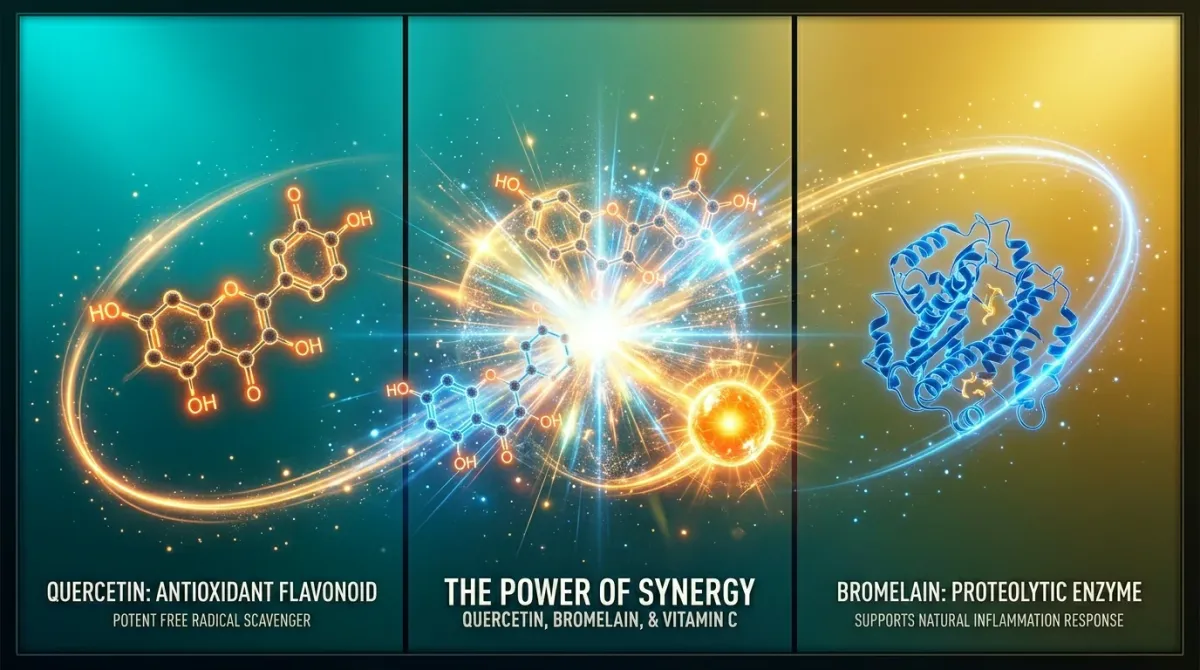
TL;DR
- Zinc inhibits viral RNA replication inside cells — but zinc ions (Zn²⁺) cannot cross cell membranes without a transport molecule (ionophore)
- Quercetin is a validated zinc ionophore: it chelates zinc, forms a neutral complex, and transports Zn²⁺ across the lipid bilayer into the cytoplasm
- Once inside, zinc blocks RNA-dependent RNA polymerase (RdRP) — the enzyme RNA viruses depend on for genome replication
- A 2023 RCT (n=100) found quercetin phytosome achieved 68% viral clearance at week 1 vs 24% in controls (p=0.0004)
- The quercetin + zinc combination is mechanistically two-component: quercetin is the shuttle, zinc is the antiviral cargo. Neither alone achieves the full effect.
- For supplement brands, quercetin + zinc offers a scientifically differentiated, defensible positioning that single-ingredient antiviral claims cannot match
The Zinc Paradox: Essential for Antiviral Defense, Trapped Outside Cells
Zinc is arguably the most important mineral for antiviral immunity. It is required for:
| Immune Function | Zinc's Role |
|---|---|
| NK cell activity | Zinc is a cofactor for NK cell cytotoxic granule release and IFN-γ production |
| T cell development | Thymic T cell maturation requires zinc; zinc deficiency causes thymic atrophy |
| Macrophage phagocytosis | Zinc-dependent enzymes mediate respiratory burst and pathogen killing |
| Antibody production | B cell proliferation and immunoglobulin class switching are zinc-sensitive |
| Epithelial barrier integrity | Zinc finger transcription factors regulate tight junction protein expression |
| Antioxidant defense | Zinc is a cofactor for Cu/Zn superoxide dismutase (SOD1) |
| Viral replication inhibition | Intracellular zinc directly blocks RNA-dependent RNA polymerase (RdRP) |
The paradox: zinc's most important antiviral mechanism — RdRP inhibition — requires zinc to be inside the cell. But Zn²⁺ ions are charged and cannot passively diffuse through the hydrophobic lipid bilayer.
Cells solve this with an elaborate system of zinc transporters: ZIP (Zrt/Irt-like protein) importers bring zinc in; ZnT (zinc transporter) exporters move zinc out. These transport proteins are tightly regulated — they do not respond to a sudden influx of dietary zinc. You cannot simply ingest more zinc and expect more intracellular zinc where the virus is replicating.
This is the zinc paradox: adequate dietary zinc is essential for baseline immune function, but supplementing zinc alone does not deliver it to the intracellular compartment where it blocks viral replication.
The solution: an ionophore.
What Is an Ionophore?
An ionophore is a molecule that binds ions and transports them across biological membranes. Ionophores work by:
- Chelating the ion (binding it via coordinate bonds to oxygen or nitrogen atoms)
- Forming a neutral complex that masks the ion's charge
- Partitioning into the lipid bilayer — the neutral complex dissolves in the hydrophobic membrane interior
- Releasing the ion on the other side of the membrane
Once the ion is released, the ionophore can diffuse back and repeat the cycle.
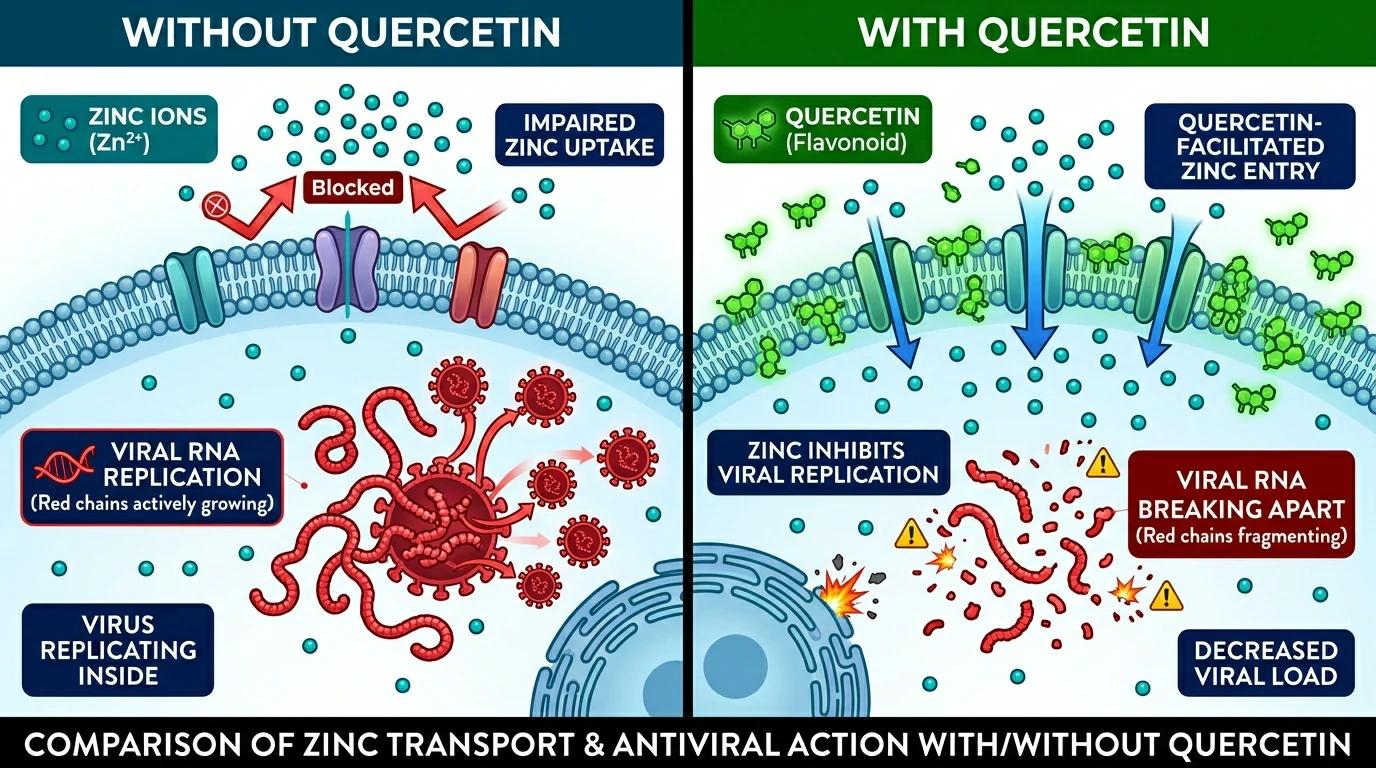 In pharmacology, ionophores are not new. Pyrithione is a synthetic zinc ionophore used in anti-dandruff shampoos. Chloroquine and hydroxychloroquine are weak-base zinc ionophores — much of their proposed antiviral mechanism is zinc transport into endosomes where viruses replicate.
Quercetin belongs to the same functional class — but it is a naturally occurring dietary flavonoid rather than a synthetic drug.
Quercetin as a Zinc Ionophore: The Landmark Study
In 2014, Dabbagh-Bazarbachi et al. at the Université de Montréal published a seminal study in the Journal of Agricultural and Food Chemistry (ACS) that demonstrated quercetin's zinc ionophore activity using two complementary models.
Experiment 1: Live Cell Transport
Researchers loaded Hepa 1-6 mouse hepatoma cells with FluoZin-3, a fluorescent probe that emits green light when it binds free zinc. They then added:
- Zinc acetate alone → no fluorescence change (zinc cannot enter cells)
- Quercetin + zinc acetate → rapid, strong fluorescence increase (zinc enters cells)
- EGCG + zinc acetate → similar fluorescence increase (confirms both are ionophores)
The increase was rapid — intracellular zinc concentration rose within minutes of quercetin + zinc addition — confirming real-time ionophore activity rather than a slow secondary effect.
Experiment 2: Liposome Model
To prove the effect was direct membrane transport (not via cellular zinc transporters), the researchers created artificial liposomes — pure phospholipid bilayers with no proteins. They encapsulated FluoZin-3 inside and added quercetin + zinc outside.
Result: fluorescence increased inside the liposomes. This confirmed that quercetin transports zinc directly through the lipid bilayer without requiring ZIP or ZnT proteins.
Quercetin vs. EGCG
Both quercetin and epigallocatechin gallate (EGCG, from green tea) showed zinc ionophore activity. The study did not rank them by potency, but both operated through the same mechanism: chelating Zn²⁺ via adjacent hydroxyl and carbonyl groups on the flavonoid ring, forming a neutral complex, and diffusing through membranes.
A 2022 review in the Journal of Inorganic Biochemistry (ScienceDirect) catalogued quercetin alongside chloroquine, pyrithione, hinokitiol, and EGCG as confirmed zinc ionophores with demonstrated antiviral relevance.
What Zinc Does Inside the Cell: The Antiviral Mechanism
Once quercetin delivers zinc into the cytoplasm (and organelles), zinc exerts several antiviral effects:
Primary: RdRP Inhibition
RNA viruses — influenza, rhinovirus, respiratory syncytial virus (RSV), coronaviruses, hepatitis C — replicate their genomes using RNA-dependent RNA polymerase (RdRP). Human cells do not have RdRP, making it an ideal drug target.
Zinc inhibits RdRP by displacing magnesium ions (Mg²⁺) at the enzyme's catalytic site. Mg²⁺ is required for the polymerase reaction; Zn²⁺ has a higher binding affinity for the same site but does not support catalysis. The result: the viral polymerase is blocked and cannot copy the viral genome.
This mechanism was first demonstrated for rhinovirus 3D polymerase and has since been confirmed for SARS-CoV-2 nsp12 (RdRP), influenza PA subunit, and HCV NS5B.
Secondary: Viral Protease Inhibition
In addition to RdRP, zinc inhibits viral proteases — the enzymes that cleave viral polyproteins into functional units. SARS-CoV-2 3CLpro (main protease) and PLpro (papain-like protease) are both reported to be zinc-sensitive in biochemical assays.
Tertiary: Immune Modulation
Intracellular zinc modulates multiple immune signaling pathways:
- NF-κB: zinc increases A20 (TNFAIP3) expression, a deubiquitinase that terminates NF-κB signaling and reduces pro-inflammatory cytokine production
- T cell receptor signaling: zinc is required for ZAP-70 kinase activity in the TCR signaling cascade
- Interferon response: zinc finger antiviral protein (ZAP) requires zinc for its RNA-degrading antiviral activity
How Quercetin and Zinc Work Together: The Two-Component System
The quercetin + zinc synergy can be summarized as a two-component antiviral system:
COMPONENT A: QUERCETIN (IONOPHORE)
    ↓ binds Zn²⁺ via catechol hydroxyl + 3-OH/4-carbonyl groups
    ↓ forms neutral lipophilic complex
    ↓ diffuses through cell membrane / organelle membrane
    ↓ releases Zn²⁺ in cytoplasm and endosomes
    ↓ diffuses back to transport next Zn²⁺ (recyclable)

COMPONENT B: ZINC (ANTIVIRAL CARGO)
    ↓ reaches cytoplasm and organelles
    ↓ binds to viral RdRP at catalytic Mg²⁺ site → replication blocked
    ↓ binds to viral proteases → polyprotein processing inhibited
    ↓ activates ZAP (zinc finger antiviral protein) → viral RNA degradation
    ↓ suppresses NF-κB via A20 upregulation → cytokine storm reduced
Why Neither Component Works Alone
| Scenario | Zinc Intracellular | Antiviral Effect |
|---|---|---|
| No zinc, no quercetin | Baseline (tightly regulated) | Minimal; viral replication proceeds |
| Zinc alone (no ionophore) | Unchanged — ZIP/ZnT maintain homeostasis | Minimal beyond baseline immune support |
| Quercetin alone (no supplemental zinc) | Modest increase from baseline labile zinc pool | Partial; quercetin's direct antiviral + immune effects |
| Quercetin + zinc | Significantly elevated | Full: ionophore-delivered zinc blocks RdRP + quercetin's direct mechanisms |
This is not a speculative synergy. It is biochemically defined and experimentally demonstrated. The zinc ionophore mechanism is quercetin's most distinctive contribution to antiviral defense.
Clinical Evidence
Quercetin Phytosome COVID-19 RCT (Frontiers in Pharmacology, 2023)
The most clinically relevant data comes from a randomized, controlled trial of quercetin phytosome in early-stage COVID-19:
| Parameter | Quercetin Group | Control Group | p-value |
|---|---|---|---|
| Sample size | 50 | 50 | — |
| Dose | Quercetin Phytosome® 500 mg TDS (week 1), BDS (week 2) | Standard care | — |
| Viral clearance (week 1) | 68% (34/50) | 24% (12/50) | 0.0004 |
| Symptom resolution (week 1) | 52% (26/50) | 24% (12/50) | 0.0051 |
| LDH reduction | 406 → 258 U/L (p=0.0001) | No significant change | — |
This trial used quercetin without zinc, so the benefit came from quercetin's zinc-independent antiviral mechanisms (protease binding, cytokine suppression) and potentially mobilization of endogenous zinc. If supplemental zinc were added, the ionophore-delivered RdRP inhibition would theoretically add an additional layer of antiviral activity.
Quadruple Therapy Trial (NCT04468139)
A registered clinical trial (NCT04468139) tested quercetin + zinc + vitamin C + vitamin D as a quadruple therapy protocol. The trial has been completed and ClinicalTrials.gov records the protocol. While full published results are pending at time of writing, the protocol design reflects clinical acceptance of the quercetin-as-ionophore concept.
Context: The Broader Zinc Ionophore Literature
A 2022 review in the Journal of Inorganic Biochemistry identified quercetin as one of four structurally diverse zinc ionophores (alongside chloroquine, pyrithione, and hinokitiol) with relevance to antiviral therapy. The review noted that zinc ionophores share a common pharmacophoric feature — adjacent oxygen or sulfur atoms that coordinate Zn²⁺ — and that quercetin's 3-hydroxy-4-keto chelation site is functionally equivalent to the N,N-chelating motif in chloroquine.
Formulation Recommendations
Standard Immune Defense Formula
| Ingredient | Dose per Serving | Rationale |
|---|---|---|
| Quercetin (≥95% HPLC) | 500 mg | Zinc ionophore + direct antiviral + immune modulator |
| Zinc (picolinate or citrate) | 15 mg | Antiviral cargo: RdRP inhibitor |
| Vitamin C (ascorbic acid) | 250–500 mg | Regenerates quercetin; independent immune support |
| Vitamin D3 (cholecalciferol) | 1,000–2,000 IU | Macrophage modulation; cathelicidin induction |
Enhanced Acute Support Formula
| Ingredient | Dose per Serving | Rationale |
|---|---|---|
| Quercetin (≥95% HPLC) | 500 mg, 2× daily | Higher total daily dose for acute antiviral demand |
| Zinc (picolinate or citrate) | 25–30 mg, 2× daily | Split dose to stay within 40 mg/day upper limit |
| Bromelain (2,400 GDU/g) | 100 mg per 500 mg quercetin | Enhances quercetin absorption approx. 20× |
| Vitamin C | 500 mg | Regeneration + immune support |
Key Formulation Considerations
| Consideration | Detail |
|---|---|
| Zinc form | Picolinate and citrate have 50–60% higher bioavailability than zinc oxide; avoid oxide in premium formulations |
| Quercetin:zinc molar ratio | The 2014 ionophore study used approx. 1:1 molar ratio (lab conditions); commercial supplements use mass ratios of approx. 20:1 to 50:1 (quin:Zn) since quercetin recycles as an ionophore |
| Absorption | Pair quercetin with bromelain or use phytosome/liposomal form; enhanced absorption improves ionophore delivery to target tissues |
| Gastric tolerance | Zinc can cause nausea on empty stomach; instruct consumption with meals |
| Copper status | Long-term zinc >30 mg/day requires copper monitoring (2 mg copper per 30 mg zinc recommended) |
Why GINKVORA Quercetin for Zinc-Ionophore Formulations
The quercetin + zinc concept depends on two variables: the ionophore (quercetin) must reach systemic circulation in sufficient quantity, and the zinc must be in a bioavailable form.
- Standardized to ≥95% quercetin by HPLC — formulations delivering reliable ionophore activity require batch-to-batch assay consistency
- Sourced from Sophora japonica — the highest natural quercetin content in commercial botanical material
- Full documentation: COA per batch, heavy metals within USP/EU/CP limits, microbiology compliant — essential for brands whose claims depend on ingredient quality
- Compatible with all delivery systems: standard powder for bromelain-enhanced capsules, or as input for phytosome/liposomal processing
For formulators developing quercetin + zinc antiviral defense products, ingredient purity is the literal foundation — if quercetin content varies batch to batch, the ionophore capacity varies with it.
Request a specification sheet, sample, or quote →
Related Articles
- Quercetin + Bromelain + Vitamin C: Why This Trio Is the Ultimate Immune Stack — Another synergistic immune combination
- Quercetin for Immune Defense: The Flavonoid That Activates Your Body's First-Line Protection — How ionophore activity boosts antiviral immunity
- Quercetin Safety Profile: Dosage, Drug Interactions, and Who Should Avoid It — Zinc + quercetin safety considerations
Sources: Dabbagh-Bazarbachi H et al., J. Agric. Food Chem. (2014) — Zinc Ionophore Activity of Quercetin and Epigallocatechin-gallate; Rondanelli M et al., Frontiers in Pharmacology (2023) — Quercetin as Complementary Agent for Early-Stage COVID-19 (n=100 RCT); NCT04468139 — Quadruple Therapy Zinc, Quercetin, Vitamin C, Vitamin D Clinical Trial; Krenn BM et al., J. Virol. (2009) — Zinc Inhibits Rhinovirus Replication via RdRP; te Velthuis AJW et al., PLoS Pathogens (2010) — Zn²⁺ Inhibits SARS-CoV and Arterivirus RdRP Activity; Doboszewska U et al., J. Inorg. Biochem. (2022) — Zinc Ionophores: Chemistry and Antiviral Relevance; Prasad AS, Am. J. Clin. Nutr. (1998) — Zinc and Immune Function; Wessels I et al., Nutrients (2017) — Zinc as Gatekeeper of Immune Function; Nieman DC et al., Pharmacol Res (2010) — Quercetin URTI RCT (n=1,002).
Reviewed for scientific accuracy. This content is intended for B2B industry professionals and educational purposes. It does not constitute medical advice.