TL;DR
- Quercetin directly stabilizes mast cells by downregulating the IgE receptor (FcεRI), blocking SYK phosphorylation, and suppressing calcium influx — three separate points of intervention
- It binds to the CD300f/CLM-1 inhibitory receptor on mast cells (Kd = 2.96 × 10⁻⁵ mol/L), triggering SHP-1 phosphatase to shut down allergic signaling
- The NF-κB pathway — a master switch for inflammatory cytokine production — is suppressed, reducing IL-6, TNF-α, and IL-1β
- Seasonal allergic rhinitis affects 25% of adults in the US alone, driving a global market projected to reach $19.6 billion by 2030
- For formulators, quercetin offers a multi-mechanism mast cell stabilizing ingredient for preventive allergy supplementation
Seasonal Allergies: A Problem That Starts Inside Mast Cells
Every spring, hundreds of millions of people experience the same cascade: pollen enters the nasal passages, IgE antibodies recognize it as a threat, and mast cells lining the respiratory mucosa explode with histamine. The result — sneezing, congestion, itchy eyes — is the defining experience of seasonal allergic rhinitis, commonly known as hay fever.
The CDC reports that 25.2% of American adults suffer from seasonal allergies. Globally, allergic rhinitis affects an estimated 400 million people, and the allergic rhinitis treatment market is projected to reach $19.6 billion by 2030 (The Business Research Company, 2025), growing at 4.7% CAGR.
Conventional treatment relies on antihistamines — drugs that block H1 receptors after histamine has already been released. But a different approach is gaining traction, one that intervenes before histamine ever leaves the mast cell. That approach centers on quercetin, a plant flavonoid that stabilizes mast cells at the cellular source of the allergic cascade.
Understanding Mast Cells: The Gatekeepers of Allergic Reaction
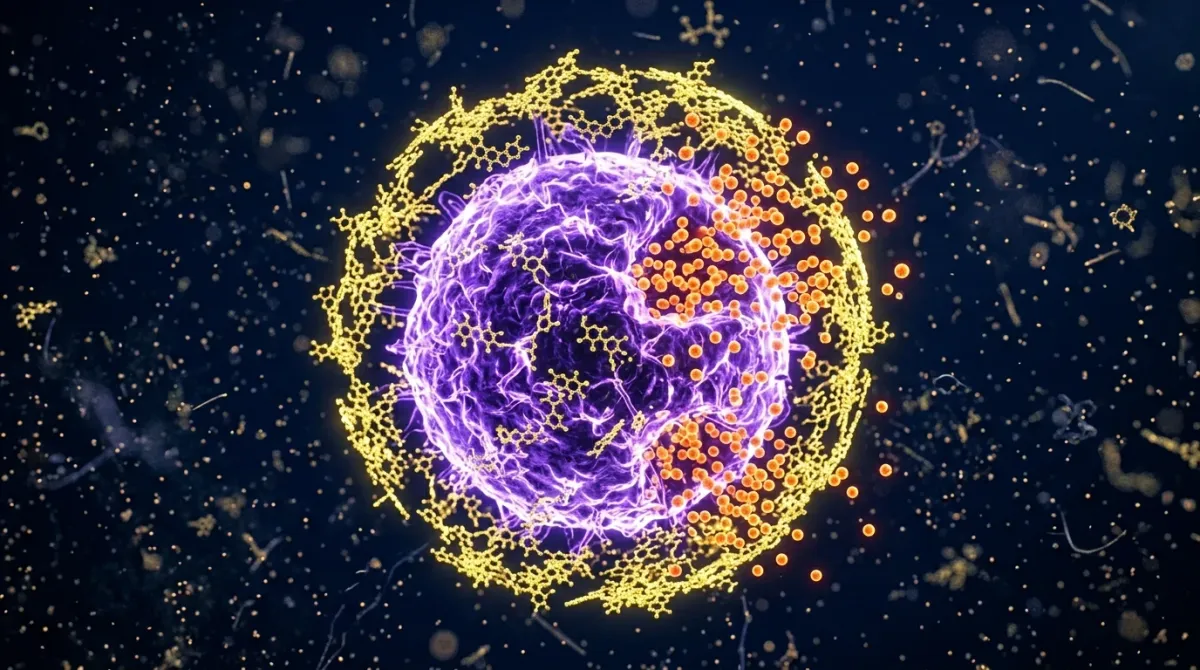
Mast cells are granulated immune cells stationed in tissues that interface with the outside world — the nasal mucosa, skin, lungs, and gastrointestinal tract. Each mast cell contains 500–1,000 secretory granules packed with pre-formed mediators including:
- Histamine — Immediate hypersensitivity: vasodilation, itching, sneezing
- Tryptase — Tissue remodeling, recruitment of eosinophils
- Heparin — Anticoagulant co-factor
- TNF-α — Pre-formed and rapidly released upon activation
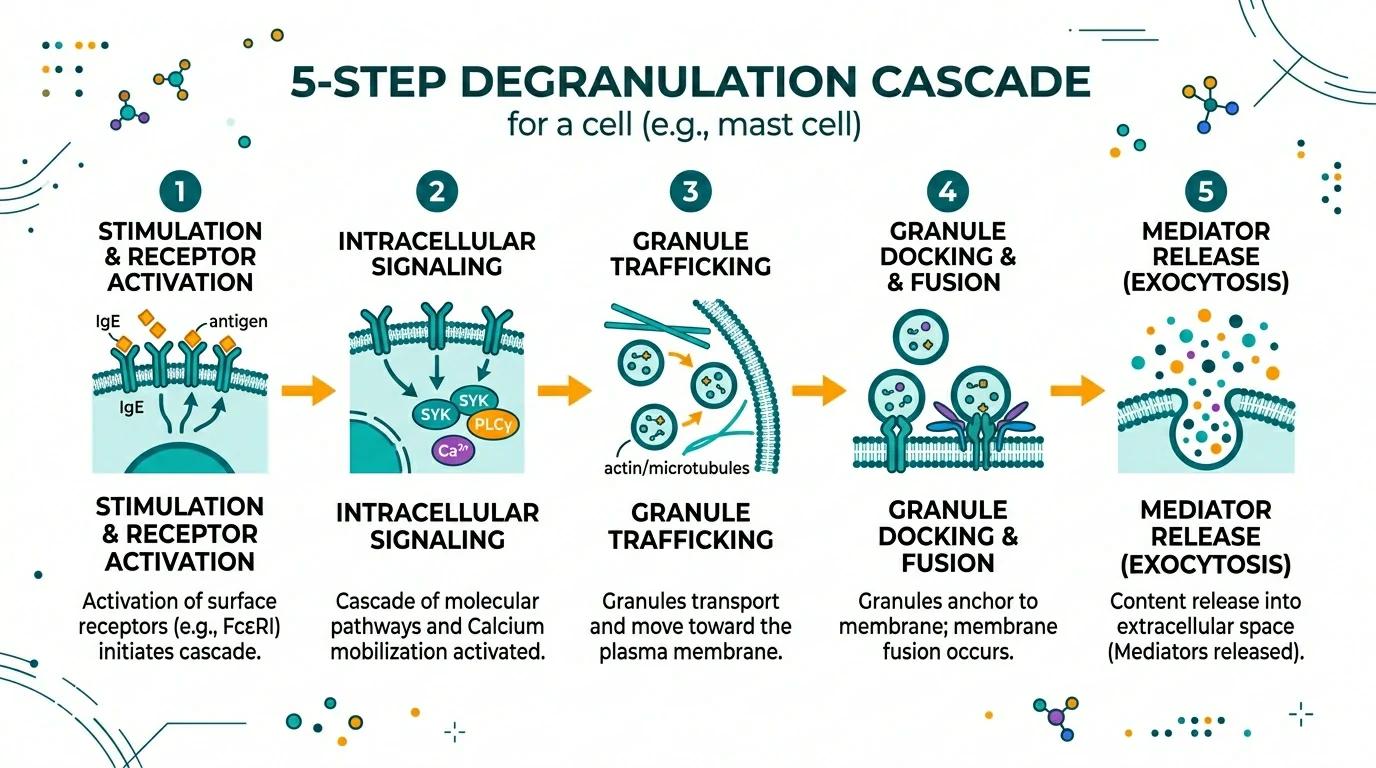
When an allergen binds IgE antibodies on the mast cell surface, it cross-links the FcεRI receptor — a high-affinity IgE receptor — triggering a cascade of intracellular events that ends with the release of these granules. This is degranulation, and it happens within seconds to minutes of allergen exposure.
Mast cells are the gatekeepers. If they can be stabilized — if degranulation can be prevented or dampened — the entire downstream allergic cascade is attenuated before symptoms even begin.
The Mast Cell Signaling Cascade: Where Quercetin Intervenes
The intracellular signaling cascade that triggers mast cell degranulation involves multiple steps — and quercetin has been shown to intervene at several of them:
Step 1: IgE Cross-Linking → FcεRI Activation
Allergen-specific IgE antibodies bind to the FcεRI receptor on the mast cell surface. When an allergen cross-links two adjacent IgE-FcεRI complexes, the receptor is activated.
- Quercetin intervention: A 2022 study published in Molecules (PMC9573482) demonstrated that quercetin significantly reduces FcεRI surface expression on human LAD2 mast cells. Fewer receptors means fewer entry points for the allergic trigger — a sustained, upstream form of mast cell stabilization.
Step 2: Lyn/SYK Kinase Phosphorylation
Activated FcεRI recruits Lyn kinase, which phosphorylates immunoreceptor tyrosine-based activation motifs (ITAMs). This recruits and activates SYK kinase — the central signaling hub for mast cell degranulation.
- Quercetin intervention: The same 2022 study found that quercetin suppresses SYK phosphorylation in IgE-sensitized mast cells. By inhibiting this key kinase, quercetin blocks the signal before it propagates downstream.
Step 3: Calcium Influx
SYK activation leads to PLCγ-mediated IP3 production, which opens calcium channels on the endoplasmic reticulum. The resulting spike in intracellular calcium (Ca²⁺) is the final trigger for granule fusion and degranulation.
- Quercetin intervention: Research by Ding et al. (2019, International Immunopharmacology) showed that quercetin inhibits pseudo-allergic mast cell degranulation by suppressing PLCγ-IP3R-related Ca²⁺ fluctuations. A 2024 Dovepress study in the Journal of Inflammation Research further confirmed that quercetin attenuates MRGPRX2-mediated calcium influx in a dose-dependent manner.
Step 4: Degranulation and Mediator Release
Elevated intracellular calcium triggers cytoskeletal reorganization — F-actin polymerization — which physically moves granules to the cell membrane for fusion and release.
- Quercetin intervention: The 2024 Dovepress study identified a novel pathway: quercetin binds to the CD300f (CLM-1) inhibitory receptor on mast cells (binding affinity Kd = 2.962 × 10⁻⁵ mol/L), recruiting SHP-1 phosphatase. This activates a PI3K/AKT/Rac1/Cdc42 cascade that suppresses F-actin reorganization, physically preventing granules from reaching the membrane.
Signal Cascade Overview
| Step | Event | Quercetin's Action |
|---|---|---|
| 1 | Allergen binds IgE → FcεRI cross-linking | Downregulates FcεRI surface expression |
| 2 | Lyn → SYK phosphorylation | Suppresses SYK phosphorylation |
| 3 | PLCγ → IP3R → Ca²⁺ release | Inhibits calcium influx via CD300f/SHP-1 |
| 4 | F-actin reorganization → degranulation | Blocks PI3K/AKT/Rac1/Cdc42 cytoskeletal pathway |
| 5 (Parallel) | NF-κB → cytokine transcription | Suppresses IKK/IκB/NF-κB via MyD88 inhibition |
By acting at multiple points — not just one — quercetin achieves broader mast cell stabilization than single-target pharmaceutical approaches.
The CD300f Pathway: A Newly Identified Mechanism
One of the most significant recent discoveries is quercetin's interaction with CD300f (CLM-1), an inhibitory receptor on the mast cell surface.
The 2024 Journal of Inflammation Research study mapped this pathway in detail:
- Quercetin binds CD300f via hydrogen bonds at residues GLN37, ARG61, TYR288, SER83, and ASN60 (Kd = 2.962 × 10⁻⁵ mol/L)
- This activates SHP-1 phosphatase, a negative regulator of immune signaling
- SHP-1 suppresses MyD88, an adaptor protein in the TLR/IL-1R signaling axis
- Downstream, IKK/IκB/NF-κB activation is dampened, reducing inflammatory cytokine transcription
- Simultaneously, PI3K/AKT phosphorylation is inhibited, disrupting the cytoskeletal machinery needed for degranulation
When the researchers silenced CLM-1 expression, quercetin's mast cell stabilizing effect was significantly diminished — confirming that CD300f binding is a required component of quercetin's anti-allergy mechanism.
This is a newly characterized pathway distinct from the previously known IgE/FcεRI/SYK route, highlighting how quercetin stabilizes mast cells through multiple, complementary mechanisms.
How NF-κB Suppression Prevents the Inflammatory Amplification Loop
Degranulation releases pre-formed mediators instantly. But mast cells also synthesize and release de novo inflammatory cytokines — a slower but longer-lasting wave of inflammation driven primarily by the NF-κB transcription factor.
Under normal allergic conditions, NF-κB translocates to the nucleus and drives transcription of:
| Cytokine | Function in Allergy | Consequence of Overexpression |
|---|---|---|
| TNF-α | Amplifies inflammation, recruits neutrophils | Chronic tissue inflammation |
| IL-6 | Promotes Th2 response, stimulates IgE production | Sustained allergic sensitization |
| IL-1β | Activates endothelial cells, increases vascular permeability | Tissue swelling and congestion |
| IL-4 / IL-13 | Drives IgE class switching in B cells | Increased allergic antibody production |
Quercetin inhibits IκB kinase (IKK), preventing the phosphorylation and degradation of IκB — the protein that keeps NF-κB sequestered in the cytoplasm. NF-κB never reaches the nucleus, and pro-inflammatory cytokine transcription is suppressed.
This is why quercetin's effect is not merely about blocking histamine — it dampens the entire inflammatory environment that sustains allergic disease.
Clinical Relevance: Quercetin for Seasonal Allergic Rhinitis
Two clinical trials of quercetin monotherapy for allergic conditions have been published as of 2025. Both reported positive results.
Clinical Snapshot
- Population: Adults with seasonal allergic rhinitis
- Dose: 500 mg quercetin per day
- Duration: 8 weeks
- Outcomes reported: Reduced nasal congestion, sneezing frequency, eye itching; improved quality-of-life scores
- Safety: No significant adverse events; no drowsiness reported
A 2024 review in Food & Function (ScienceDirect) concluded that quercetin's immunomodulatory actions — mast cell stabilization, cytokine suppression, and IgE downregulation — position it as a "promising functional food additive against allergic diseases."
A 2025 Nutrients review (PMC12073759) examining quercetin phytosome formulations for allergy confirmed that both published trials reported "promising results, including symptom reduction and improved quality of life," while noting that larger RCTs are needed.
The evidence base: strong mechanistic rationale + positive but limited human data. This is an active area of clinical investigation with a growing body of supportive research.
Quercetin vs. Other Mast Cell Stabilizers: What Makes It Different
Several natural compounds are studied as mast cell stabilizers. Here is how quercetin compares:
| Compound | Primary Mechanism | Human Data (Allergy) | Commercial Availability |
|---|---|---|---|
| Quercetin | FcεRI downregulation + CD300f binding + NF-κB inhibition | 2 RCTs (positive) | Widely available, multiple forms |
| Luteolin | Direct mast cell mediator inhibition | Limited human data | Available, less formulated |
| Curcumin | NF-κB inhibition (broad) | Mixed allergy data | Widely available, low bioavailability |
| Resveratrol | FcεRI downregulation (weaker) | No allergy RCT | Widely available |
| Cromolyn sodium | Pharmaceutical mast cell stabilizer | Approved drug | Rx only, topical/oral |
The 2022 Molecules study directly compared quercetin and resveratrol on human LAD2 mast cells and found that quercetin more potently reduced FcεRI expression — supporting clinical preference for quercetin as a mast cell stabilizer in the flavonoid category.
Practical Implications for Supplement Formulators
For manufacturers developing seasonal allergy or respiratory health products, quercetin's mast cell stabilizing mechanism translates to specific formulation considerations:
Timing: Preventive, Not Reactive
Because quercetin works by downregulating receptors and dampening intracellular signaling — processes that take days to weeks — it is best formulated as a daily preventive supplement, not a rescue product. Label recommendations should indicate starting supplementation 2–4 weeks before allergy season.
Synergy Opportunities
Quercetin pairs well with:
- Bromelain: Enhances absorption; bromelain itself has anti-inflammatory activity via bradykinin modulation
- Vitamin C: Endogenous antihistamine; stabilizes quercetin against oxidation
- Stinging nettle (Urtica dioica): Complementary mast cell stabilization via different mechanisms
- N-acetylcysteine (NAC): Reduces mucus viscosity, complements quercetin's anti-inflammatory profile

Form Selection
For seasonal allergy formulations targeting mast cell stabilization:
- Standard quercetin dihydrate (≥95%): Cost-effective for mass-market supplements; pair with bromelain for absorption
- Quercetin phytosome (Quercefit®): Premium option with 20x greater bioavailability; appropriate for high-efficacy positioning
- EMIQ (enzymatically modified isoquercitrin): Water-soluble; suitable for functional beverages and gummies
Why Source Quercetin Extract from GINKVORA
For mast cell stabilization to work at a product level, the ingredient must deliver consistent potency, purity, and documentation. Our quercetin extract is produced under these parameters:
- Botanical source: Sophora japonica flower buds — the highest natural quercetin concentration among commercial botanical sources
- Standardization: ≥95% quercetin by HPLC
- Physical form: Yellow to light brown fine powder, 80-mesh
- Heavy metals: USP <2232> / EU 1881/2006 / Chinese Pharmacopoeia compliant
- Documentation: Full Certificate of Analysis with every batch; ISO-compliant manufacturing
For brands developing seasonal allergy formulations, the ingredient's mechanism — backed by growing clinical data — combined with reliable sourcing and documentation, provides the foundation for a defensible product claim structure.
Request a sample, specification sheet, or pricing →
Frequently Asked Questions
How does quercetin stabilize mast cells?
Quercetin stabilizes mast cells through four interlocking mechanisms: (1) downregulating FcεRI — the IgE receptor on mast cell surfaces, reducing the cell's "readiness" to react to allergens; (2) suppressing SYK kinase phosphorylation, a key step in the intracellular signaling cascade triggered by IgE cross-linking; (3) blocking calcium ion influx into mast cells, a prerequisite for degranulation; and (4) inhibiting the NF-κB pathway, which controls the expression of pro-inflammatory cytokines. These mechanisms together prevent mast cells from releasing histamine, tryptase, and other allergic mediators.
What is the difference between a mast cell stabilizer and an antihistamine?
Antihistamines (such as cetirizine or loratadine) block H1 receptors after histamine has already been released. Mast cell stabilizers like quercetin work upstream — they prevent mast cells from releasing histamine in the first place. This gives quercetin a fundamentally different role: it is preventive and multi-pathway, whereas antihistamines are reactive and single-target.
Can quercetin help with seasonal pollen allergies specifically?
Yes. The mechanism by which quercetin stabilizes mast cells is directly relevant to seasonal allergic rhinitis (hay fever), which is triggered when airborne pollen binds IgE antibodies on nasal mast cells. Two clinical trials of quercetin as a monotherapy for allergic conditions reported symptom reduction and quality-of-life improvement, with dosing at 500 mg/day over 8 weeks.
Which signaling pathways does quercetin block in mast cells?
Quercetin has been shown to affect multiple signaling pathways in mast cells. These include the IgE/FcεRI/SYK pathway (decreased receptor expression and SYK phosphorylation), the MyD88/IKK/NF-κB pathway (reduced inflammatory cytokine transcription), the PLCγ-IP3R calcium pathway (suppressed calcium influx), and the PI3K/AKT/Rac1/Cdc42 pathway (inhibited cytoskeletal reorganization required for degranulation). It also binds CD300f/CLM-1, a mast cell inhibitory receptor that activates SHP-1 phosphatase to dampen allergic signaling.
How is quercetin different from other natural mast cell stabilizers like luteolin?
Quercetin and luteolin are both flavonoids with mast cell stabilizing properties, but they differ in mechanism emphasis. Quercetin has stronger evidence for IgE receptor downregulation and NF-κB inhibition, while luteolin is more studied for direct mediators of degranulation. Quercetin also has the broader evidence base across allergic rhinitis, asthma, urticaria, and MCAS, and is more widely used in commercial supplement formulations.
When should I start taking quercetin for seasonal allergy prevention?
For seasonal allergy prevention, most protocols recommend starting quercetin supplementation 2–4 weeks before the expected pollen season begins. Because quercetin's mast cell stabilizing effect builds gradually — requiring consistent intake to reduce IgE receptor expression and dampen intracellular signaling — it is most effective as a preventive measure rather than an acute rescue treatment.
Related Articles
- Quercetin as a Natural Antihistamine: How It Calms Allergy Symptoms Without Side Effects — The clinical allergy relief outcome
- Quercetin for Immune Defense: The Flavonoid That Activates Your Body's First-Line Protection — Immune cell modulation beyond mast cells
- Quercetin and Inflammation: How This Flavonoid Inhibits NF-κB — The inflammatory pathways quercetin modulates
Sources: PubMed PMC9573482 (Molecules, 2022 — Quercetin and Resveratrol Differentially Decrease FcεRI Expression); Dovepress Journal of Inflammation Research (2024 — Quercetin Attenuates MRGPRX2-Mediated Mast Cell Degranulation); Ding et al., International Immunopharmacology (2019 — Quercetin Inhibits Mrgprx2-Induced Pseudo-Allergic Reaction via PLCγ-IP3R Ca²⁺); PMC12073759 (Nutrients, 2025 — Quercetin Lecithin-Based Formulation); ScienceDirect Food & Function (2024 — Quercetin as a Functional Food Additive Against Allergic Diseases); Springer Allergy, Asthma & Clinical Immunology (2020 — Quercetin Effect on Allergic Diseases); The Business Research Company (2025 — Allergic Rhinitis Global Market Report); CDC NCHS FastStats — Allergies and Hay Fever.
Reviewed for scientific accuracy. This content is intended for B2B industry professionals and educational purposes. It does not constitute medical advice.