The Intestinal Barrier: A Wall That Must Be Both Strong and Selective
The human gut is an architectural paradox. It must simultaneously:
- Absorb nutrients — processing 30–50 tons of food over a lifetime
- Block pathogens — preventing 100 trillion gut bacteria from crossing into sterile tissues
- Tolerate commensals — avoiding immune activation against beneficial bacteria
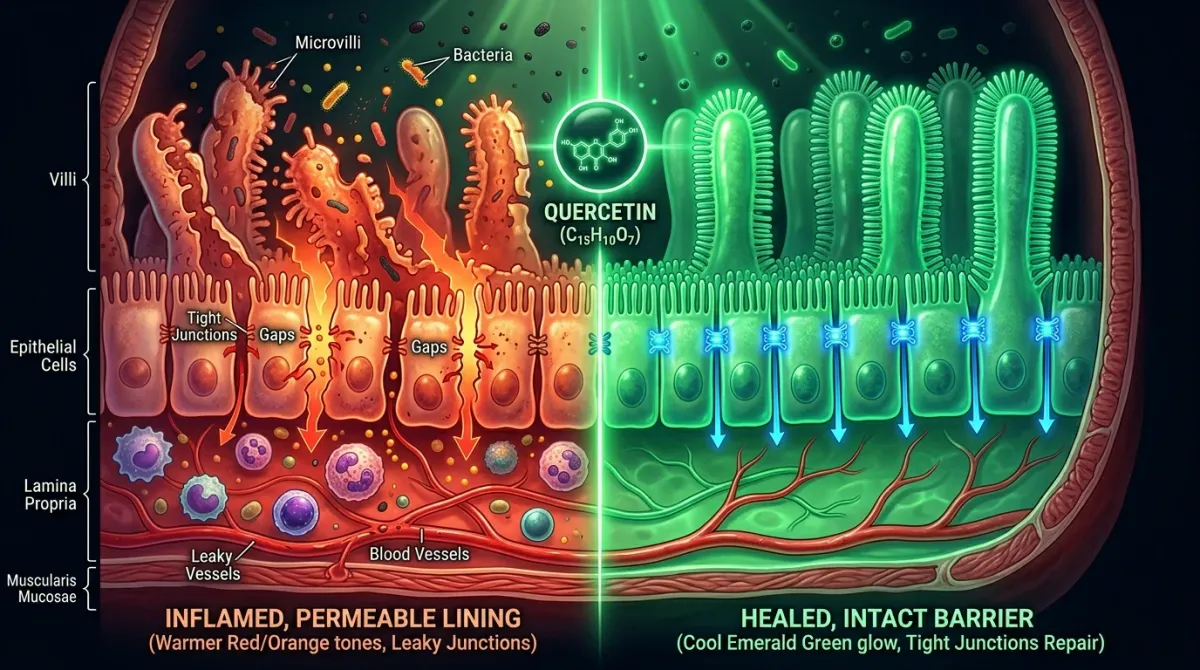
This is accomplished by a single layer of epithelial cells covering approximately 32 square meters — roughly the surface area of half a badminton court — held together by protein complexes called tight junctions.
What Tight Junctions Are (And Why They Fail)
Tight junctions are protein "stitches" that seal the spaces between intestinal epithelial cells. The key proteins include:
| Protein | Function | Consequences of Loss |
|---|---|---|
| ZO-1 (Zonula Occludens-1) | Scaffold protein, anchors other TJ proteins to actin cytoskeleton | Barrier disassembly, increased permeability |
| ZO-2 | Secondary scaffold, stabilizes ZO-1 binding | Reduced barrier integrity |
| Occludin | Transmembrane seal, regulates paracellular permeability | "Leak pathway" activation, macromolecule passage |
| Claudin-1 | Pore-forming protein, restricts paracellular flow | Increased ion and small molecule permeability |
| Claudin-4 | Tightens barrier, reduces cation permeability | Loss of barrier selectivity |
When these proteins are downregulated — by inflammation, toxins, stress, alcohol, or processed food components — the intestinal barrier becomes permeable. This is leaky gut: bacteria, bacterial fragments (LPS), undigested food proteins, and toxins cross the epithelial layer, triggering immune activation in the lamina propria beneath. The result is low-grade systemic inflammation — increasingly recognized as a contributor to autoimmune disease, metabolic syndrome, depression, and chronic fatigue.
How Quercetin Repairs the Gut Barrier: The PKCδ-Tight Junction Axis
A 2026 study published in Food Research International (ScienceDirect) provided the most detailed mechanistic map of quercetin's gut barrier repair to date.
The Mechanism: PKCδ Inhibition → Tight Junction Reassembly
Protein kinase C delta (PKCδ) is an enzyme that, when overactivated by inflammatory signals, phosphorylates tight junction proteins — tagging them for internalization and degradation. In leaky gut and IBD, PKCδ activity is chronically elevated, driving the continuous loss of barrier integrity.
Quercetin directly inhibits PKCδ, preventing this destructive phosphorylation cascade. The result: tight junction proteins remain at the cell membrane, where they can reassemble into functional barrier complexes.
The specific proteins upregulated by quercetin treatment include:
| Tight Junction Protein | Effect of Quercetin | Mechanism |
|---|---|---|
| ZO-1 | Increased expression and membrane localization | PKCδ inhibition prevents ZO-1 phosphorylation and internalization |
| ZO-2 | Enhanced assembly into TJ complexes | Scaffold stabilization |
| Occludin | Restored membrane localization | Prevents occludin degradation |
| Claudin-1 | Upregulated expression | Transcriptional and post-translational stabilization |
| Claudin-4 | Selectively increased | Tightens paracellular barrier |
Functional Evidence: The TEER Test
Researchers measure barrier integrity using TEER (Transepithelial Electrical Resistance) — a direct electrical measurement of how well tight junctions are sealing the gaps between cells. Higher TEER = stronger barrier.
In studies using intestinal epithelial cell monolayers challenged with inflammatory triggers (LPS, TNF-α, hydrogen peroxide):
- Inflammatory challenge alone → TEER dropped by 40–60% (barrier severely compromised)
- Inflammatory challenge + quercetin treatment → TEER was preserved at 80–95% of control levels
This near-complete protection of barrier function is one of the strongest in vitro demonstrations of quercetin's gut-protective capacity.
The UK Biobank IBD Study: Population-Level Evidence
The most clinically significant evidence for quercetin in gut health comes from a 2024 prospective cohort study using the UK Biobank, published in the Journal of Nutrition.
Study Design
| Parameter | Detail |
|---|---|
| Database | UK Biobank (prospective cohort) |
| Study population | 1,860 individuals with diagnosed IBD |
| Exposure | Dietary quercetin intake (quintile analysis) |
| Outcome | Adverse IBD outcomes (hospitalization, surgery, disease progression) |
| Analysis | Cox proportional hazards regression, adjusted for confounders |
Key Findings
The study found that higher dietary quercetin intake was associated with significantly lower risk of adverse IBD outcomes. The protective effect was strongest for ulcerative colitis (UC), with individuals in the highest quercetin quintile showing a meaningfully reduced hazard ratio for disease progression compared to those in the lowest quintile.
A parallel study, also published in 2024, confirmed that the protective association was specific to ulcerative colitis more than Crohn's disease — consistent with quercetin's mechanism of action on colonic epithelial barrier function rather than transmural inflammation characteristic of Crohn's.
In Vivo Validation
The 2024 Frontiers in Pharmacology study provided mechanistic validation in an animal colitis model:
- Quercetin alleviated disease activity index (DAI) scores
- Reduced colon shortening (a hallmark of colitis severity)
- Decreased histological damage scores
- Restored tight junction protein expression in colonic tissue
- Modulated gut microbiota composition
This study confirmed that the protective effects observed in the UK Biobank cohort have a direct mechanistic basis — quercetin's barrier repair translates to measurable disease modification.
Three Mechanisms for One Goal: Gut Inflammation Control
Quercetin addresses gut inflammation through three parallel, mutually reinforcing mechanisms:
Mechanism 1: Physical Barrier Repair (Structural)
Inflammatory Trigger (LPS, TNF-α, food antigens)
                ↓
          PKCδ overactivation
                ↓
   Tight junction protein phosphorylation
                ↓
   ZO-1 / occludin / claudin internalization
                ↓
         INTESTINAL BARRIER BREACH
         ┌──────────┐
         │ Leaky Gut │ → Bacteria, LPS, antigens enter lamina propria
         └──────────┘
                ↓
          Immune activation → Inflammation

    QUERCETIN BLOCKS HERE (PKCδ inhibition)
         │
         ↓
    TJ proteins preserved at membrane → Barrier maintained
Mechanism 2: NF-κB Inflammatory Suppression (Immune)
Quercetin suppresses NF-κB activation in intestinal epithelial cells and lamina propria immune cells — the same mechanism described in detail for systemic inflammation. In the gut specifically, this reduces:
- TNF-α production (a key cytokine driving IBD flares)
- IL-6 and IL-1β (which amplify intestinal inflammation)
- COX-2 expression (which drives prostaglandin-mediated gut inflammation)
By suppressing NF-κB in the gut wall, quercetin breaks the vicious cycle where barrier breach → immune activation → inflammatory cytokine release → further barrier damage.
Mechanism 3: NLRP3 Inflammasome Inhibition (Amplification Control)
The NLRP3 inflammasome plays a particularly destructive role in gut inflammation. When gut bacteria cross a compromised barrier, their components (LPS, flagellin, bacterial DNA) activate NLRP3 in lamina propria macrophages, triggering massive IL-1β release. This IL-1β further damages the epithelial barrier — creating a self-amplifying loop.
Quercetin directly inhibits NLRP3 assembly, breaking this amplification cycle. This is especially relevant for IBD, where NLRP3 hyperactivation is a documented disease driver.
Integrated Model
          QUERCETIN
              │
   ┌──────────┼──────────┐
   │          │          │
   ▼          ▼          ▼
PKCδ ↓    NF-κB ↓    NLRP3 ↓
   │          │          │
   ▼          ▼          ▼
TJ repair  Cytokine   IL-1β
ZO-1 ↑     suppression block
occludin↑  TNF-α ↓
claudin↑   IL-6 ↓
           IL-1β ↓
   │          │          │
   └──────────┼──────────┘
              ▼
      Gut Barrier Restored
      Inflammation Resolved
The Gut Microbiome Connection
Quercetin's gut benefits may extend beyond the host — to the gut microbiome itself.
SCFA Production
Short-chain fatty acids (SCFAs) — acetate, propionate, and particularly butyrate — are produced by gut bacteria fermenting dietary fiber. Butyrate is the primary energy source for colonocytes (colon epithelial cells) and has direct anti-inflammatory and barrier-strengthening effects.
Emerging evidence suggests quercetin may:
- Promote growth of SCFA-producing bacteria (e.g., Faecalibacterium prausnitzii, Roseburia)
- Increase luminal butyrate concentrations
- These SCFAs then reinforce the same tight junction proteins that quercetin directly upregulates — creating a positive feedback loop
Polyphenol-Microbiome Bidirectional Interaction
Quercetin is extensively metabolized by gut bacteria into various phenolic acids, some of which retain biological activity. This bidirectional relationship — quercetin influences microbiome composition, and the microbiome influences quercetin metabolism — is an active area of research with implications for personalized gut health protocols.
Practical Application: Quercetin for Gut Health
| Gut Health Goal | Protocol | Rationale |
|---|---|---|
| Leaky gut / intestinal permeability | 500 mg/day quercetin + 100 mg bromelain, 8–12 weeks | Direct TJ repair + anti-inflammatory + absorption enhancement |
| IBD (UC) complementary support | 500–1,000 mg/day quercetin phytosome or EMIQ, ongoing | Higher bioavailability for systemic anti-inflammatory effect |
| IBS with inflammation | 500 mg/day with meals, 8 weeks | Gut-localized NF-κB suppression |
| General gut barrier maintenance | 250–500 mg/day, ongoing | Preventive barrier support |
| Post-antibiotic gut recovery | 500 mg/day + probiotics, 4–8 weeks | Barrier repair during microbiome reconstitution |
Form Advantage for Gut Health
Because quercetin acts directly on intestinal epithelial cells — the first cells it encounters after oral ingestion — even standard quercetin dihydrate (with its ~2% systemic bioavailability) may deliver meaningful local gut effects. The intestinal epithelium sees a higher quercetin concentration than any other tissue, making gut health one of the applications where bioavailability limitations are least problematic.
That said, for systemic anti-inflammatory effects that complement local gut action — particularly in IBD where transmural inflammation is present — enhanced forms (phytosome, EMIQ) remain preferable.
Last updated: May 2026. This article is for informational purposes and does not constitute medical advice. Quercetin is not a replacement for prescribed IBD medications. Always consult a gastroenterologist before modifying your treatment protocol.
Source: This article references peer-reviewed research published in the Journal of Nutrition (UK Biobank study, 2024), Food Research International / ScienceDirect (2026), Frontiers in Pharmacology (2024), and Nature Reviews Gastroenterology & Hepatology (tight junction biology).
Related Articles
- Quercetin and Inflammation: How This Flavonoid Inhibits NF-κB — The NF-κB connection from gut to systemic inflammation
- Quercetin + Bromelain + Vitamin C: Why This Trio Is the Ultimate Immune Stack — Bromelain's complementary gut benefits
- Quercetin Safety Profile: Dosage, Drug Interactions, and Who Should Avoid It — Gut-specific safety and dosage considerations
Explore high-purity quercetin extract at ginkvora.com/products/quercetin — standardized for consistent gut health formulation with verified botanical authenticity from Sophora japonica.