Tea Polyphenols — Bulk Raw Material
Tea Polyphenols (from Camellia sinensis (L.) Kuntze leaves)
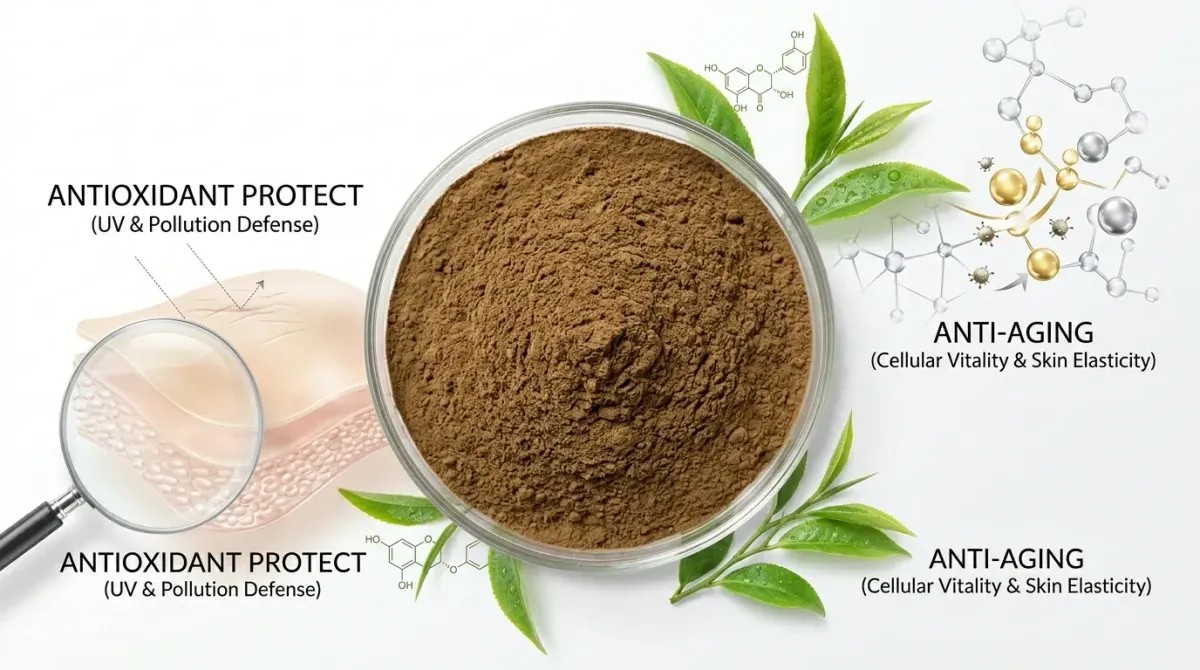
Factory-direct Tea Polyphenols bulk powder (>=98%) — a clinically studied green tea extract rich in EGCG catechins (>=45%). Antioxidant potency 25-50x stronger than Vitamin C. Anti-aging, anti-inflammatory, antimicrobial, skin-brightening. Water-soluble. Stable supply, COA per batch.
Are Tea Polyphenols Good for Skin and Health? Benefits, Science & Uses Explained
Yes, Tea Polyphenols (CAS 84650-60-2) are among the most clinically studied plant bioactives globally — with robust evidence for antioxidant, anti-aging, anti-inflammatory, antimicrobial, and metabolic health benefits across both topical cosmetic and oral nutraceutical applications. GINKVORA supplies food- and cosmetic-grade Tea Polyphenols as a high-purity bulk powder (>=98%, HPLC) for formulators, private-label brands, and CDMOs.
What Are Tea Polyphenols?
Tea Polyphenols are a complex mixture of polyphenolic compounds extracted from Camellia sinensis (green tea) leaves, representing approximately 30–40% of the leaf's dry weight. The major bioactive classes include:
- Catechins (60–80% of total polyphenols): EGCG (Epigallocatechin Gallate), EGC, ECG, EC — EGCG is the most potent and extensively studied, accounting for 50–80% of total catechins
- Theaflavins & Thearubigins: Formed during black tea fermentation; contribute additional antioxidant and antimicrobial activity
- Flavonols: Quercetin, Kaempferol, Myricetin — synergistic antioxidant support
- Phenolic Acids: Gallic acid, Chlorogenic acid — auxiliary bioactives
At >=98% purity, this product delivers a standardized, highly concentrated Tea Polyphenol extract with maximum EGCG content for cosmetic and nutraceutical applications.
Key Benefits & Mechanisms
- Potent Antioxidant: EGCG scavenges free radicals with potency 25–50x greater than Vitamin C and 100x greater than Vitamin E in standard assays (ORAC, DPPH). Upregulates endogenous antioxidant enzymes including SOD and catalase.
- Skin Anti-Aging: Inhibits MMP-1, MMP-3, and MMP-9 — collagen-degrading enzymes responsible for wrinkle formation and loss of skin elasticity. A 2024 scoping review (MDPI Antioxidants, 13:12, 1506) confirmed that green tea catechins reduce UV-induced oxidative damage and photoaging through both direct radical scavenging and TGF-beta pathway-mediated collagen synthesis support.
- Anti-Inflammatory: Suppresses NF-kappaB nuclear translocation and downregulates COX-2, TNF-alpha, IL-1beta, and IL-6 — providing broad-spectrum inflammation control relevant to sensitive skin, acne, rosacea, and post-procedure recovery.
- Antimicrobial: Broad-spectrum activity against Staphylococcus aureus, Cutibacterium acnes (acne-causing bacteria), Escherichia coli, and various fungi — making Tea Polyphenols particularly valuable for acne-prone and oily skin formulations.
- Skin Brightening: Inhibits tyrosinase activity and melanin synthesis, supporting even skin tone and reducing hyperpigmentation.
- UV Protection: Functions as a natural UV absorber and photoprotective agent (CIR safety database classification), extending sunscreen SPF when used as a booster.
Tea Polyphenols vs Resveratrol vs Quercetin: Which Polyphenol Is Best?
| Dimension | Tea Polyphenols (EGCG) | Resveratrol | Quercetin |
|---|---|---|---|
| Antioxidant Potency | 25–50x Vitamin C | ~5–10x Vitamin C | ~3–5x Vitamin C |
| Anti-Aging Pathway | MMP inhibition + collagen support | Sirtuin/NAD+ activation | Senolytic + mTOR modulation |
| Anti-Inflammatory | NF-kappaB, COX-2, broad cytokines | NF-kappaB, COX-2 | Mast cell stabilization, NF-kappaB |
| Antimicrobial | Broad-spectrum (S. aureus, P. acnes) | Moderate | Moderate |
| Skin Brightening | Tyrosinase inhibition | Mild inhibition | Tyrosinase + melanosome transfer |
| UV Protection | Natural UV absorber + SPF booster | Limited UV protection | UV-induced damage repair |
| Oral Bioavailability | Low (requires formulation) | Low (requires formulation) | Low–moderate |
| Best For | Anti-aging, acne, brightening, UV protection, metabolic health | Longevity, cardiovascular, sirtuin activation | Anti-allergy, senolytic, immune modulation |
Verdict: Tea Polyphenols (EGCG) offer the broadest spectrum of clinically validated benefits, with particular strength in antioxidant potency, antimicrobial activity, and UV photoprotection. For a synergistic polyphenol system, combining Tea Polyphenols with Quercetin and Vitamin C delivers comprehensive antioxidant, anti-inflammatory, and brightening effects suitable for advanced cosmetic formulations.
How to Use Tea Polyphenols — Recommended Usage
Topical (Cosmetic Formulations):
- Recommended concentration: 0.1%–2.0% in water-based serums, toners, emulsions, or gel formulations
- Add to the water phase during formulation. Stable at pH 3.5–6.0; avoid high-pH environments (>7.0) which accelerate catechin oxidation
- Combine with Vitamin C (L-Ascorbic Acid) and Niacinamide for a comprehensive brightening and anti-aging system
- Pair with chelating agents (EDTA) and antioxidants (Vitamin E) to enhance formula stability
Storage:
- Store at <=25degC in airtight, light-protected containers. Keep away from heat, humidity, and oxidizing agents
- Reseal immediately after each dispensing. Minimize headspace in opened containers
Medical Disclaimer: The information provided here is for educational and informational purposes only and is not intended as medical advice. Always consult with a qualified healthcare provider or licensed physician before starting any new supplement regimen, especially if you are pregnant, nursing, have liver conditions (high-dose EGCG has been associated with rare cases of hepatotoxicity), anemia, or are taking blood thinners, stimulant medications, or iron supplements. High-dose green tea extract should not be taken on an empty stomach. Individual results may vary.
Source pharmaceutical-grade Tea Polyphenols from GINKVORA — your partner in high-purity botanical cosmetic actives.
Frequently Asked Questions
Request a Quote for Tea Polyphenols — Bulk Raw Material
Complete the form below to receive pricing, specifications, and a free sample. Our sales team will contact you within 12 hours.