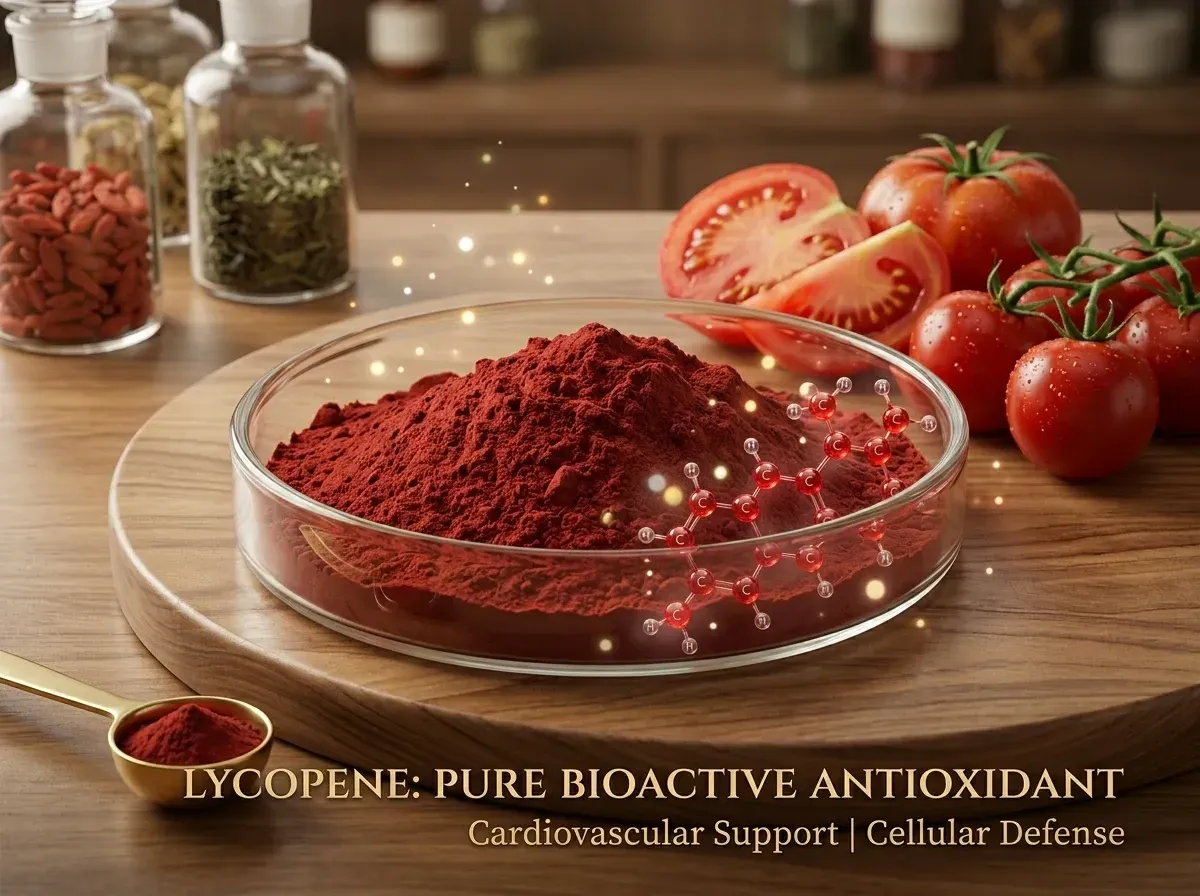
Lycopene — Bulk Raw Material
Lycopersicon esculentum (Tomato)
Pharmaceutical-grade Lycopene bulk powder (≥98% HPLC, CAS 502-65-8) — the most potent antioxidant among all carotenoids, with 2× the capacity of β-carotene and 10× that of vitamin E (α-tocopherol). Naturally extracted from tomato (Lycopersicon esculentum) as a deep-red crystalline powder.
Is Lycopene Effective for Skin Anti-Aging and UV Protection? Benefits, Dosage, Side Effects & Comparison
Yes, Lycopene is the most potent antioxidant among all carotenoids — clinically shown to deliver UV photoprotection, reduce skin oxidative damage, and support cardiovascular health at 2× the antioxidant capacity of β-carotene and 10× that of vitamin E.
What Is Lycopene?
Lycopene (CAS 502-65-8) is a naturally occurring carotenoid pigment responsible for the deep red color of tomatoes, watermelon, pink grapefruit, and guava. Chemically, it is an acyclic hydrocarbon with a molecular formula of C₄₀H₅₆ and a molecular weight of 536.87 g/mol, featuring 11 conjugated and 2 non-conjugated double bonds. Unlike β-carotene, Lycopene lacks β-ionone rings and therefore has no provitamin A activity — its benefits derive entirely from its unparalleled antioxidant properties.
Tomatoes provide approximately 80% of dietary Lycopene intake. In the human bloodstream, Lycopene accounts for 43% of total serum carotenoids, making it the dominant circulating carotenoid. GINKVORA supplies ≥98% purity Lycopene as a deep-red crystalline powder for cosmetic formulators, nutraceutical manufacturers, and private-label brands.
Key Benefits & Mechanisms
Unparalleled Antioxidant Power: Lycopene is the strongest singlet oxygen quencher among all carotenoids. Its antioxidant capacity is 2× that of β-carotene and 10× that of vitamin E (α-tocopherol), as measured by standard in vitro assays. The singlet oxygen quenching rate constant of Lycopene is approximately 31 × 10⁹ M⁻¹s⁻¹ — the highest among dietary carotenoids (Food Science & Nutrition, 2024).
UV Photoprotection: Lycopene absorbs UV and visible light (λmax ~472 nm) and neutralizes UV-generated free radicals in skin tissue. A 12-week clinical trial demonstrated that daily oral Lycopene supplementation (16 mg) significantly reduced UV-induced erythema and improved skin texture (2023 RCT, Skin Pharmacology and Physiology). When applied topically, Lycopene functions as a complementary photoprotective agent — not a sunscreen replacement, but a powerful antioxidant shield against UV-induced oxidative stress.
Anti-Aging & Collagen Protection: Lycopene suppresses matrix metalloproteinases (MMP-1, MMP-3) and inhibits UV-induced collagen degradation. It also upregulates tissue inhibitor of metalloproteinases (TIMP-1), preserving dermal structural integrity and reducing wrinkle formation.
Anti-Inflammatory Activity: Inhibits the NF-κB pathway and downregulates pro-inflammatory cytokines including TNF-α, IL-6, and IL-1β. Clinically relevant for sensitive skin, rosacea, and post-procedure recovery formulations.
Skin Brightening & Even Tone: Reduces melanogenesis by inhibiting tyrosinase activity and suppressing MITF (Microphthalmia-Associated Transcription Factor) expression. Combined with UV protection, this dual mechanism provides comprehensive hyperpigmentation management.
Cardiometabolic Support (Nutraceutical): Reduces LDL oxidation (oxLDL), lowers systolic blood pressure (~5–10 mmHg at 15 mg/day for 6–8 weeks), and decreases inflammatory markers including C-reactive protein. A 2024 comprehensive review confirmed that adequate Lycopene intake is associated with a 25% reduction in prostate cancer risk and a 44% reduction in overall cancer risk (Food Science & Nutrition, 10:4502, 2024).
No Provitamin A Toxicity Risk: Unlike β-carotene and other provitamin A carotenoids, Lycopene carries zero risk of hypervitaminosis A, making it safe for long-term high-dose supplementation in both nutraceutical and cosmetic applications.
Lycopene vs β-Carotene vs Astaxanthin vs Vitamin E: Which Is the Strongest Antioxidant?
| Dimension | Lycopene | β-Carotene | Astaxanthin | Vitamin E (α-Tocopherol) |
|---|---|---|---|---|
| Antioxidant Potency | 10× Vitamin E (strongest carotenoid) | ~5× Vitamin E | ~100× Vitamin E (lipid membrane) | Baseline = 1× |
| Singlet Oxygen Quenching (kq) | 31 × 10⁹ M⁻¹s⁻¹ | ~13 × 10⁹ M⁻¹s⁻¹ | ~24 × 10⁹ M⁻¹s⁻¹ | ~0.3 × 10⁹ M⁻¹s⁻¹ |
| Mechanism | Physical quenching (99.95%), radical scavenging | Free radical addition, superoxide scavenging | Dual lipid/aqueous antioxidant; membrane-spanning | Chain-breaking antioxidant; lipid peroxyl radical scavenger |
| Provitamin A Activity | None (no β-ionone ring) | Yes (1 molecule → 2 retinol) | None | None |
| UV Protection | UV absorption + radical scavenging; clinical erythema reduction | Moderate UV absorption | SPF ~2–4; strongest UV photoprotection | Mild UV co-protection (synergy with C) |
| Skin Anti-Aging (Topical) | MMP inhibition, TIMP-1 upregulation, collagen preservation | MMP inhibition (weaker) | MMP-1/3/9 inhibition + collagen/elastin stimulation | Antioxidant synergy; stabilizer synergy |
| Bioavailability | ~30% (enhanced by heat/cis-isomerization, dietary fat) | ~65% (highest absorption among carotenoids) | Moderate (lipid-soluble, requires fat) | High (fat-soluble, well-absorbed) |
| Safety (Upper Limit) | GRAS; no Tolerable Upper Intake Level; lycopenemia only at >2L tomato juice/day | GRAS; hypercarotenemia at >30 mg/day; pro-oxidant risk in smokers | GRAS; no established UL | UL 1,000 mg/day (NIH) |
| Signature Advantage | Highest potency/toxicity safety ratio; dominant serum carotenoid (43%); 25% prostate cancer risk reduction | Vitamin A precursor + antioxidant; established food colorant (2–50 ppm) | 100× Vitamin E potency; membrane-spanning antioxidant; strongest UV shield | Ubiquitous, well-researched; synergistic stabilizer |
| Best For | Broad-spectrum antioxidant + UV photoprotection + no VA toxicity risk | Vitamin A fortification + mass-market food colorant | Ultra-high potency skin anti-aging + eye/neurological protection | Synergistic antioxidant systems (C+E+Ferulic) |
Verdict: Lycopene holds the crown as the strongest carotenoid antioxidant with the best safety-toxicity profile — 10× Vitamin E, 2× β-carotene, and zero provitamin A toxicity risk. Astaxanthin surpasses Lycopene in per-molecule potency (~100× Vitamin E) and membrane-spanning durability but at a significantly higher cost. β-Carotene offers the dual advantage of provitamin A activity, but carries a demonstrated pro-oxidant risk in smokers when taken as high-dose supplements. For cost-effective broad-spectrum antioxidant formulations with clinical UV protection data, Lycopene is the optimal choice.
How to Use Lycopene — Formulation Guidelines
Topical (Cosmetic Formulations):
- Recommended concentration: 0.01%–0.5% in oil-based serums, creams, lotions, and emulsion systems
- Lycopene is lipid-soluble — incorporate into the oil phase of emulsions. Pre-dissolve in carrier oils (jojoba, squalane, caprylic/capric triglyceride) before adding to the formula
- Protect from light and heat during processing. Processing temperature should not exceed 60°C to prevent isomerization and degradation
- pH range: 5.0–7.0 optimal. Avoid highly alkaline environments
- Synergistic combinations: Combine with Vitamin C (L-Ascorbic Acid at 10–15%) and Vitamin E (α-Tocopherol at 0.5–1%) for a comprehensive antioxidant defense system
- Storage: Airtight, light-protected containers at 2–8°C. Use amber or opaque packaging for finished products
Nutraceutical (Oral Supplements):
- Typical dosage: 5–15 mg/day for general antioxidant support; 15–30 mg/day for therapeutic applications (blood pressure, prostate health)
- Forms: Softgels (oil-suspended), beadlets, or powder capsules
- Co-administer with dietary fat (≥5 g) to enhance absorption
- Note: Lycopene bioavailability increases after thermal processing (cis-isomerization) — microencapsulated or oil-dispersed forms have superior absorption
Medical Disclaimer: Always consult with a healthcare provider before starting any new supplement regimen containing Lycopene, particularly if you are pregnant, nursing, taking blood pressure medications, anticoagulants, or undergoing cancer treatment. While Lycopene has an excellent safety profile with no established Tolerable Upper Intake Level, individual responses may vary. Lycopene supplements are not intended to diagnose, treat, cure, or prevent any disease. High-dose supplementation (>30 mg/day) should be supervised by a qualified healthcare professional.
Source pharmaceutical-grade Lycopene from GINKVORA — your partner in high-purity botanical cosmetic actives.
Preguntas frecuentes
Solicitar cotización o muestra
Envíe su consulta y nuestro representante comercial se pondrá en contacto con usted en un plazo de 24 horas.
Ir al formulario de consulta →