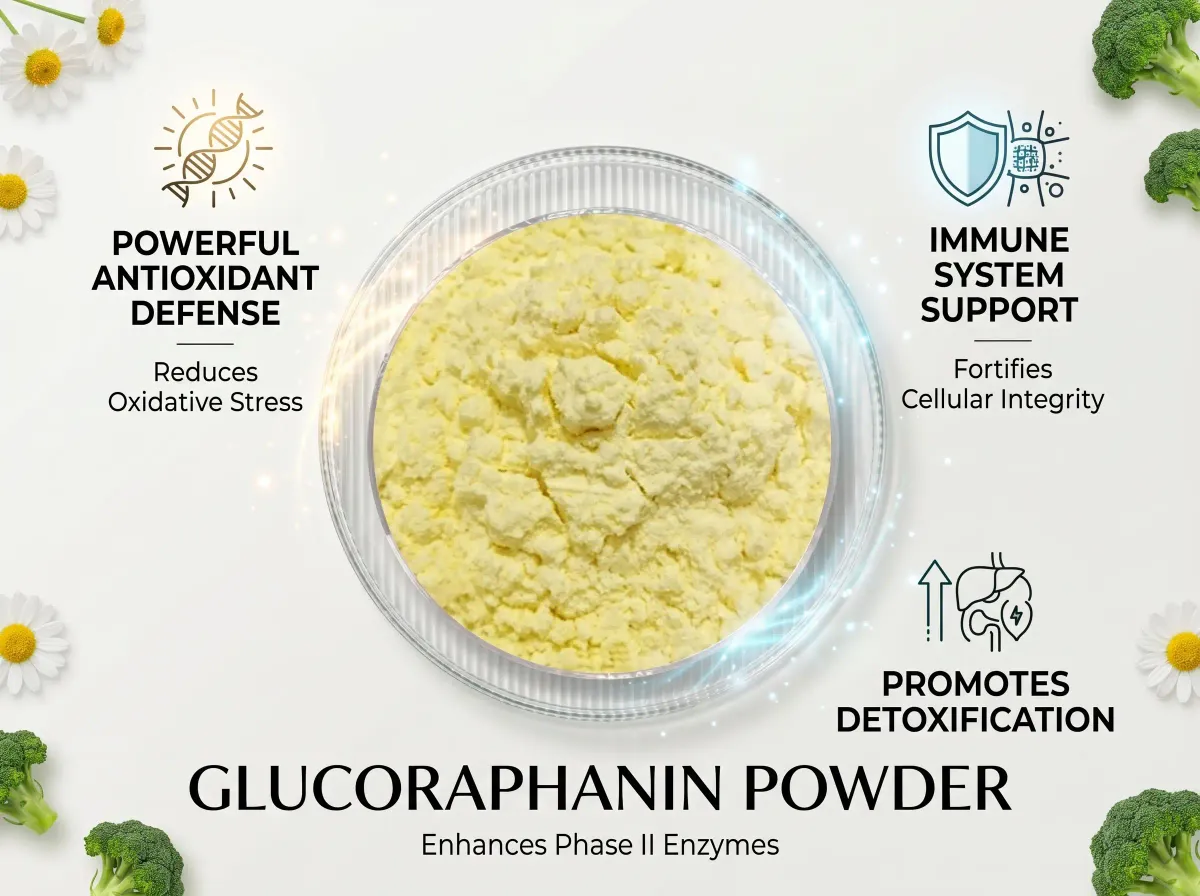
Glucoraphanin: Broccoli Glucosinolate & Sulforaphane Precursor
Brassica oleracea var. italica
Glucoraphanin: the broccoli glucosinolate converted by myrosinase into sulforaphane, the Nrf2 activator for cellular defense & detox. Standardized extract ≥10% (HPLC).
What Is Glucoraphanin?
Glucoraphanin (CAS 21414-41-5) is a glucosinolate — a sulfur-containing secondary metabolite — found primarily in cruciferous vegetables of the Brassicaceae family. It is the most abundant glucosinolate in broccoli (Brassica oleracea var. italica), particularly concentrated in seeds and young sprouts.
Chemical Identity
Glucoraphanin has the molecular formula C₁₂H₂₃NO₁₀S₃ and a molecular weight of 437.51 g/mol. Its structure consists of a β-D-thioglucose group linked to a sulfonated aldoxime moiety with a 4-(methylsulfinyl)butyl side chain — the structural signature that distinguishes it from other glucosinolates.
Glucoraphanin belongs to the aliphatic glucosinolate subclass, derived from the amino acid methionine. Unlike some other glucosinolates (e.g., sinigrin, gluconasturtiin), glucoraphanin's methylsulfinyl side chain is the key determinant of its biological activity after enzymatic conversion.
Stable Storage Form vs. Active Product
A critical concept for understanding glucoraphanin is the distinction between the precursor and the active product:
- Glucoraphanin is the chemically stable glucosinolate stored in intact plant cells. It is biologically inactive in this form — nature's way of safely sequestering a reactive precursor until needed.
- Sulforaphane is the bioactive isothiocyanate produced when glucoraphanin is hydrolyzed by the enzyme myrosinase. Sulforaphane is highly reactive and unstable — it degrades rapidly in solution and must be generated in situ for maximum biological effect.
This "stable precursor" design is the evolutionary strategy behind cruciferous plants' chemical defense system, and it is also the core logic behind glucoraphanin supplementation: deliver a stable molecule that the body can convert to the active compound on demand.
Glucosinolate Family Context
Glucoraphanin is one of over 130 known glucosinolates. Within the Brassicaceae family, the major dietary glucosinolates include:
| Glucosinolate | Hydrolysis Product | Primary Source | Biological Target |
|---|---|---|---|
| Glucoraphanin | Sulforaphane | Broccoli sprouts, seeds | Nrf2, Phase II enzymes |
| Glucobrassicin | Indole-3-carbinol | Broccoli, cabbage | Aryl hydrocarbon receptor |
| Sinigrin | Allyl isothiocyanate | Mustard, horseradish | TRP channels, antimicrobial |
| Gluconasturtiin | Phenethyl isothiocyanate | Watercress | CYP450 modulation |
Among these, glucoraphanin has attracted the most intensive research interest due to sulforaphane's uniquely potent Nrf2 activation and broad-spectrum cellular protective effects.
The Glucoraphanin → Sulforaphane Conversion: A Complete Guide
This is the most frequently asked question about glucoraphanin — and the most important concept to understand before purchasing any glucoraphanin supplement. The conversion of glucoraphanin to sulforaphane depends on a single enzyme: myrosinase.
Step 1: Myrosinase — The Conversion Enzyme
Myrosinase (β-thioglucosidase, EC 3.2.1.147) is the enzyme that catalyzes the hydrolysis of glucoraphanin. In nature, myrosinase and glucoraphanin are stored in separate cellular compartments — glucoraphanin in vacuoles, myrosinase in specialized myrosin cells. When plant tissue is damaged (chewing, cutting, blending), these compartments rupture, bringing enzyme and substrate together to generate sulforaphane.
Step 2: The Hydrolysis Reaction
Glucoraphanin + H₂O —[Myrosinase]→ Unstable Intermediate → Sulforaphane + Glucose + Sulfate
Myrosinase cleaves the β-thioglucose bond from glucoraphanin, producing an unstable aglycone intermediate. This intermediate spontaneously undergoes a Lossen rearrangement to form sulforaphane — the biologically active isothiocyanate.
Step 3: The Heat Problem
Myrosinase is a protein enzyme — and it is heat-sensitive. Cooking broccoli above approximately 60°C (140°F) denatures myrosinase, permanently destroying its catalytic activity. This is why cooked broccoli produces far less sulforaphane than raw or lightly steamed broccoli:
- Raw broccoli: Full myrosinase activity, maximum conversion potential
- Light steaming (1–3 min): Partial myrosinase retention, moderate conversion
- Boiling / microwaving: Near-complete myrosinase inactivation
- Frozen broccoli: Blanched before freezing — myrosinase destroyed, minimal conversion
Even when myrosinase is not available from the plant source, human gut bacteria possess limited β-thioglucosidase activity that can partially convert glucoraphanin to sulforaphane colonically. However, this microbial conversion is highly variable between individuals and significantly less efficient than plant myrosinase-mediated conversion.
Step 4: Supplement Design Implication
For a glucoraphanin supplement to deliver meaningful sulforaphane levels, it must include active myrosinase. The standard formulation approach is:
Glucoraphanin (stable precursor) + Active Myrosinase (enzyme) = Sulforaphane (bioactive product) → Nrf2 Activation (cellular defense)
Brands that formulate glucoraphanin without myrosinase rely entirely on gut microbial conversion, which produces lower and less predictable sulforaphane levels. This is why "glucoraphanin + myrosinase" combination supplements are the recognized standard for efficacy.
The Dose-Response Conversion
Conversion efficiency in humans varies, but studies with standardized glucoraphanin + myrosinase supplements report sulforaphane bioavailability ranging from 10% to 40% of the glucoraphanin dose, depending on formulation, myrosinase activity, and individual gut microbiome composition. A typical 30 mg glucoraphanin dose can yield approximately 3–12 mg of circulating sulforaphane metabolites.
Natural Sources: Where Glucoraphanin Comes From
Broccoli Sprouts: The Richest Natural Source
In a landmark 1997 PNAS paper, researchers at Johns Hopkins University led by Dr. Paul Talalay reported that 3-day-old broccoli sprouts contain 10–100 times more glucoraphanin than mature broccoli heads. This discovery established broccoli sprouts as the premier dietary source of glucoraphanin and launched decades of research into sulforaphane's health-protective effects.
The glucoraphanin content is highest during the early germination phase (days 2–4), when the seedling's chemical defense system is maximally activated to protect the developing plant:
| Source | Approximate Glucoraphanin Content | Relative Potency |
|---|---|---|
| Broccoli sprouts (3-day) | 1,000–2,500 μmol/g dry weight | 100× baseline |
| Broccoli seeds | 800–2,000 μmol/g dry weight | 50–80× |
| Calabrese broccoli florets (raw) | 10–50 μmol/g dry weight | 1× baseline |
| Mature broccoli stems | 5–15 μmol/g dry weight | 0.3–0.5× |
| Broccoli leaves | 5–20 μmol/g dry weight | 0.2–0.5× |
Beyond Broccoli: Other Cruciferous Sources
While broccoli is the richest known source, glucoraphanin is also found in meaningful amounts in:
- Cauliflower sprouts: Significant but lower than broccoli sprouts
- Brussels sprouts: Contains glucoraphanin and other glucosinolates
- Kale (Brassica oleracea var. sabellica): Moderate levels in young leaves
- Radish sprouts (Raphanus sativus): Contains glucoraphanin alongside distinct glucosinolates like glucoraphasatin
- Maca (Lepidium meyenii): Contains glucosinolates, though primarily glucotropaeolin and other aromatic types; glucoraphanin is present at trace levels only
The Calabrese Connection
The "Calabrese" broccoli variety is the sprouting broccoli cultivar most commonly used in glucoraphanin research and commercial extraction. Multiple search queries in the dataset specifically ask about "calabrese broccoli glucoraphanin levels," reflecting both consumer and researcher awareness of variety-specific differences. Calabrese-type broccoli consistently produces higher glucoraphanin yields compared to standard heading broccoli varieties.
Food vs. Supplement: The Dose Gap
To put food sources in perspective: achieving a 30 mg glucoraphanin dose from cooked broccoli would require consuming roughly 500–1,000 grams of cooked broccoli — an impractical daily intake for most people. Even raw broccoli, at ∼0.5–1 mg glucoraphanin per gram, would require 30–60 grams of raw florets daily. By contrast, a standardized broccoli seed or sprout extract can deliver 30–60 mg in a single capsule.
Specifications, Stability & Formulation Parameters
Glucoraphanin vs. Direct Sulforaphane: The Stability Advantage
The single most important reason to choose glucoraphanin over direct sulforaphane as a raw material is chemical stability:
| Parameter | Glucoraphanin | Sulforaphane (Direct) |
|---|---|---|
| Room-temperature stability | Stable for months to years | Degrades within hours to days |
| Heat stability | Tolerates moderate heat (enzyme is heat-sensitive, not glucoraphanin itself) | Rapidly degrades above 40°C |
| pH stability | Stable across pH 2–8 | Degrades in alkaline conditions |
| Oxidation sensitivity | Low | High — requires inert atmosphere packaging |
| Formulation flexibility | Compatible with tablets, capsules, powders | Limited to specialized encapsulation |
| Shelf life (supplement) | 18–24 months typical | 6–12 months, often shorter |
This stability is the commercial rationale behind the entire glucoraphanin supplement category: you cannot manufacture a shelf-stable sulforaphane supplement; you manufacture a glucoraphanin + myrosinase supplement that generates sulforaphane upon ingestion.
Standardized Extracts & Brand References
Several standardized glucoraphanin extracts serve as industry benchmarks:
- TrueBroc® (Brassica Protection Products LLC): A glucoraphanin-rich broccoli seed extract developed from the Johns Hopkins research lineage. TrueBroc® is the most recognized branded glucoraphanin ingredient, used in Avmacol® and other clinically studied formulations.
- SGS™ (Sulforaphane Glucosinolate): An earlier standardized broccoli sprout extract, also derived from the Talalay/Fahey research program at Johns Hopkins.
- Generic broccoli seed extracts standardized to ≥10% glucoraphanin by HPLC.
Solubility & Formulation Considerations
Glucoraphanin is water-soluble (as expected for a glucosinolate with a glucose moiety), which simplifies aqueous extraction and facilitates incorporation into liquid formulations, beverages, and capsule-fill solutions. This contrasts with many other phytochemicals (e.g., kaempferol, quercetin aglycones) that require organic solvents or specialized delivery systems.
Recommended Dosage Range
Based on published clinical literature:
- Maintenance dose: 10–20 mg glucoraphanin/day (with active myrosinase)
- Therapeutic dose: 30–60 mg glucoraphanin/day (with active myrosinase)
- Maximum studied dose: Up to 200 μmol glucoraphanin (∼87 mg) in clinical trials, with good tolerability
The corresponding sulforaphane yield depends on myrosinase activity and individual conversion efficiency. A well-formulated glucoraphanin + myrosinase supplement typically delivers 10–40% conversion.
Pairing with Myrosinase: The Standard Protocol
For B2B buyers formulating finished supplements:
- Myrosinase source: Typically extracted from mustard seed (Sinapis alba) or daikon radish sprouts
- Ratio: Glucoraphanin to myrosinase activity units—specific ratios depend on the enzyme preparation used
- Formulation tip: Myrosinase must be physically separated from glucoraphanin until ingestion (enteric coating or two-part capsule), otherwise premature hydrolysis occurs during storage
Safety & Precautions
Clinical Safety Data
Glucoraphanin has an established safety profile supported by multiple human clinical trials. Doses up to 200 μmol/day (∼87 mg glucoraphanin) have been administered for weeks to months with no serious adverse events reported. The FDA has granted GRAS (Generally Recognized as Safe) status to broccoli seed extract preparations.
Common Side Effects
The most commonly reported side effects are gastrointestinal:
- Mild gas and bloating: The sulfur-containing metabolites produced during glucoraphanin hydrolysis can cause intestinal gas, particularly in individuals unaccustomed to cruciferous vegetable consumption. Taking glucoraphanin supplements with food significantly reduces this effect.
- Digestive adjustment period: Some users report mild digestive changes during the first 1–2 weeks of supplementation as the gut microbiome adapts.
Metabolic Pathway
After conversion to sulforaphane, the primary elimination route is the mercapturic acid pathway: sulforaphane conjugates with glutathione (GSH) and is sequentially metabolized to sulforaphane-cysteine and sulforaphane-N-acetylcysteine (SFN-NAC), which is excreted in urine. This pathway is efficient and saturable — at very high doses, a greater proportion of unconjugated sulforaphane circulates systemically.
Drug Interactions
- CYP450 enzymes: Sulforaphane can modulate CYP1A2, CYP3A4, and other cytochrome P450 isoforms. Individuals taking medications metabolized by these pathways (e.g., certain anticoagulants, anticonvulsants) should consult a healthcare provider.
- Thyroid function: Unlike some other glucosinolates (e.g., progoitrin), glucoraphanin has minimal goitrogenic potential at typical supplemental doses. The goitrin-forming glucosinolates are structurally distinct from glucoraphanin.
Pregnancy & Lactation
Safety during pregnancy and lactation has not been specifically established in controlled trials. While dietary cruciferous vegetable consumption is generally considered safe during pregnancy, concentrated glucoraphanin supplementation has not been systematically evaluated in pregnant or nursing populations. Consultation with an obstetric care provider is recommended.
Acne-Related Reports
A small number of anecdotal reports and online discussions mention acne as a potential side effect. The mechanism, if real, may relate to sulforaphane's modulation of inflammatory pathways during the initial phase of supplementation. This effect, if it occurs, is typically transient and self-limiting as the body adapts.
Preguntas frecuentes
Solicitar cotización o muestra
Envíe su consulta y nuestro representante comercial se pondrá en contacto con usted en un plazo de 24 horas.
Ir al formulario de consulta →