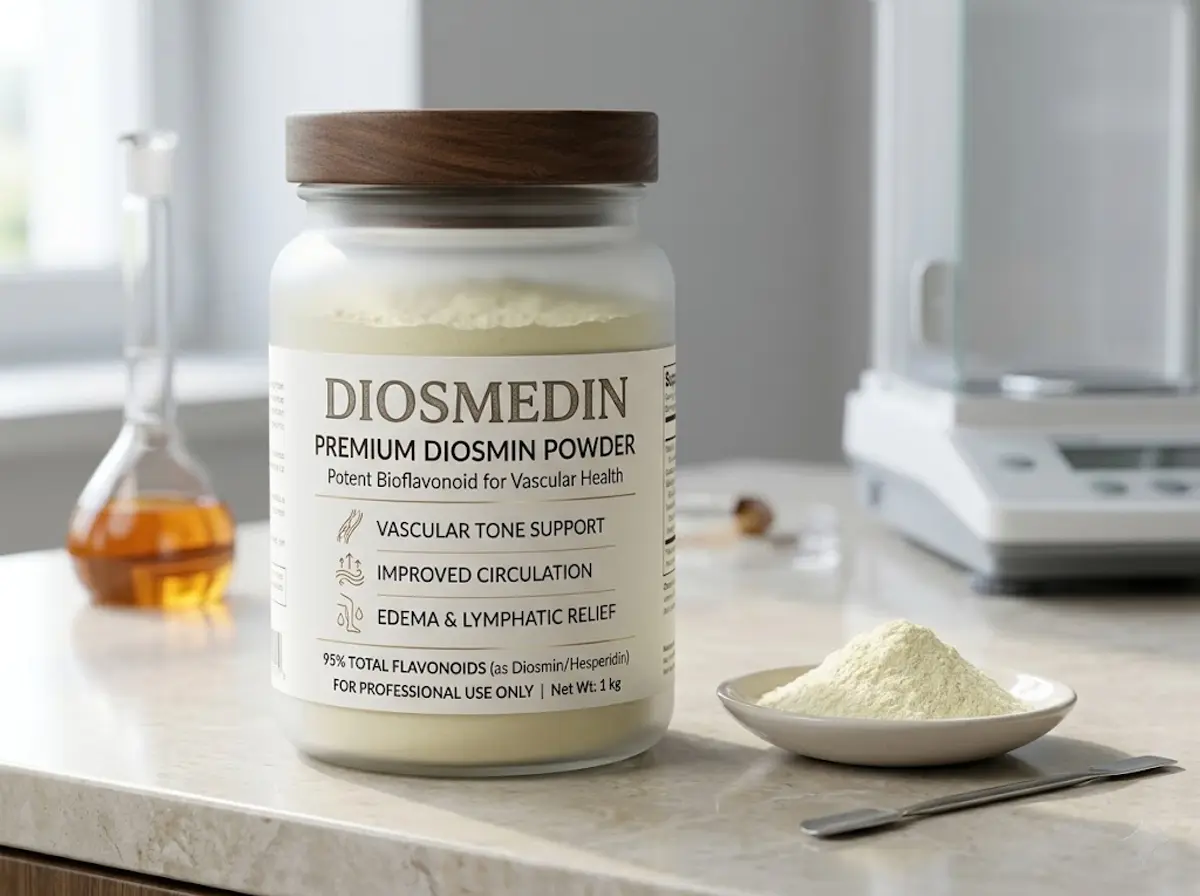
Diosmetin — Bulk Raw Material
3',4',5,7-Tetrahydroxyflavone; 5,7-Dihydroxy-4'-methoxyflavone
Diosmetin (CAS 520-34-3) is a naturally occurring flavone aglycone found in citrus fruits and herbs. It offers potent antioxidant, anti-inflammatory, and anti-aging properties, making it a versatile active ingredient for both nutraceutical and cosmetic formulations.
Is Diosmetin Good for Skin and Health? Benefits, Uses & Safety Explained
Yes — Diosmetin is a potent, naturally occurring flavone with well-documented antioxidant, anti-inflammatory, and collagen-protective properties, making it valuable for both cosmetic formulations and nutraceutical applications.
As research into plant-derived bioactives continues to expand, Diosmetin has emerged as a compelling ingredient for formulators seeking science-backed, multi-functional compounds. Its dual applicability — topical and oral — combined with a favorable safety profile positions it as a versatile addition to modern anti-aging and wellness product lines.
What Is Diosmetin?
Diosmetin (CAS 520-34-3) is a naturally occurring flavone aglycone found predominantly in citrus fruits (particularly lemon peel and bitter orange) and aromatic herbs such as oregano (Origanum vulgare) and rosemary (Rosmarinus officinalis). It also occurs in smaller quantities in peppermint, spearmint, and various other Lamiaceae family plants.
Chemically, Diosmetin is classified as a 4′-methoxyflavone with the systematic name 5,7,3′-trihydroxy-4′-methoxyflavone. Its molecular formula is C₁₆H₁₂O₆ (MW: 300.26 g/mol).
Critically, Diosmetin is the aglycone metabolite of Diosmin — meaning it is the biologically active form produced when the body cleaves the sugar moiety (rutinose) from Diosmin during intestinal metabolism. This metabolic relationship is central to understanding its superior bioavailability compared to its glycoside precursor.
Key identifiers:
- CAS Number: 520-34-3
- IUPAC Name: 5,7,3′-trihydroxy-4′-methoxyflavone
- Molecular Formula: C₁₆H₁₂O₆
- Molecular Weight: 300.26 g/mol
- Appearance: Light yellow to yellow crystalline powder
Key Benefits of Diosmetin
1. Antioxidant Activity
Diosmetin exhibits strong free radical scavenging capacity, attributed to its hydroxyl groups at positions 5, 7, and 3′ of the flavone backbone. It effectively neutralizes reactive oxygen species (ROS), including superoxide anion radicals and hydroxyl radicals, and has demonstrated the ability to upregulate endogenous antioxidant enzymes such as superoxide dismutase (SOD) and catalase. This makes it particularly relevant in formulations targeting oxidative stress-driven skin aging and systemic inflammation.
2. Anti-Inflammatory Effects
Multiple in vitro and in vivo studies have demonstrated Diosmetin's capacity to inhibit pro-inflammatory cytokines, including TNF-α, IL-1β, and IL-6, as well as to suppress NF-κB signaling pathways — a master regulator of inflammatory gene expression. These properties support its use in formulations targeting chronic low-grade inflammation, a key driver of both skin aging and metabolic disease.
3. Collagen Stimulation
Diosmetin has been shown to promote collagen type I synthesis in dermal fibroblasts by activating TGF-β/Smad signaling pathways. This collagen-stimulating activity supports its use in anti-aging cosmetic formulations aimed at improving skin firmness, elasticity, and reducing the appearance of fine lines and wrinkles.
4. MMP Inhibition
Matrix metalloproteinases (MMPs), particularly MMP-1 (collagenase) and MMP-3 (stromelysin), are enzymes responsible for collagen degradation in aged and UV-damaged skin. Diosmetin has demonstrated significant MMP inhibitory activity, helping to preserve the extracellular matrix (ECM) integrity and slow the structural breakdown associated with photoaging.
5. Anti-Glycation
Advanced glycation end-products (AGEs) are a major contributor to skin stiffening, yellowing, and loss of elasticity. Diosmetin has shown anti-glycation activity by inhibiting the Maillard reaction and trapping reactive carbonyl species, making it a relevant ingredient in formulations targeting glycation-induced skin aging.
6. Neuroprotective Potential
Emerging preclinical research suggests Diosmetin may exert neuroprotective effects by reducing neuroinflammation, inhibiting acetylcholinesterase activity, and protecting neurons from oxidative damage. Studies in animal models have indicated potential relevance in the context of neurodegenerative conditions, though clinical evidence in humans remains limited.
7. Anticancer Research Findings
Preclinical studies have reported that Diosmetin can induce apoptosis and cell cycle arrest in various cancer cell lines (including breast, lung, and colon cancer models) through modulation of PI3K/Akt/mTOR and MAPK signaling pathways. These findings are preliminary and require further clinical investigation before any therapeutic claims can be substantiated.
Diosmetin vs Diosmin: Which Is Better?
Diosmetin and Diosmin are closely related compounds that are frequently compared in both research and formulation contexts. Understanding their differences is essential for selecting the right ingredient for a given application.
| Property | Diosmetin | Diosmin |
|---|---|---|
| Chemical Form | Aglycone (sugar-free) | Glycoside (with rutinose sugar) |
| CAS Number | 520-34-3 | 520-27-4 |
| Molecular Weight | 300.26 g/mol | 608.56 g/mol |
| Bioavailability | Higher — absorbed directly without prior hydrolysis | Lower — must be metabolized to Diosmetin in the gut |
| Mechanism | Direct cellular activity; antioxidant, anti-inflammatory, MMP inhibition | Primarily vascular-protective via lymphatic and venous tone |
| Primary Applications | Cosmetics, nutraceuticals, anti-aging, neuroprotection research | Chronic venous insufficiency (CVI), hemorrhoids, vascular health |
| Regulatory Status | Cosmetic/nutraceutical ingredient | Pharmaceutical drug (approved in EU for CVI) |
| Solubility | Slightly better in organic solvents; moderate aqueous solubility | Poor aqueous solubility; often micronized for pharmaceutical use |
| Available Forms | Powder, standardized extracts | Micronized powder, pharmaceutical-grade tablets |
| Research Depth | Growing body of preclinical evidence | Extensive clinical data (decades of pharmaceutical use) |
Summary: Diosmin is the established pharmaceutical choice for vascular conditions, backed by decades of clinical use. Diosmetin, as its active metabolite, offers superior bioavailability and a broader mechanistic profile — making it the preferred choice for cosmetic formulators and nutraceutical developers seeking a more bioactive, versatile compound.
Preguntas frecuentes
Solicitar cotización o muestra
Envíe su consulta y nuestro representante comercial se pondrá en contacto con usted en un plazo de 24 horas.
Ir al formulario de consulta →