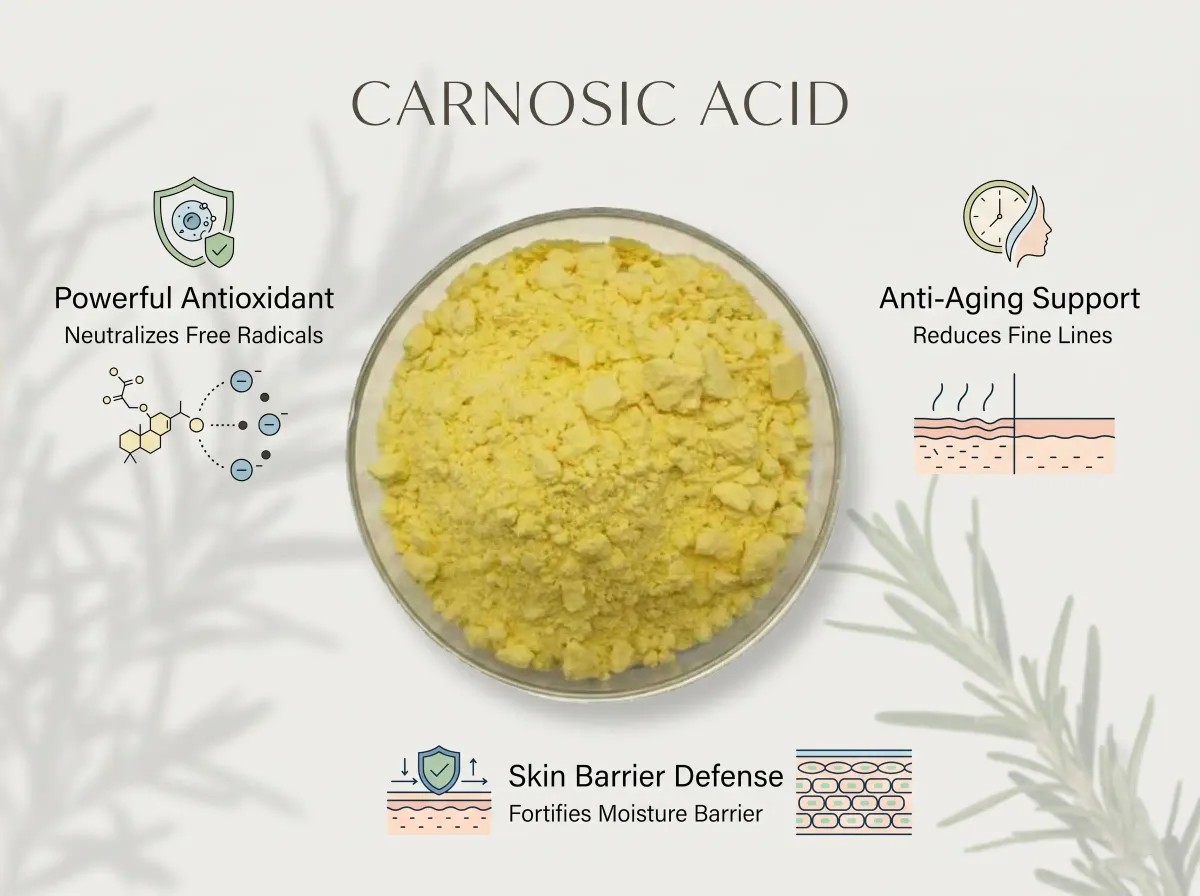
Carnosic Acid — Bulk Raw Material
Rosmarinus officinalis L.
GINKVORA Carnosic Acid powder (≥95% HPLC) is a natural phenolic diterpene extracted from the leaves of Rosmarinus officinalis (rosemary) — the premier botanical source of this potent antioxidant.
Carnosic Acid — The Nrf2-Activating Antioxidant from Rosemary with Multi-Organ Benefits
Carnosic Acid (CAS 3650-09-7; INCI: Carnosic Acid) is a natural phenolic diterpene extracted from the leaves of Rosmarinus officinalis L. (rosemary) — the plant that gives this compound its name and remains its richest known botanical source. Unlike conventional antioxidants that work through direct free-radical scavenging, Carnosic Acid operates primarily through Nrf2 pathway activation — upregulating the body's endogenous antioxidant defense enzymes including superoxide dismutase (SOD), glutathione (GSH), catalase, and heme oxygenase-1 (HO-1). This 'indirect antioxidant' mechanism provides broader, longer-lasting, and more physiologically integrated protection than single-use radical quenchers.
Structurally, Carnosic Acid is a catechol-type abietane diterpene — a class of compounds exclusive to the Lamiaceae plant family (rosemary, sage, thyme). It is NOT related to Carnosine (a dipeptide found in meat) — a frequent source of confusion that we address in detail below.
Why Formulators Choose GINKVORA Carnosic Acid
- ≥95% purity by HPLC — verified by third-party laboratory; suitable for supplement, cosmeceutical, and functional food applications
- Full documentation suite: COA, MSDS, TDS, and Third-Party Lab Report provided with every batch
- Multi-organ protection: Documented benefits for brain (blood-brain barrier penetration + Nrf2), skin (UV protection + collagen preservation), hair (5α-reductase inhibition), cardiovascular system, and metabolic health
- Natural preservative capability: Carnosic Acid's potent antioxidant activity makes it a clean-label alternative to synthetic preservatives (BHA/BHT) in functional foods and cosmeceuticals — covering an additional 80 search queries in the 'rosemary extract preservative' keyword cluster
- Plant-derived and vegan: Solvent-extracted from rosemary leaf; no animal-derived inputs or synthetic modification
- Long shelf stability: 24 months under recommended storage (cool, dry, <25°C, protected from light)
Target Applications
- Dietary supplement capsules and tablets (antioxidant, cognitive, metabolic health)
- Hair growth serums and anti-hair-loss formulations (5α-reductase inhibition)
- Anti-aging skincare serums, creams, and facial oils (Nrf2-mediated UV protection)
- Functional food and beverage preservation (clean-label antioxidant, natural BHA/BHT replacement)
- Brain health and neuroprotection supplements (blood-brain barrier penetrating Nrf2 activator)
- Cardiovascular and metabolic health formulations (lipid regulation, AMPK activation)
Carnosic Acid vs. Carnosine — They Are NOT the Same
| Property | Carnosic Acid | Carnosine |
|---|---|---|
| Chemical Class | Phenolic diterpene (abietane-type) | Dipeptide (β-alanine + L-histidine) |
| Natural Source | Rosemary leaf (Rosmarinus officinalis) | Meat, fish, poultry (animal tissue) |
| CAS Number | 3650-09-7 | 305-84-0 |
| Molecular Formula | C₂₀H₂₈O₄ | C₉H₁₄N₄O₃ |
| Primary Mechanism | Nrf2 pathway activation (indirect antioxidant) | pH buffering + anti-glycation |
| Key Benefits | Antioxidant defense, neuroprotection, hair growth, food preservation | Muscle endurance, anti-glycation, exercise recovery |
| Blood-Brain Barrier | ✓ Yes — penetrates BBB | ✓ Yes — via peptide transporters |
| Vegan-Friendly | ✓ Yes (plant-derived) | ✗ No (animal-derived dipeptide) |
| Best For | Supplements, skincare, hair growth, functional foods | Sports nutrition, anti-aging, exercise recovery |
For formulators and buyers: Carnosic Acid and Carnosine are completely different molecules with different sources, mechanisms, and applications. Carnosic Acid from rosemary is a plant-derived Nrf2 activator ideal for antioxidant defense, hair growth, and neuroprotection. Carnosine is an animal-derived dipeptide suited for sports nutrition and anti-glycation. When sourcing, always verify by CAS number — 3650-09-7 (Carnosic Acid) vs. 305-84-0 (Carnosine).
5 Core Benefits of Carnosic Acid — Mechanisms & Evidence
1. Nrf2 Activation & Comprehensive Antioxidant Defense
Carnosic Acid is a potent electrophilic activator of the Keap1/Nrf2/ARE signaling pathway — the body's master antioxidant switch. Upon activation, Nrf2 translocates to the nucleus and drives expression of over 200 cytoprotective genes, including SOD, GSH, catalase, HO-1, and NAD(P)H quinone oxidoreductase 1 (NQO1). This 'indirect' antioxidant mechanism provides sustained cellular protection that direct antioxidants (vitamin C, vitamin E, glutathione) cannot match — because Carnosic Acid upregulates the body's own defense machinery rather than being consumed in a 1:1 stoichiometric reaction with each radical.
2. Hair Growth & Anti-Hair-Loss
Carnosic Acid has demonstrated 5α-reductase inhibitory activity — the same mechanism targeted by finasteride for androgenetic alopecia — but through a natural, plant-derived pathway. By reducing the conversion of testosterone to dihydrotestosterone (DHT) in scalp tissue, Carnosic Acid helps preserve hair follicle function and extend the anagen (growth) phase. Additionally, its Nrf2-mediated antioxidant activity protects hair follicle stem cells from oxidative stress-induced miniaturization — providing a dual-mechanism approach to hair retention and regrowth. This makes Carnosic Acid a compelling natural ingredient for hair growth serums, anti-hair-loss shampoos, and oral hair health supplements.
3. Brain Health & Neuroprotection
Carnosic Acid crosses the blood-brain barrier and activates Nrf2 in neural tissue — a critical capability for any neuroprotective ingredient. Preclinical studies show protection against amyloid-β toxicity (relevant to Alzheimer's disease), reduction of neuroinflammation, and preservation of dopaminergic neurons. The compound's ability to simultaneously provide antioxidant protection, reduce neuroinflammation, and cross the BBB makes it one of the most promising natural neuroprotective agents for supplement formulation targeting cognitive longevity, focus, and age-related cognitive decline.
4. Cardiovascular & Metabolic Support
Through AMPK activation and PPAR-γ modulation, Carnosic Acid supports healthy lipid metabolism, glucose homeostasis, and endothelial function. Research demonstrates reduction of oxidized LDL, improvement of lipid profiles, and protection of vascular endothelial cells from oxidative damage. For supplement formulators targeting metabolic syndrome, cardiovascular health, or weight management, Carnosic Acid offers a multi-target mechanism complementary to ingredients like berberine, CoQ10, and omega-3 fatty acids.
5. Skin Protection & Anti-Aging
Carnosic Acid provides UVB protection through Nrf2-mediated upregulation of phase II detoxification enzymes in skin cells, while simultaneously inhibiting matrix metalloproteinases (MMPs) that degrade collagen and elastin. Unlike sunscreen actives that work topically, Carnosic Acid can be formulated both topically (serums, creams at 0.1%–1%) and orally (supplements for systemic skin protection), offering a comprehensive approach to photoaging prevention and skin health maintenance.
Extraction & Source — From Rosemary to Pure Carnosic Acid
GINKVORA Carnosic Acid is extracted from the dried leaves of Rosmarinus officinalis L. (rosemary) using a multi-step solvent extraction and chromatographic purification process:
- Raw material selection — Premium-grade dried rosemary leaf, verified for carnosic acid content before extraction
- Solvent extraction — Food-grade ethanol or acetone extraction under controlled temperature to maximize diterpene yield
- Liquid-liquid partitioning — Removal of chlorophyll, waxes, and non-target lipophilic compounds
- Chromatographic purification — Silica gel or macroporous resin column chromatography to achieve ≥95% purity
- Crystallization & drying — Vacuum crystallization followed by low-temperature vacuum drying to preserve phenolic integrity
- Quality verification — HPLC-UV quantification against USP reference standard; identity confirmed by HPLC fingerprinting
This solvent-based method avoids the harsh alkaline/acid hydrolysis used for some other diterpenes, preserving the native catechol structure essential for Nrf2 activation.
Formulation Guide
Recommended Addition Method
- Dietary supplement capsules: Direct encapsulation at 50–200 mg per serving. Compatible with vegetarian (HPMC) and gelatin capsule formats. Pairs synergistically with CoQ10, resveratrol, and curcumin for comprehensive antioxidant stacks.
- Hair growth serums / scalp treatments: Incorporate at 0.5%–2% in ethanol or glycol-based delivery systems for optimal scalp penetration. Compatible with caffeine, biotin, and peptide actives.
- Anti-aging skincare: Add at 0.1%–1% to the oil phase of serums, creams, and facial oils. Pre-dissolve in a small amount of caprylic/capric triglyceride or ethanol before blending.
- Functional beverages: Due to limited aqueous solubility, pre-dispersion in food-grade ethanol or microencapsulation is recommended. Alternatively, liposomal encapsulation can improve both solubility and bioavailability.
Recommended Use Levels
| Application Type | Typical Concentration / Dosage |
|---|---|
| Dietary supplement capsules | 50–200 mg per serving (daily) |
| Hair growth serum / topical | 0.5%–2% |
| Anti-aging skincare | 0.1%–1% |
| Functional beverage / food | 20–100 mg per serving |
Synergistic Ingredient Combinations
- CoQ10 + Resveratrol: Mitochondrial antioxidant support + sirtuin activation — complements Nrf2 pathway for multi-layered cellular defense
- Vitamin C + Vitamin E: Direct radical scavengers provide immediate protection while Carnosic Acid upregulates endogenous defense for sustained coverage
- Biotin + Caffeine: For hair growth formulations — combines 5α-reductase inhibition (Carnosic Acid) with keratin synthesis support (Biotin) and microcirculation stimulation (Caffeine)
- Curcumin: Dual Nrf2 activation + NF-κB inhibition for enhanced anti-inflammatory and antioxidant synergy
- Bakuchiol: For anti-aging skincare — combines retinol-like gene expression (Bakuchiol) with Nrf2-mediated UV protection (Carnosic Acid)
Solubility Information
- Ethanol: Soluble (>10 mg/mL) — preferred solvent for topical and supplement pre-dispersion
- DMSO: Highly soluble — used in research, not for consumer products
- Water: Practically insoluble (<0.1 mg/mL) — requires microencapsulation, liposomal delivery, or ethanol pre-dispersion for aqueous formulations
- Oils (caprylic/capric triglyceride): Moderate solubility (~2–5 mg/mL) — suitable for anhydrous serums and oil-based formulations
Stability & Storage
- Stable under recommended storage conditions (cool, dry, <25°C, protected from light)
- Shelf life: 24 months in unopened original container
- Avoid prolonged exposure to high humidity, direct UV light, and alkaline pH (>8.0)
- Carnosic Acid undergoes oxidation to carnosol at elevated temperatures and in alkaline environments — maintain formulation pH below 7.0 for optimal stability
Quality Control & Certifications
Every batch of Carnosic Acid powder undergoes a standardized quality control protocol:
- Identity verification — HPLC fingerprinting against USP carnosic acid reference standard
- Purity assay — HPLC-UV quantification, ≥95% specification confirmed
- Related substances — Carnosol and other diterpene impurities quantified and reported
- Heavy metal screening — ICP-MS for Pb, As, Cd, Hg, within USP <2232> limits
- Microbiology testing — Total aerobic plate count, yeast & mold, E. coli, Salmonella, Staphylococcus aureus
- Residual solvent analysis — GC headspace, compliant with USP <467>
- Loss on drying — Gravimetric determination, ≤5.0%
Available documentation with every shipment: Certificate of Analysis (COA), Material Safety Data Sheet (MSDS), Technical Data Sheet (TDS), Third-Party Lab Report.
All statements have not been evaluated by the FDA. This product is not intended to diagnose, treat, cure, or prevent any disease. Always consult with a qualified healthcare provider before using any ingredient in a therapeutic context. Regulatory status of health claims varies by jurisdiction — confirm with your local regulatory authority prior to marketing.
Preguntas frecuentes
Solicitar cotización o muestra
Envíe su consulta y nuestro representante comercial se pondrá en contacto con usted en un plazo de 24 horas.
Ir al formulario de consulta →