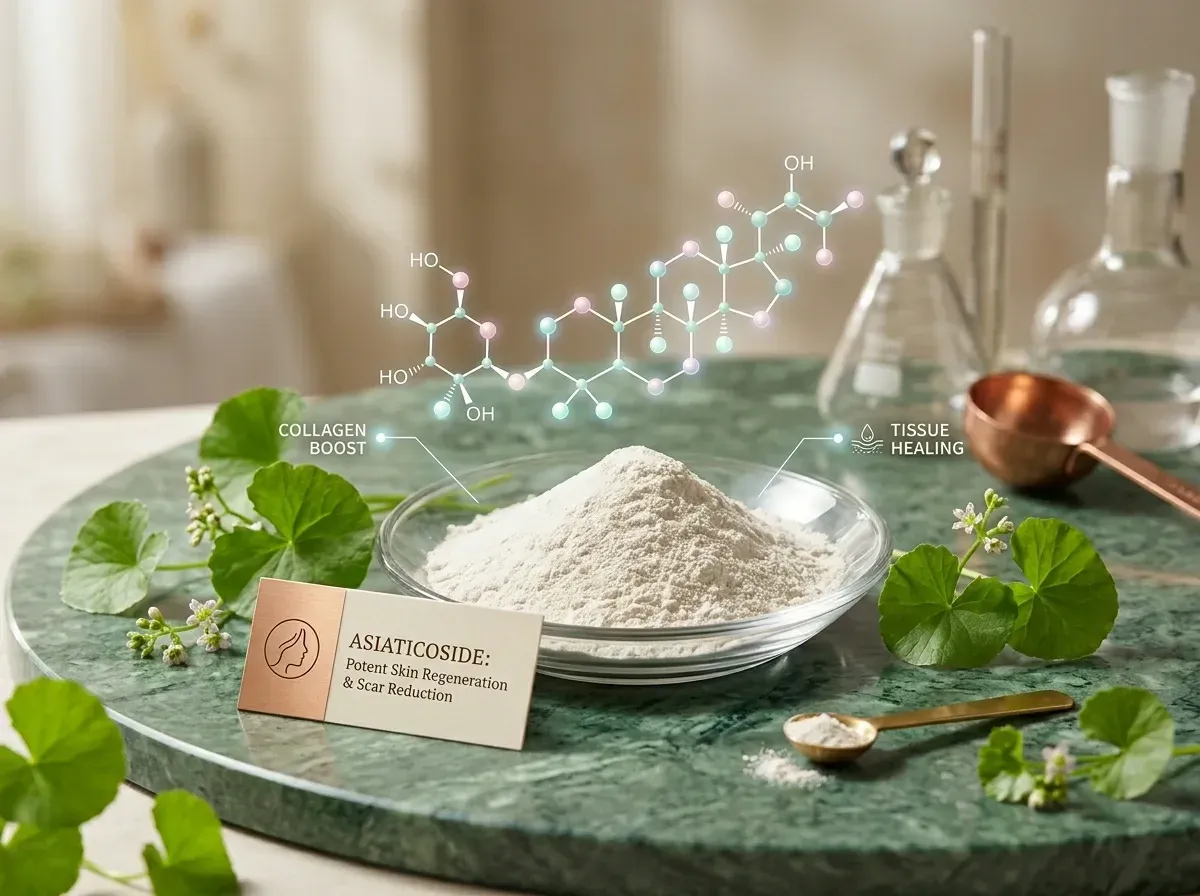
Asiaticoside — Bulk Raw Material
Centella asiatica (L.) Urb.
Clinically proven wound-healing and collagen-boosting triterpenoid saponin from Centella asiatica. Available in 95%+ purity for cosmetic and pharmaceutical formulations.
Is Asiaticoside Effective for Skin Repair? Clinical Guide
Yes, asiaticoside is a clinically proven wound-healing and collagen-boosting active. At 0.2–0.4% topical concentration, it accelerates tissue repair and reduces scar formation.
Asiaticoside is the primary pentacyclic triterpenoid saponin isolated from Centella asiatica (Gotu Kola), a medicinal herb used for centuries in Ayurvedic, traditional Chinese, and Southeast Asian medicine. Modern research has identified asiaticoside as the molecule largely responsible for the plant's renowned wound-healing, anti-inflammatory, and collagen-synthesizing properties. Unlike crude Centella extracts that vary widely in triterpene content (typically 2–8% total), purified asiaticoside at ≥95% delivers consistent, measurable bioactivity — making it the preferred form for pharmaceutical gels, cosmeceutical scar treatments, and advanced wound-care formulations.
How Asiaticoside Works: The Collagen Synthesis Mechanism
Asiaticoside's skin-repair mechanism centers on fibroblast activation and extracellular matrix (ECM) remodeling. Research demonstrates three core pathways:
Fibroblast Proliferation: Asiaticoside stimulates human dermal fibroblast proliferation in a dose-dependent manner, comparable to retinoic acid — but without retinoid-associated irritation. At concentrations as low as 5–10 µg/mL, it triggers cell-cycle progression from G0/G1 into S phase.
Collagen Type I & III Upregulation: Both animal models and human dermal fibroblast cultures show that asiaticoside significantly increases Type I collagen synthesis (the primary structural collagen in skin) and Type III collagen (essential for wound granulation tissue). This dual collagen boost improves both tensile strength and skin elasticity.
Anti-Inflammatory Modulation: Asiaticoside suppresses pro-inflammatory cytokines — TNF-α, IL-6, and IL-1β — while upregulating IL-10 (an anti-inflammatory cytokine) in a dose-dependent manner. It also inhibits LPS-induced iNOS expression, reducing nitric oxide-driven oxidative stress at the wound site.
Clinical Evidence: From Bench to Bedside
The clinical data supporting asiaticoside spans decades:
Burn Wound Healing (PMC3546525): In controlled burn-wound models, asiaticoside-enriched Centella fractions accelerated epithelialization, increased hydroxyproline content (a collagen marker), and improved wound tensile strength compared to untreated controls.
Scar Modulation (2025, SAGE): A combined nursing-intervention study demonstrated that asiaticoside treatment significantly improved scar recovery outcomes, reducing hypertrophy and improving psychological wellbeing scores in patients with burn scars.
Keloid Treatment (2025, ScienceDirect): Network pharmacology and in vitro validation showed asiaticoside alleviates keloid formation by modulating macrophage function and keloid fibroblast activity through NF-κB and PI3K-Akt signaling pathways.
Topical Formulation Efficacy: The standard effective topical concentration range is 0.2–0.4% asiaticoside. At these levels, maximum tolerated concentration for gingival fibroblasts is 0.25 mg/mL, with Col1A1 gene expression significantly upregulated.
Asiaticoside vs Madecassoside vs Centella Extract: Which Should You Choose?
| Dimension | Asiaticoside | Madecassoside | Centella asiatica Extract |
|---|---|---|---|
| Molecular Class | Triterpenoid saponin glycoside (asiatic acid + trisaccharide) | Triterpenoid saponin glycoside (madecassic acid + trisaccharide) | Whole-plant extract (variable triterpene blend) |
| CAS | 16830-15-2 | 34540-22-2 | 84696-21-9 |
| Collagen Synthesis | Potent Type I upregulation; stronger scar-modulation evidence | Type I + III; slightly broader collagen stimulation | Depends on asiaticoside/madecassoside ratio in the extract |
| Anti-Inflammatory | Strong TNF-α/IL-6 suppression; NF-κB pathway modulation | Superior anti-inflammatory due to extra hydroxyl group (+18% hydrophilicity) | Combined effects of all triterpenes + flavonoids |
| Skin Penetration | Moderate; glycoside acts as slow-release reservoir for asiatic acid | ~30% higher transdermal absorption vs asiaticoside | Variable; depends on carrier and concentration |
| Antioxidant | Moderate free-radical scavenging | Enhanced due to additional –OH group; better photoaging protection | Synergistic with extract's polyphenols |
| Standardization | ≥95% single-compound purity possible | ≥95% single-compound purity possible | 2–40% total triterpenes; highly variable by source |
| Best Use Case | Scar treatment, wound healing, pharmaceutical gels | Sensitive-skin formulations, anti-redness, luxury anti-aging | Mass-market cica creams, general barrier support |
| Typical Dosage | 0.1–0.4% | 0.1–0.5% | 3–5% (as whole extract) |
| Market Segment | Pharma + mid-tier cosmeceutical | Premium anti-sensitive lines (e.g., La Roche-Posay B5) | Entry-level K-beauty cica products |
The choice between these three forms depends on your formulation goals. For evidence-based scar treatment and pharmaceutical-grade wound healing, purified asiaticoside offers the strongest clinical validation. Madecassoside excels in anti-redness and sensitive-skin applications due to its superior anti-inflammatory profile. Whole extract provides cost-effective general barrier support but sacrifices batch-to-batch consistency.
Industry Context: The Centella Market
The global Centella asiatica extract market was valued at approximately USD 790 million in 2024, projected to grow at a CAGR of 6.7% through 2030 (Grand View Research, 2023). This growth is driven by three converging trends:
- K-Beauty Cica Boom: Korean skincare brands have made Centella (cica) a global phenomenon, with Centella-containing product launches increasing over 200% between 2019 and 2024.
- Clinical Validation: Growing peer-reviewed evidence for asiaticoside's specific mechanisms distinguishes it from generic "natural extract" marketing.
- Clean Beauty Demand: Consumers increasingly demand scientifically characterized botanical actives rather than undefined herbal extracts.
Asiaticoside from GINKVORA is available in research-to-commercial quantities with full documentation including Certificate of Analysis (CoA), Safety Data Sheet (SDS), and technical data sheets. Our raw material is produced under strict quality control with batch-to-batch consistency verified by HPLC.
Always consult with a healthcare provider or qualified formulation chemist before incorporating asiaticoside into pharmaceutical or cosmetic products. Concentrations above 0.5% may cause irritation in sensitive individuals. The Cosmetic Ingredient Review (CIR) Expert Panel has assessed Centella asiatica-derived ingredients as safe for cosmetic use at established concentrations, but product-specific safety testing is the manufacturer's responsibility.
Preguntas frecuentes
Solicitar cotización o muestra
Envíe su consulta y nuestro representante comercial se pondrá en contacto con usted en un plazo de 24 horas.
Ir al formulario de consulta →