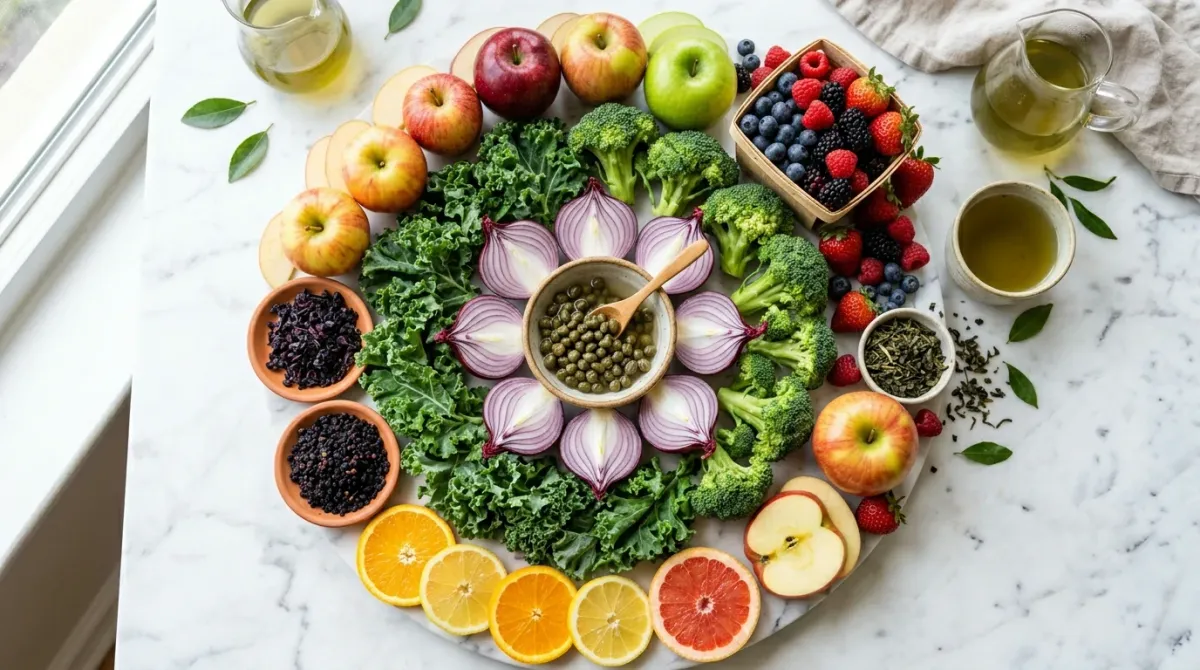
TL;DR — The quercetin in your supplement bottle starts as flower buds on the Sophora japonica (pagoda tree), harvested in East Asia during the summer bloom. These buds contain 15–25% rutin — quercetin with sugar molecules attached. The manufacturing process in five stages: (1) solvent extraction pulls rutin from the dried buds; (2) acid hydrolysis cleaves the sugar to release free quercetin; (3) crystallization and filtration purify the quercetin; (4) HPLC analysis confirms ≥95% purity; (5) the final product ships as a yellow crystalline powder. The process is semi-synthetic — the starting material is natural, but the hydrolysis step is chemical. The end molecule, however, is identical to the quercetin in your red onion. Understanding this process helps supplement brands audit suppliers, verify CoAs, and communicate ingredient transparency to increasingly educated consumers.
Stage 0: The Raw Material — Sophora Japonica
Why Sophora Japonica?
Commercial quercetin production is overwhelmingly sourced from a single plant: Sophora japonica (also called Styphnolobium japonicum, pagoda tree, or 槐树 in Chinese). This is not a coincidence — it's an economic and chemical imperative.
| Parameter | Sophora japonica | Alternative Sources |
|---|---|---|
| Rutin content in dried buds | 15–25% | Onion skin: 2–5% quercetin (no hydrolysis needed, but low yield per kg) |
| Cultivation scale | Industrial plantations in China (Henan, Shandong, Shaanxi) | Onion skin: byproduct of food processing, inconsistent supply |
| Harvest cycle | Annual (July–August bloom) | Onion: seasonal; buckwheat: seasonal |
| Price stability | Established global commodity market | Niche; volatile |
| Global production | ~8,000–10,000 metric tons of rutin extract annually | Negligible |
The economic reality: Sophora japonica dominates because it's the only source that can produce quercetin at the price ($50–150/kg for 95% extract) that the supplement industry requires. Direct quercetin extraction from onion skin (no hydrolysis needed) is technically feasible but commercially non-viable at scale — the yield per kilogram of raw material is too low.
Cultivation and Harvest
Sophora japonica is a hardy deciduous tree that thrives across temperate China. The key agronomic factors that affect final quercetin quality:
- Harvest timing: Flower buds must be harvested at the pre-bloom stage (July–August in China) when rutin content peaks (18–25%). Post-bloom flowers have 30–40% less rutin.
- Drying method: Sun-drying reduces rutin content by 5–10% from UV degradation; shade-drying preserves more but takes longer (7–10 days). Industrial hot-air drying at ≤60°C provides the best compromise of speed and preservation.
- Storage conditions: Dried buds are hygroscopic; moisture above 12% promotes mold and rutin degradation. Proper storage in ventilated warehouses at ≤25°C with humidity control is essential.
- Pesticide management: Since the flower buds are the harvested product (not just a byproduct), pesticide residues are a significant quality concern. Good suppliers track pesticide residue profiles and test to USP <561> or equivalent limits.
Stage 1: Extraction — Getting the Rutin Out
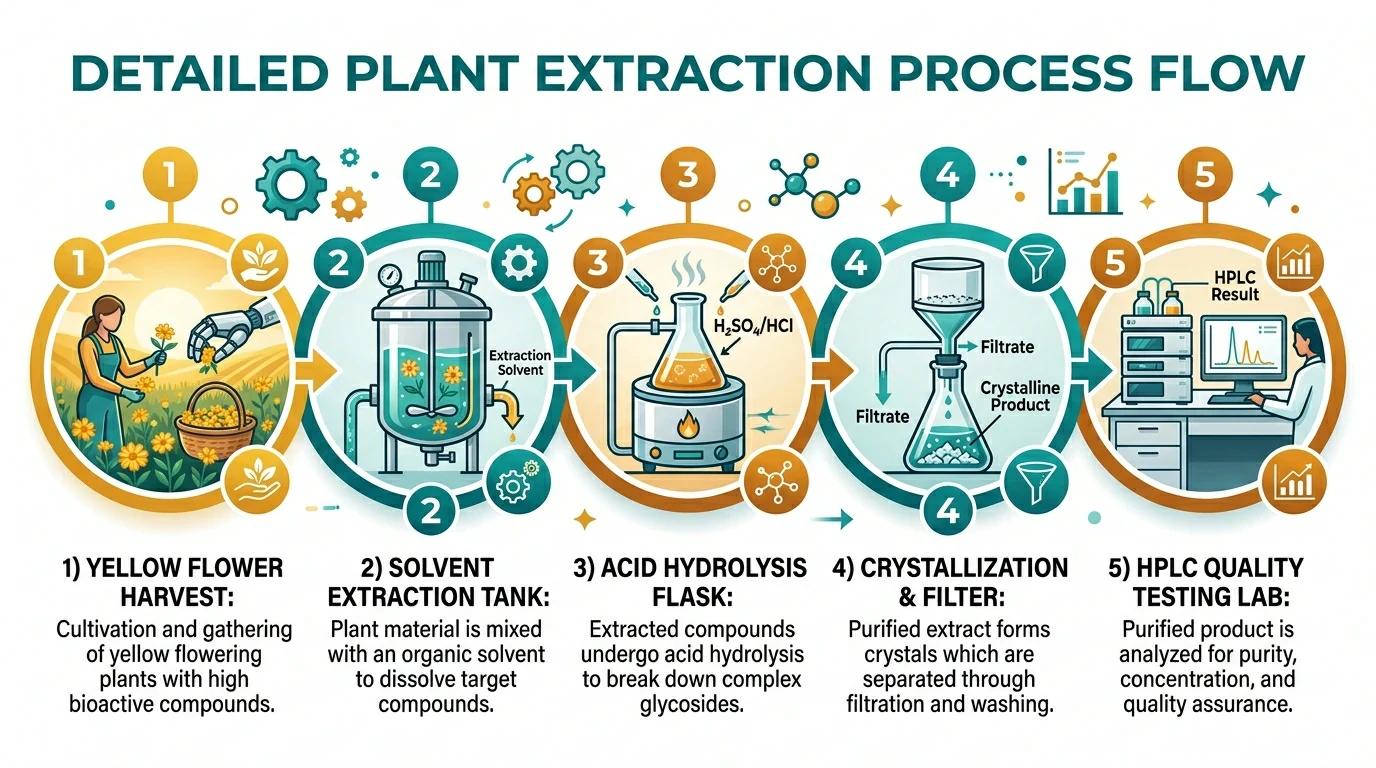
The first manufacturing step extracts rutin from the dried Sophora japonica flower buds.
Solvent Selection
| Solvent System | Rutin Solubility | Extraction Efficiency | Pros | Cons |
|---|---|---|---|---|
| Ethanol-water (60–80% ethanol) | Excellent | 85–95% | GRAS solvents, environmentally manageable | Higher solvent cost; requires solvent recovery system |
| Hot water | Moderate–good | 65–80% | Lowest cost, simplest equipment | Lower efficiency; extracts more impurities; requires larger volumes |
| Methanol-water | Excellent | 90–98% | Highest efficiency | Methanol is toxic; must be removed to ≤50 ppm residual (USP limit) |
Industry standard: 70–75% ethanol-water at 60–70°C, with a 1:8–1:12 solid-to-solvent ratio, extracted for 2–4 hours, repeated 2–3 times. The ethanol is recovered by vacuum distillation for reuse.
The Extraction Process in Practice
Grinding: Dried flower buds are milled to 40–80 mesh particle size. Too fine (excessive fines) creates filtration problems; too coarse reduces extraction efficiency.
Extraction: Ground buds are mixed with 70% ethanol-water at 65°C in a jacketed extraction vessel with agitation. The ethanol penetrates plant cell walls, dissolving rutin and other flavonoids.
Filtration: The extract slurry passes through a filter press or centrifuge to separate the liquid extract from the spent plant biomass (marc). The marc may undergo a second or third extraction to maximize yield.
Concentration: The filtered extract is concentrated under vacuum at ≤60°C to reduce volume by 80–90% and recover ethanol. The result is a dark brown viscous concentrate containing 30–50% rutin (dry basis) along with other co-extracted flavonoids, sugars, and pigments.
Stage 2: Hydrolysis — Converting Rutin to Quercetin
This is the defining chemical step. Rutin is quercetin-3-O-rutinoside — quercetin with a disaccharide (rhamnose + glucose) attached at the 3-position. To make quercetin, that sugar must be cleaved off.
The Hydrolysis Reaction
Rutin + H₂O + H⁺  →  Quercetin + Rutinose (rhamnose + glucose)
    (hydrolysis, 80–100°C, 2–6 hours)
| Parameter | Typical Specification | Rationale |
|---|---|---|
| Acid catalyst | Hydrochloric acid (HCl) or sulfuric acid (H₂SO₄) | HCl is preferred — lower cost, easier neutralization |
| Acid concentration | 2–5% (v/v HCl) | Higher concentration = faster hydrolysis but risk of quercetin degradation |
| Temperature | 80–100°C | Below 80°C: incomplete hydrolysis; above 100°C: quercetin thermal degradation |
| Duration | 2–6 hours | Monitored by TLC or HPLC until rutin residual ≤1.0% |
| pH neutralization | NaOH to pH 5.5–6.5 | Prevents quercetin degradation in acidic conditions post-hydrolysis |
Critical quality control point: Hydrolysis must go to completion. Residual rutin in the final product means a lower effective quercetin dose than the label claims. A proper specification includes "rutin ≤1.0%" on the CoA. Some lower-quality extracts contain 5–10% residual rutin — you're paying for quercetin but getting its precursor.
Side Reactions to Monitor
Hydrolysis is not perfectly selective. Side reactions can produce:
- Quercetin degradation products: Protocatechuic acid, phloroglucinol — formed by excessive heating or over-acidification
- Isorhamnetin: Quercetin methylated at the 3'-OH position — naturally present at low levels, but can increase during aggressive hydrolysis
- Polymeric oxidation products: Brown pigments that reduce final purity and marketability
A well-controlled hydrolysis process achieves >98% rutin conversion with <2% degradation products.
Stage 3: Purification — From Crude Hydrolysate to 95% Quercetin
After hydrolysis, the reaction mixture contains quercetin (target), residual rutin, co-extracted flavonoids, sugars, salts, and degradation products. Purification separates quercetin from everything else.
Step 1: Crude Precipitate Isolation
The hydrolysate is cooled to 5–10°C. Quercetin has poor cold-water solubility (~0.002 g/L at 5°C), so it precipitates as yellow crystals. Filtration yields a crude quercetin cake at 70–85% purity.
Step 2: Recrystallization
The crude cake is dissolved in hot ethanol (70–80°C), filtered to remove insoluble impurities, then slowly cooled. Pure quercetin recrystallizes as fine yellow needles while more soluble impurities (residual sugars, isorhamnetin, kaempferol) remain in the mother liquor.
| Recrystallization Round | Approximate Purity | Notes |
|---|---|---|
| Crude precipitate | 70–85% | Direct from hydrolysate cooling |
| 1st recrystallization | 88–93% | Removes most sugars and polar impurities |
| 2nd recrystallization | 93–97% | Removes kaempferol and isorhamnetin |
| 3rd recrystallization (if needed) | 97–99% | For premium grades; significantly increases cost |
Economic tradeoff: Each recrystallization round costs ~15–20% in yield loss (quercetin left in mother liquor). Two-round recrystallization to 95% purity is the industry standard that balances purity and cost. Three-round recrystallization to 98%+ is reserved for pharmaceutical-grade or research-grade quercetin at 3–5× the market price.
Step 3: Drying and Milling
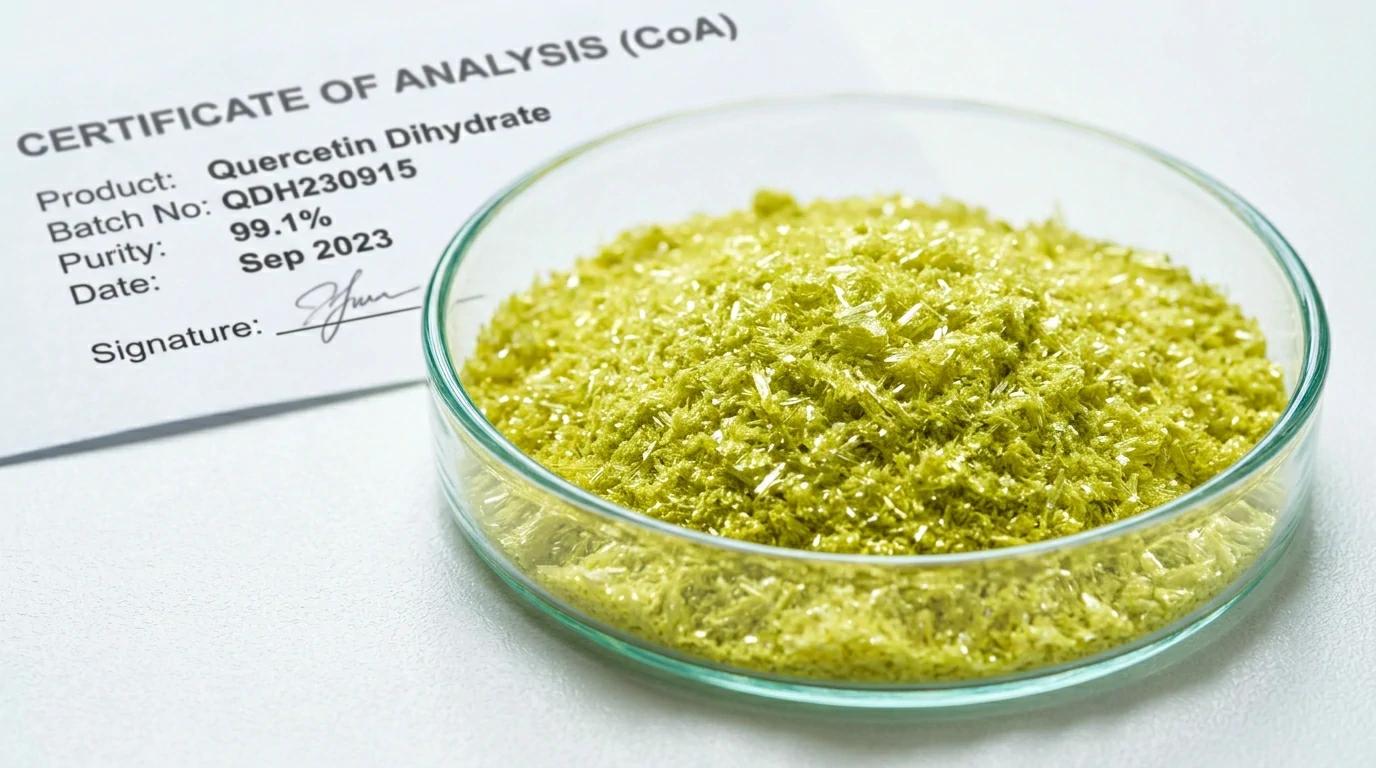
Recrystallized quercetin is vacuum-dried at 50–60°C to ≤5% moisture. Over-drying can convert dihydrate to anhydrous form, which affects weight-based dosing calculations. The dried material is milled to specification:
| Application | Target Particle Size (D90) | Rationale |
|---|---|---|
| Capsule filling | ≤75 μm | Ensures uniform powder flow and capsule weight consistency |
| Tablet compression | ≤50 μm | Smaller particles for better compressibility |
| Softgel suspension | ≤30 μm | Prevents nozzle clogging; uniform suspension |
| Premix / blend | ≤150 μm | Larger particles acceptable if flow properties are adequate |
| Phytosome preparation | ≤20 μm (micronized) | Required for phospholipid complexation efficiency |
Stage 4: Quality Control — Specification Verification
HPLC Analysis
High-Performance Liquid Chromatography with UV detection at 370 nm (quercetin's absorption maximum) is the definitive purity test. A typical HPLC method:
| Parameter | Specification |
|---|---|
| Column | C18, 5 μm, 250 × 4.6 mm |
| Mobile phase | Methanol:0.4% phosphoric acid (50:50) |
| Flow rate | 1.0 mL/min |
| Detection | UV at 370 nm |
| Injection volume | 10 μL |
| Run time | ~20 minutes |
A proper CoA should identify and quantify:
| Analyte | Acceptance Criterion |
|---|---|
| Quercetin | ≥95.0% (HPLC, area normalization) |
| Rutin (residual) | ≤1.0% |
| Isoquercitrin | ≤1.0% |
| Kaempferol | ≤2.0% |
| Isorhamnetin | ≤1.0% |
| Total other flavonoids | ≤3.0% |
Additional Quality Tests
| Test | Method | Limit | Why It Matters |
|---|---|---|---|
| Loss on drying | USP <731> | ≤5.0% | Affects assay calculation; excess moisture promotes degradation |
| Heavy metals (Pb) | ICP-MS | ≤0.5 ppm | Chronic toxicity risk; accumulates in long-term supplement use |
| Arsenic (As) | ICP-MS | ≤0.3 ppm | Carcinogen; soil contaminant in some growing regions |
| Cadmium (Cd) | ICP-MS | ≤0.1 ppm | Nephrotoxic; soil contaminant |
| Mercury (Hg) | ICP-MS | ≤0.1 ppm | Neurotoxic; less common in plant material |
| Residual ethanol | GC headspace | ≤5,000 ppm (USP) | Solvent residue from extraction and recrystallization |
| Residual methanol | GC headspace | ≤3,000 ppm (USP) | If methanol used in extraction (less common) |
| Total plate count | USP <2021> | ≤1,000 CFU/g | Microbial quality; higher limits suggest poor post-hydrolysis handling |
| Yeast & mold | USP <2021> | ≤100 CFU/g | Indicates moisture issues during storage |
| E. coli / Salmonella | USP <2022> | Absent in 25g | Pathogen safety |
| Pesticide residues | USP <561> / EU 396/2005 | See monograph | Varies by regulation; critical for organic certification claims |
Stage 5: Supply Chain Transparency — What Buyers Should Demand
For supplement brands sourcing quercetin, the following documentation should be standard — not a premium service:
| Document | Content | Why It Matters |
|---|---|---|
| Certificate of Analysis (CoA) | Batch-specific test results for all quality parameters | Verifies this specific batch meets specifications |
| HPLC chromatogram | Raw chromatogram with peak identification | Confirms purity, detects co-eluting impurities |
| Heavy metal test report | ICP-MS data for Pb, As, Cd, Hg | Independent verification of safety limits |
| Residual solvent report | GC headspace data | Confirms solvent removal is below limits |
| Source traceability document | Harvest region, date, cultivation practices | Supports organic/non-GMO claims; supply chain integrity |
| Stability data | Accelerated (40°C/75%RH) and real-time (25°C/60%RH) stability results | Establishes shelf life and retest period |
| Allergen statement | Declaration of allergen cross-contamination risk | Required for labeling compliance (EU 1169/2011, US FALCPA) |
| GMO statement | Confirmation of non-GMO status | Sophora japonica is not genetically modified; still requires documentation |
Red flags in supplier relationships:
- CoA without an accompanying HPLC chromatogram
- Purity reported as "by UV" rather than "by HPLC" (UV overestimates purity by 5–15%)
- Heavy metal data reported as "conforms" without numerical values
- Inconsistent purity between batches (variation >3% suggests poor process control)
- Reluctance to provide source traceability documentation
The Economics: Why Quality Costs What It Does
| Cost Driver | % of Final Product Cost | Notes |
|---|---|---|
| Raw material (Sophora japonica buds) | 30–40% | Most significant variable; harvest quality and yield determine everything downstream |
| Extraction (solvents, energy, labor) | 15–20% | Ethanol recovery systems reduce solvent cost per batch |
| Hydrolysis (acid, neutralization, waste treatment) | 10–15% | Wastewater treatment for acid neutralization is a significant environmental compliance cost |
| Purification (recrystallization, filtration) | 15–20% | Each additional recrystallization round adds cost and reduces yield |
| Quality control (HPLC, metals, microbial) | 5–10% | Scale-dependent; batch testing cost amortizes over larger production volumes |
| Drying, milling, packaging | 5–10% | Particle size specification drives milling cost |
A 95% quercetin extract priced at $50–80/kg is standard for bulk orders (100 kg+). Prices below $40/kg typically indicate either lower purity (under-specification), inadequate quality testing, or environmental compliance shortcuts.
Conclusion: Knowledge Is Your Quality Assurance
The quercetin supplement you formulate is only as good as the extract it contains — and the extract is only as good as the process that made it. Understanding the Sophora japonica → rutin → hydrolysis → quercetin pathway gives you the ability to ask the right questions of suppliers: residual rutin levels, heavy metal data, particle size specifications, recrystallization history.
Transparency in manufacturing is increasingly a consumer demand. Brands that can describe their quercetin's origin story — the farm, the process, the quality checks — build trust that generic "quercetin 500 mg" labels never will. E-E-A-T isn't built in the marketing department; it's built in the supply chain.
Source high-purity quercetin from Sophora japonica — ≥95% HPLC purity, full CoA documentation, batch traceability, and third-party testing available.
Research References
- Chua LS. A review on plant-based rutin extraction methods and its pharmacological activities. Journal of Ethnopharmacology. 2013;150(3):805-817.
- Gullon B, Lu-Chau TA, Moreira MT, Lema JM, Eibes G. Rutin: a review on extraction, identification and purification methods, biological activities and approaches to enhance its bioavailability. Trends in Food Science & Technology. 2017;67:220-235.
- Zhang Y, Li H, Zhang Y, et al. Optimization of rutin extraction from Sophora japonica L. by ultrasound-assisted extraction. Ultrasonics Sonochemistry. 2020;63:104946.
- USP. Quercetin Monograph. United States Pharmacopeia. Current edition.
- Jiang P, Burczynski F, Campbell C, Pierce G, Austria JA, Briggs CJ. Rutin and flavonoid contents in three buckwheat species Fagopyrum esculentum, F. tataricum, and F. homotropicum. Food Research International. 2007;40(3):356-364.
- Valentova K, Vrba J, Bancirova M, Ulrichova J, Kren V. Isoquercitrin: pharmacology, toxicology, and analytical methods. Food and Chemical Toxicology. 2014;68:267-282.
Related Articles
- What Foods Contain the Most Quercetin? Top 15 Dietary Sources Ranked — Natural vs. extracted quercetin sources
- How to Formulate a Quercetin Supplement — From extract to finished product
- EGCG Stability: What Green Tea Catechins Actually Need — Polyphenol extraction and stability parallels