TL;DR
"Green Tea Extract" on a finished product label tells you nothing about how much EGCG — the molecule responsible for 90% of green tea's clinical evidence — is actually in the formula. Depending on the extraction grade, the EGCG content ranges from 5% to 50%. A 50%-polyphenol extract delivers approximately 15% EGCG. An HPLC-purified EGCG 98% delivers ≥98%.
This is not a semantic distinction. It is the difference between adding a marketing story to your formula and adding a dose-controlled, clinically traceable bioactive ingredient.
Here is what five common green tea extract grades actually contain — and why "Green Tea Extract" is the specification your formula should leave behind.
What "Green Tea Extract" Actually Means — Five Grades, Five Realities
The term "Green Tea Extract" covers a spectrum of products with fundamentally different compositions. The defining characteristic is the extraction method and the chosen standardization target — but most brands never ask which one their supplier used.
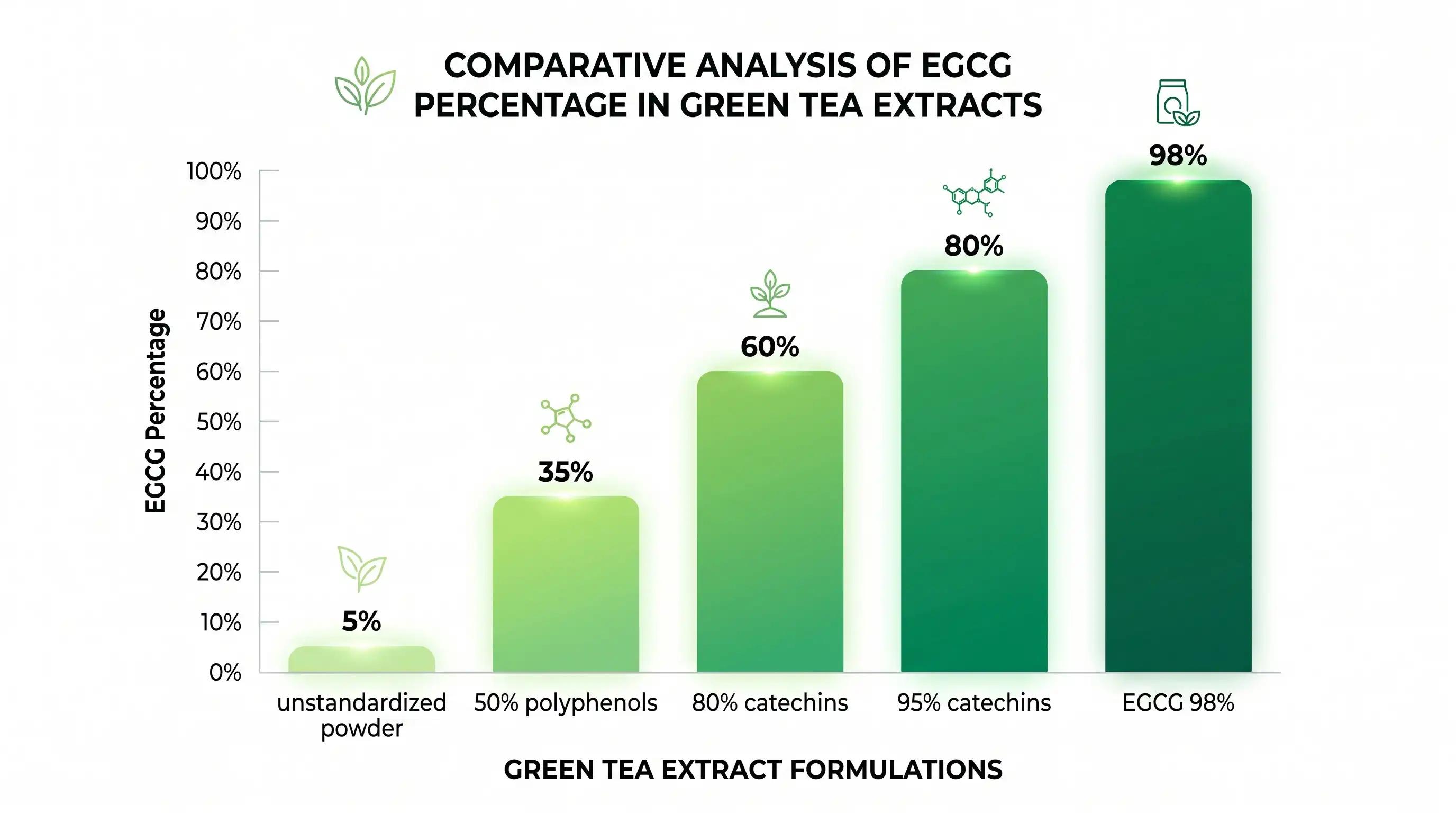
| Grade Specification | Polyphenol Content | EGCG Content | EGCG per Gram | Caffeine |
|---|---|---|---|---|
| Unstandardized green tea powder | ~20–30% | ~5–8% | 50–80 mg | 2–3% |
| 50% Polyphenols extract | 50% | ~15% | ~150 mg | 0.5–5% |
| 80% Catechins extract | ~80% | ~40% | ~400 mg | 0.5–5% |
| 95% Catechins extract | ≥95% | 45–55% | ~500 mg | 0.5–5% |
| EGCG 98% (HPLC-purified) | ≥98%* | ≥98% | ≥980 mg | <0.5% |
*In the case of EGCG 98%, polyphenol content is effectively equivalent to EGCG content, since the purification process isolates a single molecular species. For all other grades, "polyphenols" and "EGCG" are very different numbers.
The most common specification on the market — 50% polyphenols with 15% EGCG — is widely available across B2B suppliers including Plants2Market and Nutraceuticals Group. It is the entry point. An 80%-catechins grade nearly triples the EGCG dose per gram. But only HPLC-purified EGCG 98% approaches the theoretical ceiling: nearly one gram of bioactive molecule per gram of ingredient.
This is not a 10% improvement over the alternatives. It is a 6.5× improvement over the most common grade on the market.
The Four Problems With Using "Green Tea Extract" in Your Formula
Using a mixed green tea extract instead of purified EGCG 98% introduces four structural problems that compound each other.
Problem 1: Catechin Competition at the Absorption Gate
Green tea contains at least eight major catechins: EGCG, EGC, ECG, EC, GCG, GC, CG, and C. All of them share the same intestinal absorption transporters — primarily members of the organic anion transporting polypeptide (OATP) family expressed in enterocytes and hepatocytes.
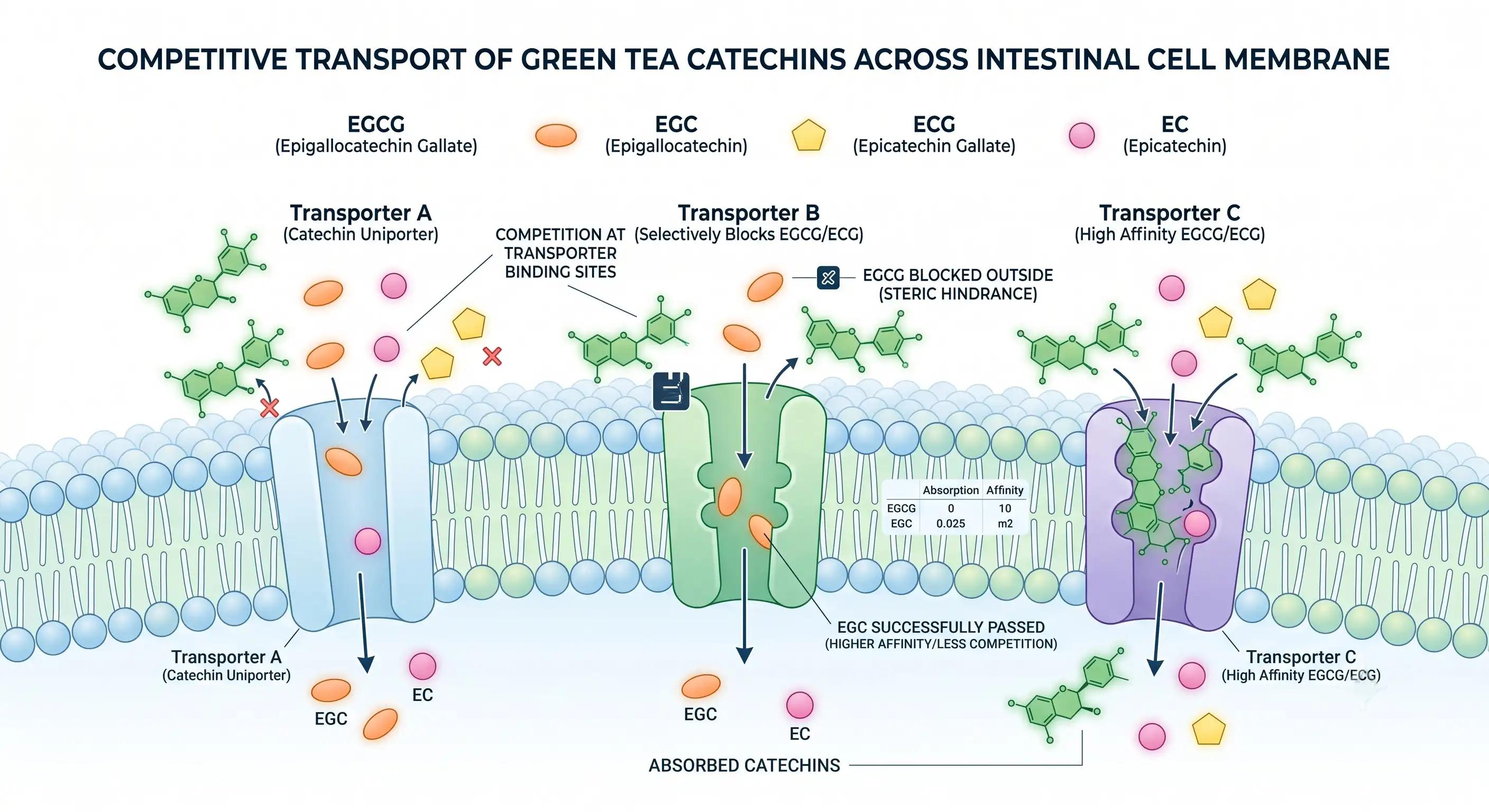
Research by Roth et al. (2011) demonstrated that green tea catechins interact with OATP1A2, OATP1B1, OATP1B3, and OATP2B1 — the four OATP isoforms responsible for catechin uptake at the intestinal barrier. When EGCG is ingested alongside EGC, ECG, and other catechins in a whole extract, these molecules compete for the same transport proteins. The result: EGCG absorption from a mixed extract is lower than from an equivalent dose of isolated EGCG, because the transporter capacity is shared across multiple competing substrates [1].
This is not a theoretical concern. It directly undermines the dose-response relationship that your formula relies on.
Problem 2: Caffeine — An Uncontrolled Co-Active
Every non-purified green tea extract contains caffeine. How much depends entirely on the extraction process:
- Raw water extracts: 7–8% caffeine by weight
- Standard commercial extracts: 0.5–5.0% caffeine
- Decaffeinated grades: specified at <1% caffeine
At the upper end, a 500 mg dose of a raw water extract delivers 35–40 mg of caffeine — enough to be physiologically active and to require labeling consideration. At the standard 0.5–5% range, the caffeine content is unpredictable batch to batch unless specifically controlled.
For product lines positioned as "caffeine-free," "stimulant-free," "nighttime," or "gentle," even 2% caffeine in a 500 mg extract dose (10 mg caffeine per serving) creates a labeling problem. Several dietary supplement brands have faced class-action lawsuits over undeclared caffeine in multi-ingredient products where green tea extract was a secondary ingredient [2].
EGCG 98% eliminates this variable entirely. Residual caffeine is below 0.5%, and HPLC purity analysis confirms it.
Problem 3: The Oxidation Cascade You Didn't Design For
Green tea leaves contain polyphenol oxidase (PPO), an enzyme that catalyzes the oxidation of catechins into brown polymerization products — the same reaction that turns a cut apple brown. During extraction, PPO is supposed to be inactivated by heat treatment (steaming or pan-firing, the step that defines green tea processing versus black tea oxidation). In practice, residual PPO activity varies by supplier, and even trace amounts accelerate EGCG degradation in the finished extract.
Whole extracts also contain multiple catechins with different oxidation kinetics. EGC (epigallocatechin) degrades faster than EGCG under the same conditions. ECG (epicatechin gallate) is more stable. Gallic acid, a hydrolysis byproduct of gallated catechins, accumulates over time. The net result is a shifting compositional profile during storage — one that makes stability testing exponentially more complex because you are tracking 8+ molecules, not one.
EGCG 98% simplifies this to a single degradation pathway. You test for one molecule. You know exactly what changes over time.
Problem 4: Batch Variability That Kills Reproducibility
Natural extracts carry inherent variability. Different harvest seasons, leaf grades, extraction parameters, and supplier processes produce different catechin profiles even from the same Camellia sinensis species. A ±15% variation in EGCG content between two batches of a "50% polyphenols" extract is common in the industry.
If your clinical data was generated with a batch at 55% EGCG and your production run uses a batch at 45% EGCG, your formula is delivering 18% less active than intended — and you may not know until consumer complaints surface. This is not a supplier quality problem. It is a structural problem with relying on a mixture instead of a purified standard.
Why "Which Green Tea Has the Most EGCG?" Is the Wrong Question
A quick detour for the brands and formulators who have asked this question — because it comes from the right instinct but the wrong framework.
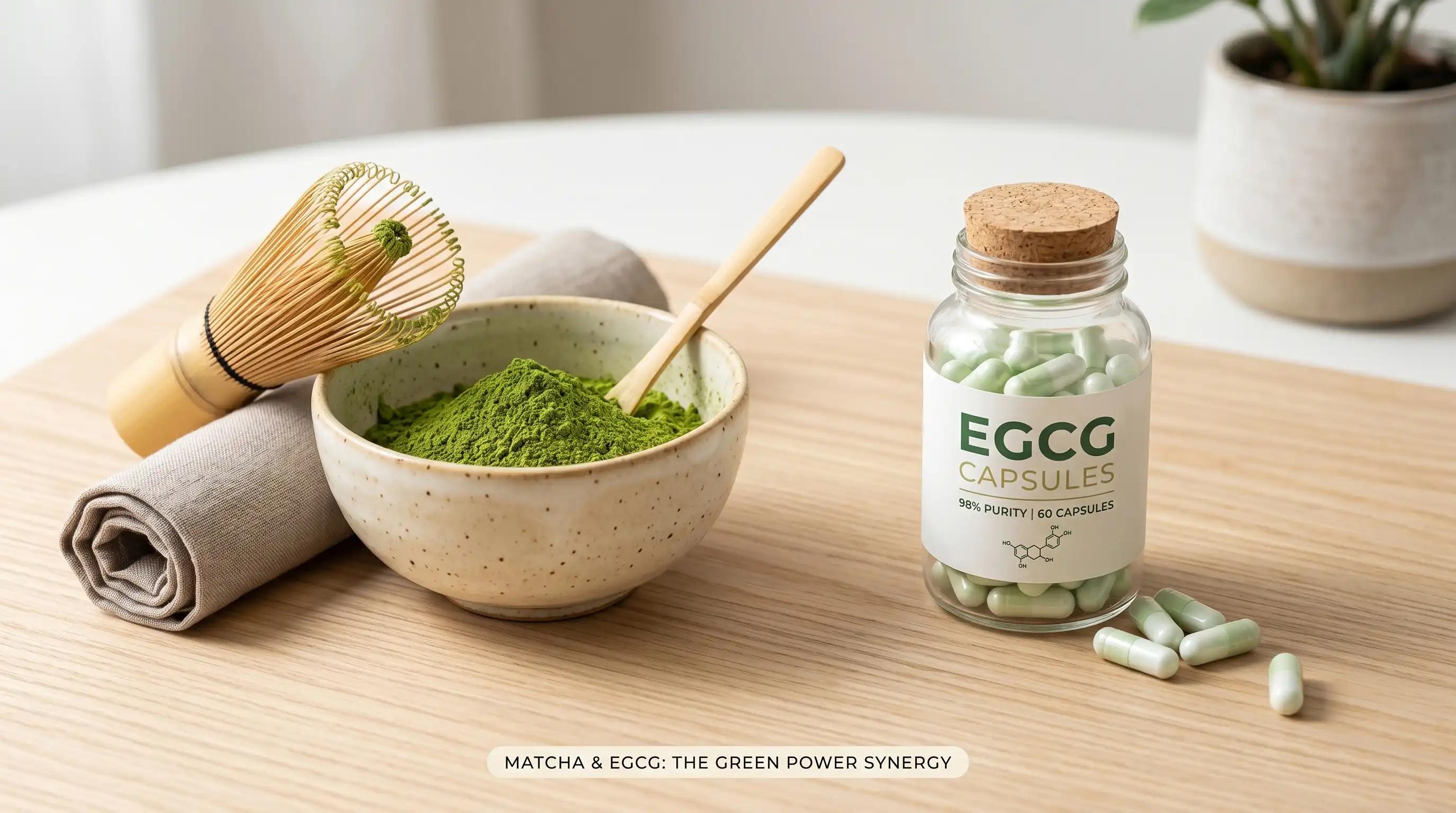
The short answer: matcha provides the most EGCG among whole-leaf green teas. At approximately 62.5 mg EGCG per gram of dry powder for premium ceremonial grade, matcha outperforms high-quality sencha (~9.4 mg/g) by roughly 6.6×, and standard tea bag green tea (~5.0 mg/g) by 12.5× [3].
But the better answer: even premium matcha contains only 6.25% EGCG — and only a fraction of that is actually absorbed. When brewed as a beverage, green tea delivers less than 1% absolute bioavailability. The catechins that do enter systemic circulation are extensively conjugated by phase II metabolism (glucuronidation, sulfation, methylation) in the intestinal epithelium and liver before reaching target tissues.
This is why the question should not be "which tea has more EGCG." The question should be: "how much EGCG do you need in your formula, and can your ingredient grade deliver it at a known, reproducible dose?"
| Source | EGCG per typical serving | Bioavailable fraction | Reachable daily dose |
|---|---|---|---|
| Brewed green tea bag | 15–30 mg | <1% | <0.3 mg |
| Premium sencha (loose leaf) | 40–75 mg | <1% | <0.75 mg |
| Ceremonial matcha (2g) | ~125 mg | 20–95%* | 25–119 mg |
| EGCG 98% supplement (200mg) | 196 mg | 2–15%** | 4–30 mg |
*Matcha's higher bioavailability is due to whole-leaf consumption, not extraction. **EGCG supplement bioavailability depends on formulation (fasted, liposomal, co-administered with fat or vitamin C).
The conclusion is simple: no tea can replace a purified ingredient when dose control matters.
Before-and-After in Your Formula: The Concentration Arithmetic
Here is the calculation every formulator should run before choosing an ingredient grade.
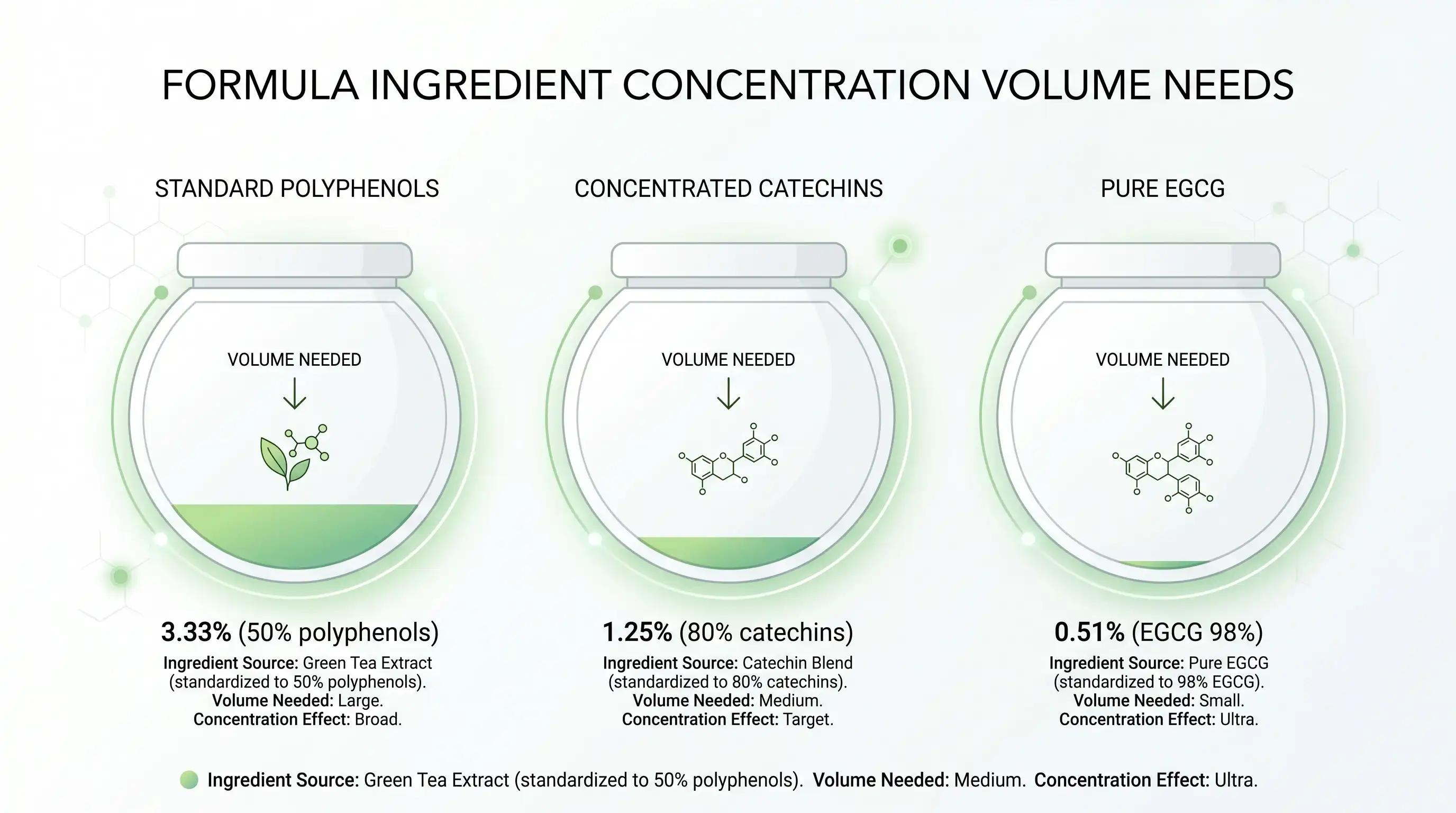
Target: 0.5% EGCG in a 50g topical formulation.
- Using 50% polyphenols (~15% EGCG) extract: 0.5% ÷ 15% = 3.33% extract in formula
- Using 80% catechins (~40% EGCG) extract: 0.5% ÷ 40% = 1.25% extract in formula
- Using EGCG 98%: 0.5% ÷ 98% = 0.51% ingredient in formula
The 50%-polyphenols option consumes 3.33% of your formula space — enough to crowd out other actives, affect texture, and introduce a noticeable brown tint that requires additional color correction. The EGCG 98% option uses one-sixth of that space, leaving room for complementary actives like vitamin C, niacinamide, or UV filters.
For a dietary supplement targeting 200 mg EGCG per capsule:
- 50% polyphenols extract: 1,333 mg extract needed (impossible for a single capsule)
- 80% catechins extract: 500 mg extract needed
- EGCG 98%: 204 mg ingredient needed (fits in a single 00 capsule with room for excipients)
In the supplement use case, the lower grades fail the basic packaging constraint. The purity hierarchy is not just about efficiency — it determines whether the product can physically exist in the format you intend to sell.
For formulators selecting an EGCG ingredient, EGCG 98% (Epigallocatechin Gallate) provides HPLC-verified purity with residual caffeine below 0.5%, delivering the dose control and batch reproducibility that mixed extracts structurally cannot guarantee.
The Safety Argument for Purity
There is a counterintuitive point worth making explicitly: a purified ingredient often has a better-characterized safety profile than a complex extract.
The European Food Safety Authority (EFSA) published its comprehensive safety assessment of green tea catechins in 2018. The core finding: the safety of green tea catechins depends heavily on the form of intake. Traditional brewed tea — where catechins are consumed gradually, with food, in a complex aqueous matrix — has an observed safe level of 704 mg EGCG/day from beverages. Concentrated supplements taken in bolus form on an empty stomach — a fundamentally different pharmacokinetic scenario — have a no-observed-adverse-effect level of 338 mg EGCG/day [4].
Rare cases of hepatotoxicity have been associated with green tea extract supplements at doses of 800 mg EGCG/day and above, particularly when taken fasted in a single bolus [4]. The mechanism is not fully characterized but likely involves the saturation of phase II conjugation pathways, leading to accumulation of reactive EGCG quinone intermediates.
Here is the formulation implication: with a whole green tea extract, the total catechol load is the sum of EGCG + EGC + ECG + EC + GCG + minor catechins — and the ratio between them shifts from batch to batch. With EGCG 98%, the pharmacokinetic exposure is a single, well-characterized molecule at a known dose. If you are formulating at 200 mg EGCG per serving, you can verify that every capsule contains exactly that — not 200 mg EGCG plus 80 mg of other catechins whose combined effect on hepatic phase II capacity is unknown.
The EFSA did not conclude that EGCG is unsafe. It concluded that high-dose, fasted, bolus intake of mixed catechins — the scenario that describes most green tea extract supplements on the market — requires careful dose control. EGCG 98% gives you that control. A mixed extract takes it away.
Related Articles
- EGCG Stability: What Green Tea Catechins Actually Need — The five-variable protocol for keeping EGCG active from manufacturing to consumer use.
- Before and After EGCG: What UV-Induced Collagenase Activity Looks Like With and Without It — How EGCG 98% at 0.5% concentration blocks all three UV-induced collagenases in human skin.
- Liposomal Ingredient Delivery: The Commercial Guide — Why liposomal encapsulation addresses the absorption ceiling for EGCG and other polyphenols.
References
[1] Roth, M., Timmermann, B. N., & Hagenbuch, B. (2011). Interactions of green tea catechins with organic anion-transporting polypeptides. Drug Metabolism and Disposition, 39(5), 920–926. https://doi.org/10.1124/dmd.110.036640
[2] Qalitex. (2026, March 19). Green Tea Extract Testing: EGCG Standardization, Caffeine Content, and Brand Protection. https://www.qalitex.com/blog/green-tea-extract-egcg-standardization-testing-brands/
[3] AMD Alliance. (2026, February 14). Which Green Tea Has the Most EGCG? A Science-Based Comparison. https://www.amdalliance.org/which-green-tea-has-the-most-egcg/
[4] EFSA Panel on Food Additives and Nutrient Sources added to Food (ANS). (2018). Scientific opinion on the safety of green tea catechins. EFSA Journal, 16(4), 5239. https://doi.org/10.2903/j.efsa.2018.5239